
The application of BIM technology is becoming increasingly widespread. Initially limited to civil buildings, its use has now expanded significantly. However, the current implementation of BIM in bridge design faces challenges. For design institutes, adopting BIM increases design costs and extends project timelines. Meanwhile, construction companies and owners often find that the BIM outputs submitted by design institutes fall short of meeting the practical needs of construction and subsequent operation and maintenance.
1. The Necessity of Adopting 3D Parameterization
Steel bridges have a clear advantage in large-span bridge construction due to their structural properties. However, their complex structures require extensive design work. Traditionally, steel bridge design has relied on 2D CAD software such as AutoCAD. Because design information is scattered across numerous views and drawings, this approach is prone to errors, clashes, omissions, and misinterpretations.
Moreover, 3D entities represented by 2D points, lines, arcs, annotations, and similar graphic elements cannot be automatically interpreted by computers, which severely limits the implementation of product data management and collaborative design.
From the perspective of CAD technology development, 3D parameterization offers an effective solution. This process embeds geometric and dimensional relationships into a 3D model, reflecting the engineer’s design intent. The benefits of three-dimensional parametric design include:
- Structural design is an iterative process of conceptualization and verification. Intuitive 3D visualization makes the entire structure clear at a glance, significantly improving design efficiency.
- It fully captures the engineer’s design intent, minimizing the risk of misinterpretation.
- It simplifies handling complex spatial geometric relationships.
- It facilitates the management of components and 2D engineering drawings, which is especially important for large-scale structures. Geometric objects in 3D models are fully defined, enabling real-time creation of 2D drawings. Various sectional views and material lists can be generated automatically.
- The 3D model is directly linked to the engineering drawings and material lists, avoiding redundant and inefficient manual work.
- Parallel design becomes possible, shortening the design cycle. Once the structural form is determined, preliminary dimensions serve as parameters. Changes in dimensions later only require updating these parameters to refresh the model and related drawings.
- Models created during conceptual and technical design stages can be reused in subsequent phases, as well as for presentations and demonstrations. These models can also support finite element analysis, reducing design costs.
2. Secondary Development Based on 3D Parameterization
The development of 3D parametric design platforms for steel structures has progressed rapidly and can be categorized into two groups. The first includes mechanical industry software such as Catia, UG, Solidworks, and Inventor. These are suited for designing machinery, molds, sheet metal, pipelines, and small fully welded structures, typically equipped with mechanical standard parts libraries.
The second group comprises construction industry-specific products like Bentley’s ProStructure, Dassault’s 3DExperience, Tekla Structure from Finland, and AceCAD’s StruCAD from the UK. These platforms focus on designing high-rise buildings, sports venues, and industrial plants, offering extensive libraries of profiles and node details.
Due to the lack of specialized 3D steel bridge design software, general-purpose programs are often adapted or combined with other disciplines. However, bridge design has unique characteristics that make direct use of existing software challenging. Engineers often encounter unfamiliar concepts such as feature trees, shell extraction, drafts, layouts, and convex platforms, which differ from bridge-specific terminology like trusses, node lengths, members, beams, node plates, splice plates, and filling plates. This gap necessitates secondary development of existing platforms to create specialized parameterized object libraries tailored for steel bridge design.
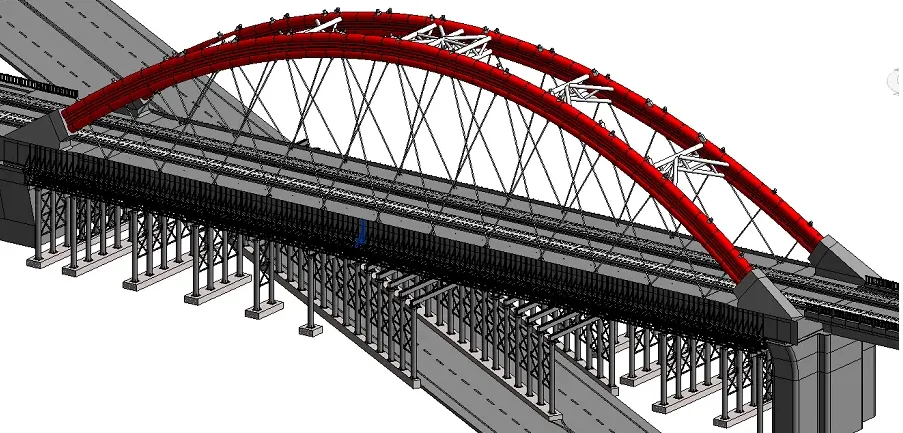
Considering cost-effectiveness, usability, and development interfaces, the China Railway Construction Bridge Institute selected Solidworks as the platform for developing the “Steel Bridge 3D Design Toolkit” starting in 2009. This toolkit has been successfully applied to several projects, including the four-line railway cable-stayed steel truss bridge on the Guiguang Railway, the Zhuhai Hengqin Second Bridge (the largest span highway steel truss tied arch bridge in China), and the Tanjiang Bridge on the Shenmao Railway, among others.
3. From 3D Models to 2D Drawings
Currently, bridge design in China requires delivering two-dimensional drawings. Traditionally, these 2D engineering drawings result from engineers mentally projecting and sectioning 3D models onto a 2D plane. This process reduces the accuracy and error-checking capabilities compared to the original 3D models.
In contrast, drawings generated directly from 3D models offer more diverse and accurate representations. Three-dimensional layout and pre-assembly drawings clearly depict the spatial relationships of detailed components. Two-dimensional sectional and detailed drawings are automatically generated through computer algorithms, offering higher efficiency and accuracy than manually produced 2D drawings. These automatically generated drawings are also easier for reviewers to assess.
Thus, 3D drawings provide clear advantages not only in representing spatial structures but also in producing sectional views, large-scale displays, and engineering quantity statistics, ensuring higher accuracy.
The integration between 3D models and engineering drawings not only improves drafting efficiency but also shifts engineers’ focus toward design, rather than producing drawings before models. This approach enhances the accuracy of BIM 3D models and encourages design institutes to adopt BIM technologies. The China Railway Construction Major Bridge Institute has already implemented direct construction drawing generation from 3D models in multiple large and complex steel structure bridge projects.
4. Building on 3D Parametric Technology in the BIM Era
3D parametric modeling forms the core of BIM systems and distinguishes them from traditional CAD tools. Throughout a bridge’s lifecycle and across disciplines, 3D parametric models act as vital information carriers. BIM tools like Solidworks and Inventor can export these models in formats such as IFC (Industry Foundation Classes) and STEP (Product Data Exchange Standard), facilitating collaboration and data exchange across platforms.
During practical use, it was observed that although Solidworks offers ease of use, high modeling efficiency, and strong 2D drawing support, its performance declines significantly when handling large models, such as entire bridge assemblies. To address this, the CATIA V6 platform was introduced, creating a complementary BIM environment alongside Solidworks. In this setup, Solidworks handles detailed modeling of secondary assemblies like steel bridge nodes, members, and anchor boxes, while CATIA V6 manages the full bridge assembly, integrates multidisciplinary data, supports collaborative design, and generates lightweight models for distribution.
In reality, BIM implementation involves many repetitive details. As technical proficiency improves, BIM software evolves, and secondary development deepens, the transformative impact of BIM technology on bridge design will become increasingly evident.
This overview highlights the role of BIM and 3D technologies in bridge design engineering. We hope it provides valuable insights!
















Must log in before commenting!
Sign Up