
In recent years, Building Information Modeling (BIM) has become increasingly prominent in construction engineering. BIM technology is now being introduced and applied to large-scale projects. At its core, BIM integrates both graphical and non-graphical information within a comprehensive data model for construction projects. This technology is applicable not only during the design and construction phases but throughout the entire lifecycle of a building.
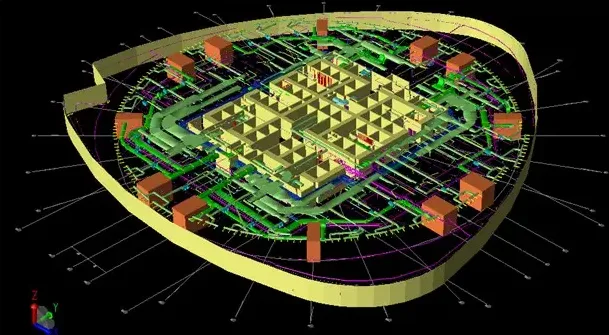
BIM primarily relies on 3D models combined with extensive engineering data, encompassing various aspects of construction projects. This integrated approach supports comprehensive project management, leading to significant improvements in efficiency and risk reduction. The BIM model covers multiple disciplines, including architecture, civil engineering, water conservancy, and electromechanical engineering. It incorporates 3D geometric data (such as building elements, equipment, and pipelines), specifications, functional properties, materials, size and location information, geographic topology, and environmental context.
Key stakeholders involved in BIM span owners, architects, specialized engineers (civil, structural, electromechanical), building material suppliers, and manufacturers, all collaborating throughout the building’s lifecycle. The ultimate aim of BIM is to allow all participants to continuously update and modify the integrated information model, sharing feedback seamlessly. This coordination enhances multidisciplinary collaboration, enabling spatial conflict detection, 4D construction scheduling and simulation, as well as accurate quantity and cost estimation. Consequently, project progress and quality control are improved, while costs are reduced. However, the impact of BIM varies significantly depending on the participant and project stage.
This variation is illustrated by the relationship between the timing of design changes and their associated time and cost impacts throughout the project lifecycle. The impact curve (line 1) indicates the greatest influence occurs during the planning stage, followed sequentially by draft and preliminary design phases. In contrast, traditional design processes (line 3) often confirm designs during the construction phase. Changes made at this late stage (curve 2) tend to be costly and time-consuming, with far less benefit compared to early-stage design modifications.
By adopting BIM technology, the design process curve shifts forward. This means that critical teams—such as structural, mechanical, and electrical engineers—are involved earlier during the detailed design phase. Early collaboration helps identify and resolve issues collectively, reduces design conflicts, and minimizes changes during construction. The more thorough the design evaluation upfront, the fewer uncertainties remain later, ultimately reducing time, cost, and risk.
Within the current domestic engineering environment, architectural design firms primarily focus on planning and design. Actively implementing BIM can help identify and solve potential project challenges in advance. This proactive approach reduces design changes during construction, enhances construction efficiency, and significantly lowers risks.
In summary, integrating BIM technology into engineering management delivers substantial benefits. Opinions may vary, but hopefully, this article provides valuable insights for everyone interested in BIM’s impact on the construction industry.
















Must log in before commenting!
Sign Up