
The application of BIM technology in building water supply and drainage design includes the following key areas:

Visual Design Using BIM Technology
BIM technology enables the creation of 3D models, drawings, and tables that vividly represent the building’s water supply and drainage system. These 3D visualizations provide designers and construction teams with a clear, detailed view of the system’s structure, allowing for continuous adjustments and refinements. For example, parameters such as pipeline locations, construction materials, layout of water supply and drainage pipelines, and system specifications can all be visualized and analyzed through BIM to optimize design accuracy.
Parametric Design with BIM Technology
Parametric design, also known as data-driven design, leverages modern information and network technologies to process and manage raw data effectively. As a product of the information age, BIM technology supports parametric design by organizing, analyzing, and managing data related to water supply and drainage systems. This approach improves the precision of parameter settings, which is crucial for enhancing water supply and drainage design quality.
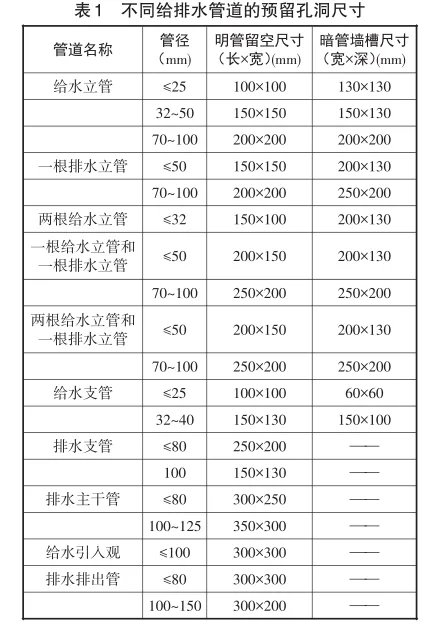
For instance, when designing a pipeline system—a critical component of water supply and drainage—BIM software can automatically analyze on-site inspection data and generate 3D models, data tables, and detailed drawings. These include parameters such as reserved hole sizes for different pipelines (see Table 1 for details), pre-embedding depths, and installation specifics. The information is stored systematically to support future design modifications and optimizations.
Collaborative Design with BIM Technology
Water supply and drainage design is a fundamental part of building engineering, with the system itself being a core structural component. Therefore, collaboration between the water supply and drainage system and the overall building structure is essential. BIM technology facilitates this collaboration by quickly identifying and resolving issues, enhancing the design process.
For example, when adjusting pump volumes, BIM can display data related to the existing pump, the water supply and drainage system, and the entire building structure through 3D models. This multi-dimensional data enables precise adjustments, ensuring that changes to the pump volume integrate smoothly with the overall system and building, thus improving operational efficiency.
Comprehensive Pipeline Design Using BIM
Pipeline design plays a vital role in the efficiency and safety of the water supply and drainage system. Beyond employing advanced design methods, designers use BIM technology to develop a comprehensive pipeline data information system. BIM software helps calculate parameters such as pre-embedding depths, installation specifications, and spatial distribution, including net height, real spatial dimensions, and pipeline diameters.
Once the design is complete, collision detection is performed. Any issues identified require adjustments to the original design to ensure a smooth and safe installation process.
Installation Simulation Design with BIM Technology
Before executing the water supply and drainage design, installation simulations are crucial to detect potential issues. BIM technology supports this by allowing designers to create 3D models of domestic water supply and drainage systems for installation simulation. This process helps minimize resource waste by enabling early problem detection and coordination between design and construction teams.
During installation simulation tests, if the system passes, installation proceeds smoothly. If issues arise, immediate modifications can be made to the design.
Additionally, BIM technology aids in material management by storing material data in a database, providing a reliable basis for controlling material quantities during construction.
— Excerpt from “Analysis of BIM Technology Application in Building Water Supply and Drainage Design” by Cheng Jincheng
















Must log in before commenting!
Sign Up