
Content source: BLM Digital

The “Pudong Cup” is a national labor competition focused on innovation in BIM technology applications. Shanghai Yuchuang Engineering Consulting Co., Ltd. entered this competition with their project on the High School Department of Shanghai Middle School East Campus.
This new high school department construction project employs BIM technology extensively. Currently, the models for both design and construction phases are complete, integrating mechanical and electrical pipelines throughout. The auxiliary design team has refined structural and steel structure modifications and finalized the interior decoration plans. Meanwhile, the auxiliary construction team developed plans for high formwork, lifting, and site layout. BIM technology has been indispensable in this project, reducing costs and boosting efficiency for construction teams, ensuring buildings comply with planning requirements, harmonizing architecture with the surrounding environment, and establishing a strong foundation for building digitization.
Project Overview
The high school department project at Shanghai Middle School East Campus is situated within the wedge-shaped green space of the Third Ring Road in Lingang’s main urban area, Shanghai. It spans from Huangrigang to the east and south, Huanhu West Third Road to the west, and Olive Road to the north, approximately 2 kilometers from the original campus. The site covers 99,998 square meters, accommodating 48 classes with a total construction area of 151,547 square meters—of which 118,602 square meters are above ground and 32,945 square meters underground.
The project is led by Shanghai Gangcheng (Development) Group Co., Ltd., designed by Shanghai Tianhua Architectural Design Co., Ltd., and contracted to Shanghai Construction Second Construction Group Co., Ltd. It integrates the educational characteristics of Shanghai’s high schools with the site’s environmental features, embracing the design concept “Longmen School City, Vibrant Green Island.” The “One City, One Island” concept divides the land into two zones: teaching and living area, and sports area. This zoning aligns with the overall master plan and the specific functional needs of a high school.
Construction goals for the Eastern High School section of Shanghai Middle School:
- Build a boarding high school that surpasses standards;
- Become the largest boarding high school in Lingang New Area;
- Develop key social and livelihood projects in Lingang New Area.
Project Highlights
#01 Fully Underground Campus Shuttle Service
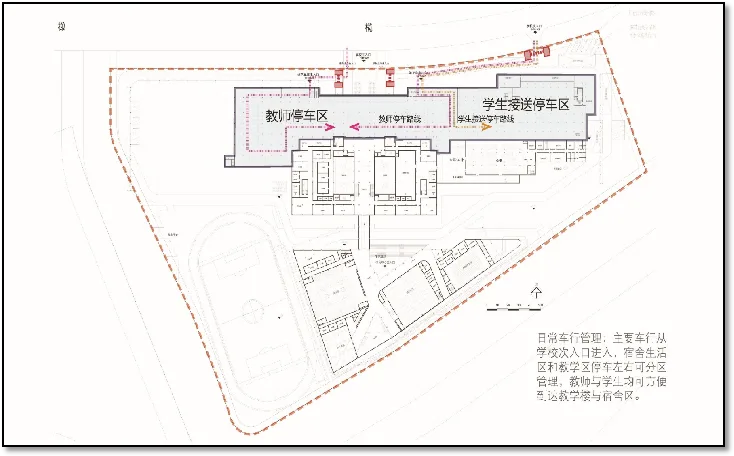
The project combines multifunctional underground spaces to create an underground shuttle hall. Private cars operate entirely below ground, alleviating surface traffic congestion and accommodating modern educational space transportation needs.
The school serves 2,400 students, including 2,000 boarders. Weekly pick-up and drop-off schedules are arranged: students depart from the dormitory underground hall every Friday at 5 pm via private cars assigned for each class. On Sundays at 7 pm, students return to the dormitories in a staggered shuttle service. Some students also use school buses that pick up and drop off at the dormitory area’s south square.
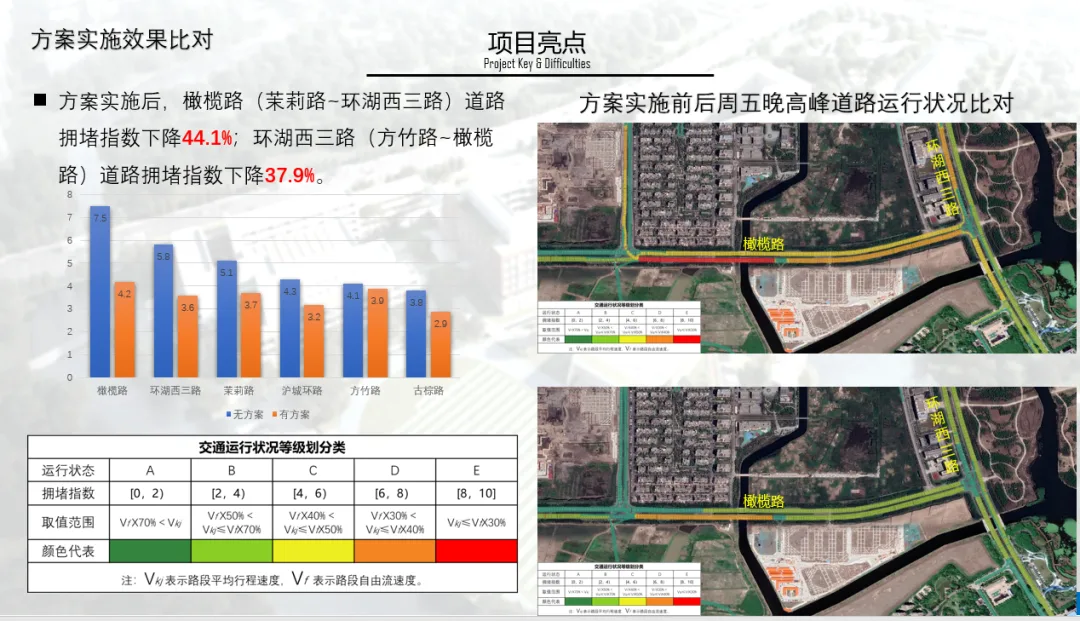
The peak pick-up period from 3:00 pm to 6:00 pm on Fridays was analyzed through simulation. Previously, temporary parking near the school gate caused traffic jams on Olive Road. The underground parking garage plan allows shuttle vehicles to enter via the left entrance, exit on the right, then turn right onto Olive Road, reducing conflicts with surface vehicles and easing congestion.
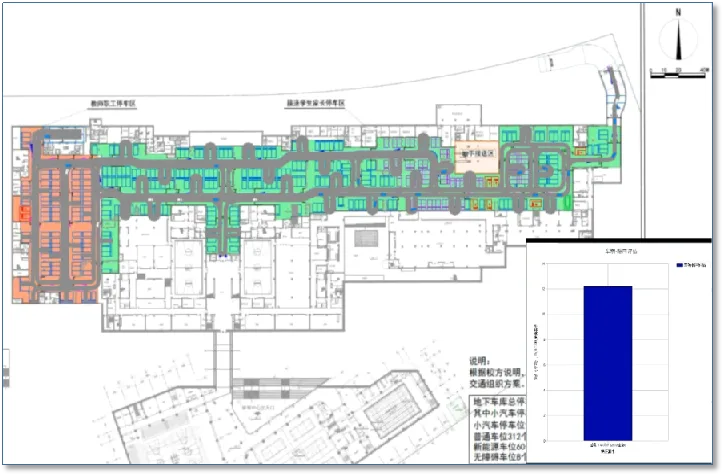
VISSIM micro traffic simulation software was used to analyze underground garage traffic flow.
After implementation, congestion on Olive Road (Jasmine Road to Huanhu West Third Road) dropped by 44.1%, and on Huanhu West Third Road (Fangzhu Road to Olive Road) it decreased by 37.9%, effectively solving school transportation challenges and improving harmony between the school and urban traffic.
#02 Campus Open to the Community
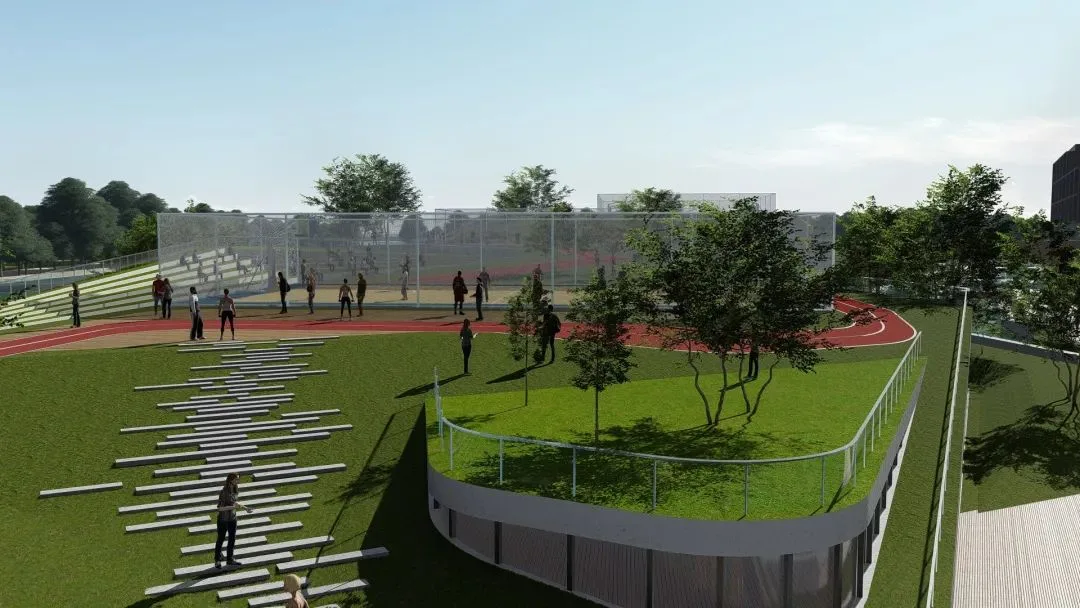
In response to China’s “14th Five Year Plan” national fitness initiatives, the sports island will be accessible during holidays and leisure times, allowing local residents to enter from the green space on the east side for recreational activities. This approach frees up exclusive waterfront campus space on weekdays, promoting natural sharing through intelligent management and contributing to a better community environment.
The design also considers adaptability to transform quickly into a temporary hospital to support epidemic control efforts.
#03 PKPM: Live and Dead Load Calculations
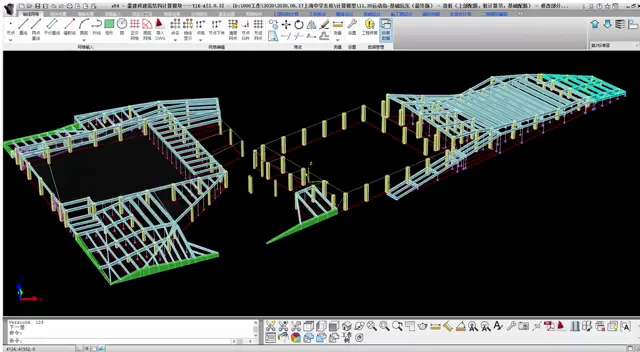
Load calculations also reviewed soil cover depths for landscape greening plans. Shallow soil cover impacts plant selection and informs landscape design decisions.
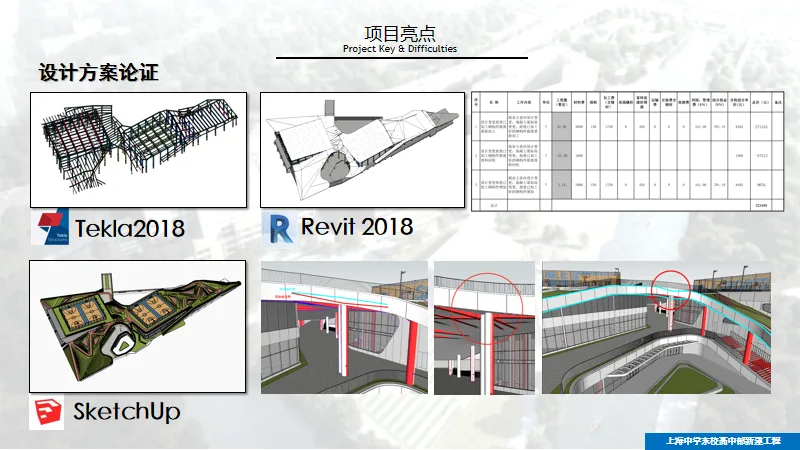
Multi-channel design scheme demonstration.
#04 BIM-Assisted Drawing
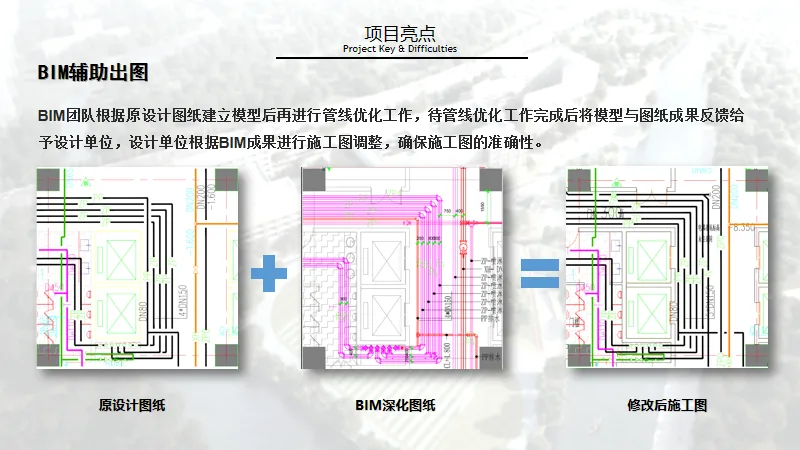
Using multi-channel design demonstrations, the BIM team creates models from original drawings and optimizes pipeline layouts. These optimized models and drawings are then returned to the design team, who update construction drawings accordingly to ensure accuracy.
#05 Traffic Simulation During Construction
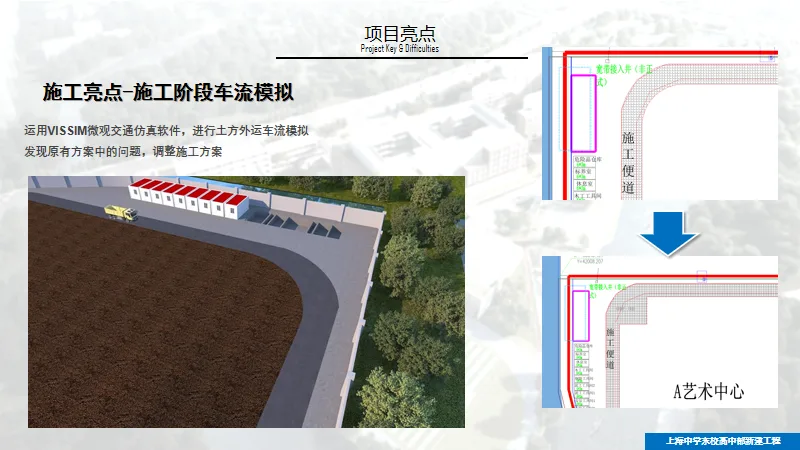
VISSIM micro traffic simulation software was used to model earthwork transportation flows during construction.
BIM Application in the Design Phase
#01 Implementation Plan Demonstration
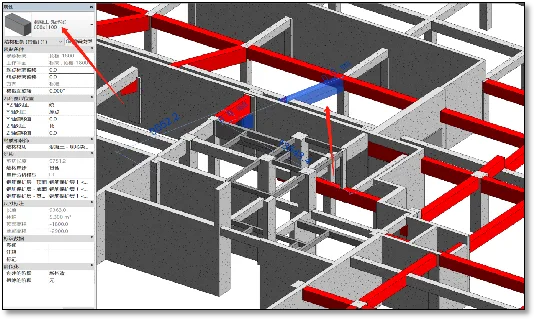
Structures exceeding specific dimensions—beams with cross-sectional areas over 0.54 m² and lengths over 18 meters, or slabs thicker than 350 mm with floor heights above 8 meters—require high formwork. BIM models help identify these cases and assist in planning using travel tables.
#02 Net Height Analysis
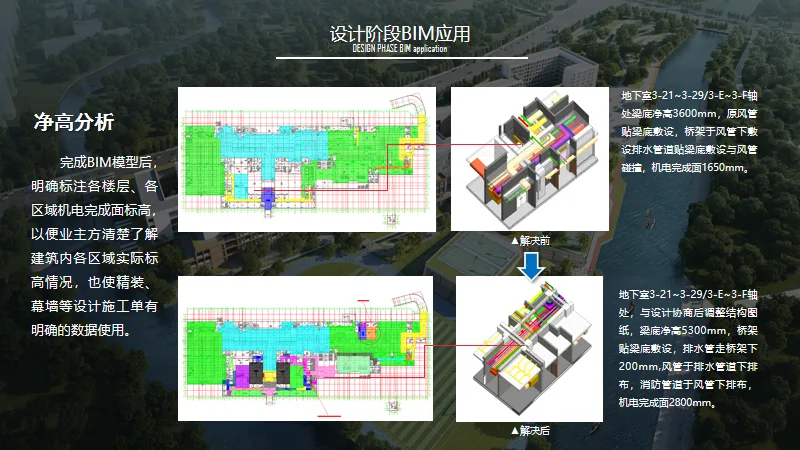
Once the BIM model is complete, the mechanical and electrical finish elevations for each floor and area are clearly marked. This provides the client with accurate elevation data and supports design and construction of finishes, curtain walls, and other materials.
Example:
Before adjustment: The net height under the beam at axis 3-21~3-29/3-E~3-F in the basement was 3,600 mm. The original air duct was placed against the beam bottom, with the bridge beneath the duct. The drainage pipe conflicted with the air duct, and the mechanical and electrical finish surface was at 1,650 mm.
After adjustment: Structural drawings were revised after negotiation with designers. The net height under the beam increased to 5,300 mm. The bridge was repositioned next to the beam bottom, drainage pipes placed 200 mm below the bridge, air ducts below the drainage pipes, and fire pipelines under the air ducts. The mechanical and electrical finish surface rose to 2,800 mm.
#03 BIM-Assisted Steel Structure Deepening Design
BIM models submitted by steel structure specialists are reviewed and merged. Conflicts between steel structure reinforcements and original plans are checked, and pipeline models adjusted accordingly.
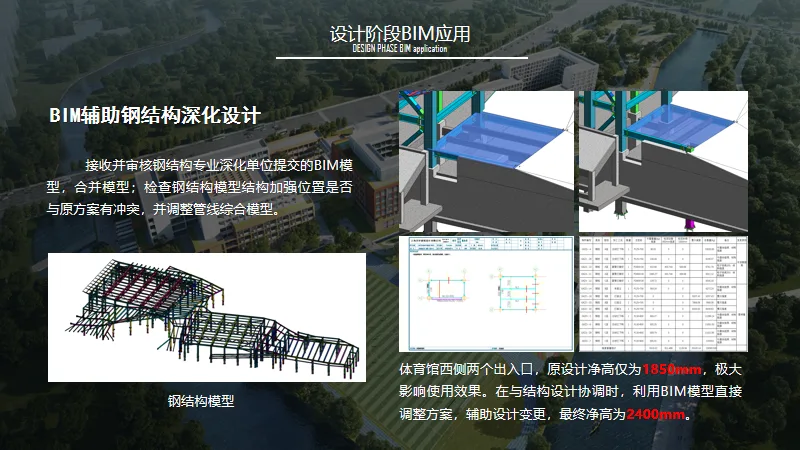
For example, the two entrances/exits on the sports hall’s west side were initially designed with a net height of only 1,850 mm, limiting usability. Using BIM, the design was adjusted to achieve a final net height of 2,400 mm.
#04 Optimizing Professional Clash Detection
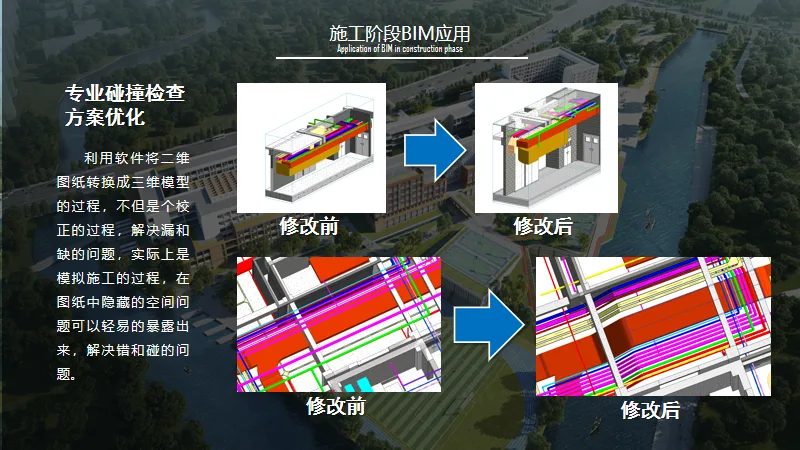
Converting 2D drawings into 3D BIM models not only corrects omissions and errors but also simulates construction. This process exposes spatial conflicts and prevents potential issues.
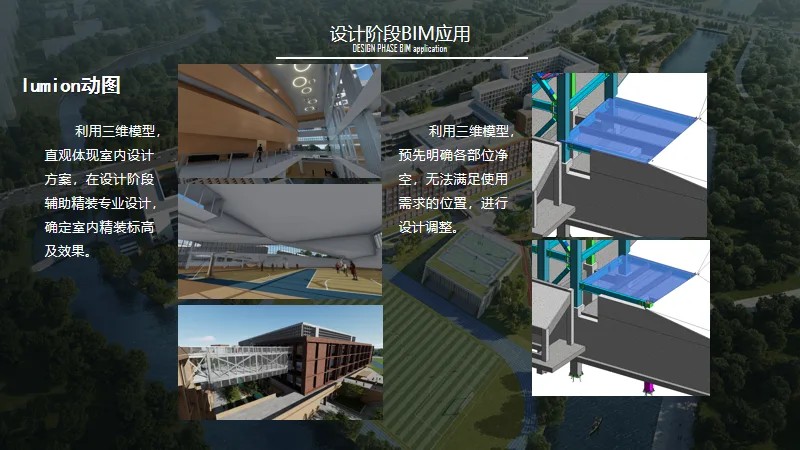
#05 Lumion Motion Visualization
3D models visually present interior design schemes, aiding interior decoration during the design phase. This helps determine elevations and effects, clarifying clearances in advance and enabling design adjustments to meet functional requirements.
#06 BIM Modeling in the Design Phase
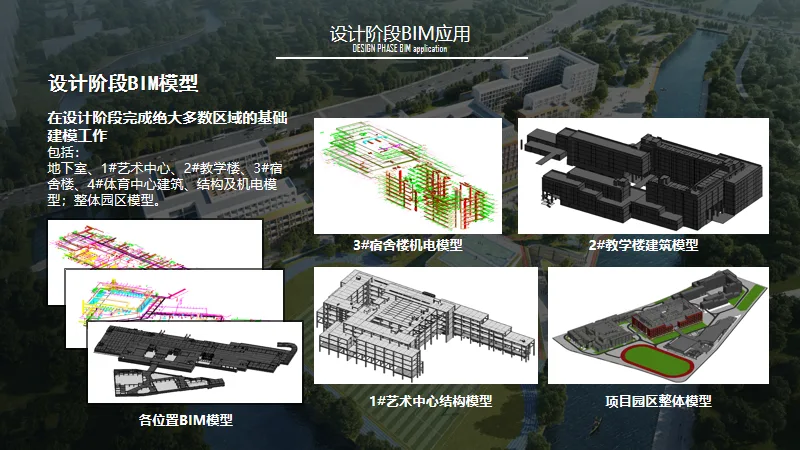
Basic models were completed for most areas during design, including the basement, Art Center #1, Teaching Building #2, Dormitory Building #3, Sports Center #4, structural, mechanical, electrical models, and the overall campus model.
#07 Design Phase Results
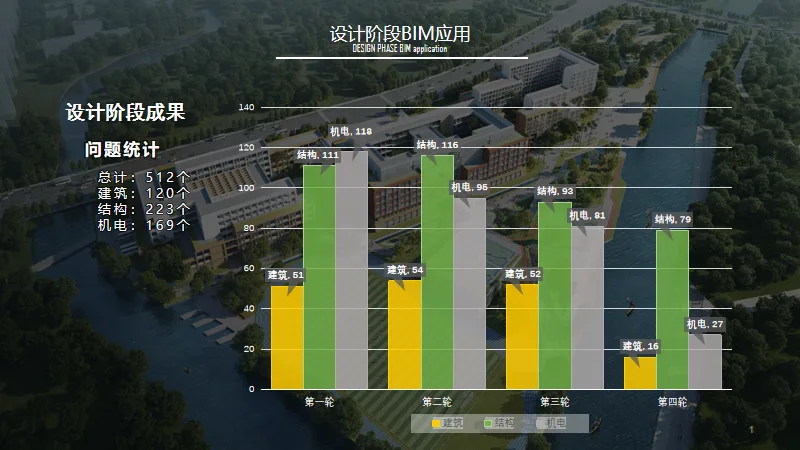
During design, 512 issues were identified related to construction:
- 120 construction-related problems
- 223 structural issues
- 169 mechanical and electrical challenges
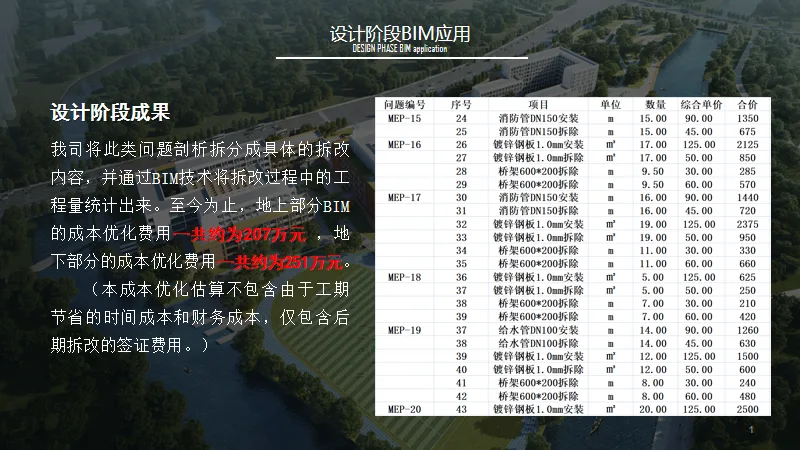
The company analyzes these issues, breaking them down into demolition and renovation tasks, using BIM to calculate quantities for these processes. So far, cost optimizations total approximately 2.07 million yuan for above-ground BIM and 2.51 million yuan for underground parts. (These estimates exclude time and other financial savings from project duration, focusing only on visa fees for demolition and renovation.)
BIM Application During the Construction Phase
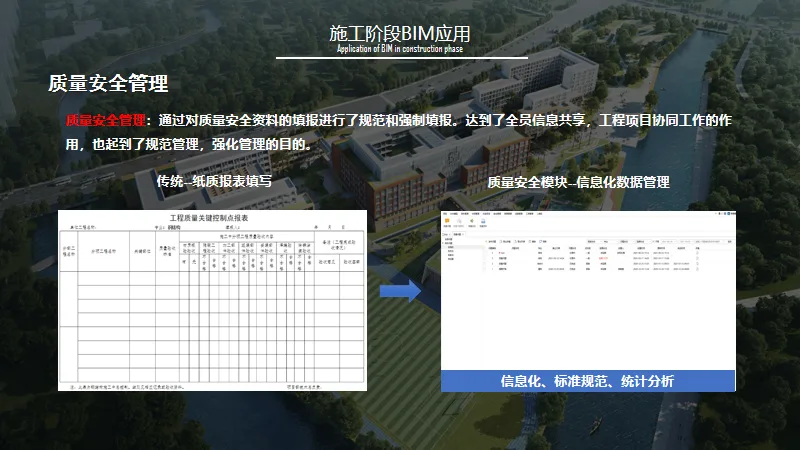
#01 Quality and Safety Management
Standardized and mandatory reporting of quality and safety data has been implemented, facilitating information sharing and collaboration among all project members. This approach strengthens management and ensures compliance.
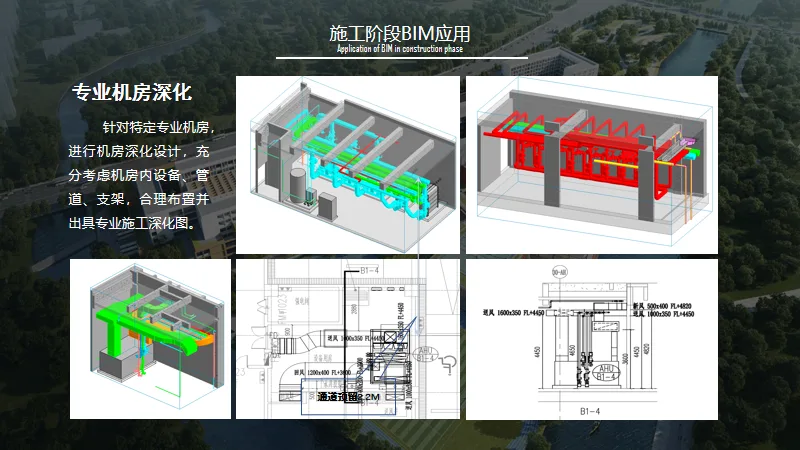
#02 Computer Room Deepening Design
Detailed designs were developed for specialized computer rooms, carefully planning equipment, pipelines, and supports to optimize layout and produce professional construction drawings.
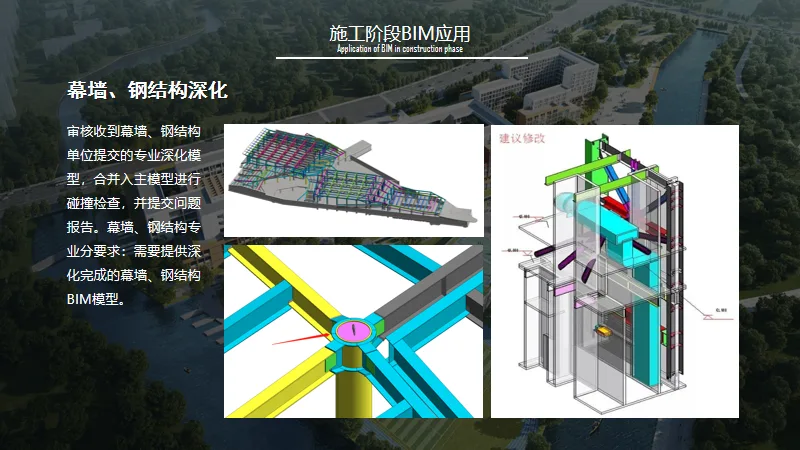
Models submitted by curtain wall and steel structure teams were reviewed, merged into the main model for clash detection, and problem reports generated. Detailed BIM models are required for these specialties.
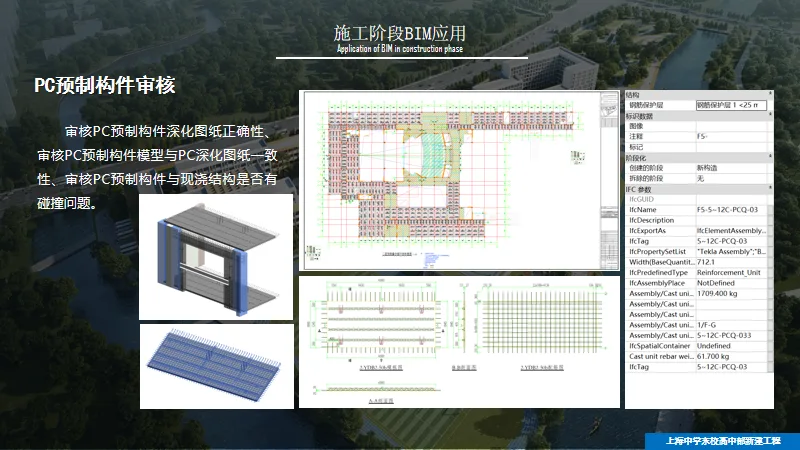
#03 Prefabricated Component Review
Detailed drawings of prefabricated components were verified for accuracy and consistency with models. Checks ensured no clashes occurred between prefabricated components and cast-in-place structures.
For example, the sports hall’s west entrances originally had a net height of 1,850 mm, limiting usability. BIM-assisted coordination adjusted the design to increase the net height to 2,400 mm.
#04 Drawing Guidance
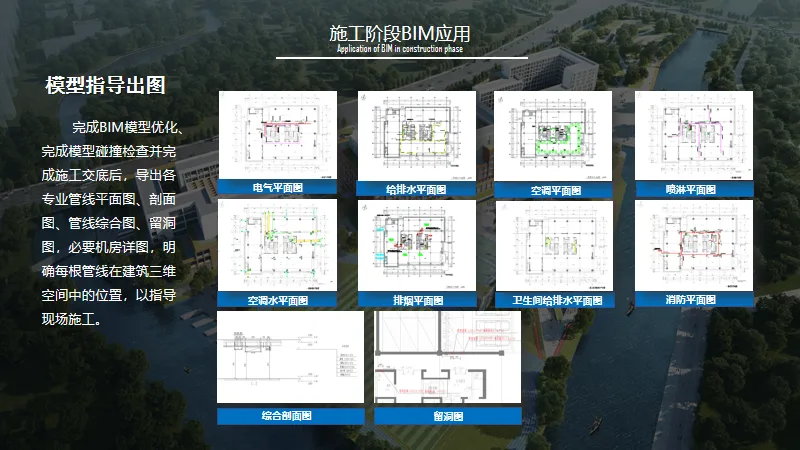
Following BIM model optimization, clash detection, and construction briefings, various specialized pipeline plans, sections, comprehensive diagrams, hole reservation diagrams, and detailed machine room drawings were exported. These clarify pipeline positions in 3D space, guiding on-site construction.
#05 Schedule Management
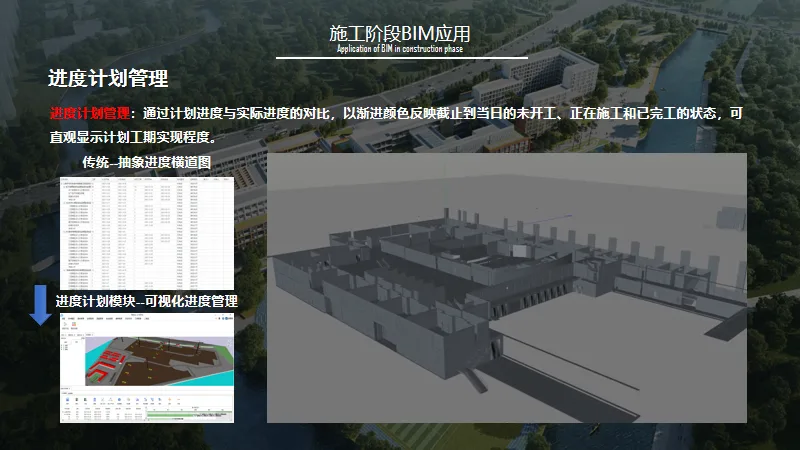
Progress is tracked by comparing planned versus actual schedules, highlighting statuses such as not started, in progress, or completed using progressive color coding. This visualizes schedule achievement clearly.
#06 Process Simulation and Management
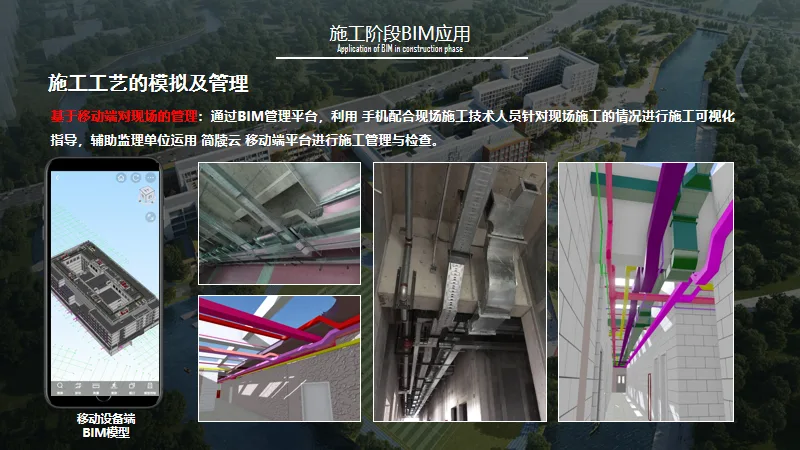
On-site management utilizes mobile devices connected to the BIM management platform. Construction technicians receive visual guidance via smartphones, assisting supervisors through the Bamboo Cloud mobile platform for construction management and inspection.
#07 Special Construction Plan Demonstration
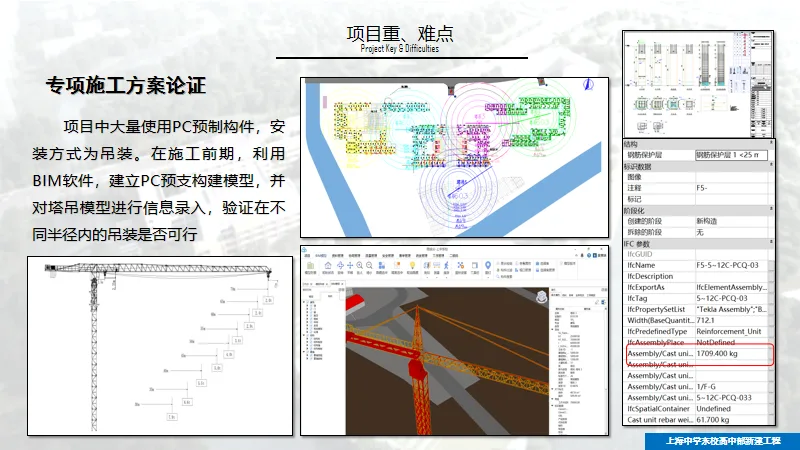
The project uses numerous prefabricated components installed by lifting. Early in construction, BIM software established a pre-construction model, integrating tower crane data to verify lifting feasibility at different radii.
#08 BIM Model Optimization
Building on the finalized design phase models, on-site conditions and construction requirements guide BIM model optimization during construction. Problem reports and optimization plans are provided, and construction drawings adjusted accordingly to support on-site work.
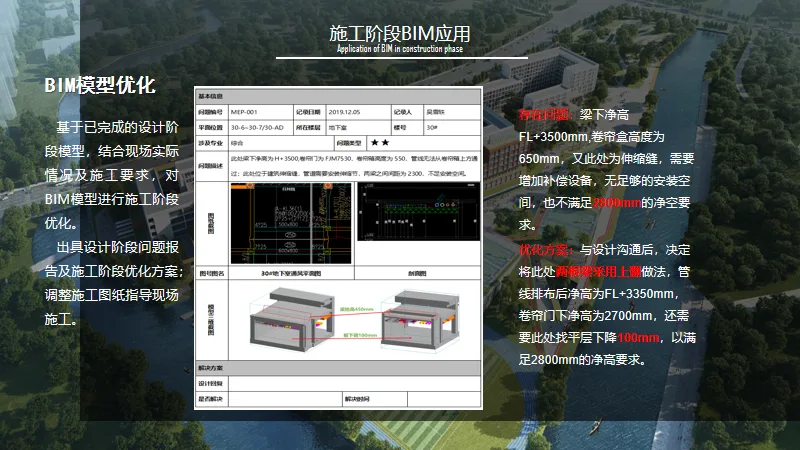
Case and Solution:
Issue: The net height under the beam is FL+3500 mm, with a 650 mm rolling shutter box. This area features an expansion joint requiring additional compensation equipment, leaving insufficient installation space and failing to meet the 2800 mm clearance requirement.
Optimization: After consultation with the design team, the two beams were flipped upward at this location. The net height after pipeline layout became FL+3350 mm, with 2700 mm clearance under the rolling shutter door. The leveling layer was lowered by 100 mm to meet the 2800 mm net height requirement.
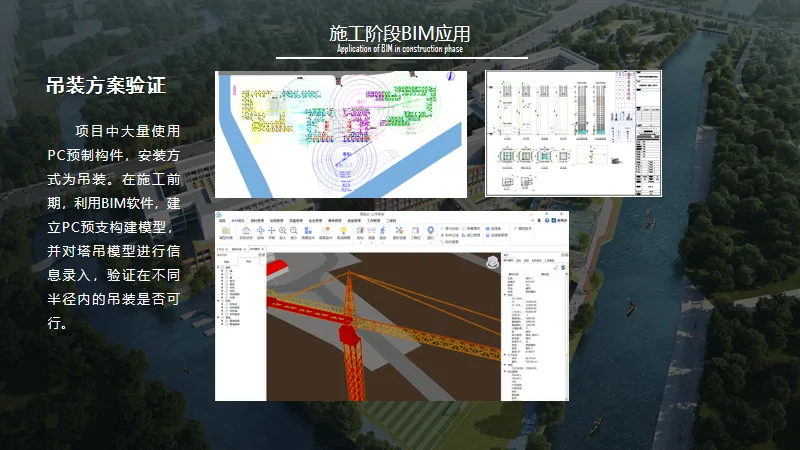
#09 Hoisting Plan Verification
A large number of prefabricated components are lifted into place. Early in construction, a BIM-based pre-construction model incorporating tower crane data verified the feasibility of lifting within various radii.
















Must log in before commenting!
Sign Up