
In recent years, the high-rise spatial template support system, commonly known as high-rise formwork, has seen widespread adoption. As a crucial component of the main structure’s load-bearing system, high-rise formwork not only supports its own weight but also carries the weight of the formwork, various construction equipment, and the vibrations generated during pouring and other construction activities. If not properly managed, these factors can lead to serious safety concerns.
The emergence of Building Information Modeling (BIM) has introduced a new approach to managing engineering construction models. BIM enables virtual visualization of the construction process before work begins, giving management teams a clearer and more comprehensive understanding of the construction dynamics. This enhanced insight helps reduce risks and ensures safety throughout the construction phase. The following image illustrates the application of BIM technology in managing high-rise formwork safety:
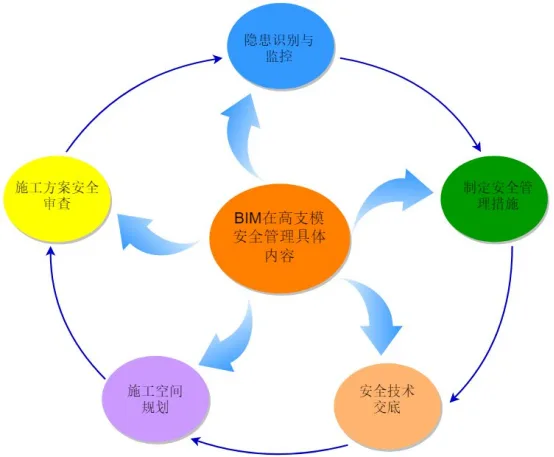
Construction Plan Review. The high-rise formwork construction process involves complex components that are difficult to thoroughly review. Traditional inspections may overlook hidden dangers, leaving potential safety risks unaddressed. BIM technology allows dynamic visualization of the construction process, enabling site managers to better understand real-time conditions. This improves the speed and accuracy of safety inspections and provides essential support for future hazard detection and warning systems.
High-rise formwork construction typically takes place on compact sites where construction activities and materials can overlap, increasing safety risks. BIM supports spatial planning of formwork components, preventing insufficient safety distances that could compromise structural stability. By predicting hazards in advance and optimizing component placement, BIM reduces accident likelihood and enhances on-site management efficiency.
Usually, safety information related to high-rise formwork is conveyed through verbal descriptions and drawings, which can lead to misinterpretation and unclear construction methods. BIM overcomes these challenges by clearly displaying the exact locations of each steel pipe node through 3D animations. Combined with 4D process simulations, this technology allows managers to monitor critical points closely, ensuring safe and orderly progress of the construction.
Traditionally, safety control has been reactive—corrective actions are taken only after incidents such as formwork collapse, often resulting in damage to personnel and property. BIM enables proactive safety management by detecting risks early through dynamic model visualization. This allows for tailored management plans and real-time adjustments to maintain safety throughout the project.
Safety hazards can arise at any stage during construction. Since the BIM database contains comprehensive project information, it can identify potential risks at every phase of high-rise formwork construction. This capability provides a reliable foundation for developing effective safety management strategies, ultimately safeguarding the construction process.
















Must log in before commenting!
Sign Up