
Currently, design institutes primarily focus their BIM technology research on modeling applications during the early stages, such as effect visualization and preliminary design. Thanks to the strong visual impact of BIM-designed 3D models, which can be further enhanced using other rendering software, BIM offers significant advantages in project presentations and bidding processes.
Using BIM platform software for model creation and project walkthroughs allows early identification of potential design issues, helping to prevent errors before construction begins. Employing visual design thinking with a top-down approach provides a comprehensive understanding of the entire project, improves design efficiency, and significantly reduces workload. Here are several key features of BIM technology applied during the design phase:
(1) Visualization: Traditional 2D design is replaced by 3D visualization through BIM technology. This means “what you see is what you get,” enabling designers to intuitively inspect every detail, making the design process more convenient and precise.
(2) Parameterization: Any component of the bridge structure can be parameterized and easily stored within the information model.
(3) Collaboration: Collaboration involves multidisciplinary cooperation on the same structure, not only in building geometric models but also in sharing and coordinating data.
(4) Automation: After completing the 3D model, BIM software can automatically generate drawings, calculate quantities, and detect clashes as needed. This helps designers identify errors and develop more optimized design solutions.
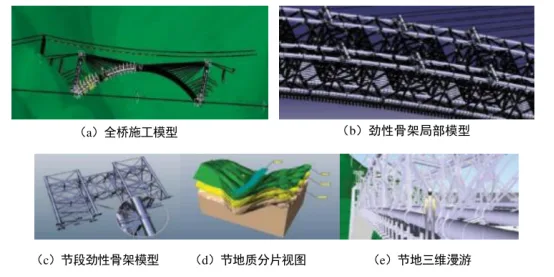
The example below showcases a BIM design by China Railway Eryuan Engineering Group Co., Ltd. for the Beipanjiang Bridge on the Shanghai-Kunming Passenger Dedicated Line. Bentley software was used for preliminary design and construction phase simulation, including the creation of a 3D walkthrough animation. The details are illustrated in the image above.
















Must log in before commenting!
Sign Up