
In China, the architectural design industry has traditionally relied on two-dimensional drawings—plans, elevations, and sections—to convey building information. However, this approach often fails to provide an intuitive understanding of the building and is prone to information gaps. Typically, experienced architects are required to oversee the construction process, but a single building project involves numerous stakeholders from design to maintenance. Miscommunication and information loss during this process can lead to construction errors and significant financial losses. The advent of Building Information Modeling (BIM) technology offers new methods for engineering design and construction management, excelling at collecting, categorizing, storing, analyzing, and transmitting building data.
Over the past decades, BIM technology in China has evolved through stages of conceptualization, institutionalization, application development, and deep integration. Currently, BIM adoption in the Chinese construction sector remains at an early development stage. Proper implementation of BIM in the early design phases improves design efficiency and allows real-time validation of design rationality. This ensures the accuracy of building information and supports subsequent applications, such as construction planning and facility management. BIM forward design uses 3D models as the foundation and data source, covering the entire process from conceptual design to detailed construction drawings. Compared to traditional methods, BIM enhances the quality, efficiency, and coordination among professionals, resulting in richer design content.
At present, BIM forward design primarily depends on BIM’s core technologies, especially during collaborative workflows involving multiple disciplines. BIM models contain extensive design data, and BIM applications in design are implemented in stages and levels to address various tasks. BIM is not just about digitizing traditional designs but about using the technology to identify problems and develop solutions. However, due to the current maturity of BIM technology and the varying expertise of designers, achieving fully integrated BIM forward design remains a work in progress. Most design firms currently use BIM primarily as a modeling tool, which represents a transitional phase in BIM development but already delivers positive impacts. Below is a flowchart summarizing the BIM forward modeling design process and methodology:
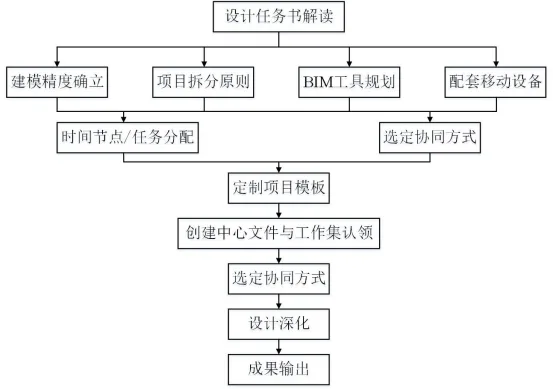
The BIM forward design process begins with interpreting the project brief to clearly define the building requirements. The second step involves determining the modeling accuracy, establishing principles for project segmentation, planning BIM software tools, and selecting necessary hardware. Third, the schedule is established by setting task start times, defining each participant’s responsibilities, and selecting appropriate collaboration methods. Finally, the modeling and design phase commences, which includes developing project templates, creating initial BIM models, refining model details, and integrating multiple data sources to complete a comprehensive building model.
















Must log in before commenting!
Sign Up