
BIM’s full-process project management capabilities offer effective solutions to construction and operational challenges encountered in the later stages of a project. Issues can be identified and resolved early on, reducing construction difficulties and enhancing overall project control. From a management perspective, BIM models facilitate collaboration among all stakeholders, minimizing communication barriers and enabling better personnel coordination. In terms of information management, all engineering data is integrated within the BIM model, reducing information loss and ensuring data accuracy and control.
BIM enables comprehensive control over project management. Its impact goes beyond mere mapping technology; it represents a transformative revolution across the entire construction and engineering industry.
Currently, in specific engineering projects, BIM-based building information management offers accessible and user-friendly tools to handle various processes and tasks. It effectively models and digitizes each phase, improving the accuracy and efficiency of business management. By adopting measurable methods for project oversight, BIM enhances collaborative management capabilities. The main applications of BIM in collaborative management are illustrated in Figure 1.
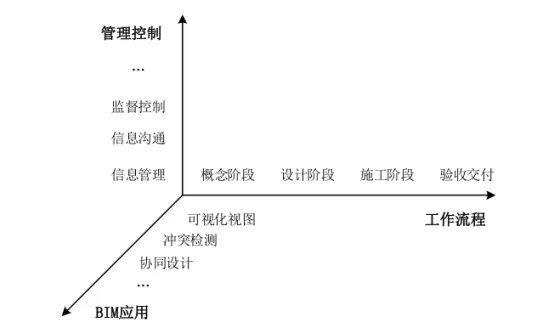
In practice, BIM primarily supports the early stages of a project by managing design, documentation, visualization, and clash detection. Throughout project execution, BIM provides essential data support. However, BIM’s role in collaborative management depends on additional team efforts to coordinate and complete tasks. As BIM adoption grows, users become more skilled, further enhancing collaborative project management, which in turn improves project efficiency and quality.
BIM links various aspects of engineering projects by constructing comprehensive building models, enabling better collaboration across teams. Given the complexity of construction projects, which involve multiple departments, effective collaboration is crucial. Building information management with BIM abstracts project elements into models, representing the roles and relationships among different components to support management processes and business operations. This includes preliminary cost estimation, preliminary design renderings and drawings, detailed design plans, construction workflows, material allocation, project phase inspections, and final delivery. Through process and model design, BIM facilitates effective project management and timely data sharing and communication.
Despite these advantages, the overall skill level of practitioners in many construction phases remains relatively low, and their familiarity with site tasks and information systems is limited. Therefore, BIM systems are essential for operations, data transmission, and information retrieval. Currently, BIM alone cannot fully accomplish these tasks, highlighting the need for additional management strategies to support information and collaborative management.
















Must log in before commenting!
Sign Up