
At its core, Building Information Modeling (BIM) is a collection of specialized computer software technologies designed to store and manipulate graphical data while linking relevant information to these graphics. Consequently, BIM relies heavily on software support. Today, there is a wide range of BIM software available both domestically and internationally.
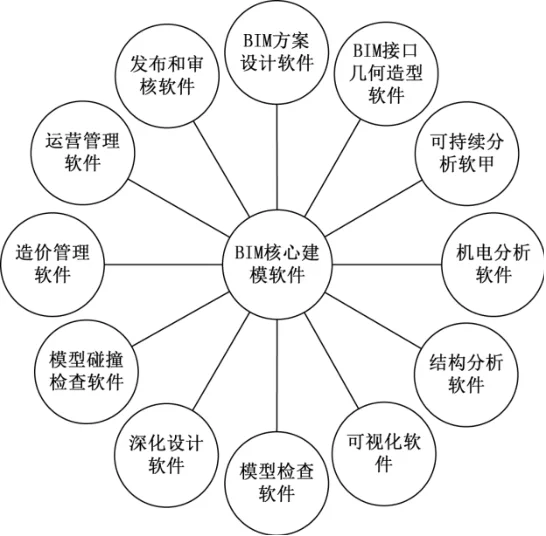
Within the water conservancy and hydropower sectors, the leading BIM core modeling software platforms are primarily three: Autodesk, Bentley, and Catia. These are commonly referred to as the industry’s “ABC” platforms. For more details, see Figure 1 below. Additional functional software is categorized using the “BIMBOX” classification method, illustrated in Figure 2.
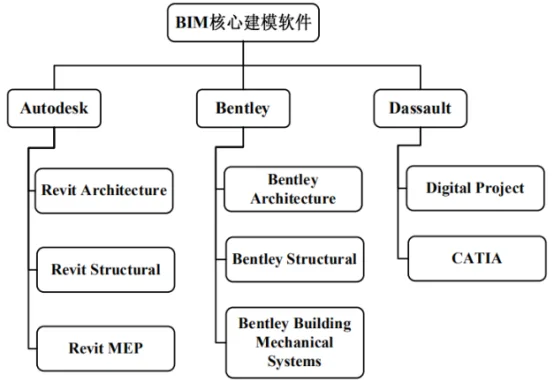
Among the leading core modeling software, Autodesk leverages the widespread popularity of its AutoCAD drafting software and robust collaborative features, allowing its Revit platform to dominate market share in architecture, structural engineering, and MEP (mechanical, electrical, and plumbing) disciplines within the building construction industry.
Bentley’s suite of software, developed on the MicroStation platform, offers unique strengths in infrastructure projects such as municipal works, roads, and bridges. It also excels in construction, structural, and equipment applications across industries like pharmaceuticals, petroleum, and chemical manufacturing.
Catia, developed by Dassault Systèmes, is a powerful modeling tool that surpasses traditional software in handling complex shapes and large-scale buildings. It provides exceptional parametric modeling and drafting capabilities, making it well-suited for sectors such as mechanical structures, aerospace, automotive, and shipbuilding.
In summary, selecting the right modeling software can significantly enhance efficiency and quality, enabling you to achieve twice the results with half the effort when creating high-quality models.
















Must log in before commenting!
Sign Up