
Level of Detail (LOD), also known as Level of Development, refers to the degree of detail in a BIM model. It describes the progression of a BIM model component from a rough conceptual stage to a highly accurate demonstration level. Although China has introduced some LOD standards and specifications for building models, the development of BIM standards in China remains in its early stages. Consequently, the accuracy achievable in building information models for actual engineering projects primarily depends on the shared requirements of designers, owners, and other stakeholders. This is particularly true for complex subway projects involving multiple disciplines, where a clear and detailed accuracy scheme is essential to prevent excessive modeling when applying BIM technology in engineering design.
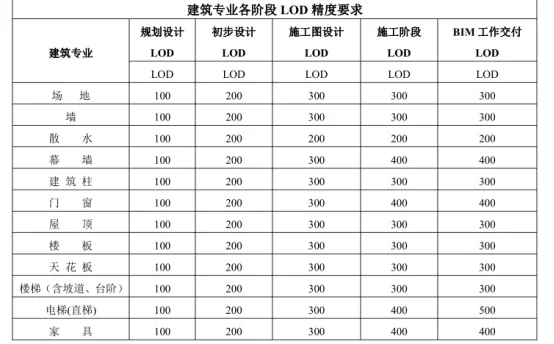
The American Institute of Architects categorizes model accuracy into five levels—LOD100 through LOD500—each representing a different stage in the development of building information models: conceptualization, approximate components, precise components, fabrication, and as-built completion. Recently, due to growing demands in real-world projects, an additional level, LOD350, has been introduced.
In practice, increasing the LOD accuracy of certain model components by even one level often incurs significant costs in terms of time, manpower, and budget. Therefore, determining the appropriate LOD should be based on the specific goals at each project phase and the requirements of all stakeholders, especially the owner. The modeling accuracy is set according to summarized model accuracy standards at various levels. Currently, most BIM standards reference the U.S. LOD classification system and the “Depth Regulations for the Compilation of Architectural Engineering Design Documents” issued by China’s Ministry of Housing and Urban-Rural Development. Table 1 illustrates the modeling accuracy standards for the architectural discipline at a particular station.
















Must log in before commenting!
Sign Up