
BIM technology relies on a variety of software to collaborate and share data. However, since different BIM programs use different data formats, information can be lost during data exchange between them. Software interoperability in BIM measures how effectively data is transmitted between different applications. This interoperability can be categorized into one-way and two-way data transmission.
One-way transmission occurs when one BIM software can send data to another but cannot receive data back. Many simulation applications operate in this mode. Two-way transmission, on the other hand, allows for mutual data exchange between different BIM software.
There are two main methods for transferring data between BIM software:
1. Data Format Conversion
This method involves converting the model’s storage format to enable information exchange between software. For example, Revit models can be exported to the .fbx format and imported into Lumion for enhanced rendering. Similarly, Rhino models can be converted to .sat files to be imported into Revit, or structural elements can be extracted from Rhino models and rebuilt within Revit. The relationships between these format conversions are illustrated in the image below.
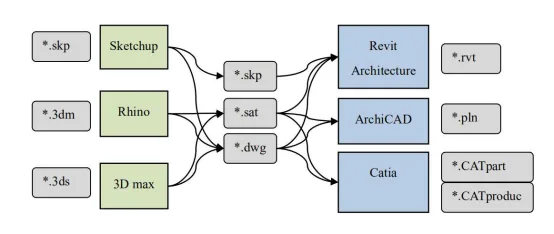
While intermediate format conversion helps facilitate data sharing between software, it often results in some degree of information loss. This makes it challenging to maintain consistent information management throughout a BIM project’s entire lifecycle.
2. Information Transmission via Plugins
Another approach involves developing specific plugins tailored to the characteristics of each BIM software. For instance, the Dynamo plugin Rhynamo enables data exchange between Rhino and Revit. The Grasshopper component Hummingbird assists in creating local geometry in Revit, which can then be easily imported using the WhitefeedModelbuilder tool.
Custom plugins can enhance the efficiency of data exchange between certain software packages. However, because there are many BIM applications, plugins usually target only a few specific programs and cannot cover all platforms. Developing these plugins requires significant time, effort, and resources, resulting in higher costs.
In summary, although BIM software can exchange data through plugins and intermediate formats, most existing plugins support only limited, bidirectional transfers between specific software pairs. Achieving seamless data exchange among all BIM platforms remains challenging. Additionally, software interpretations of intermediate formats vary, often causing information loss during transmission despite the use of conversion formats.
















Must log in before commenting!
Sign Up