
The semi-BIM design approach primarily focuses on model creation during the construction drawing design phase. In this workflow, the BIM team develops the 3D model concurrently with the 2D construction drawings produced by the traditional 2D design team, as illustrated in Figure 1.
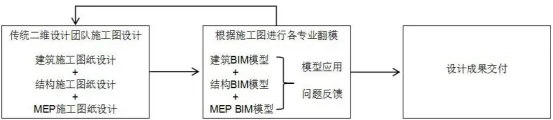
Figure 1: Semi-BIM Design Process
In this setup, the BIM team works closely alongside the 2D design team. Through the creation of 3D models, they can identify and address issues within the 2D design drawings promptly, enhancing the overall design quality. However, since the expertise of semi-BIM modeling personnel can vary, the potential for improving construction drawing results may be limited. Additionally, this mode primarily uses BIM technology as a tool to assist and refine 2D design, rather than fully leveraging its capabilities. Although it represents progress compared to the “flipping BIM” design approach, semi-BIM design still falls short of unlocking the full potential of BIM technology throughout the design process.
With the growing adoption of BIM concepts and advancements in computer technology, the construction industry is transitioning towards a full BIM design era. Subway engineering, a critical sector within construction, often faces increased time and costs due to the involvement of multiple disciplines and complex interactions. BIM technology offers a solution by enhancing design quality and mitigating time and cost escalations. As a result, the subway design process is moving decisively into full BIM design, marking an inevitable trend.
It is important to clarify that full BIM design does not imply that every aspect of professional design relies solely on 3D modeling. Instead, it represents an integrated design approach combining both 3D and 2D methods. Consequently, professional designers must be proficient not only in 3D design techniques but also maintain strong foundational skills in 2D design.
















Must log in before commenting!
Sign Up