
BIM encompasses information throughout the entire lifecycle of a construction project, including the planning, proposal, design, bidding, construction, sales, operation, renovation, and recycling stages. Participants involved at each phase contribute to and update the BIM model, continuously enhancing its accuracy and detail. Additionally, each participant can set specific access and editing permissions based on their needs.
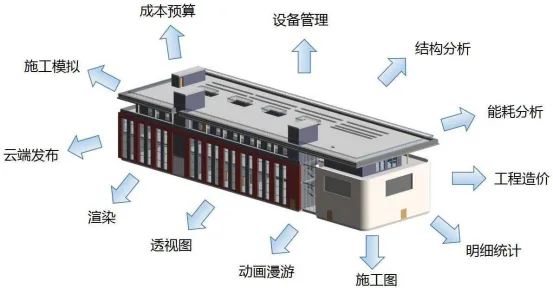
BIM-based building and structural design goes beyond simple collections of points, lines, and surfaces. It integrates building components—such as the building envelope, doors, windows, and stairs—within three-dimensional or even four-dimensional space. Every building element has a unique ID and carries specific design information. This approach allows designers and engineers to compare and optimize their design choices effectively, as illustrated below.
Currently, the BIM market in China has grown significantly—from less than 50 million yuan in 2011 to more than 600 million yuan in 2016. Regarding adoption, by 2016, 30% to 40% of projects had implemented Building Information Modeling. However, BIM technology in China remains in its early development stages. While BIM software fits well within the Chinese market, overall integration levels remain low. Based on these statistics, China’s construction informatization rate is only about one-tenth of the international standard, falling far short of the 90% target set by the 2020 “Guiding Opinions on Promoting the Application of Building Information Modeling.” Therefore, advancing BIM adoption in China remains a challenging and ongoing process.
















Must log in before commenting!
Sign Up