
The BIM information data model spans the entire lifecycle of construction projects, covering planning, design, construction, and operation phases. By integrating 3D, 4D, and 5D technologies, it enables systematic design, virtual progress simulation, real-time cost control, and ongoing management of facility and equipment operation and maintenance. Leveraging BIM’s robust platform and data capabilities, project managers can optimize schedule control, enhance quality management methods, and perform real-time statistical and comparative analyses of costs and material resources. This significantly advances construction process management and boosts project efficiency and effectiveness. BIM technology is essential for future enterprise production development and serves as a key driver for technological upgrades within companies.
During the bidding process, precise quantity calculation is crucial, along with the reasonable classification of all engineering quantities. Using civil engineering as an example, the workflow for applying BIM to quantity calculation is illustrated in the following flowchart:
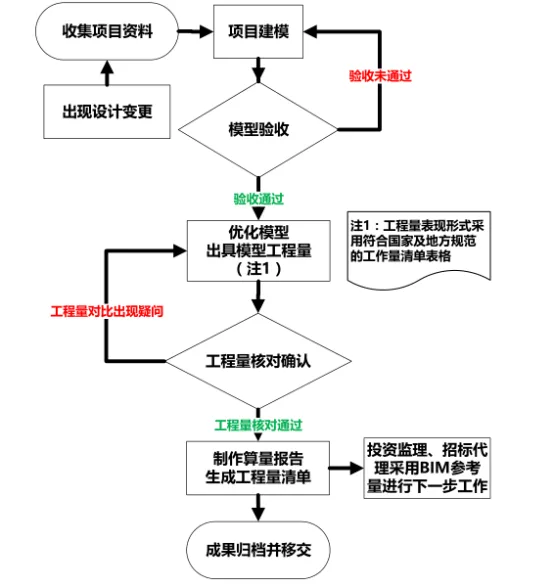
Workflow steps:
A. Gather all relevant construction drawings, atlases, and specifications required for bidding;
B. Develop the BIM model based on these drawings and atlases;
C. Maintain ongoing communication with the design team during modeling to provide feedback on potential design issues and ensure corrections;
D. Upon model completion, have the design team review and confirm its accuracy;
E. Incorporate the necessary statistical parameters into the model;
F. Generate a phased bill of quantities;
G. Compare the calculated quantities with those from professional investment supervisors;
H. Produce an error-free bill of quantities and submit it to the investment supervisor and bidding agent;
I. Archive the finalized model in the database for future design updates and other applications.
















Must log in before commenting!
Sign Up