
BIM technology is an innovative information integration method that has gained prominence in recent years. While its foundation lies in computer-aided imaging, it differs significantly from traditional drawing tools like CAD. Essentially, BIM represents an advancement of conventional 2D CAD techniques into multidimensional spaces. This technology enables modeling in three, four, and even five dimensions, which is why it is often referred to as building multidimensional information modeling technology.
Since the BIM model is a virtual entity that consolidates and utilizes diverse information throughout the entire lifecycle of an engineering project, it effectively presents the project’s overall layout, geometry, and spatial attributes. These can be delivered through various outputs such as digital formats, visualizations, and simulations. Additionally, BIM serves as an information-sharing platform, capturing data related to materials, construction progress, and quantities. It allows for storing and updating this information according to actual construction conditions, facilitating access and collaboration among different teams and departments. This helps prevent isolated data silos and promotes seamless information flow.
As a result, BIM technology finds application across all phases of a project—from survey and design to construction, operation, and maintenance—linking departments closely to ensure smooth project execution while enhancing quality and efficiency.
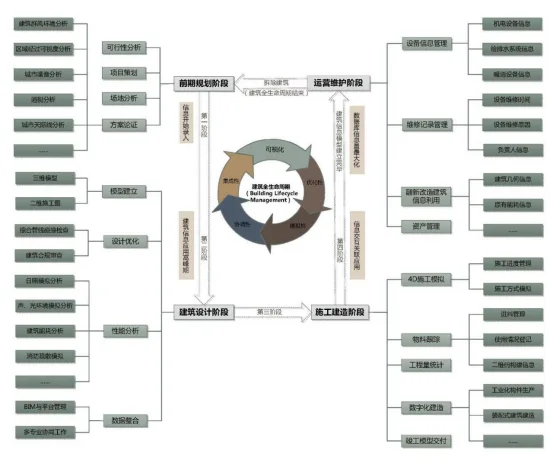
As a cutting-edge technology, BIM introduces new workflows and technical tools that offer both opportunities and challenges for transforming design processes in the construction industry. By establishing a unified BIM information platform, the traditional disconnect between specialized disciplines has been significantly reduced, ushering in a new era of collaborative work.
The core principle behind BIM is Building Lifecycle Management, which involves technical engagement from the project’s inception through to the building’s demolition. This lifecycle is typically divided into four key stages: pre-planning, building design, construction, and operation & maintenance.
The adoption of BIM technology plays a crucial role in advancing the digitalization, networking, and intelligence of the construction industry. Its applications are broad, and the author has synthesized BIM’s use throughout the entire building lifecycle, drawing upon standards established by the Building SMART Alliance (bSA) in the United States.
















Must log in before commenting!
Sign Up