
The Revit platform is a comprehensive software system used for building information modeling (BIM), design, and documentation. It supports the creation of designs, drawings, and schedules essential for building projects. Revit models provide users with detailed information about project design, scope, quantities, and various phases of the project.
All drawings, including 2D and 3D views, as well as schedules in Revit, are generated from a single, unified building model database. When working within drawing and schedule views, Revit gathers data about the building project and synchronizes this information across all other project representations. Thanks to Revit’s parametric modification engine, any changes made in one location—whether in model views, drawings, schedules, sections, or plans—are automatically coordinated throughout the entire project.
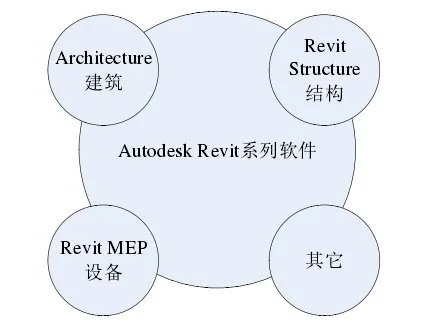
Figure 1: Composition of Revit software
Revit software mainly comprises three components: Revit Architecture for architectural design, Revit MEP for mechanical, electrical, and plumbing engineering, and Revit Structure for structural engineering design. Together, these components cover almost the entire lifecycle of engineering projects, as illustrated in Figure 1.
The Architecture module focuses on basic building elements such as walls, doors, windows, columns, and floor slabs. The Structure module deals with structural components like columns, beams, supports, and foundations. Meanwhile, the MEP module is used to create mechanical, electrical, and plumbing systems, as well as to define spaces and zones within building models.
Each graphical element in Revit is classified into different “family type instances,” with the final BIM parameter model being constructed by combining these various instances. Prior to the 2013 release, these three components were separate software applications. Although each serves a distinct professional discipline, they share the same fundamental working principles, centered around parametric modeling.













Must log in before commenting!
Sign Up