
Revit refers to a series of programs developed by Autodesk, designed for Building Information Modeling (BIM) in residential construction.
As an application, Autodesk Revit integrates the powerful functionalities of Autodesk Revit Architecture, Autodesk Revit MEP, and Autodesk Revit Structure. Project parameters include adding and drawing structural and original components, which are created as “families.”
Autodesk Navisworks is a comprehensive project review software that supports analysis, simulation, and information exchange. It allows integration of multidisciplinary design data into a unified project model for conflict management and detection. Navisworks helps design and construction professionals anticipate and avoid potential risks before construction begins.
Collision Analysis Process
Collision inspection is a crucial step in verifying construction drawings. Leveraging BIM technology, collision detection can be performed quickly and conveniently during or even before the design phase. In practice, collisions are mainly categorized as:
- Hard collisions: Physical overlaps between two objects, such as pipes intersecting load-bearing walls.
- Soft collisions: No direct overlap, but insufficient clearance prevents construction activities, for example, tight spacing that hinders installation or maintenance.
- Secondary collisions: Rare cases where identical structures occupy the same space. In detailed calculations, such as steel and cement usage, avoiding duplicate counts is essential to control costs.
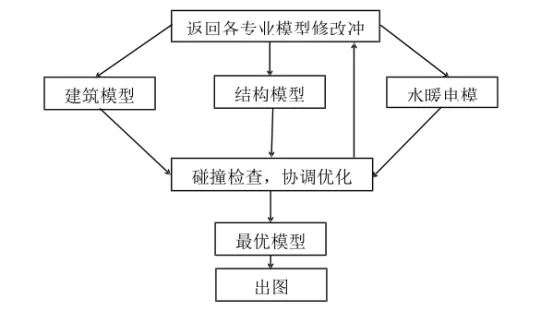
Currently, BIM collision detection primarily focuses on identifying hard collisions. Traditional collision detection relies on reviewing 2D drawings by specialists, which is labor-intensive and prone to oversight, often resulting in discovering clashes during construction. Using the BIM platform for collision detection involves first establishing a detailed professional information model and consolidating all specialized models within the software. The software identifies collision points, which are then addressed by modifying individual discipline models. This approach saves time, effort, and reduces errors. The diagram above illustrates the workflow of BIM-based collision detection.
BIM-based collaborative design requires all experts to work together to complete the design process. Unlike traditional methods, BIM collision testing by each discipline improves efficiency and effectiveness, continuously enhancing design quality. Collision inspection serves as a coordination tool among various disciplines, reducing conflicts and disputes. Regular coordination reviews are conducted to optimize and improve the overall project continuously.
















Must log in before commenting!
Sign Up