
BIM technology plays a crucial role in quality and safety management during the construction phase of assembly engineering projects. By leveraging computer information technology, BIM management techniques, and construction methods, a comprehensive BIM information model system is established. This system fosters a collaborative management approach that enhances coordination among all project participants involved in prefabricated building construction. On-site, BIM serves as a guiding tool to optimize resource scheduling, elevate construction quality control, and ensure safety standards are met. The digital engineering model created through BIM integrates construction process data, forming a complete information system that also supports the operation and maintenance stages of prefabricated buildings.
During the construction phase of prefabricated and assembled buildings, BIM technology facilitates the accurate recording of quality and safety management data based on real conditions. The integration and processing capabilities of BIM information modeling systems enhance construction management across information flow, processes, and practical application. This leads to improved and innovative management methods during the transfer construction phase, enabling effective collaborative management.
Engineering Information Dimension
Effective quality and safety management in prefabricated construction requires real-time access to detailed information about the engineering entities, which must be centrally processed. The BIM digital model represents a digital entity composed of various information units. These units encapsulate engineering data and related attributes of the physical components, serving as fundamental objects for data input and management within the BIM platform.
These information units are categorized into four levels: project, functional, component, and part levels.
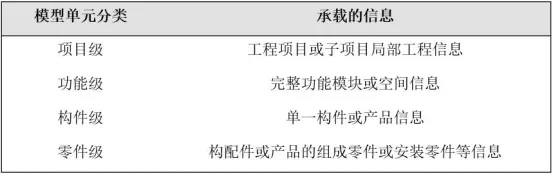
From an information type perspective, BIM model units can be divided into disciplines such as enclosure, foundation, civil engineering, decoration, and electrical and plumbing systems.
Regarding information characteristics, units fall into geometric and non-geometric categories. Geometric units include elements representing spatial data and physical properties of the building, such as length, width, and height, as well as structural constraints like parallelism and intersections. Non-geometric units encompass data beyond spatial attributes, including material specifications, construction costs, and scheduling details. These datasets are essential for construction projects and are generated independently at various construction stages, forming the foundation for effective BIM application.
Process Dimension
BIM technology supports quality and safety management throughout the entire construction lifecycle, providing technical assistance during prefabricated building stages. By establishing an information model based on engineering entities, BIM integrates data generated throughout different construction phases. It collects, stores, processes, and analyzes engineering information, making data transmission and retrieval more precise and efficient. This significantly improves construction management efficiency and supports safety and quality oversight during the build process.
The construction phase relies on design documents handed over from the planning stage. Throughout construction, continuous updates are made to the BIM model with detailed information about the physical entities, equipment, materials, construction costs, contracts, site conditions, and workflow. Additionally, data related to quality, safety, costs, and detailed design are incorporated to create a comprehensive BIM completion model for the prefabricated construction phase. This approach streamlines the delivery of completion models, replacing previous inefficient methods. Owners benefit from effective use of construction process data in later operation and maintenance, further extending BIM’s value in project lifecycle management.
Moreover, BIM’s simulation capabilities are employed during construction to model plans across various disciplines and stages. These simulations guide actual construction activities, enhancing accuracy and reducing risks throughout the process.

Value Dimension
The greatest advantage of establishing a BIM-based information sharing system lies in its ability to provide intuitive and standardized information, thereby optimizing quality and safety management methods. This benefit is reflected in three key areas: the clear visualization of engineering data, uniform information processing standards, and synchronized, consistent access to data across all stakeholders.
(1) The BIM project model visually presents engineering information, making quality and safety management activities more transparent and easier to understand. Its simulation capabilities allow for forecasting construction processes and outcomes, helping to avoid potential issues, streamline workflows, and correct mistakes before they occur.
(2) Data within the BIM model is compiled following unified standards, enabling the handling of complex and diverse data formats generated during prefabricated construction. This facilitates efficient data exchange among multiple project participants and promotes software interoperability, laying the groundwork for comprehensive engineering information sharing and management.
(3) The BIM model acts as a central platform where information is continuously updated in real time based on input from all participants. This ensures that everyone has access to accurate, timely, and reliable data. By addressing common challenges such as communication barriers, redundant information transfer, and inefficiencies, the BIM platform reduces communication overhead and enables stakeholders to easily access the information they need.
(4) BIM technology provides critical guidance throughout the construction phase of prefabricated engineering. It helps resolve existing issues within engineering entities, simplifies construction processes, and optimizes coordination across various disciplines and steps through construction simulations.
















Must log in before commenting!
Sign Up