
During subway construction, limited on-site space necessitates strict control measures. Implementing BIM technology for management enhances the regulation and utilization of subway spaces, considering crucial factors such as demand, location, and timing throughout the process. BIM elevates spatial information management by leveraging visualization tools to provide a clearer understanding of the environment. It effectively captures dynamic changes in subway operations, offering management teams interactive 3D models that help address challenges arising during construction.
Thanks to its intuitive information display, BIM technology streamlines traditionally cumbersome procedures during construction. It optimizes personnel placements and movement routes, maximizing the use of underground subway space. This not only boosts construction efficiency but also helps control costs and ensures safety.
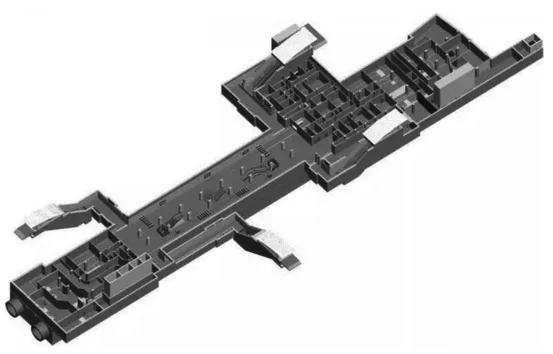
BIM model illustrating the station hall level civil engineering
Safety control is indispensable in subway construction. Incorporating BIM technology significantly improves safety management and ensures a secure construction environment. Before breaking ground, a detailed 3D model of the subway project is created to fully understand the spatial characteristics and preliminarily assess potential safety risks. This model supports thorough safety inspections throughout the process.
By utilizing BIM data, as shown in the illustration, spatial information of various subway locations is clearly visualized, allowing for risk analysis through simulations. Sensors and other monitoring devices provide real-time updates on site conditions during construction. This enables immediate responses and interventions whenever safety risks arise, optimizing information use and fostering safer working conditions.
Spatial conflicts often occur during subway design, making BIM crucial for conflict detection. For instance, mechanical arms and seat cranes used in construction can clash, posing risks to both the project and worker safety. BIM technology facilitates the creation of dynamic construction models that help identify current and potential issues early on. This reduces equipment and planning conflicts, ensures economic efficiency, resolves safety concerns, and enforces strict control over subway project execution.
Source: Science and Technology Innovation and Application, Issue 35, 2021
Author: Guo Jie (China Railway Fifth Survey and Design Institute Group Co., Ltd.)
















Must log in before commenting!
Sign Up