
HOK Architects in the United States introduced the well-known McLean Curve:
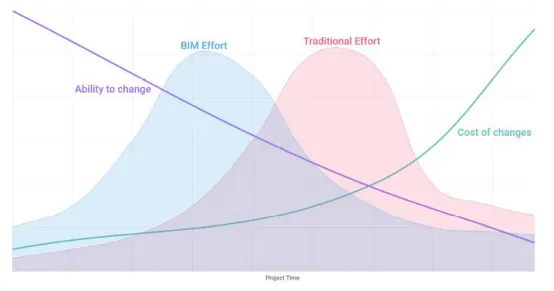
This curve illustrates that the impact of project optimization is directly proportional to the cost in both early and later stages, but inversely proportional to its functional effect. In other words, the lower the cost of optimization early on, the greater the impact it has; conversely, higher costs at later stages result in a smaller impact. From this, it is clear that applying BIM technology early in a project is the most effective strategy.
BIM technology and prefabricated building systems align closely in many ways. Utilizing BIM models significantly enhances the workflow of prefabricated buildings throughout all phases, promoting tighter coordination and more rational processes in design, production, construction, and operation. Together, these technologies enable comprehensive site analysis and environmental assessment during feasibility planning, boost design efficiency and quality, facilitate the identification and tracking of component information during production, simulate construction progress for better scheduling, and optimize operations by reducing costs and energy consumption through data-driven management.
Prefabricated buildings demand high levels of collaboration across disciplines. BIM technology integrates architectural, structural, electrical, fire protection, plumbing, and finishing information into a single platform. This allows all project participants to refine plans and provide feedback in real time, ensuring everyone stays updated and can adjust their work accordingly, which greatly improves construction efficiency.
Key applications include:
1. Detailed Design: Designers use BIM models to create precise designs for prefabricated components, accurately positioning internal parts, visually checking component fit, and detecting any conflicts such as errors, omissions, or clashes to avoid design mistakes.
2. Production: During component manufacturing, critical information like geometry, detailed structures, and production layouts can be extracted from BIM models. RFID chips embedded in components store tracking information within the BIM system, enabling quality control and process optimization.
3. Construction: Contractors leverage BIM to optimize and simulate site layouts, transportation routes, and material stacking, minimizing secondary transport. They can also retrieve component information for quality inspections and installation verification, improving site management efficiency.
4. Scheduling and Cost Management: BIM models incorporate time and cost data, while 5D models provide quick insights into budgets and schedules, allowing real-time adjustments to project timelines and resource allocation.
5. Operation and Maintenance: Combining BIM with RFID technology allows facility managers to quickly access information about component manufacturers and installers, facilitating prompt maintenance. It also enables precise accident location, situational awareness of surrounding elements, and rapid response, enhancing operational management.
















Must log in before commenting!
Sign Up