
The language used in the Revit platform includes standard industry terminology, but also features some unique terms. Understanding these terms is essential for users to effectively navigate and utilize the software.

(1) Template
The project template file uses standardized settings to significantly boost designers’ efficiency. It contains the most basic content of a project, which varies across different templates. Users can customize templates to suit their preferences. Any new project created from a template inherits its properties, such as families, units, line styles, and view scales. Template files are organized and systematic, with the file extension .rte. Using the right template can streamline design workflows. For example, the widely used Chinese localization template integrates commonly used families and national standards.
(2) Revit Project
A Revit project is essentially a database containing all project information—from geometric shapes to construction data. It includes model components, project views, and more. When you modify the model, those changes automatically update all related views, such as plans and schedules. From a project management perspective, all user data resides in a single file, making it easier to track and manage the project throughout its lifecycle.
(3) Revit Elevation
In any 3D environment, a reference plane is necessary, and Revit is no exception. An elevation in Revit represents an infinite horizontal plane, serving as a baseline for elements like roofs and floors that are layer-based. Elevations primarily help determine a building’s vertical height, and users can create elevations for each building.
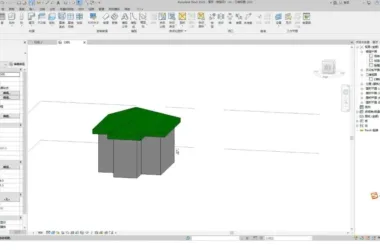
Elevations can be displayed in various styles depending on settings. The image below shows a typical Chinese elevation style, which users can customize according to their needs.
(4) Revit Elements
Elements are the building blocks within a project. When creating a project, users can add parameters to transform abstract classes into visible elements within the model. Revit categorizes elements into three types: class, family, and type. The class serves as the base, from which families inherit, and types inherit from families.

(5) Revit Category
A category is a collection of base classes used mainly for modeling or documenting architectural designs. It groups related elements for organizational purposes.
(6) Revit Family
A family inherits from a category and represents a class of elements within that category. Families group graphical elements based on shared parameters and similar shapes. All members of a family share the same attribute settings, with differences between elements arising solely from varying attribute values.
(7) Revit Family Library
A family library is a database that organizes families according to specific rules. As companies accumulate projects, they develop unique family libraries. During future designs, users can efficiently reuse families from these libraries, applying different parameters as needed. Family libraries are valuable intangible assets that reflect a company’s expertise and standing within the industry.
(8) Type
Each family can have multiple types, which further specify the family’s characteristics. Types might define size—for example, whether a component is 40″x50″ or 20″x20″—or style, such as whether dimensions align left or right.
(9) Instance
An instance is a specific graphical element placed within a project. It has a fixed position and size that users can see and interact with in the model.













Must log in before commenting!
Sign Up