
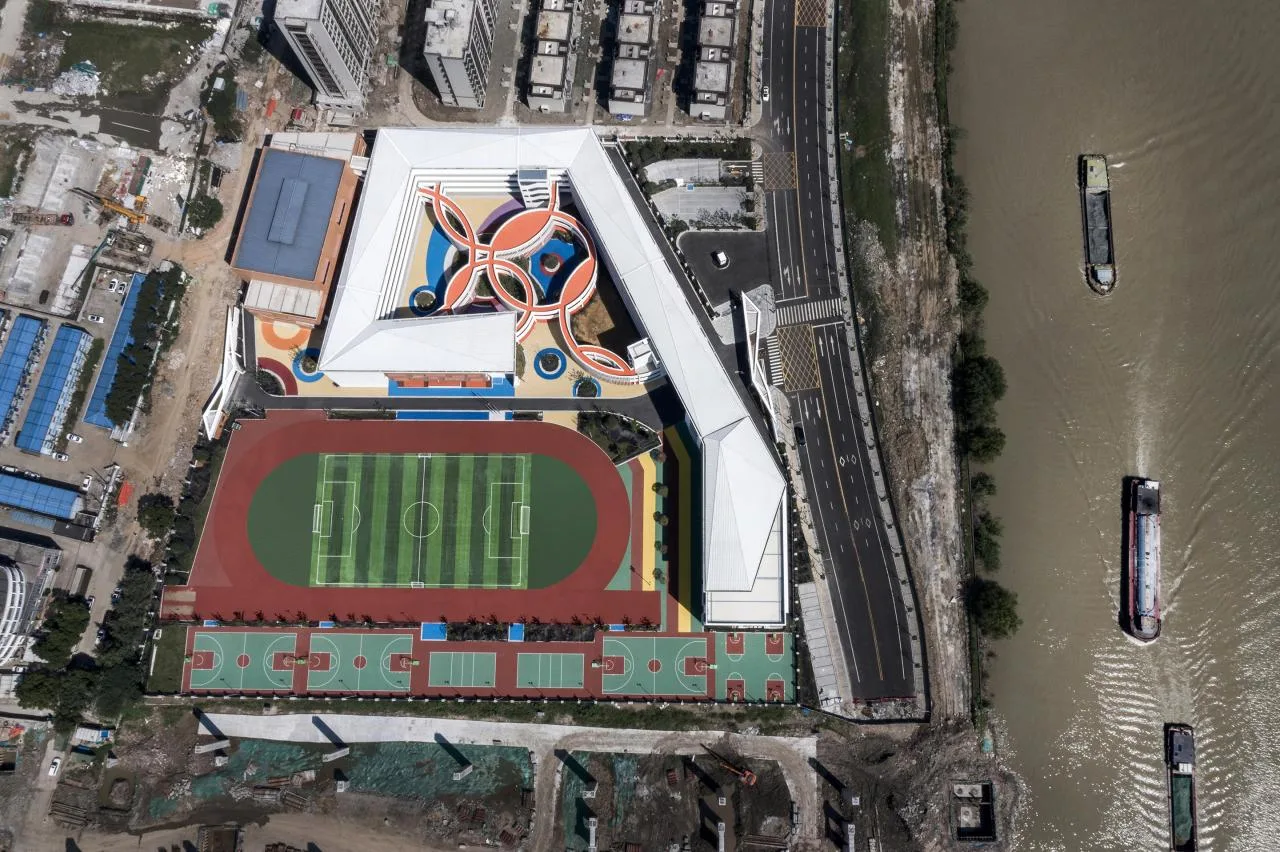
Overall bird’s-eye view of the campus -1 © Mi Zhang Building
In dense urban environments, a clear divide often exists between built structures and open spaces. Prioritizing efficiency tends to overshadow the enjoyment of spatial quality, making it challenging to find harmony between the two. This issue is especially apparent in school architecture. Due to strict regulations and the need for economical land use, school buildings tend to look similar. After allocating spaces for classrooms and necessary auxiliary functions, there is little room left for continuous and meaningful free activity areas. The placement of buildings fragments the site, and the scale of indoor public spaces contrasts sharply with concentrated outdoor sports fields. The lack of a unique, coherent narrative between building clusters often results in predictable, conventional layouts. This campus called for innovative strategies to create new expressions and landscapes.
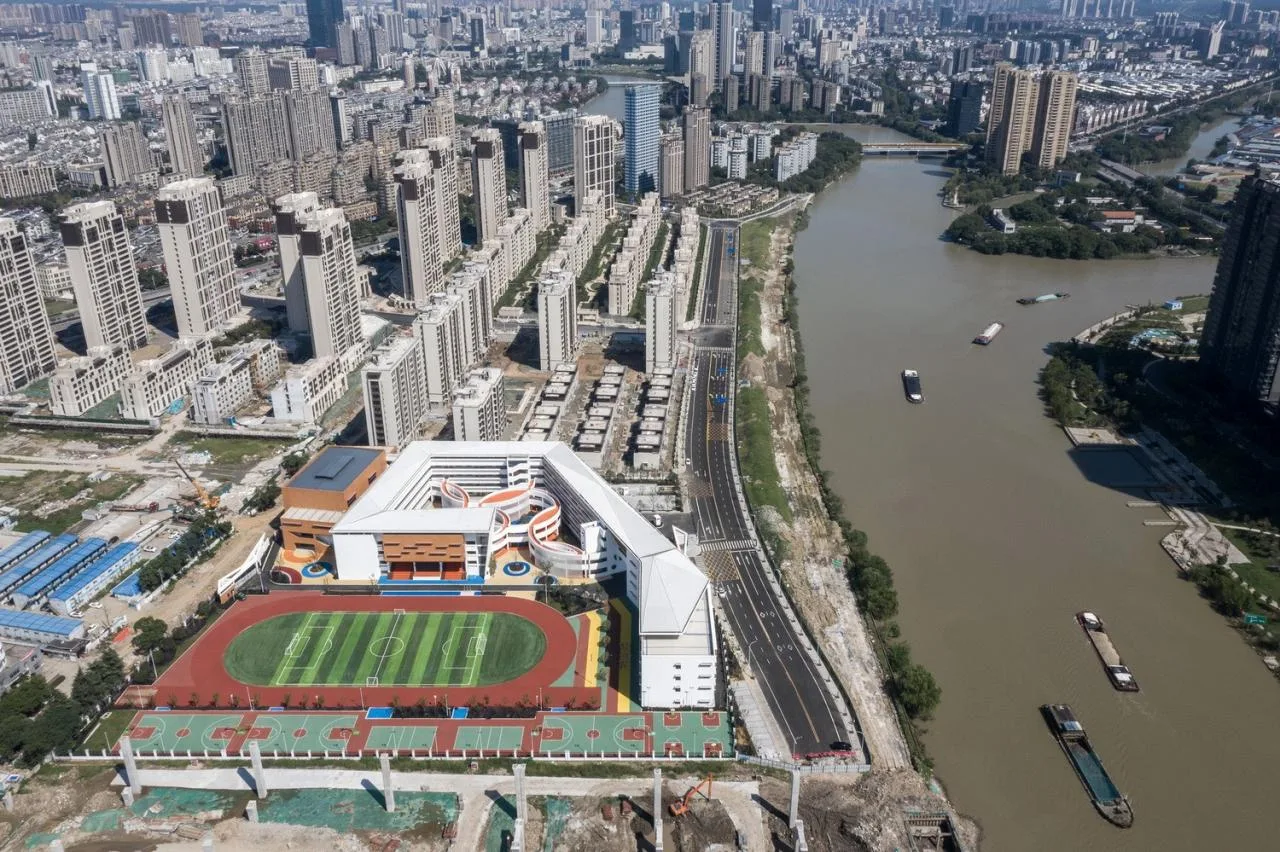
Overall bird’s-eye view of the campus -2 © Mi Zhang Building
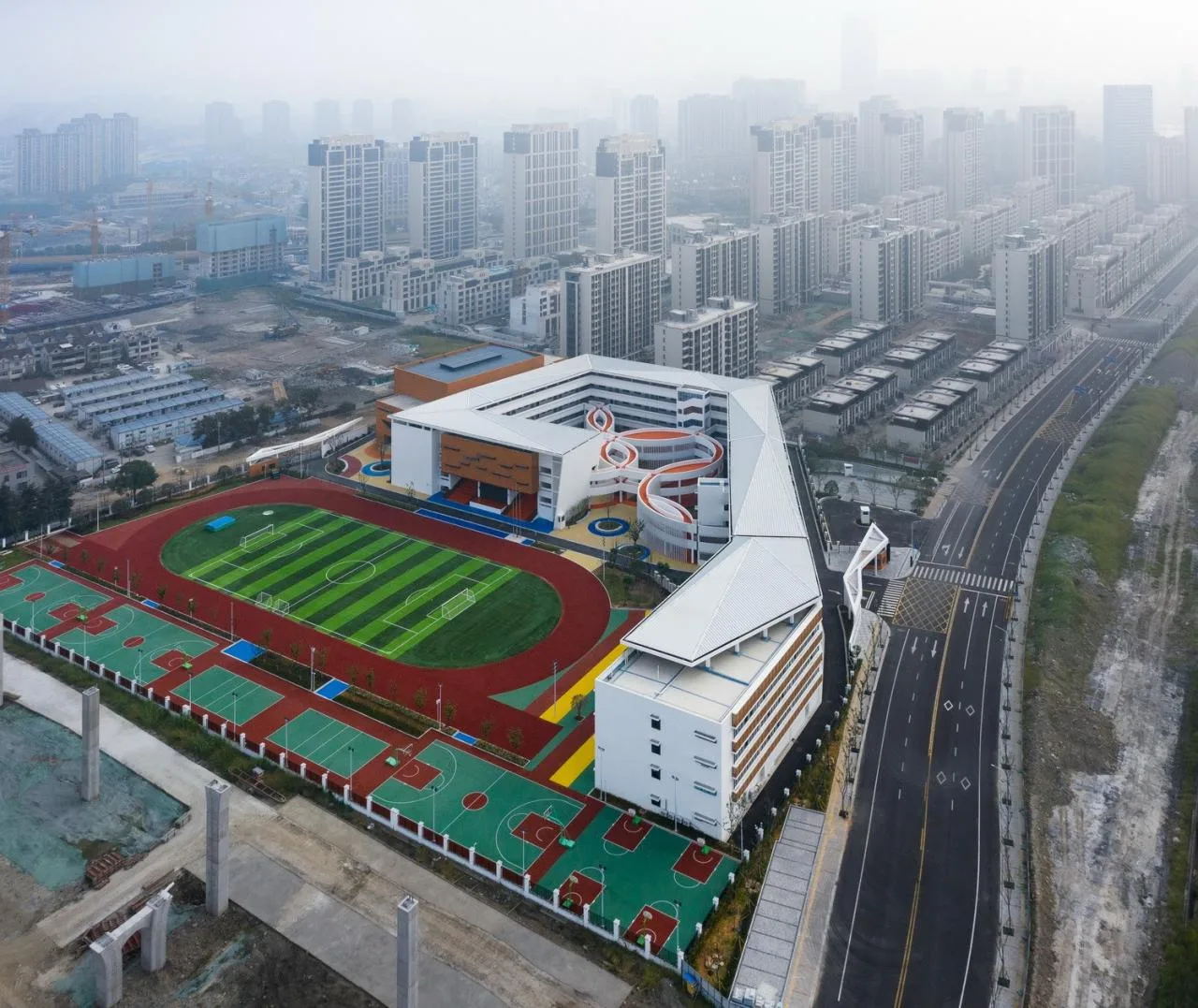
△ Aerial view of campus and city © Wu Qingshan
The site is situated in a newly developed urban area, surrounded by dense residential buildings and extensive infrastructure. Instead of following traditional campus layouts, the design treats the school’s various functional buildings as a unified element arranged in a “surrounding and open center” configuration. By extending the buildings along the plot edges and roadways, continuous lines are formed that enclose relatively independent courtyards. This approach not only responds to the urban scale with a cohesive volume but also divides the site into open sports zones and enclosed activity courtyards.
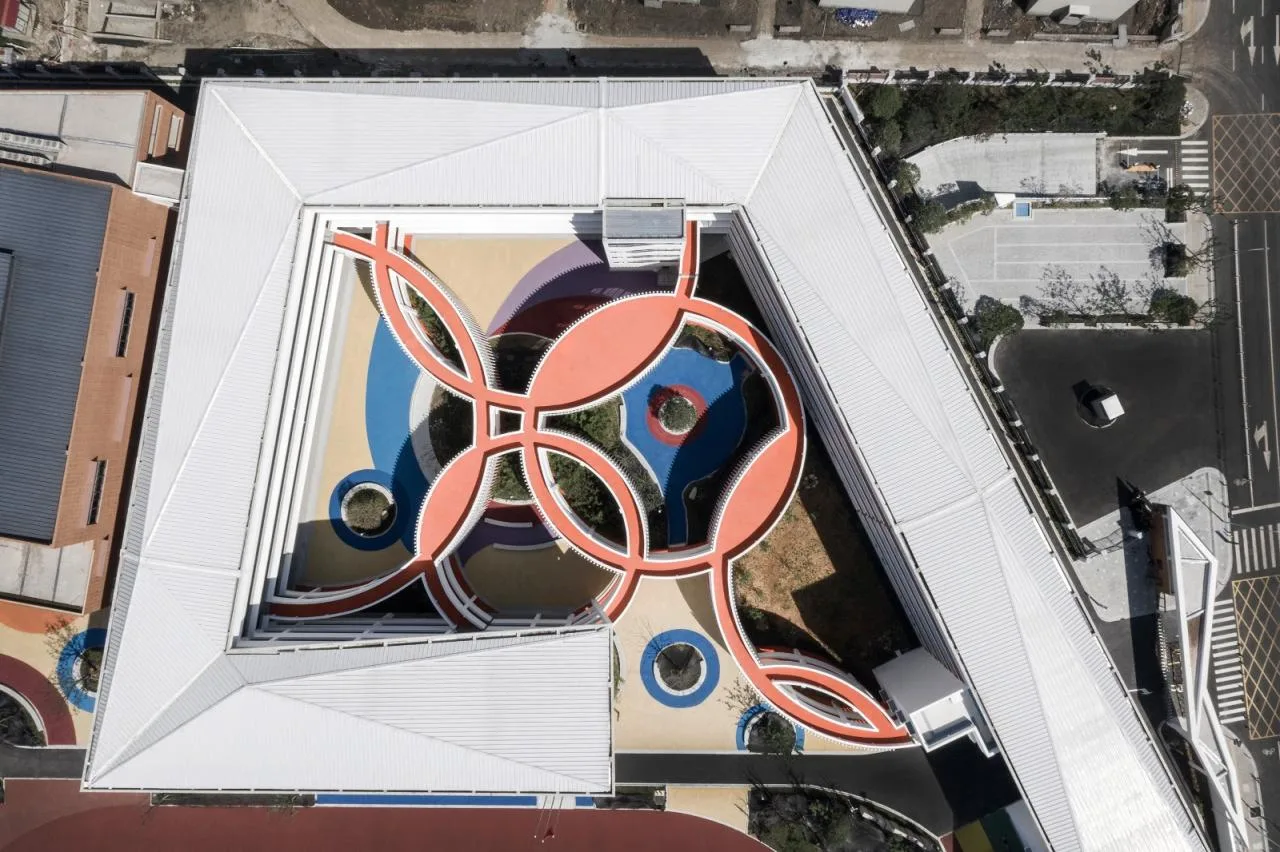
△ Courtyard Aerial View -1 © Mi Zhang Building
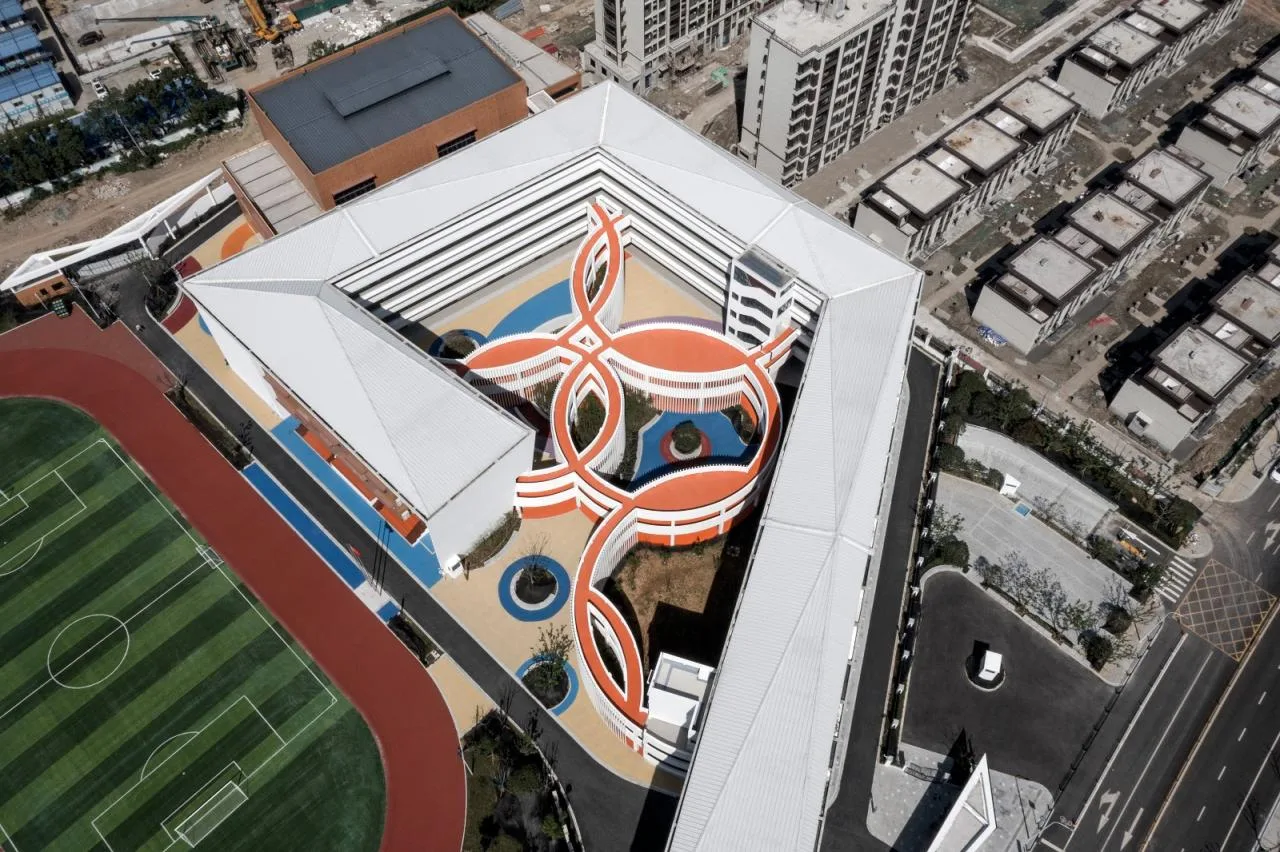
△ Courtyard Aerial View -2 © Mi Zhang Building
This strategy of unifying diverse campus functions into a continuous linear form creates a visually expansive space both inside and outside. It gives the campus a distinctive identity and a generative logic. The main entrance is positioned on the southern edge, with traffic circulation divided by the building’s angled massing. Each building block is placed based on functional relationships, generating logical combinations. The spatial experience is further enhanced through dimensional transformation, creating a new way of shaping and connecting spaces.
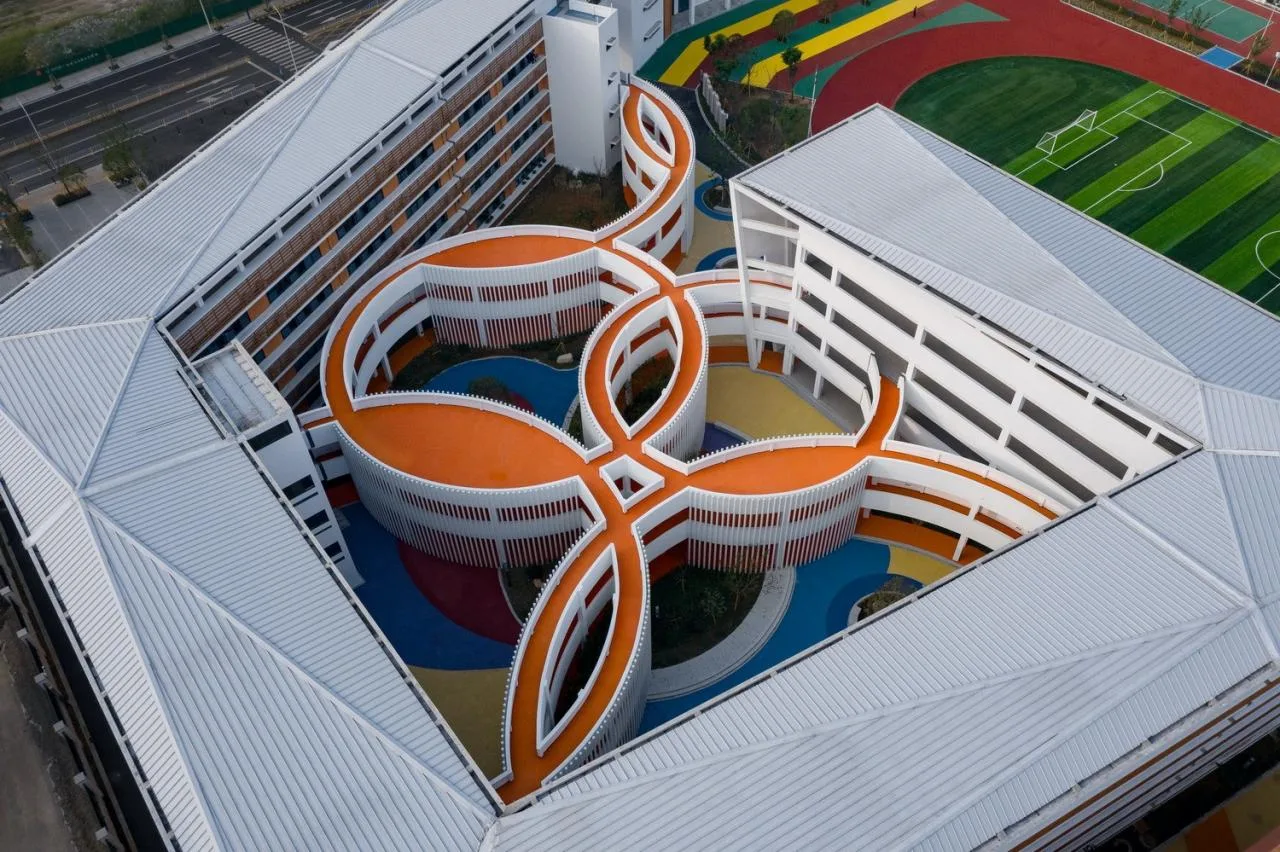
△ Courtyard Aerial View -3 © Wu Qingshan
Horizontal Dimension: Openness and Enclosure
The continuous building is horizontally divided into three layers: the ground floor, the middle section, and the roof. Functionally, public teaching and auxiliary spaces are situated on the ground floor, standard classrooms occupy the middle section, and the roof serves as a continuous element that connects the entire campus.
The ground floor functions as an open, public area, distinct from the standard classrooms above. Within the naturally enclosed building form, the ground level creates diverse functional spaces and interfaces, introducing dynamic architectural variations. This horizontal layering reflects an intentional integration and utilization of building volume.
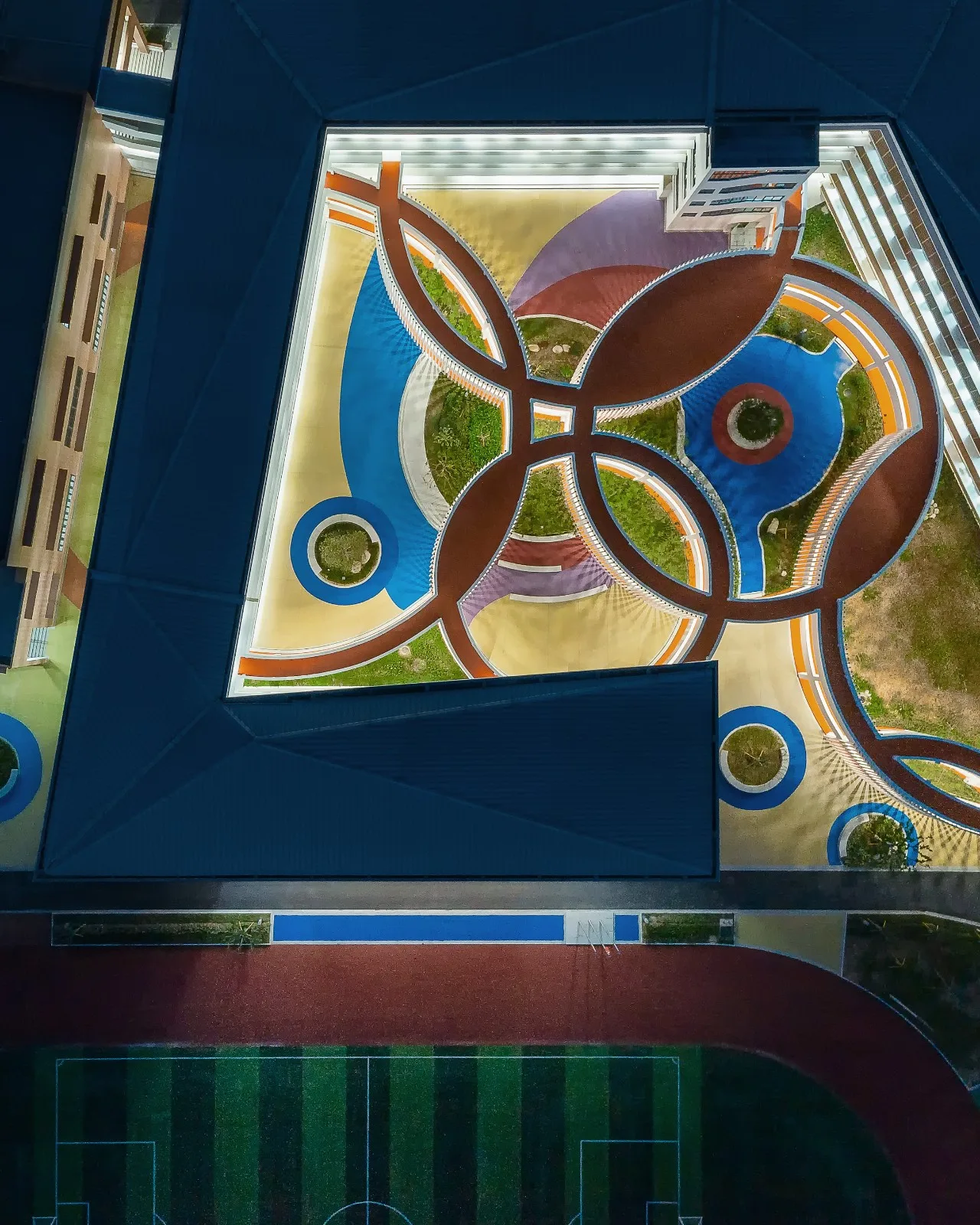
Campus courtyard illuminated at night © Wu Qingshan
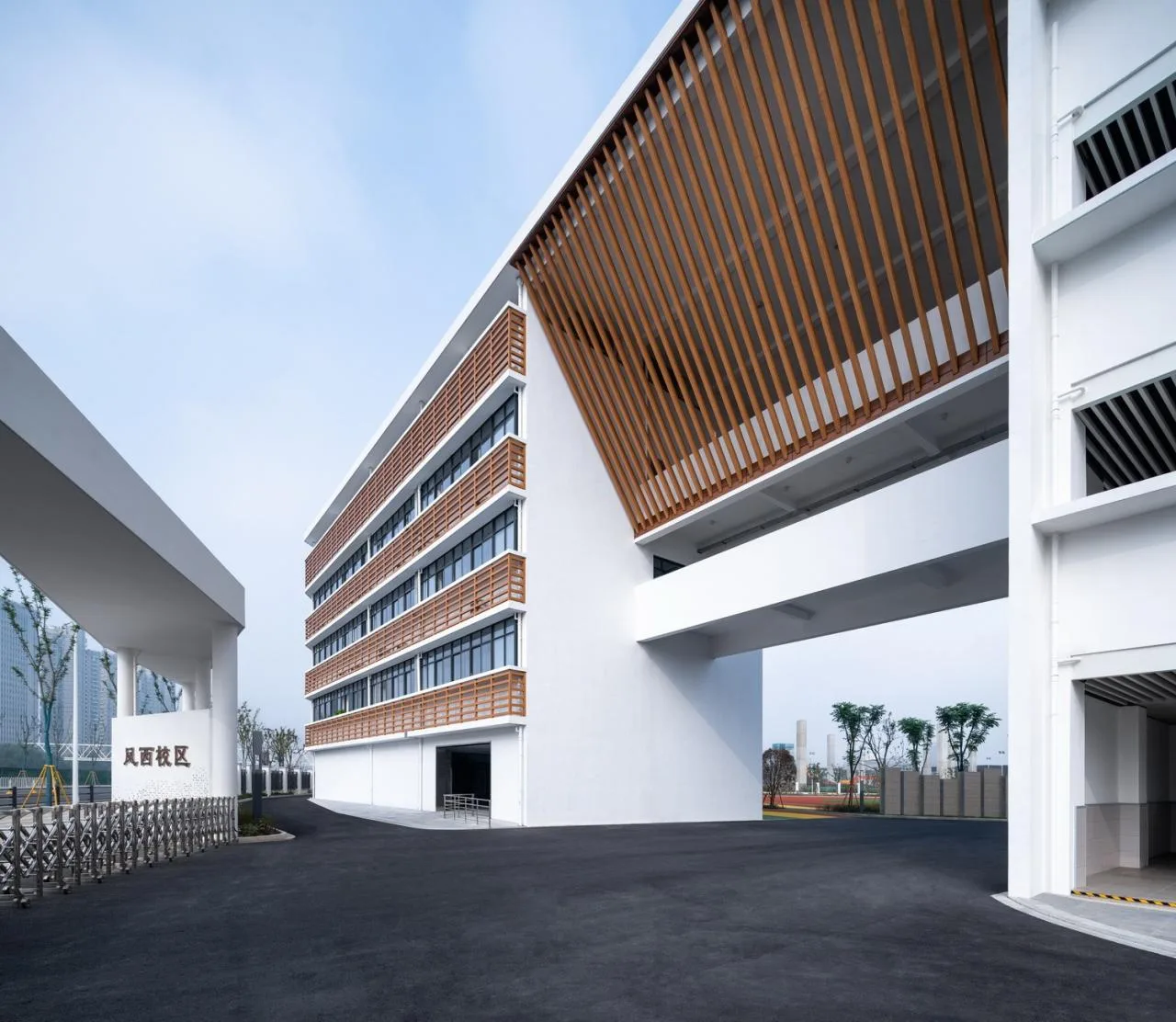
△ Passing through the main entrance of the building -1 © Wu Qingshan
The shifting forms and volumes create various types of public spaces that connect different parts of the campus. Corridors, elevated stands, and tall entrances break away from traditional dispersed building layouts. This new architectural paradigm maximizes the effectiveness of continuous spatial generation, allowing public activities to naturally permeate every corner and interface through volumetric variation.
Moreover, the roof transforms from a passive, segmented element into an iconic feature, hosting additional teaching activities and shaping the campus’s unique image. Education and nurturing thus unfold autonomously within this evolving dialogue of form and space. Openness and public accessibility flow seamlessly within enclosed buildings, whether expanding outward or transitioning inward. Public activities prompt architectural responses, resulting in spaces that grow and shift organically.
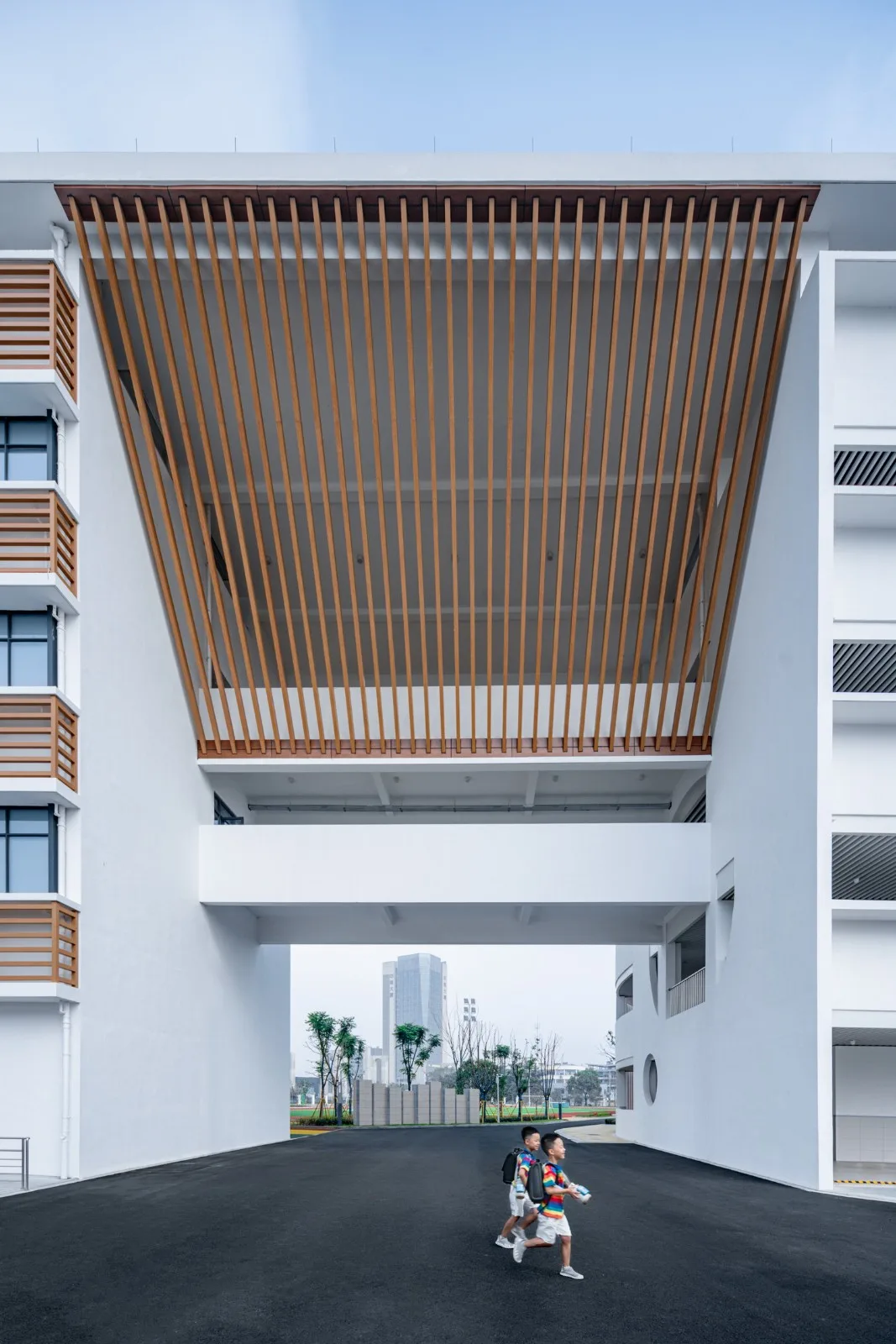
△ Passing through the main entrance of the building -2 © Wu Qingshan
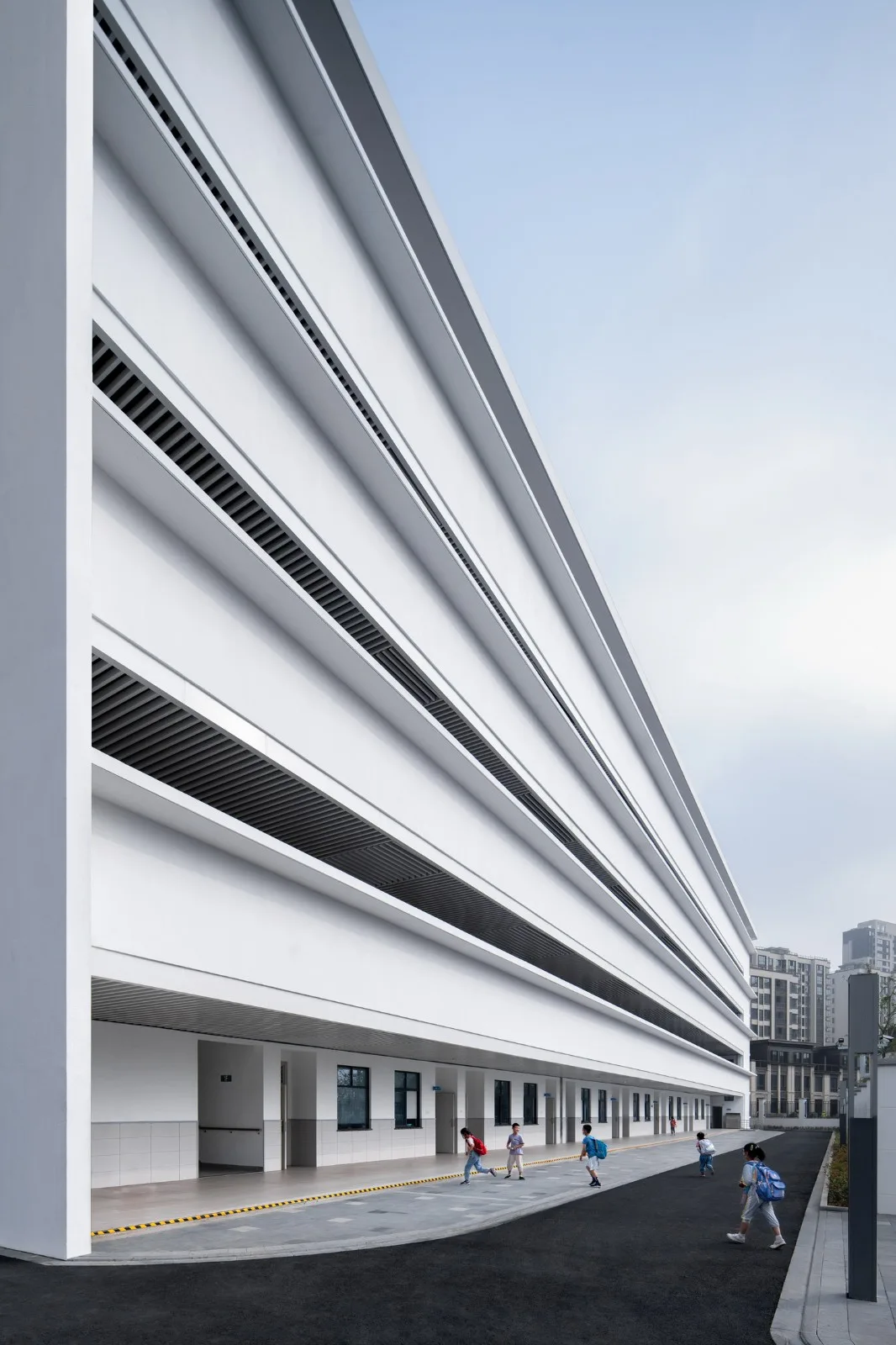
Facing the urban façade -1 © Wu Qingshan
Vertical Dimension: Interweaving and Infiltration
A series of circular corridors located within the enclosed courtyard vertically extend the public activity spaces that were initially concentrated on the ground floor. These overlapping circular corridors dramatically transform both the building and courtyard.
Where once there was alienation and strict rationality, the corridors introduce strong interweaving and infiltration. The courtyard’s original flat, straightforward character shifts into a dynamic spatial narrative, alternating between expansion and contraction, resulting in a playful and engaging environment.
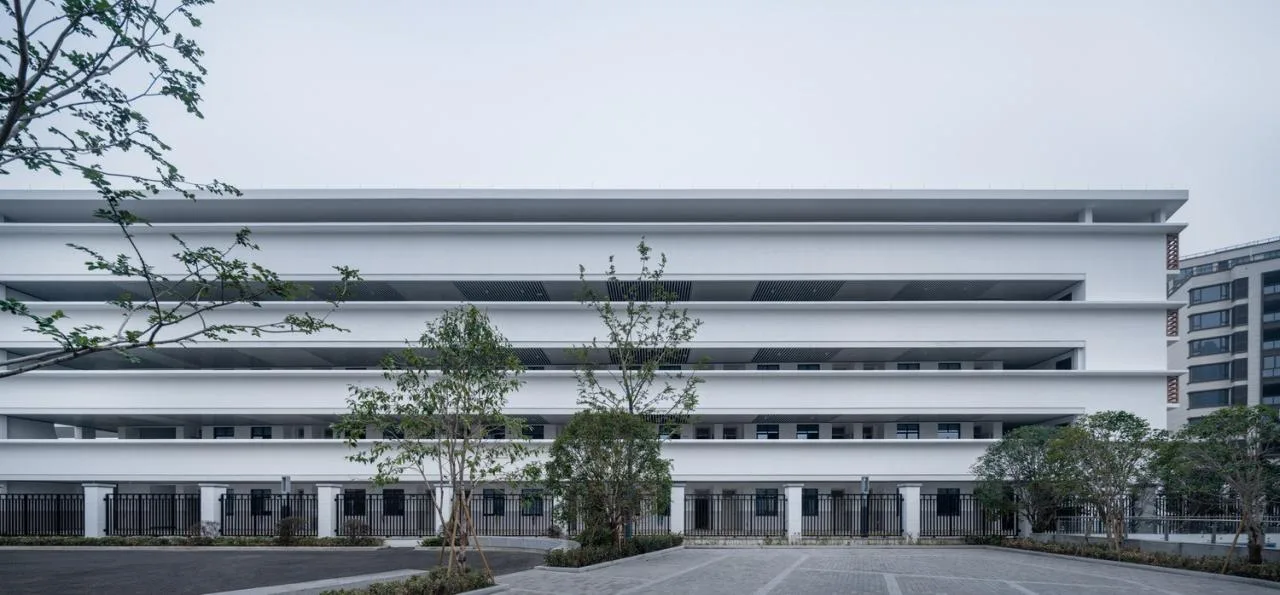
Facing the urban building façade -2 © Wu Qingshan
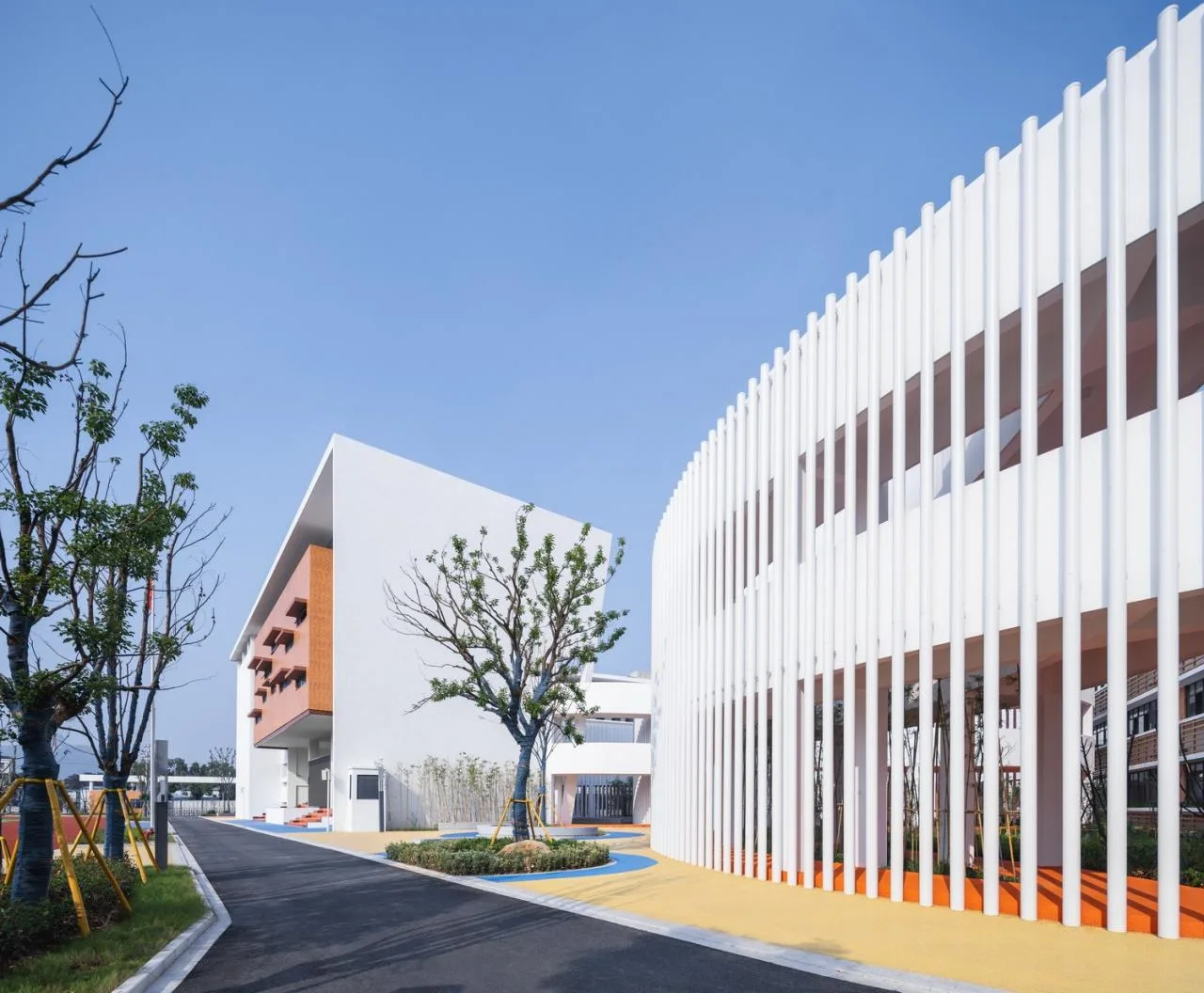
Entrance to the courtyard © Wu Qingshan
The courtyard corridor serves not only as a passageway but also as a vital outdoor activity area for students, introducing dynamic elements within an otherwise orderly setting. It enhances connectivity while naturally creating multiple levels within the courtyard. The interaction between the circular corridor and courtyard generates relative movement and absolute change. Observation and communication from various perspectives establish a three-dimensional hierarchy, breaking free from a single-dimensional experience.
This integration allows students to engage with the environment and architecture more fully, dissolving boundaries and encouraging free expression and imagination.
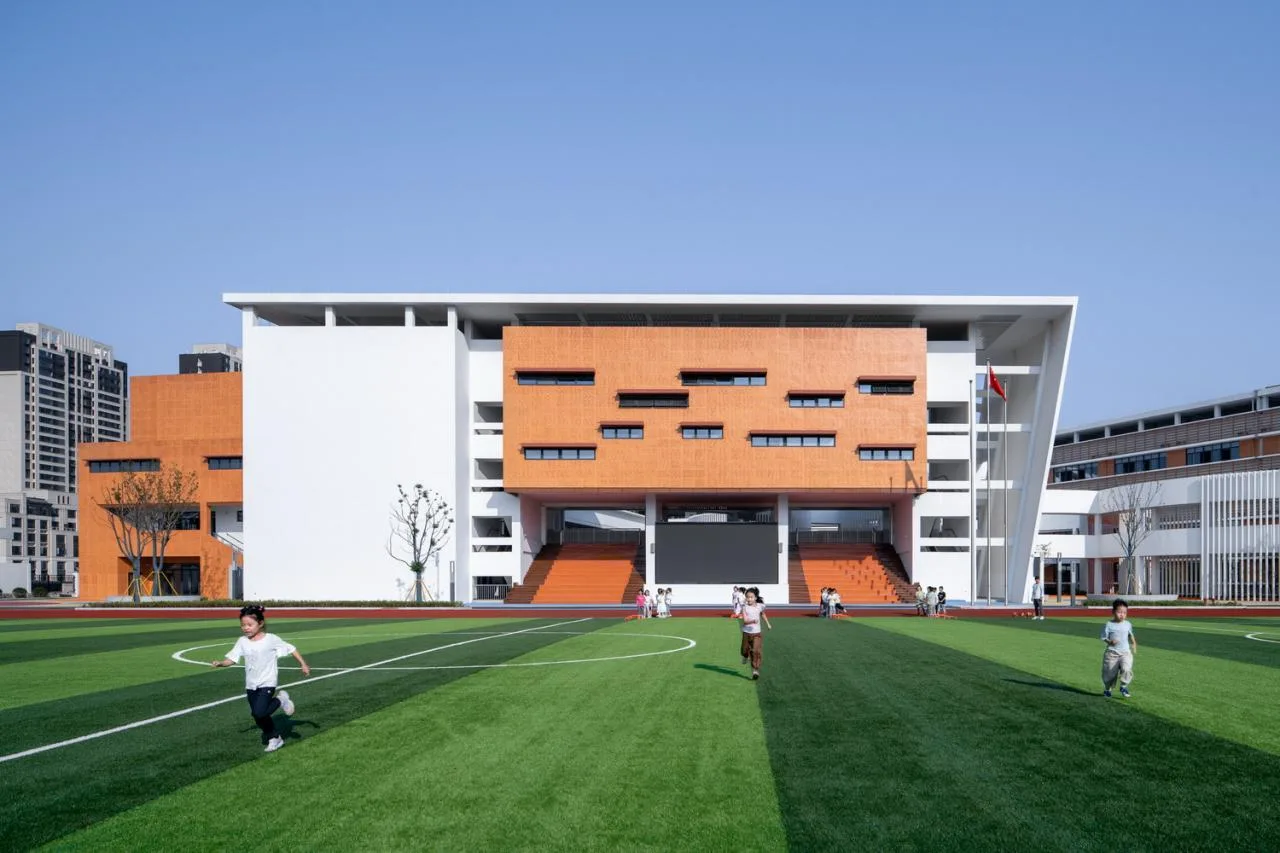
△ View of the library from the playground © Wu Qingshan
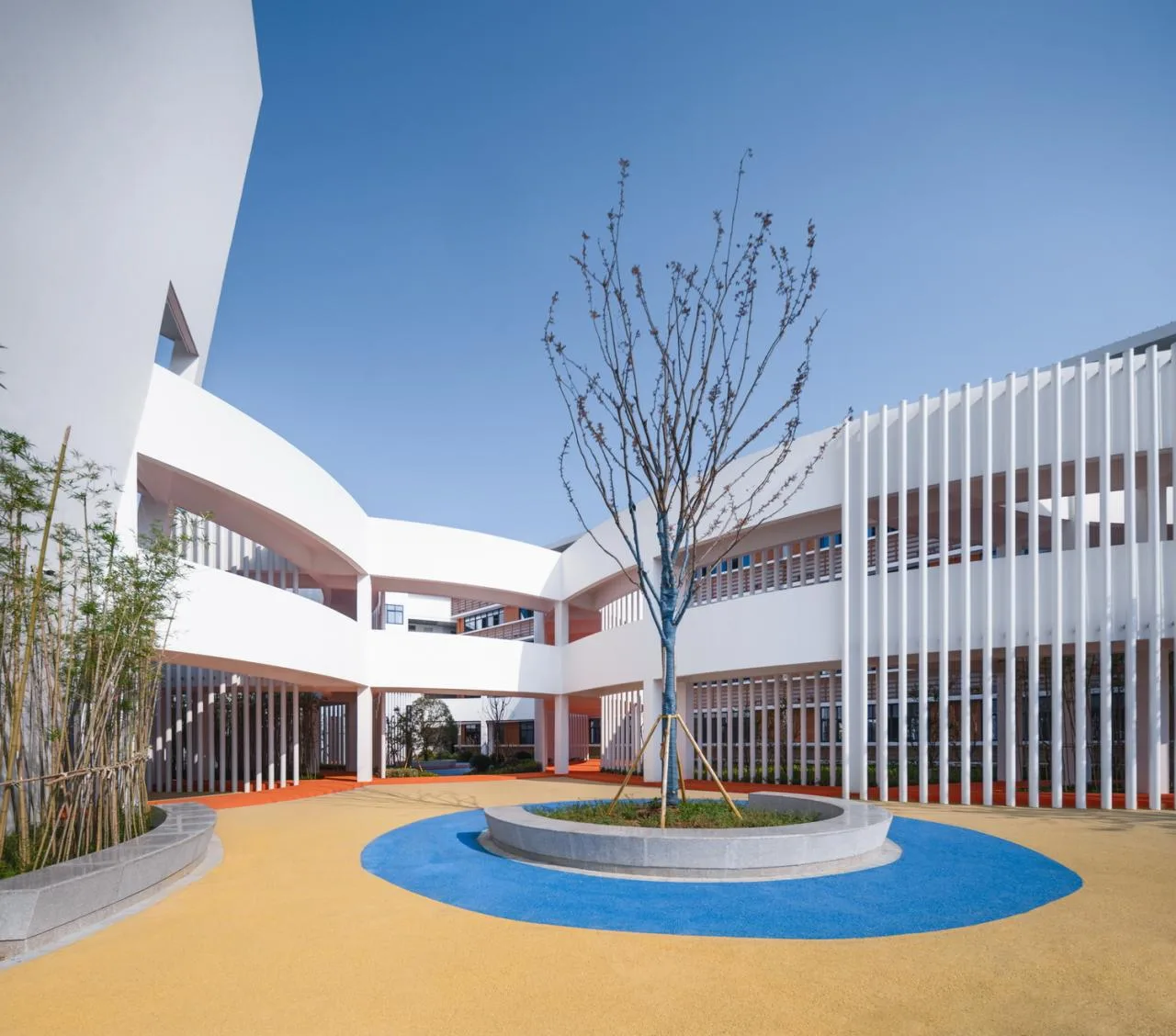
△ Corridor and Courtyard © Wu Qingshan
Time Dimension: Movement and Pause
From the moment visitors enter the campus, their footsteps follow the building’s flowing form, accompanied by changing light and perspective. The surrounding greenery, dappled sunlight filtering through grid-like structures, and the undulating roof shape create a spatial experience that compresses and expands time—balancing movement and stillness.
The continuous architectural flow adjusts travel speed at various turns and nodes, replacing straightforward spatial narration with layered transitions.
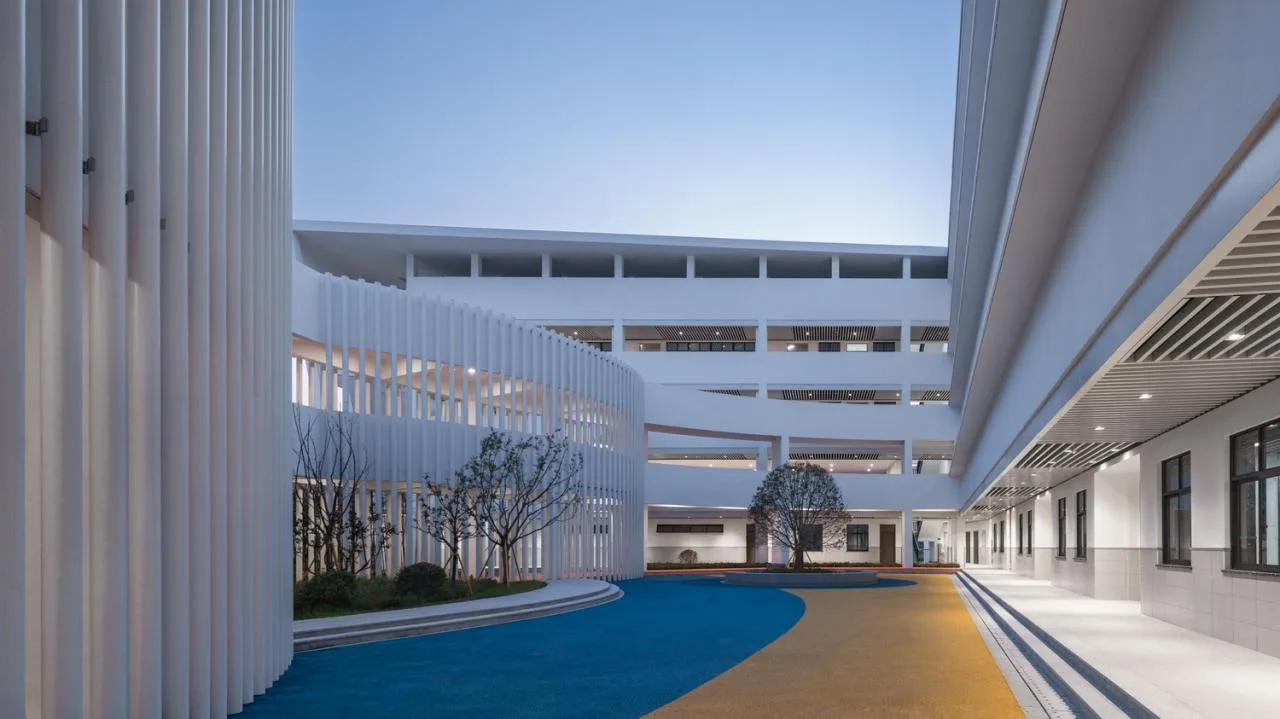
△ Public space between building and corridor -1 © Wu Qingshan
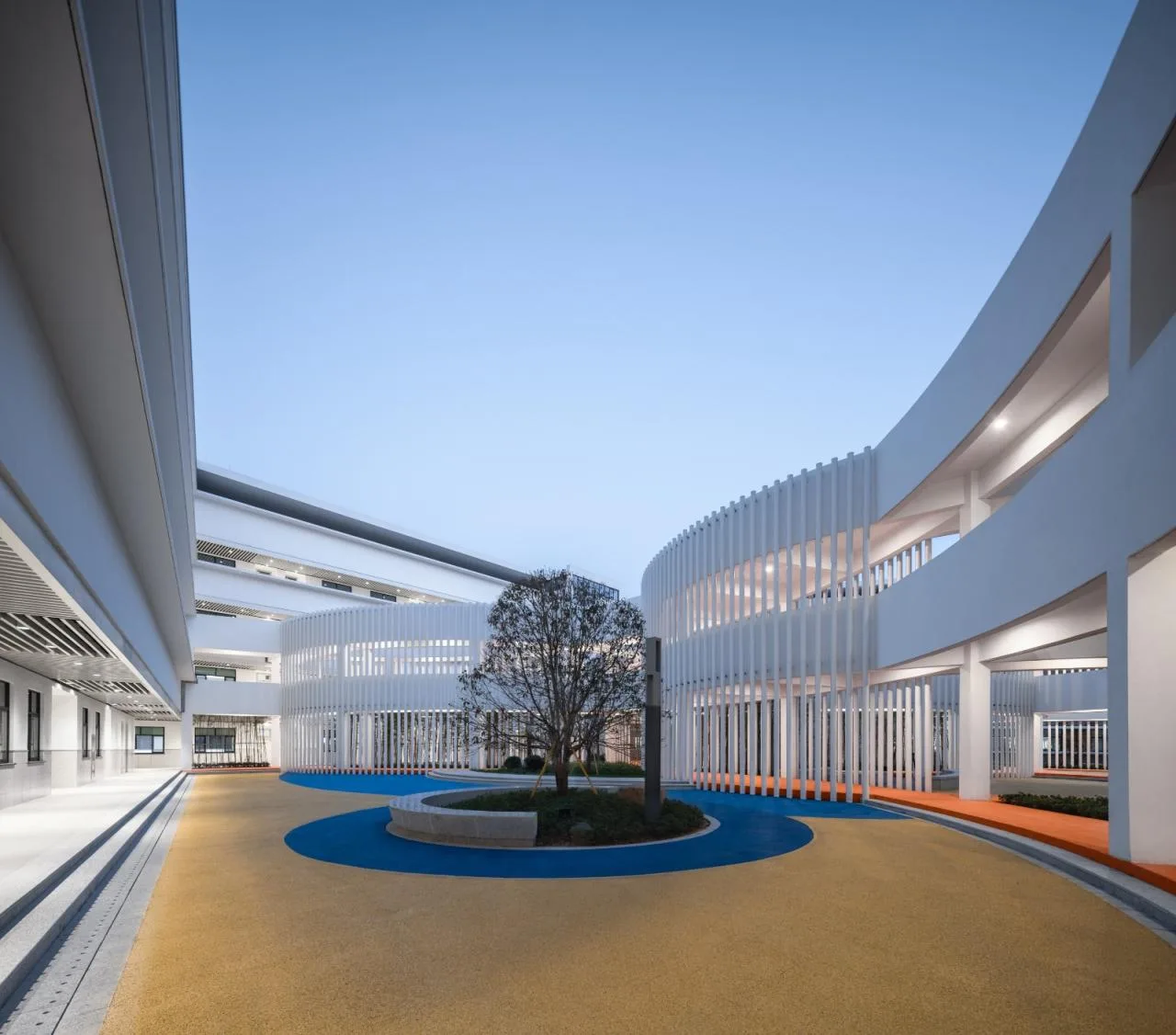
△ Public space between building and corridor -2 © Wu Qingshan
The interplay of shifting forms and overlapping curves causes each space to become a distinct moment in time. These continuous moments connect different areas, fostering spontaneous encounters and interactions. The multidimensional environment encourages unexpected meetings and experiences, which are key to forming lasting memories.
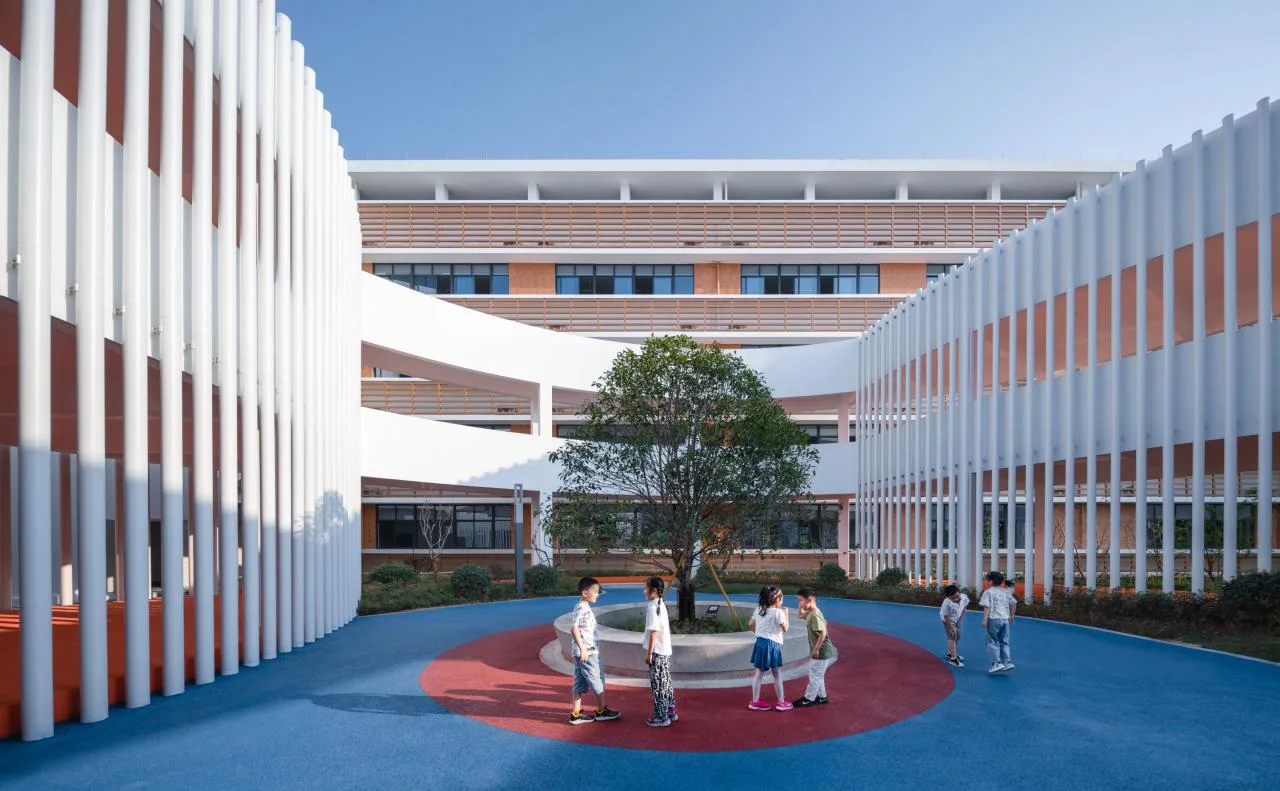
The courtyard divided by the corridor © Wu Qingshan
Learning is a process of accumulating memories, which forms the basis for mastering the unknown. The evolving interplay of architecture, space, and light provides students with a rich sensory environment, sparking curiosity and encouraging exploration beyond the familiar.
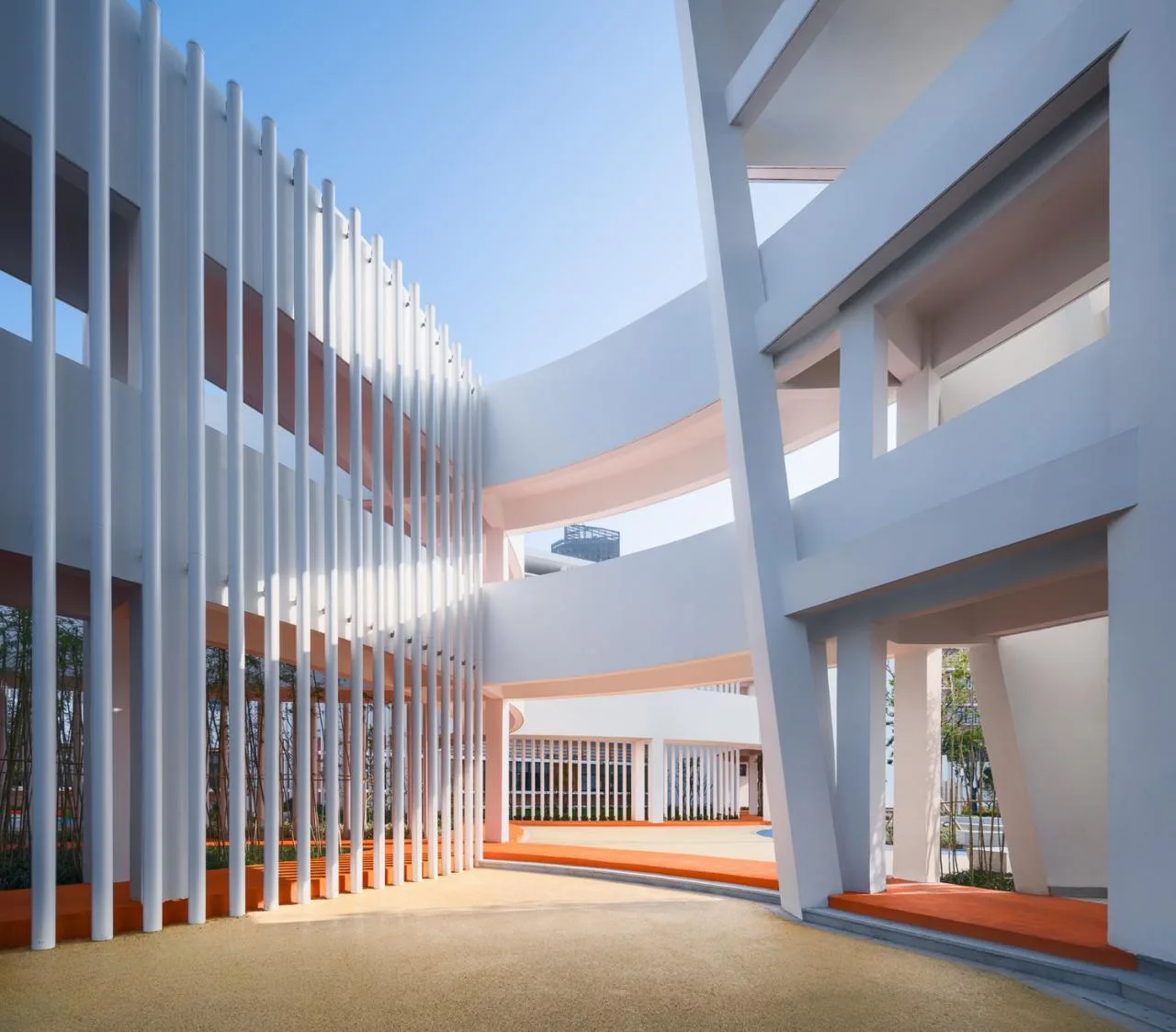
△ Corridor light and shadow -1 © Wu Qingshan
Fengxi Primary School represents a breakthrough in traditional campus design. By dramatically shaping space across multiple dimensions, it inspires daily surprises through spatial possibilities and engaging experiences. Within this unpredictable environment, students accumulate knowledge and awareness, fulfilling the goals of learning and growth.
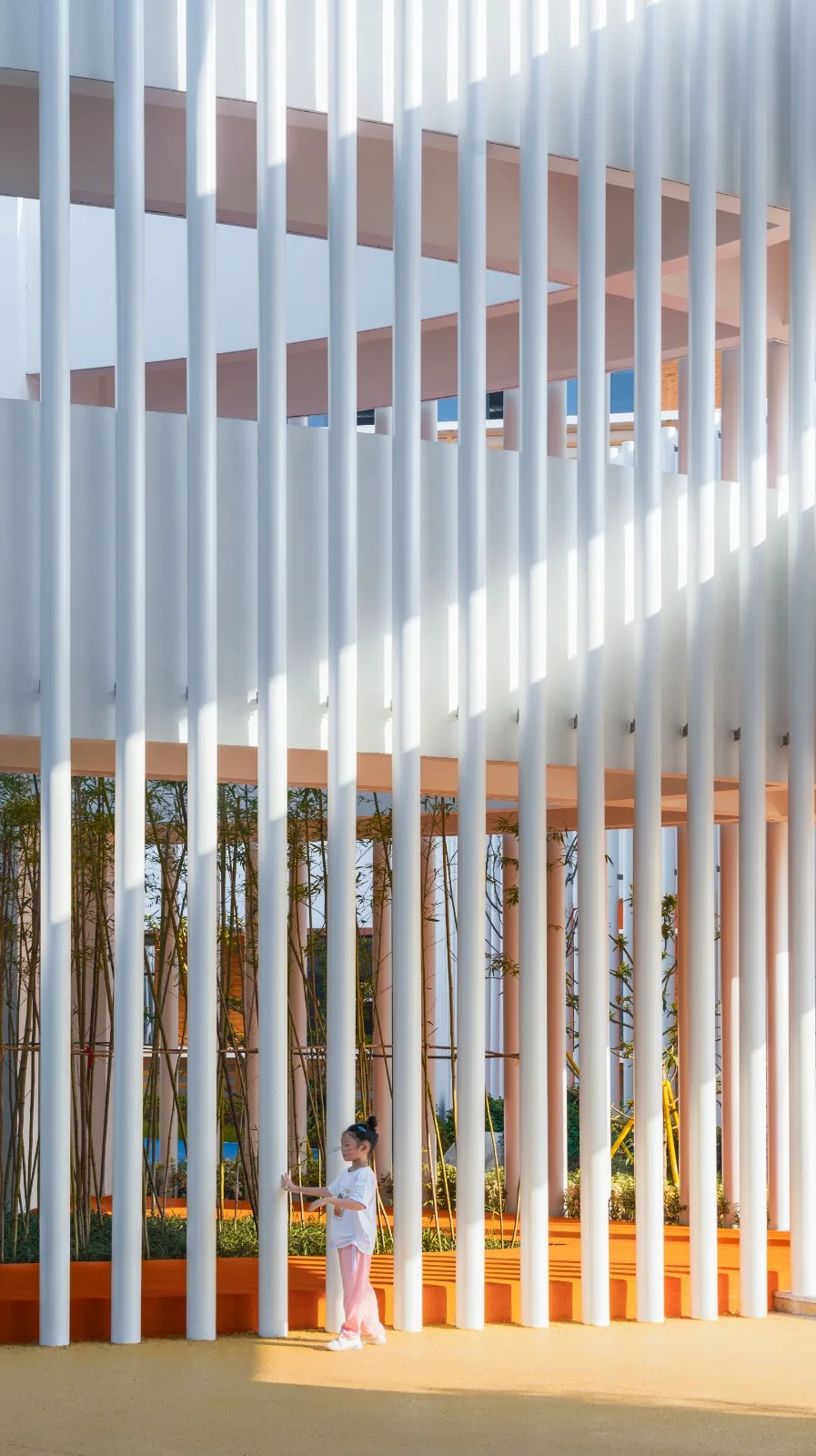
△ Corridor light and shadow -2 © Wu Qingshan
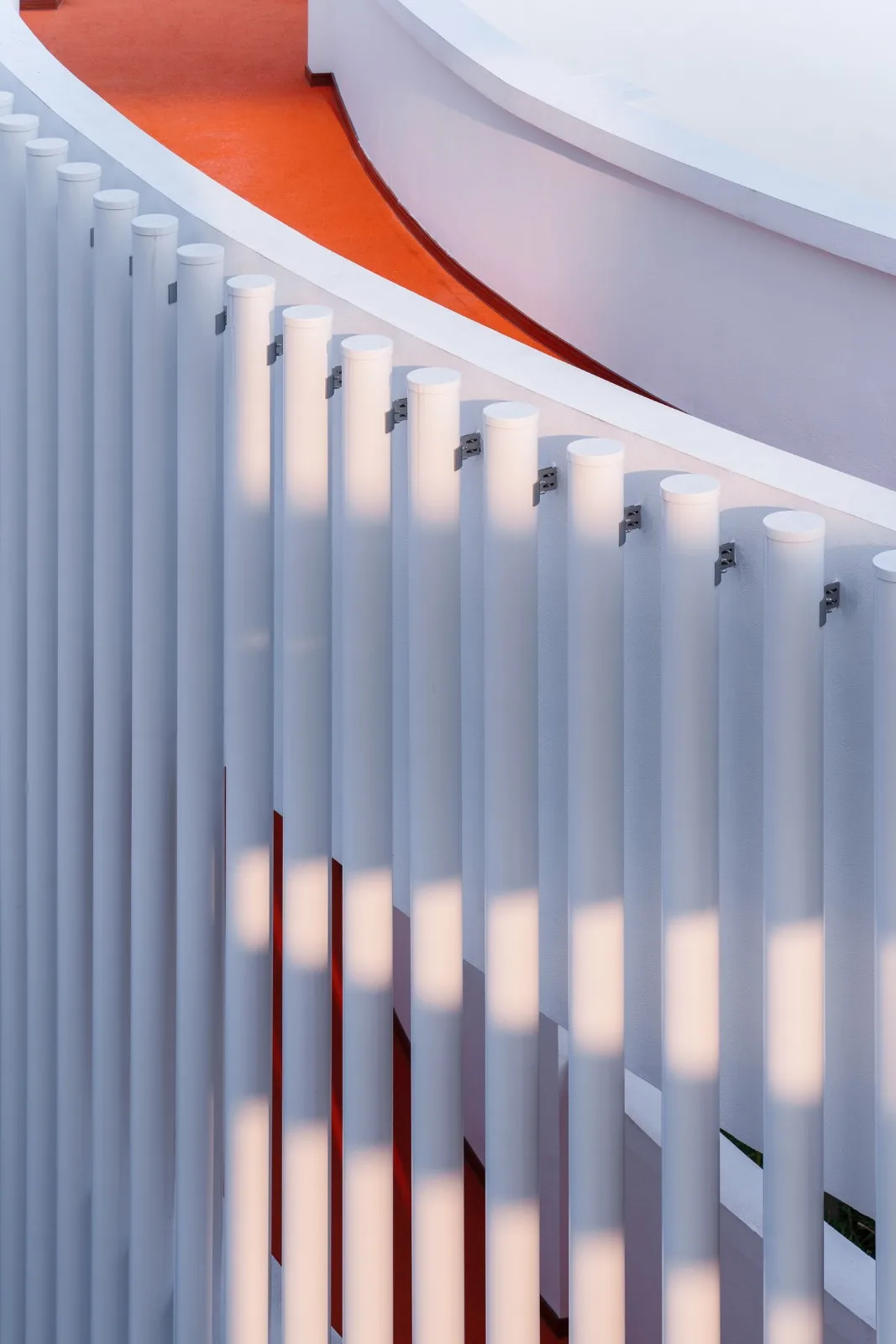
△ Corridor light and shadow -3 © Wu Qingshan
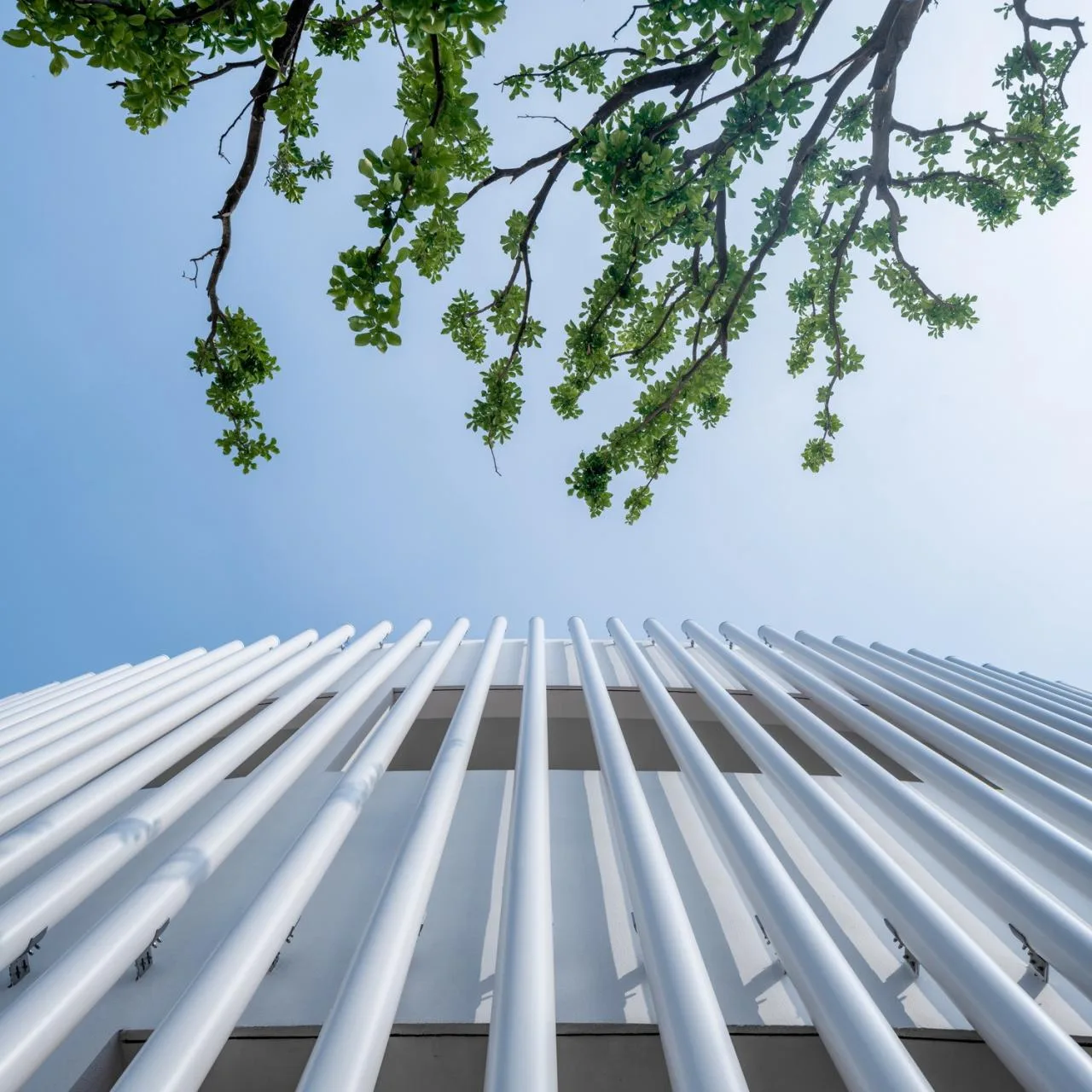
△ Corridor façade © Wu Qingshan
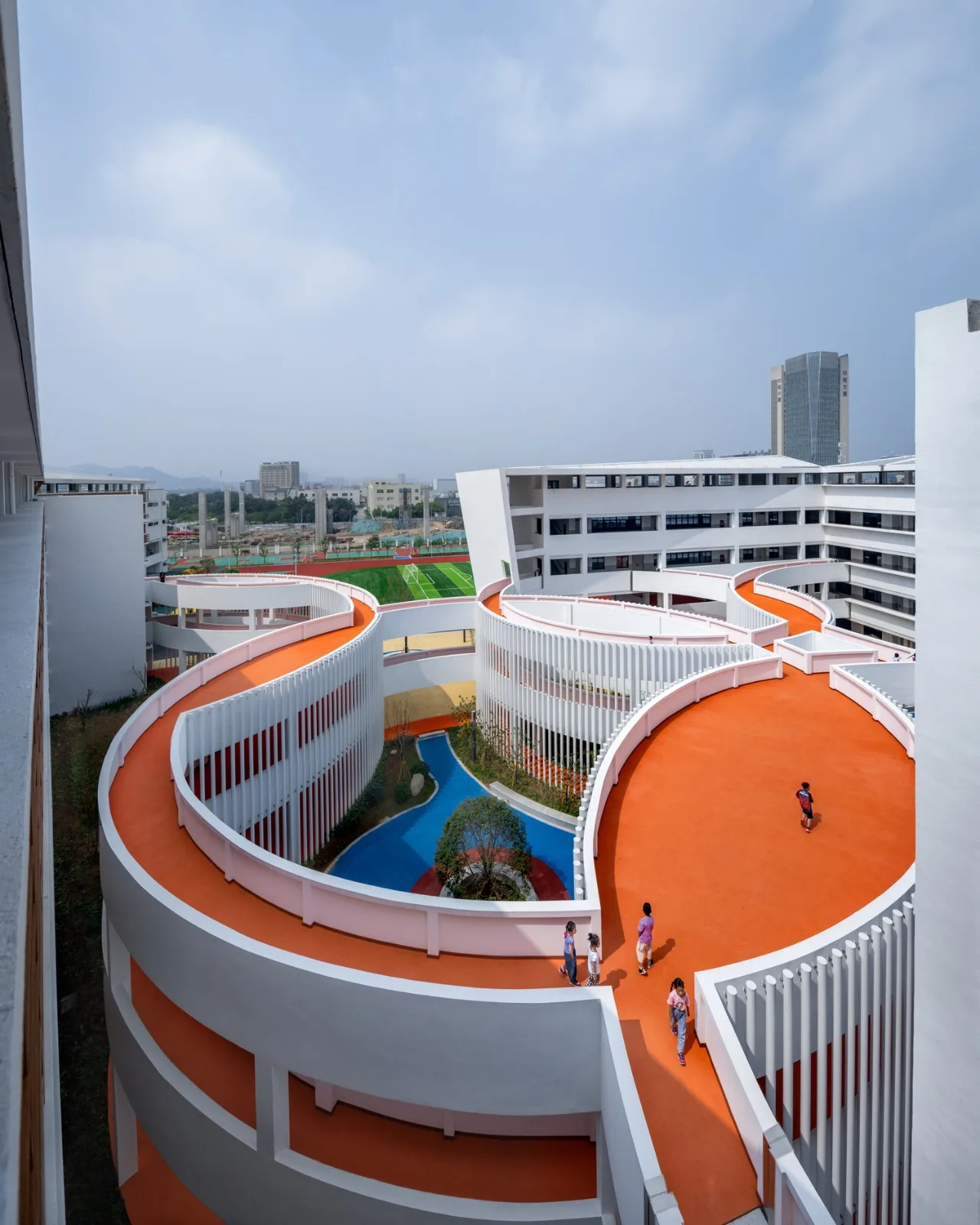
△ Corridor scenery -1 © Wu Qingshan
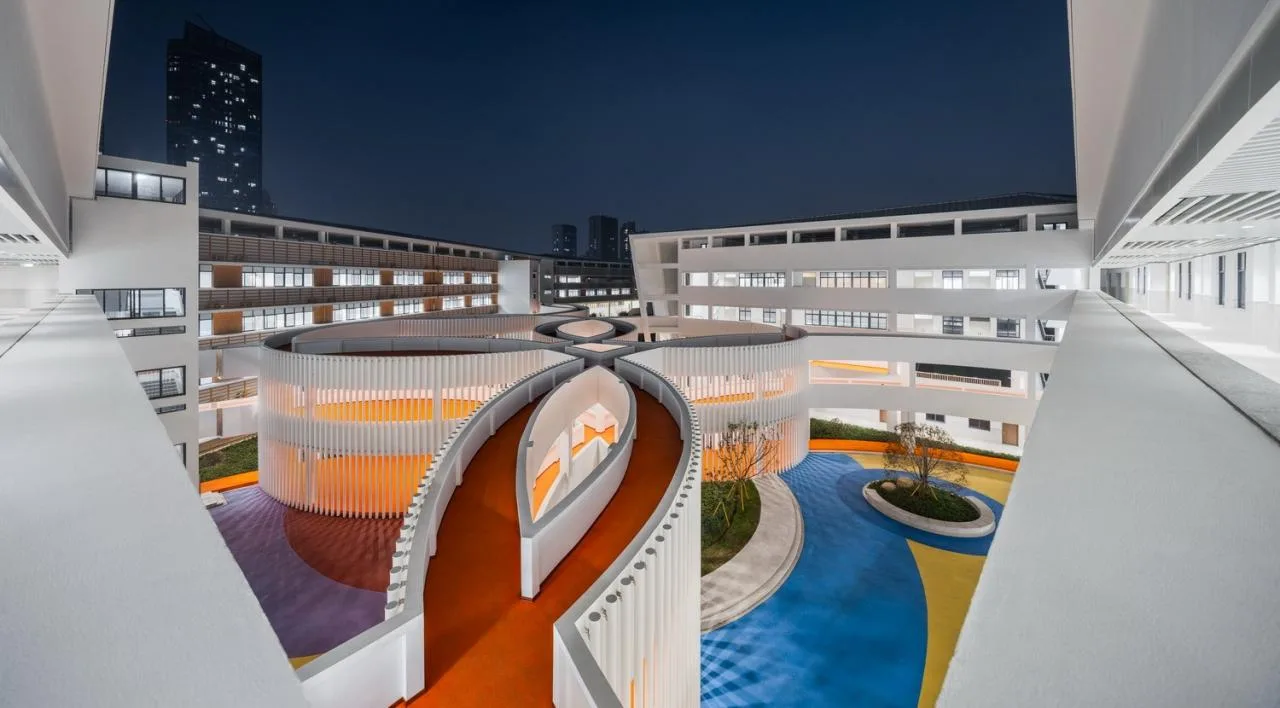
△ Courtyard night view © Wu Qingshan
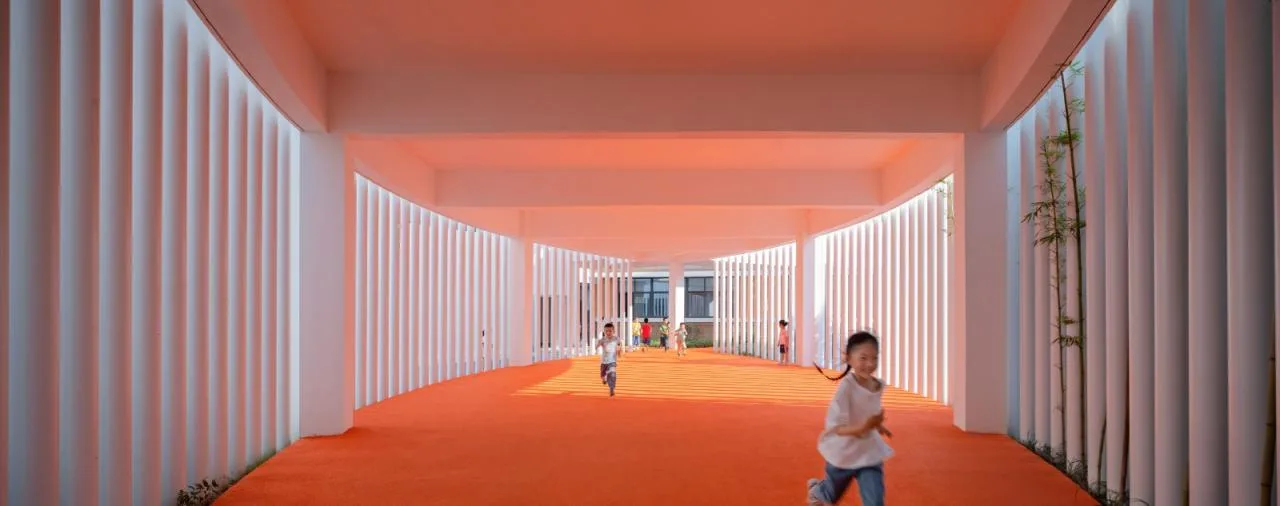
Enlarged public space beneath the corridor © Wu Qingshan
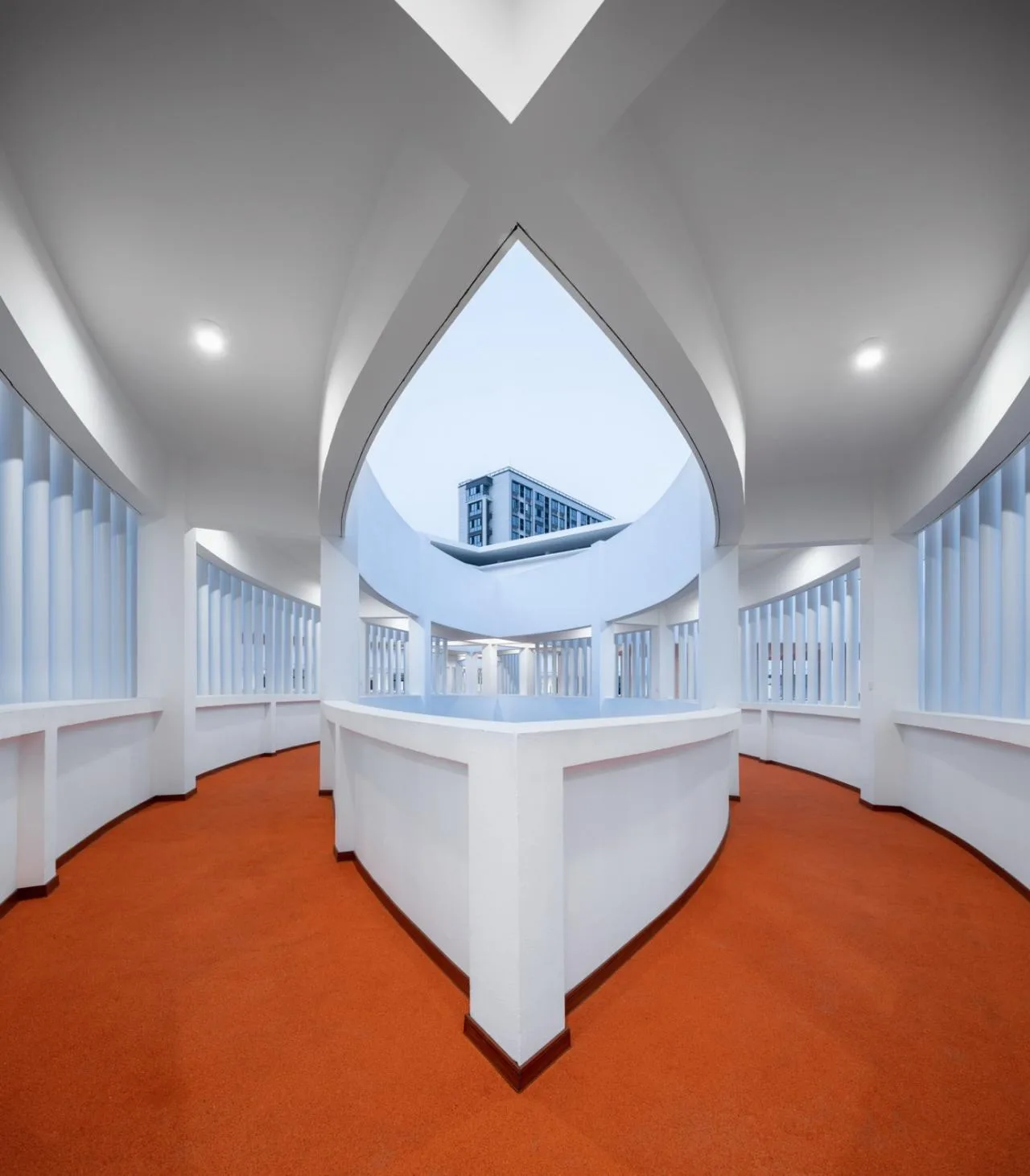
△ City reflections in the corridor © Wu Qingshan
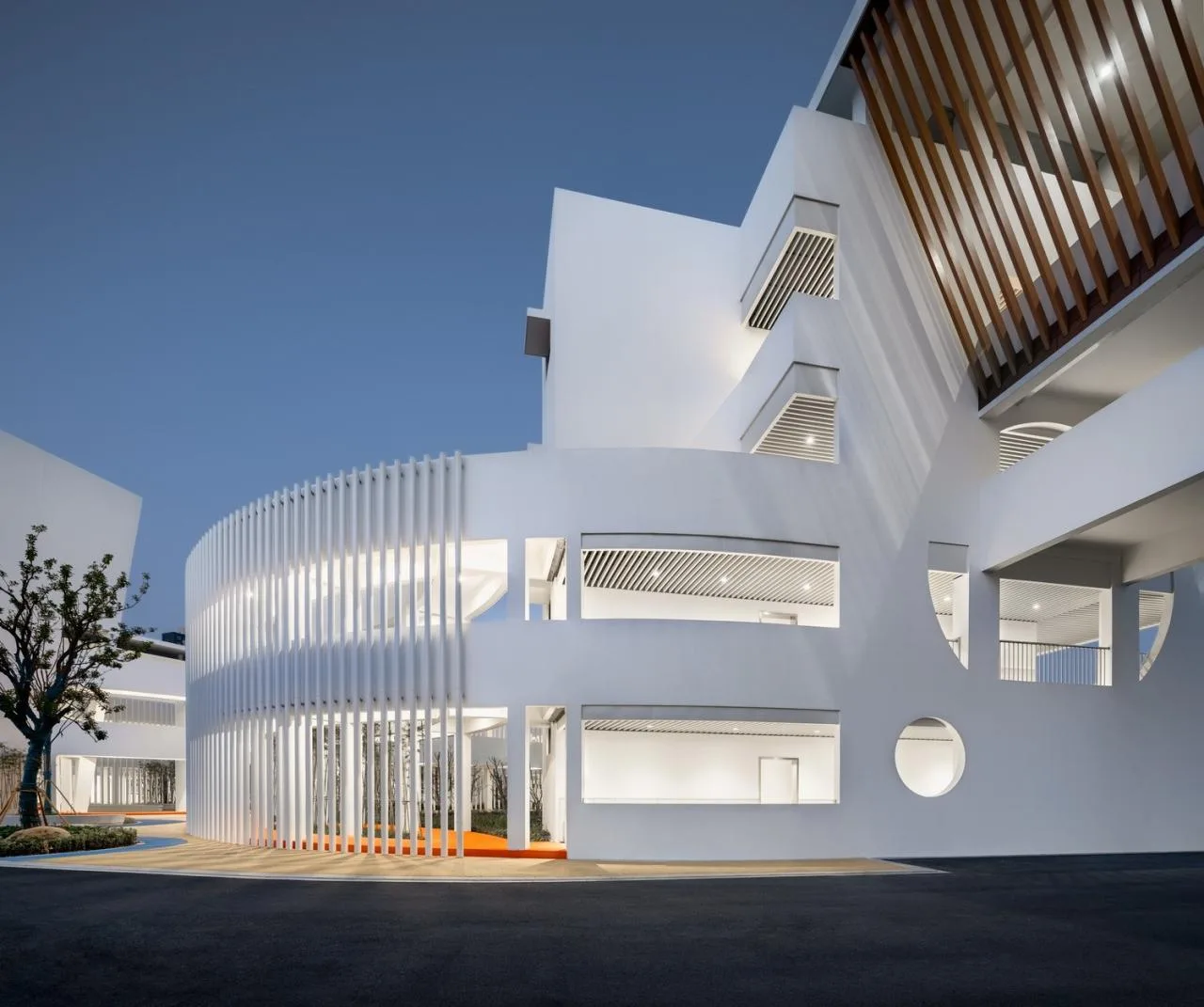
△ Night Campus -1 © Wu Qingshan
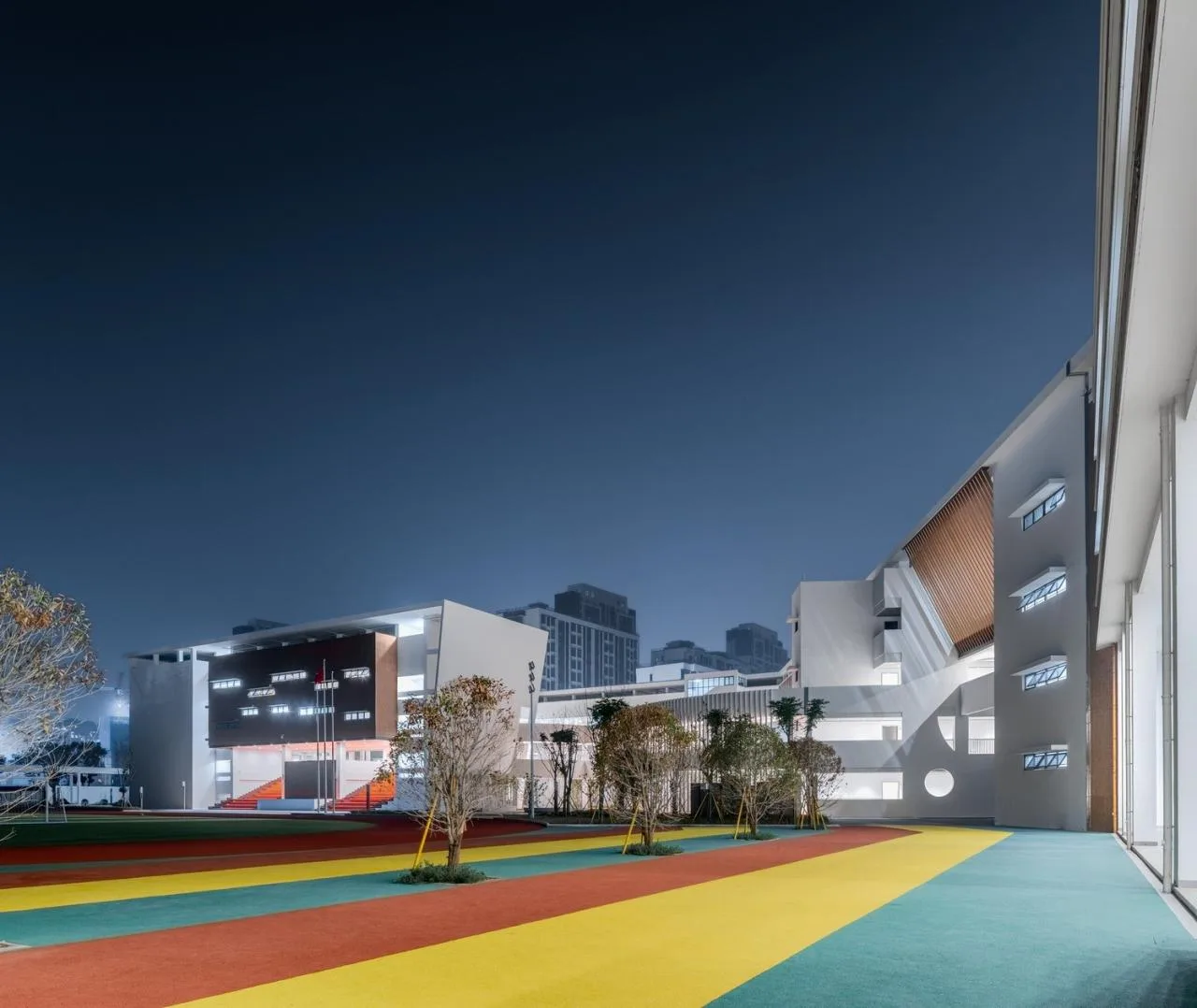
△ Night Campus -2 © Wu Qingshan
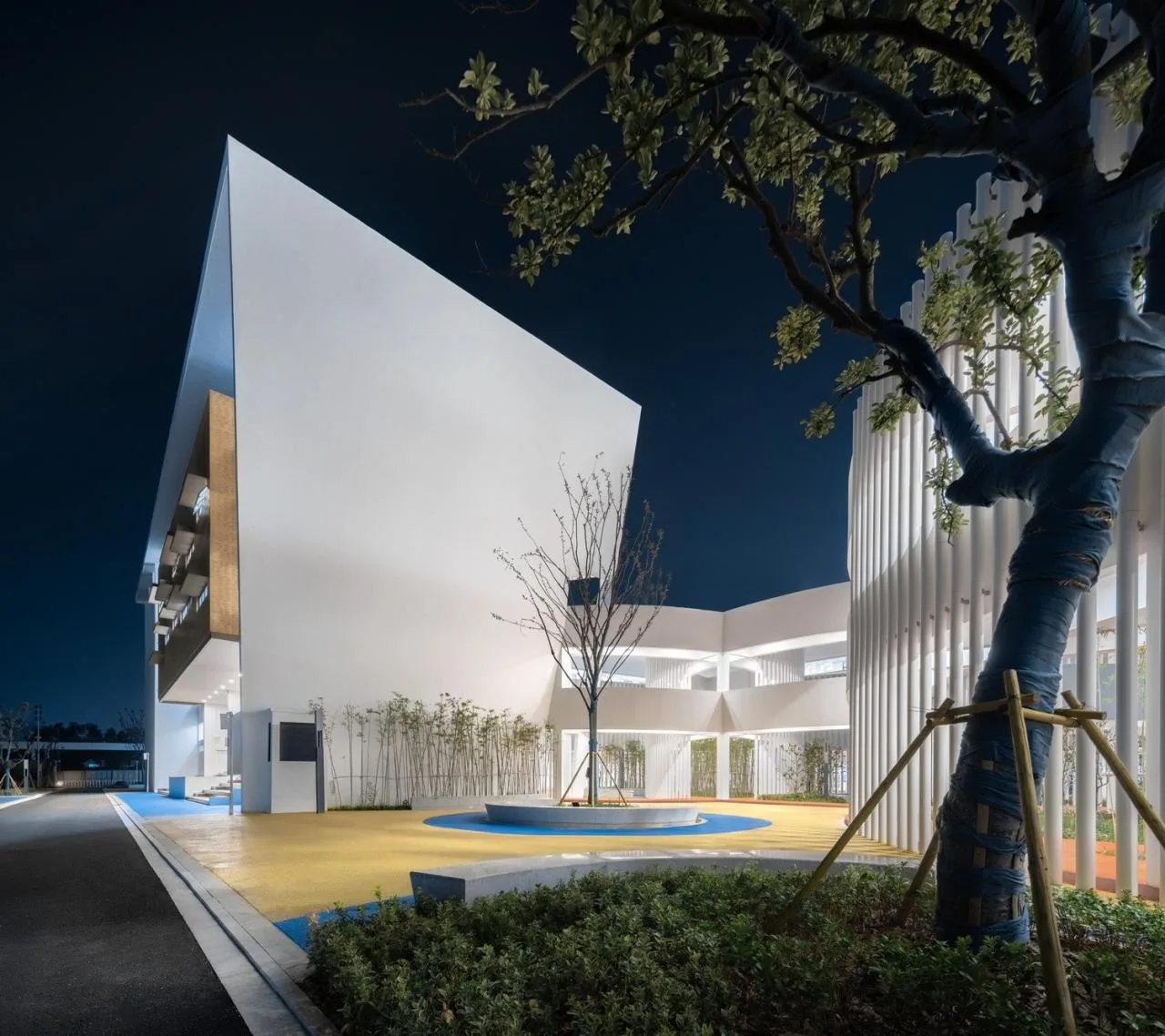
△ Night Campus -3 © Wu Qingshan
Project Drawings
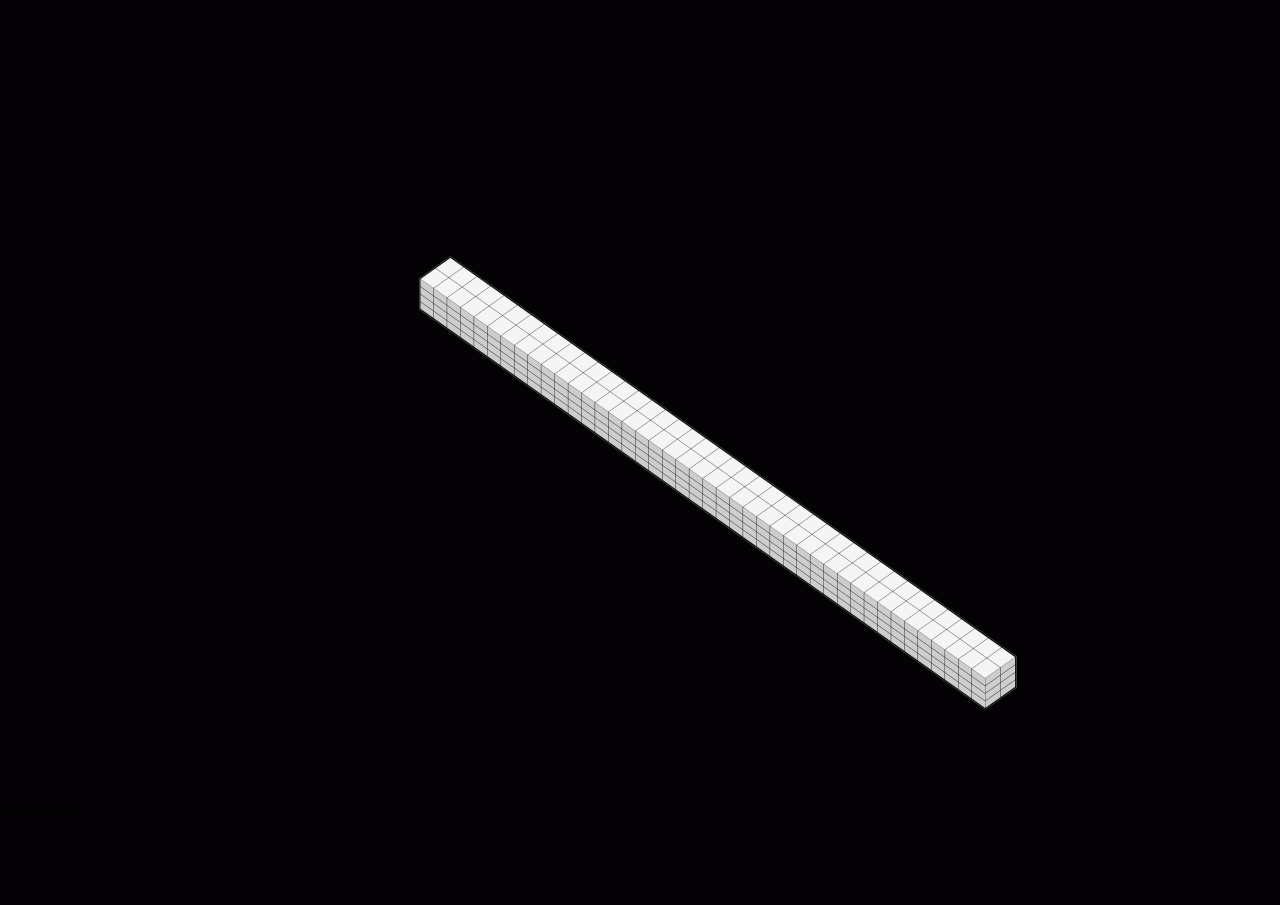
△ Architectural Generation Diagram © Mi Zhang Building
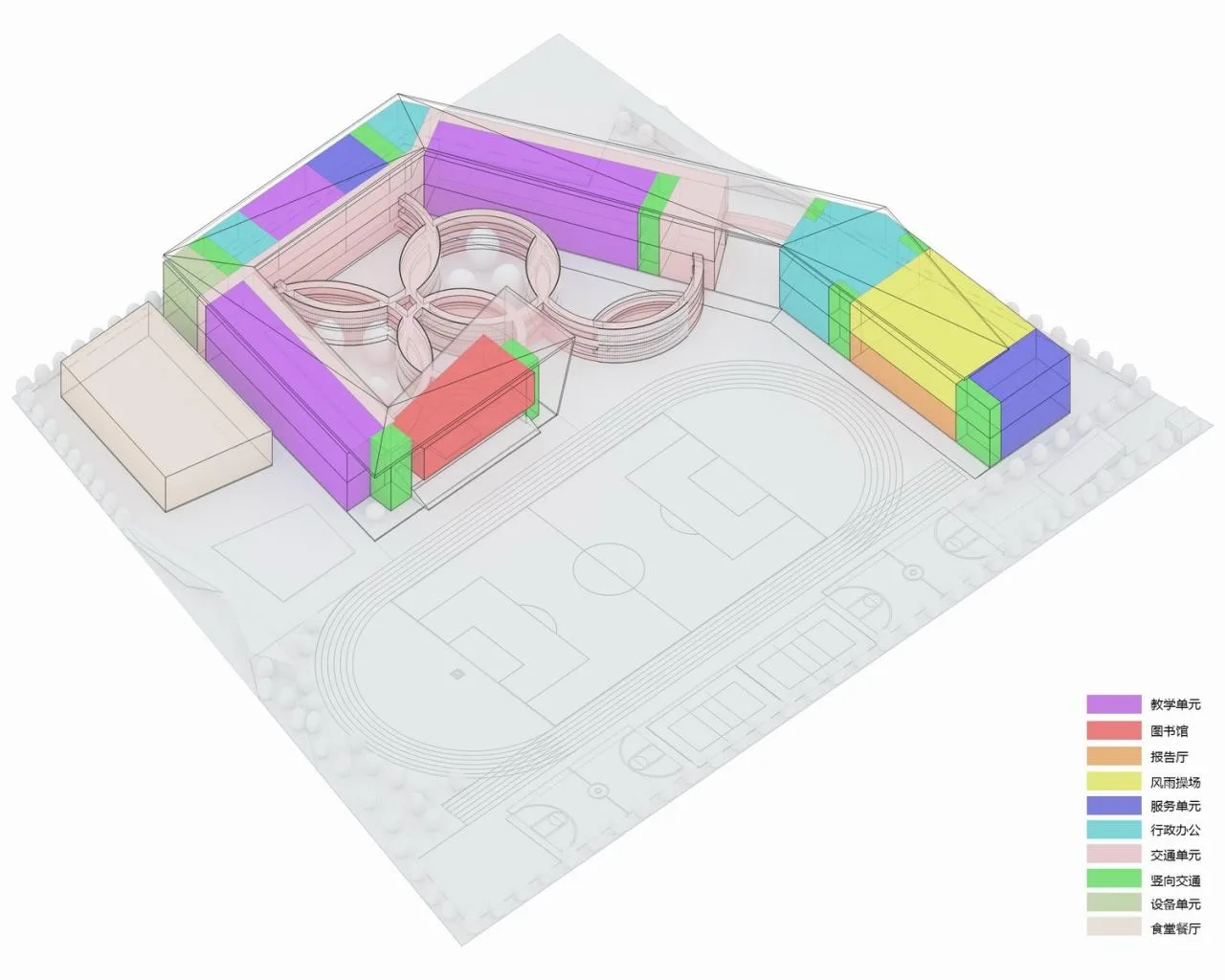
△ Functional Analysis Diagram © Mi Zhang Building
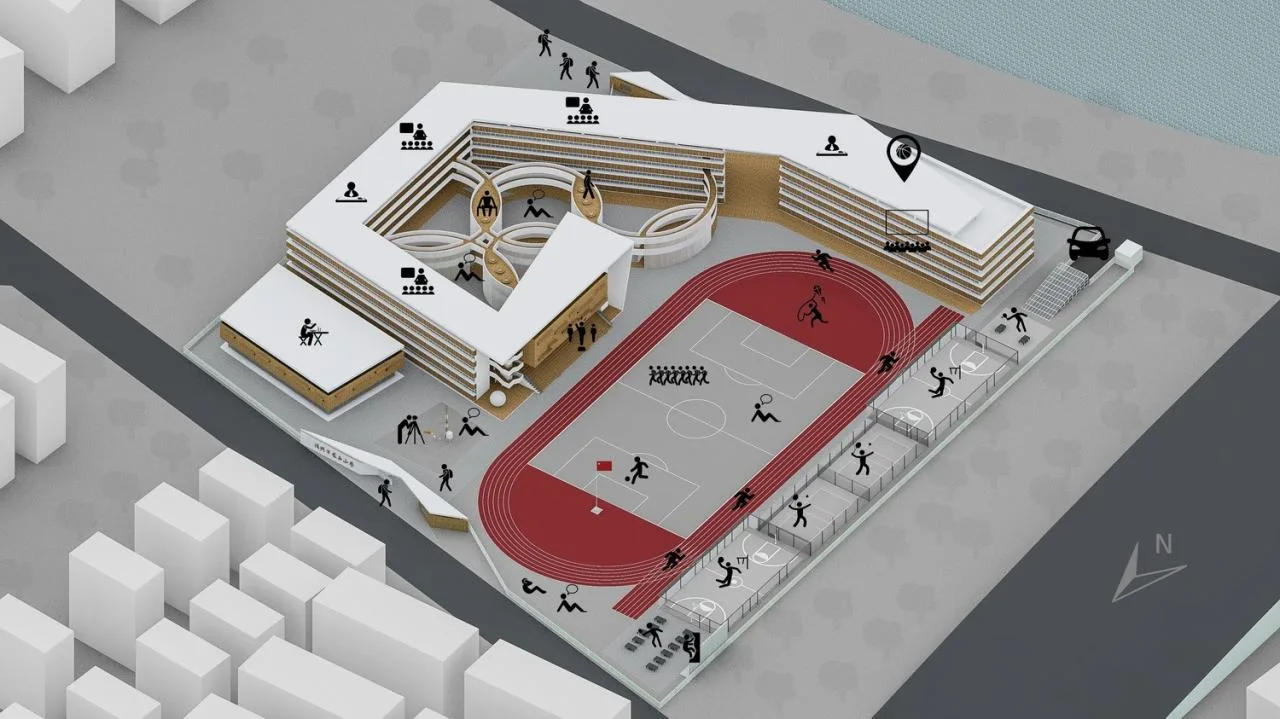
△ Functional Distribution Axis Measurement © Mi Zhang Building
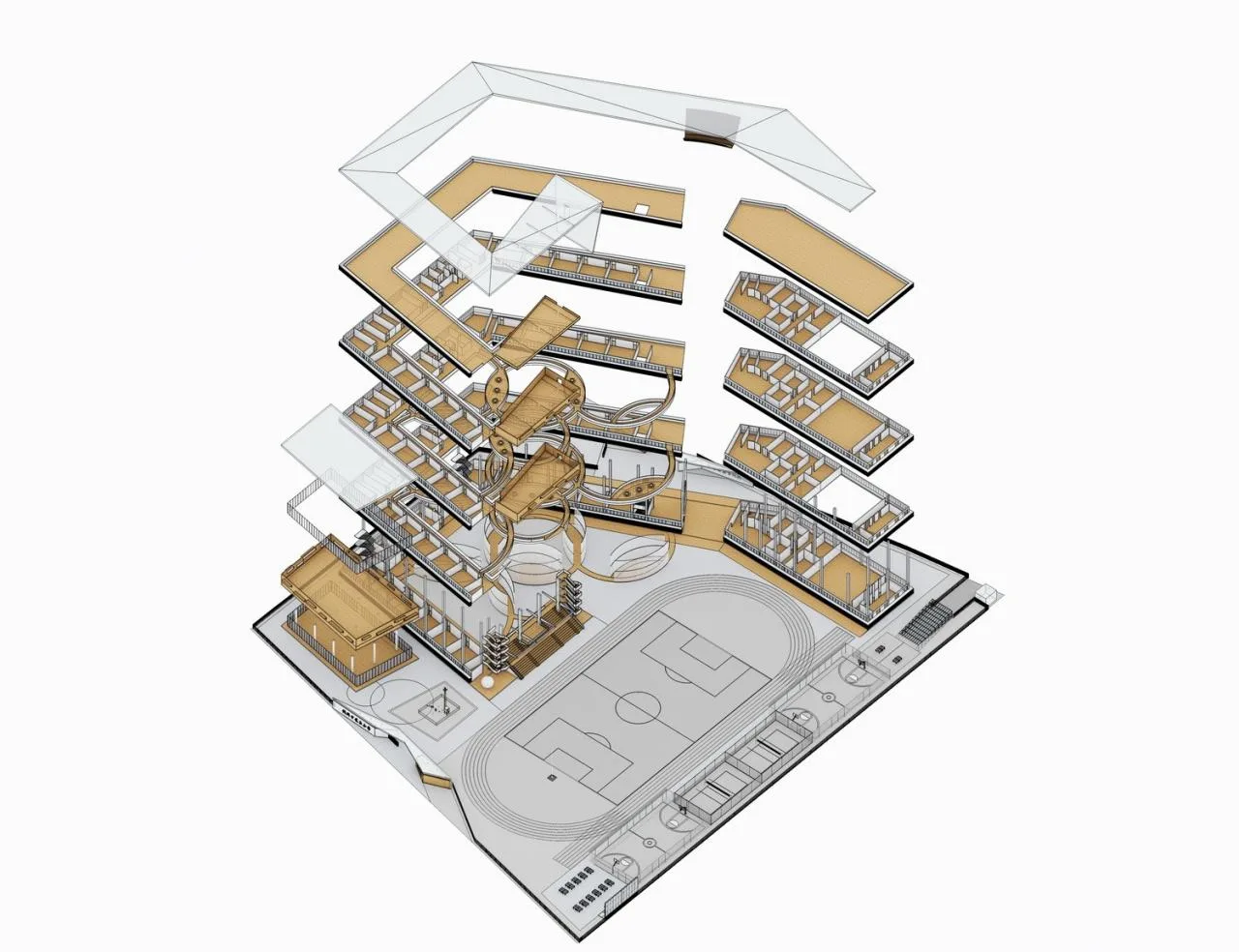
△ Axonometric Decomposition Figure-1 © Mi Zhang Building
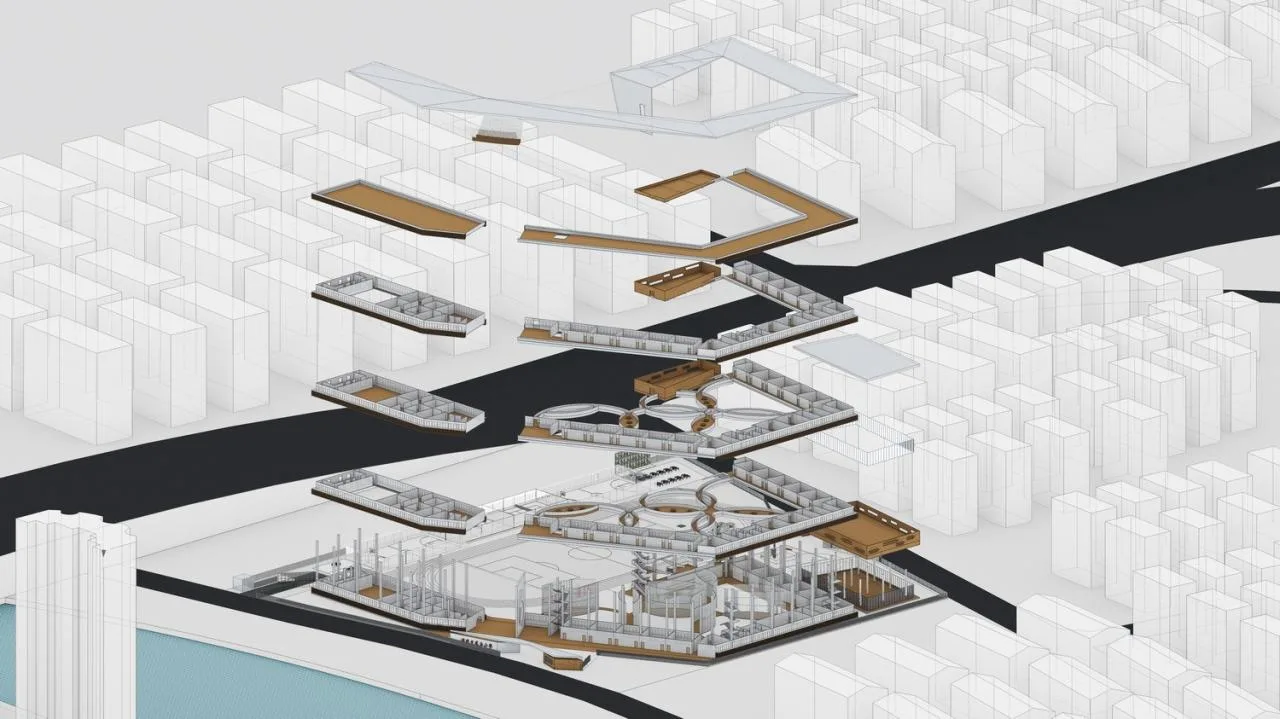
△ Axonometric Decomposition Figure-2 © Mi Zhang Building
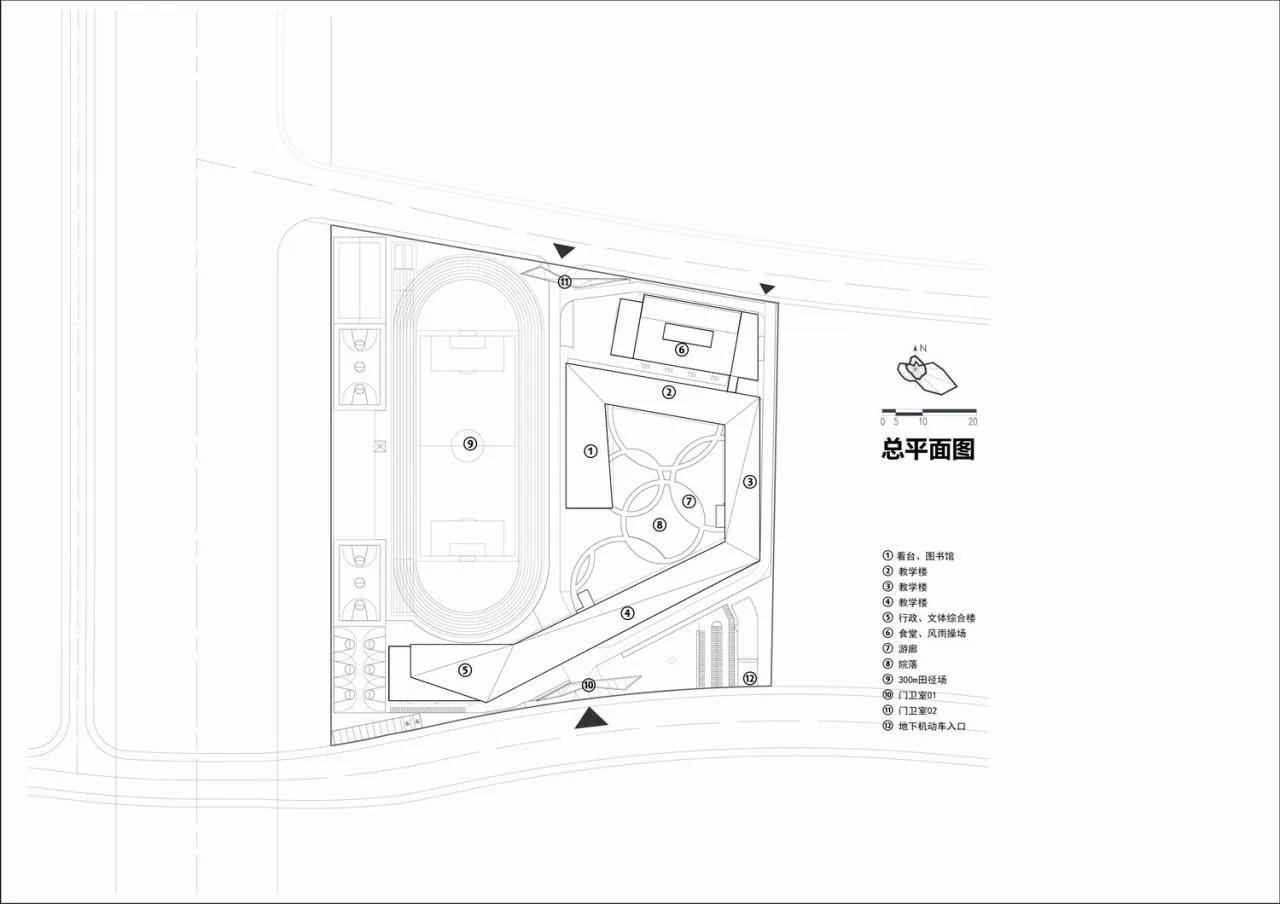
△ General Layout Plan © Mi Zhang Building
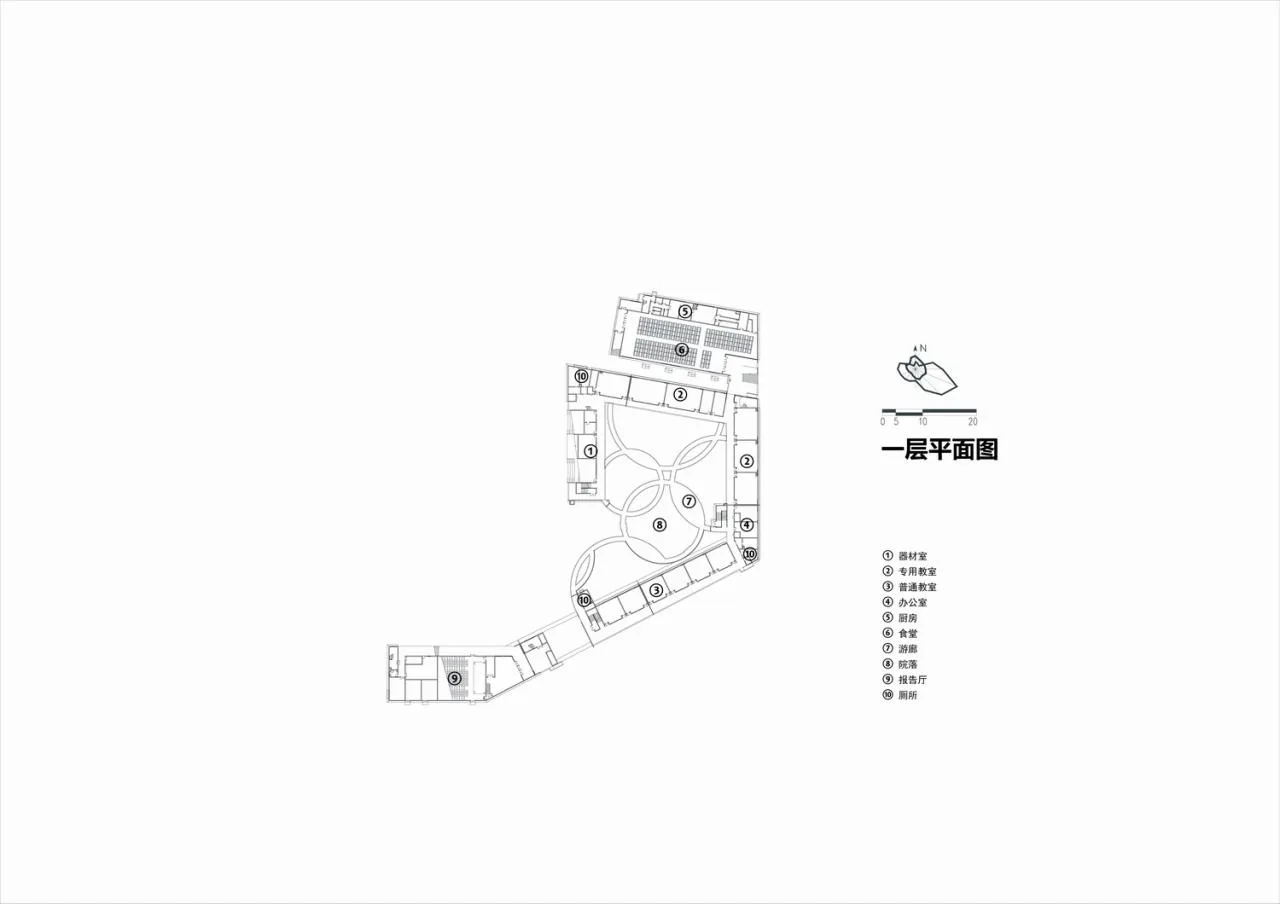
△ First Floor Plan © Mi Zhang Building
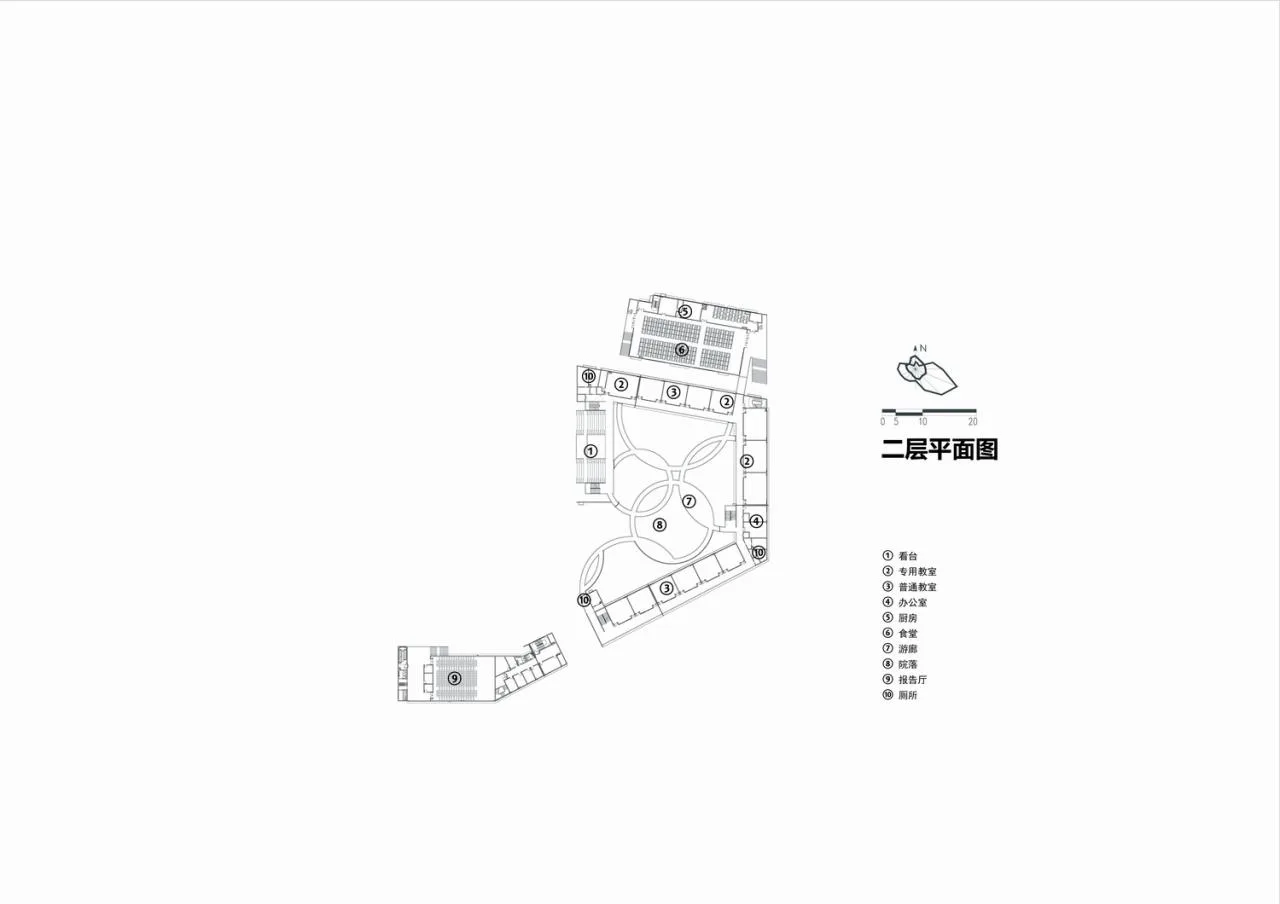
△ Second Floor Plan © Mi Zhang Building
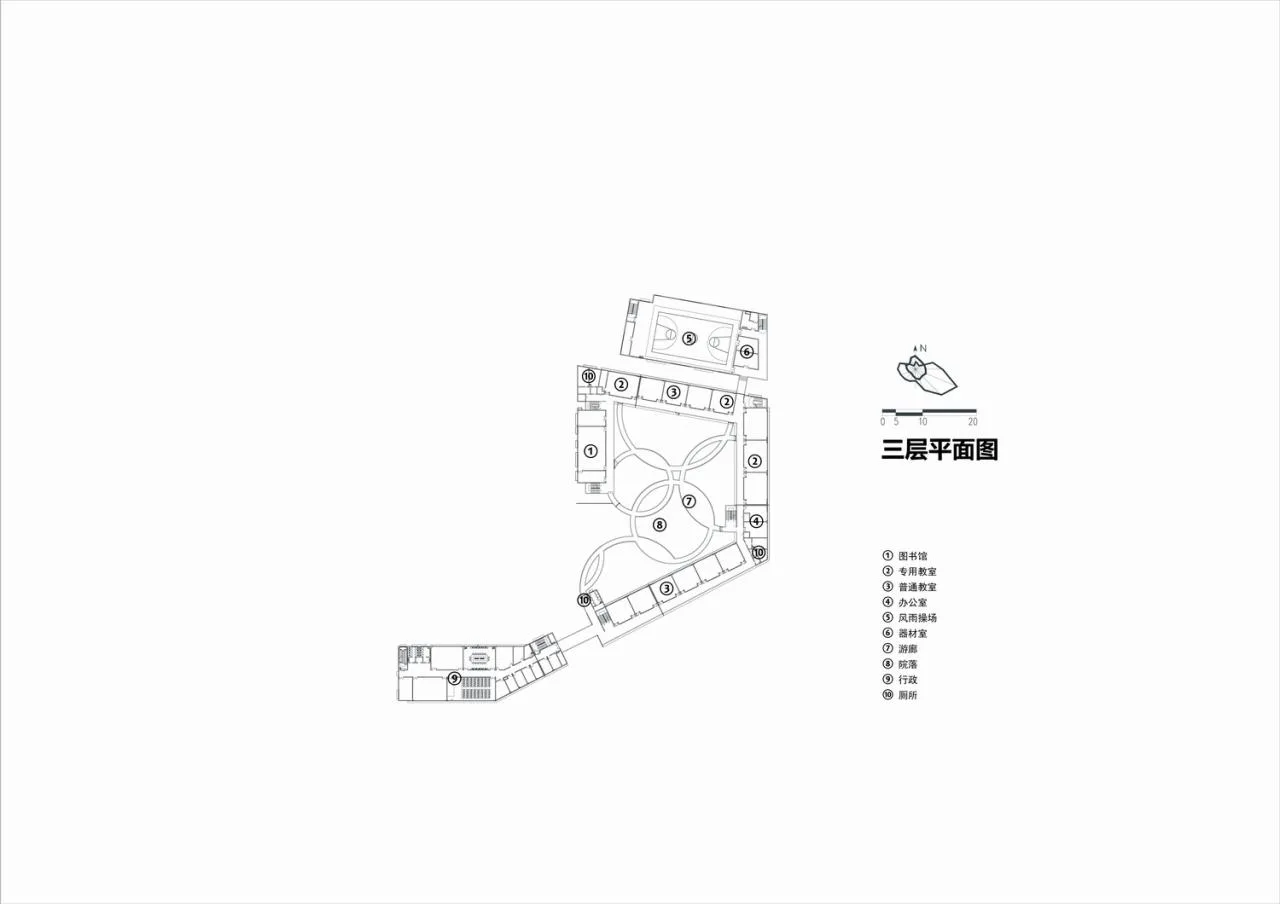
△ Third Floor Plan © Mi Zhang Building
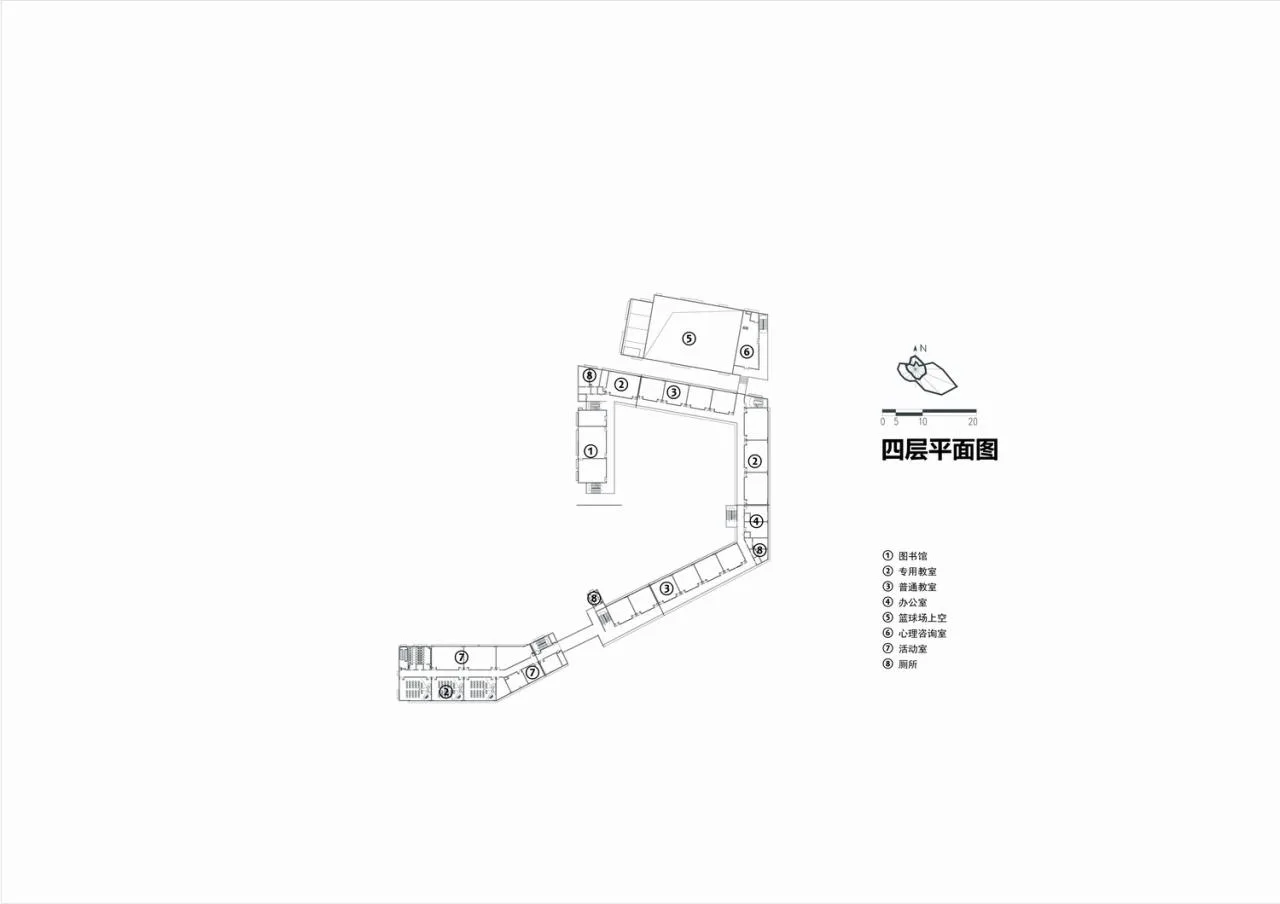
△ Fourth Floor Plan © Mi Zhang Building
Project Information
Architectural Design: Meter Sized Building
Area: 23,791 m²
Project Year: 2021
Photographer: Wu Qingshan
Lead Architect: Lu Zhigang
Design Team: Huang Congyi, Liang Dingpeng, Liu Li, Liu Zhirui, Niu Liko
Construction Drawing Design: Zhejiang Tianhe Design & Construction Co., Ltd
Construction Drawing Team: Yang Yuefang, Yao Qi, He Liangfu, Cui Feng, Ge Chen, Jin Peibiao, Shen Minqi
Owner: Huzhou Economic Development Investment Group Co., Ltd
Location: Huzhou, China














Must log in before commenting!
Sign Up