
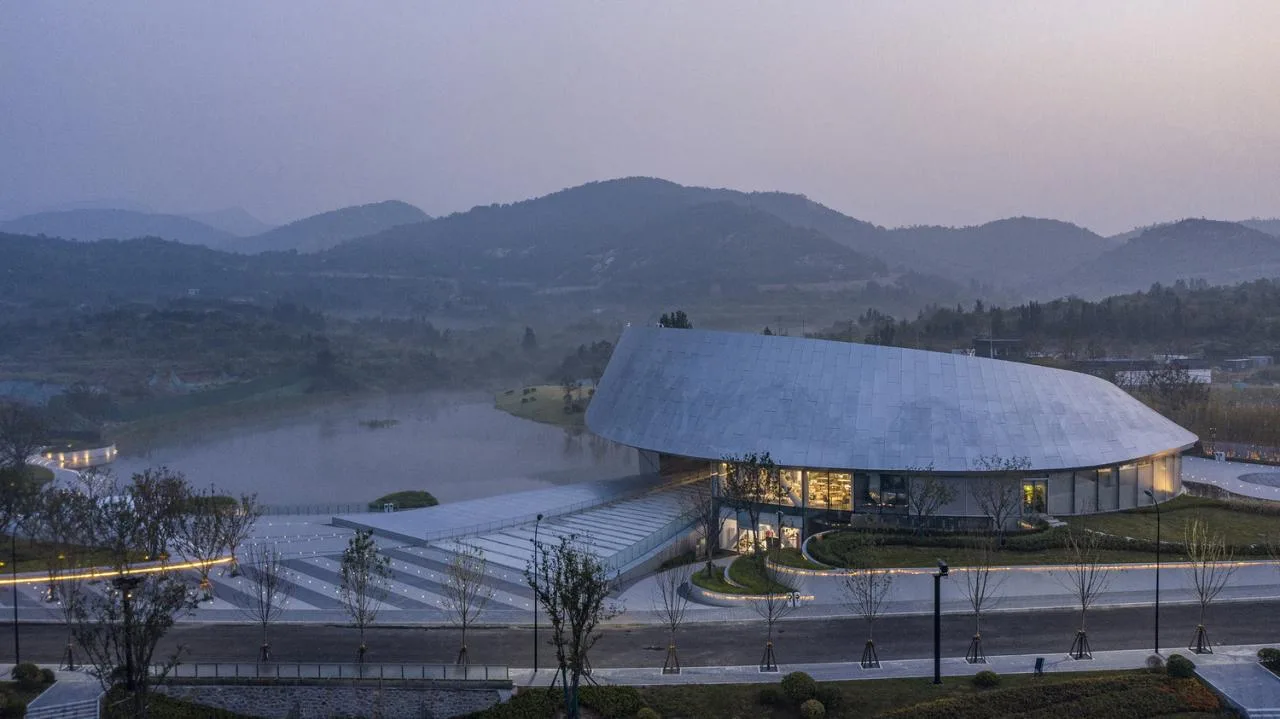
“Mount Taishan is located on the east wing of the mountain, echoing the ‘cloud of hometown’ on the west wing. The tourist center serves as a key spatial node in a low-lying terrain. The building is designed to face the majestic Mount Taishan with a hovering posture. It is not only a viewpoint for Mount Taishan but also a seamless integration with the mountain landscape.” – Meng Fanhao
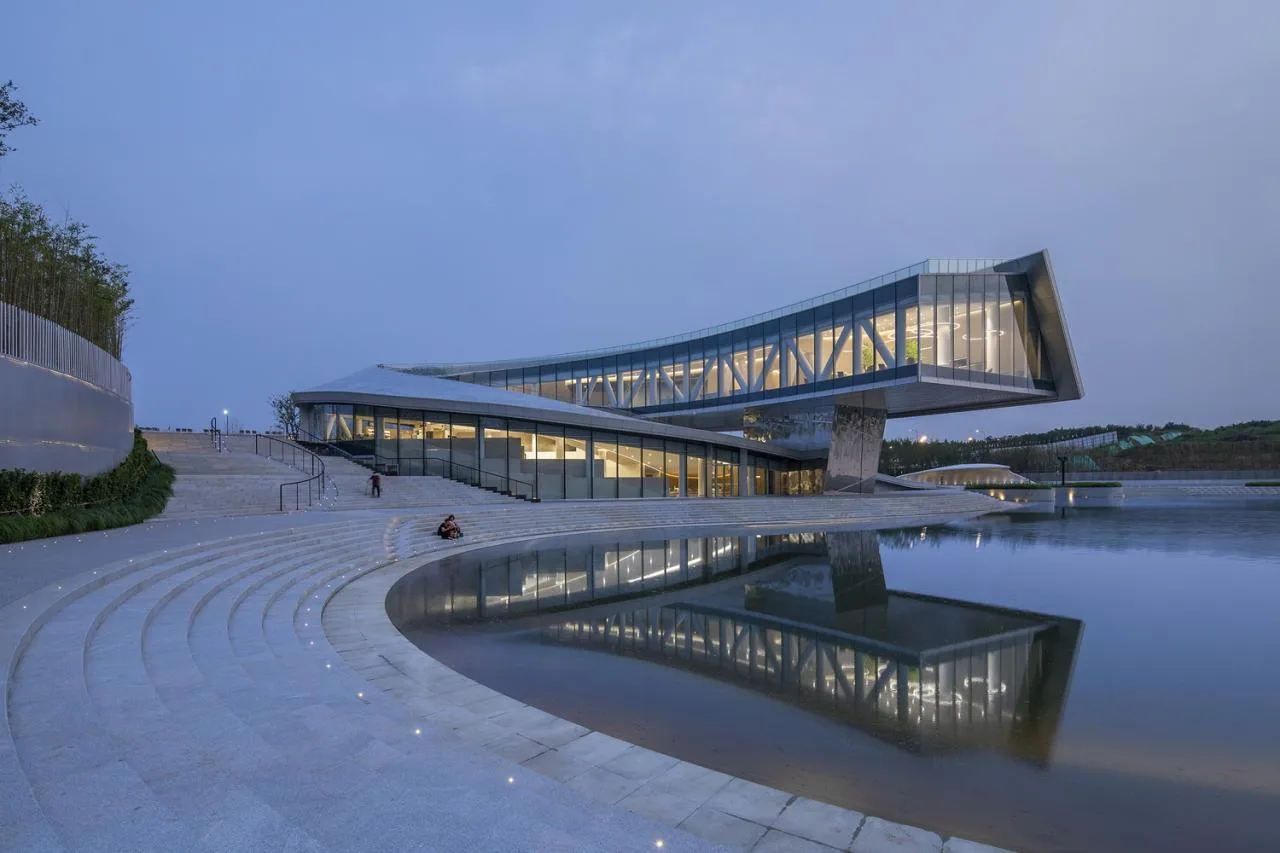
The Mount Taishan Youyou International Eco-Tourism Resort represents another step by line+ in exploring the deeper hinterlands of Mount Taishan, following the Jiunvfeng · Hometown cloud project. Located at the southern end of the resort, the tourist center connects directly to the main entrance. The site offers expansive views, surrounded by mountains and rivers, allowing visitors to admire the grandeur of Mount Taishan from afar. Thus, the initial design concept focused on creating an architectural scene that “connects to mountains and rivers, blending with nature.”
01 Flowing Form
The original site exhibits a 5-meter height difference from east to west. The eastern side is elevated, linking to the scenic area’s main entrance, while the western side slopes downward, connecting to the theme square within the park. To the north lies a key landscape facing the scenic lake and rolling mountain views in the distance.
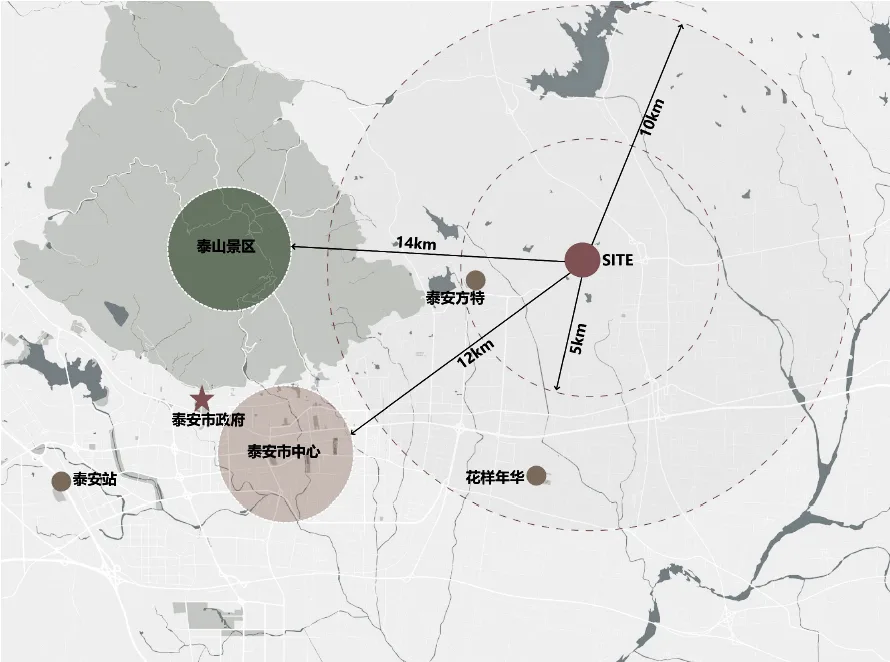
△ Location Map
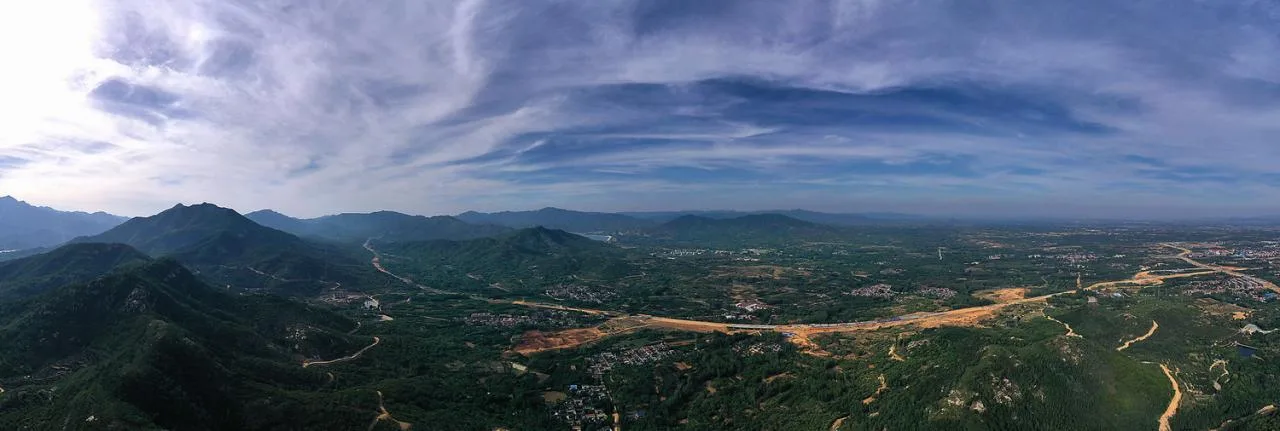
△ Base Environment
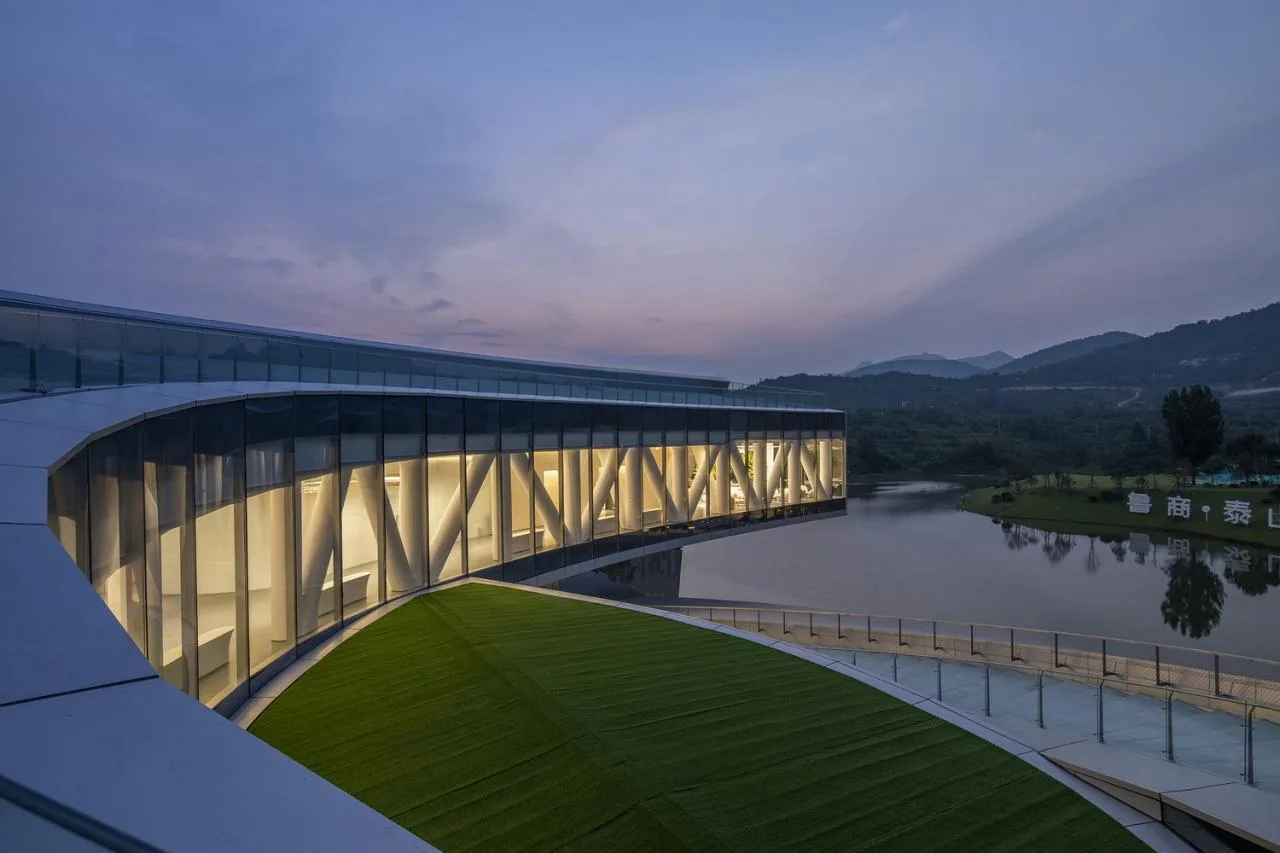
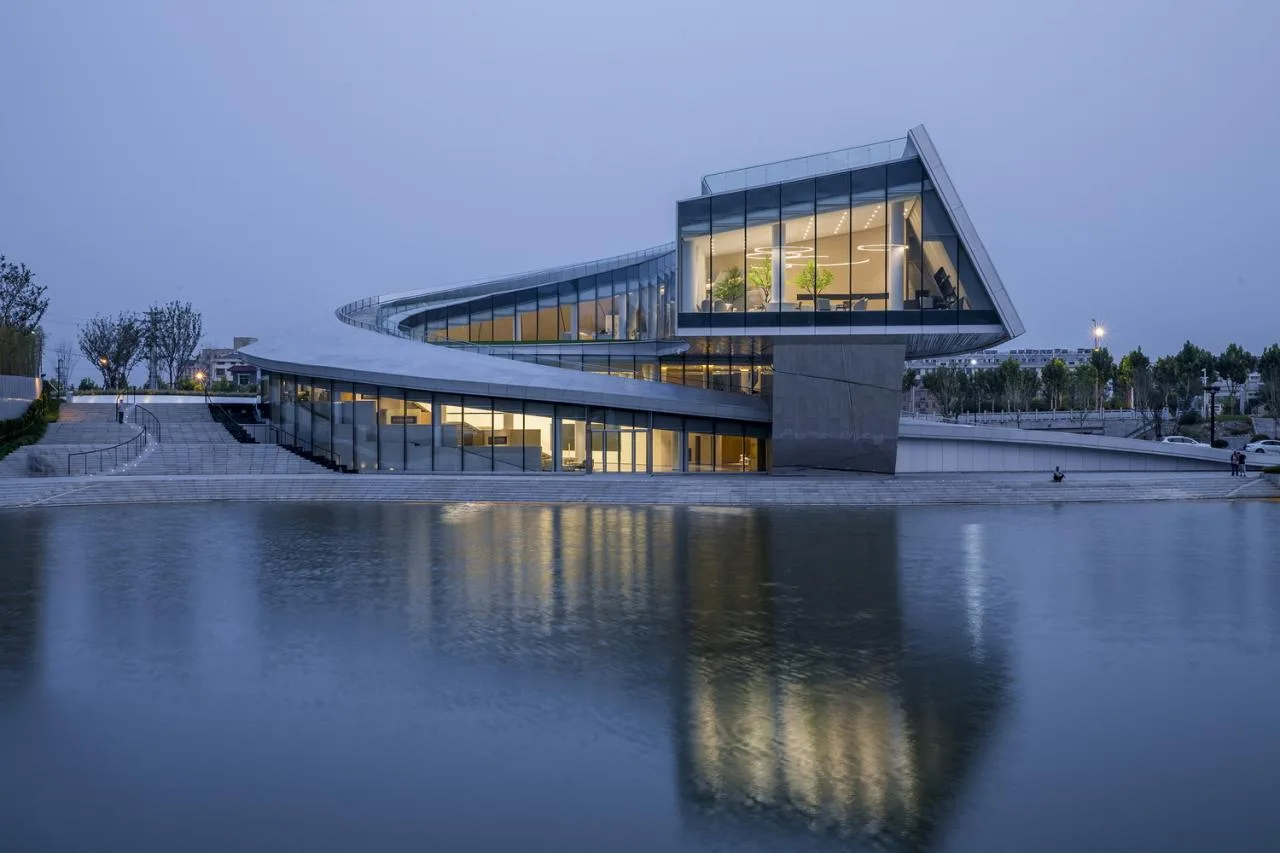
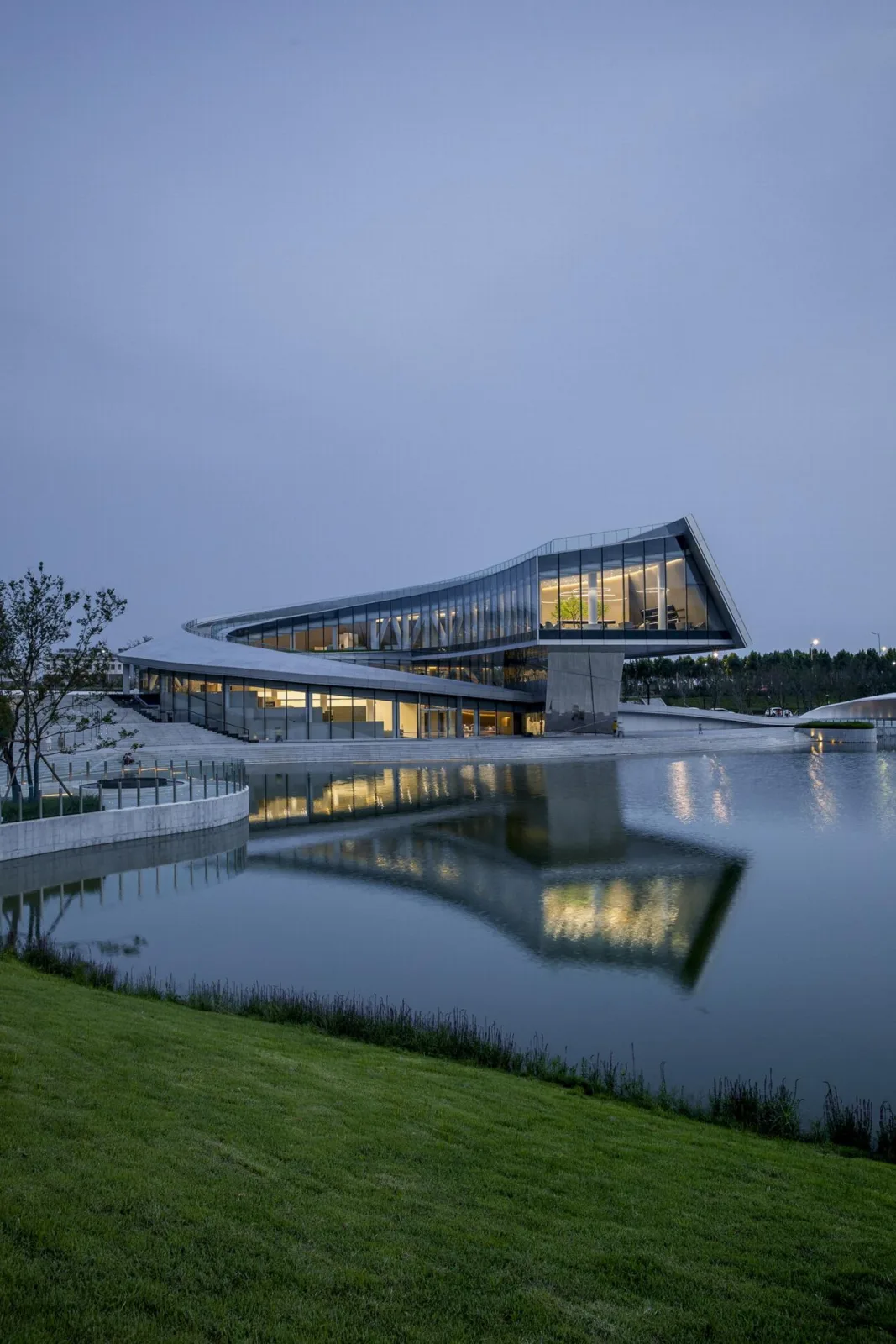
The building emerges naturally from the ground, forming a continuous spiral that rises toward the distant towering mountains. Its stretched, curved shape responds to the surrounding mountainous environment, skillfully addressing the site’s height differences while connecting public spaces on both sides.
The roof, rising gradually from the lower western ground, acts as a third facade and an open public space. Visitors can ascend to the highest point to enjoy unique panoramic views from above.
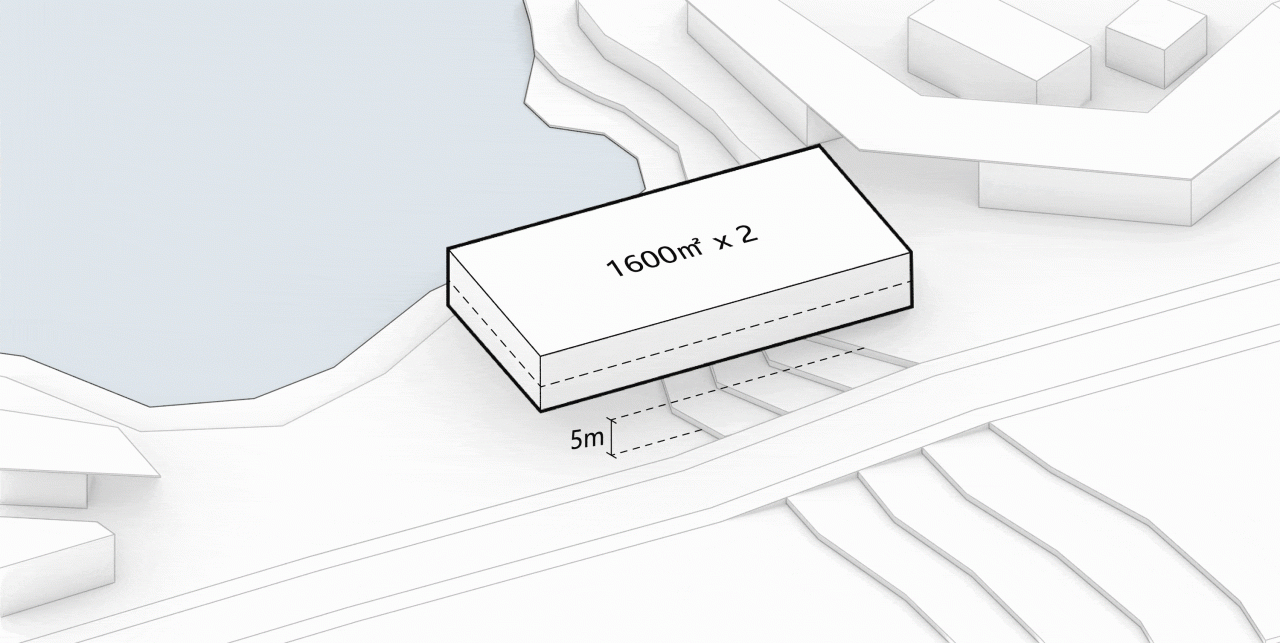
△ Generation Diagram
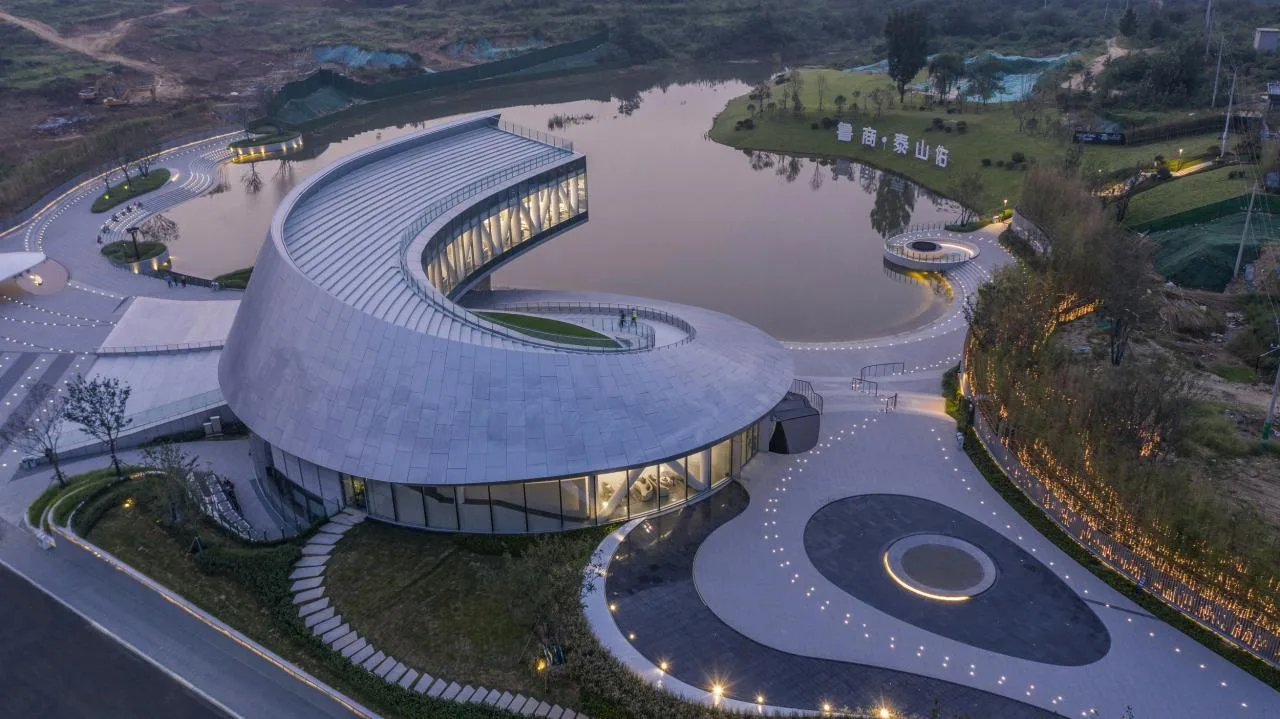
The building’s main entrance is situated on the east side, connecting seamlessly to the entrance circulation. The roof overhang creates a floating visual corridor linking the scenic area’s entrance and the lake’s surface.
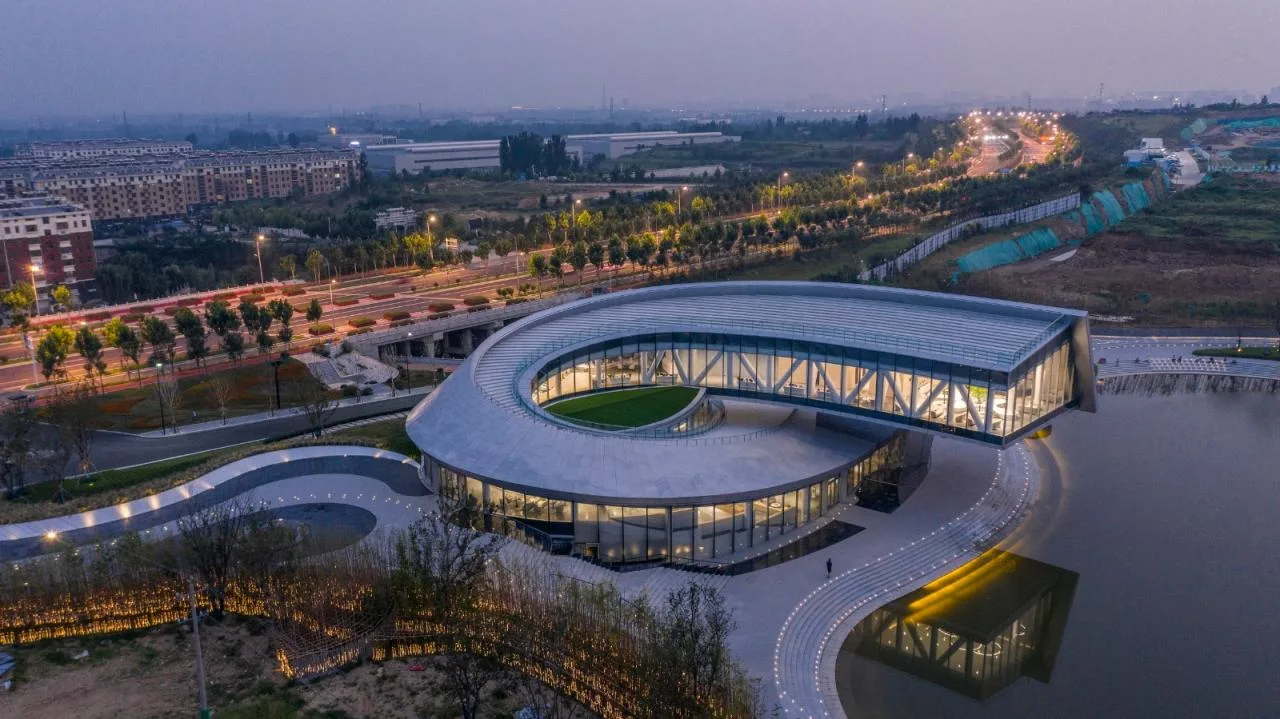
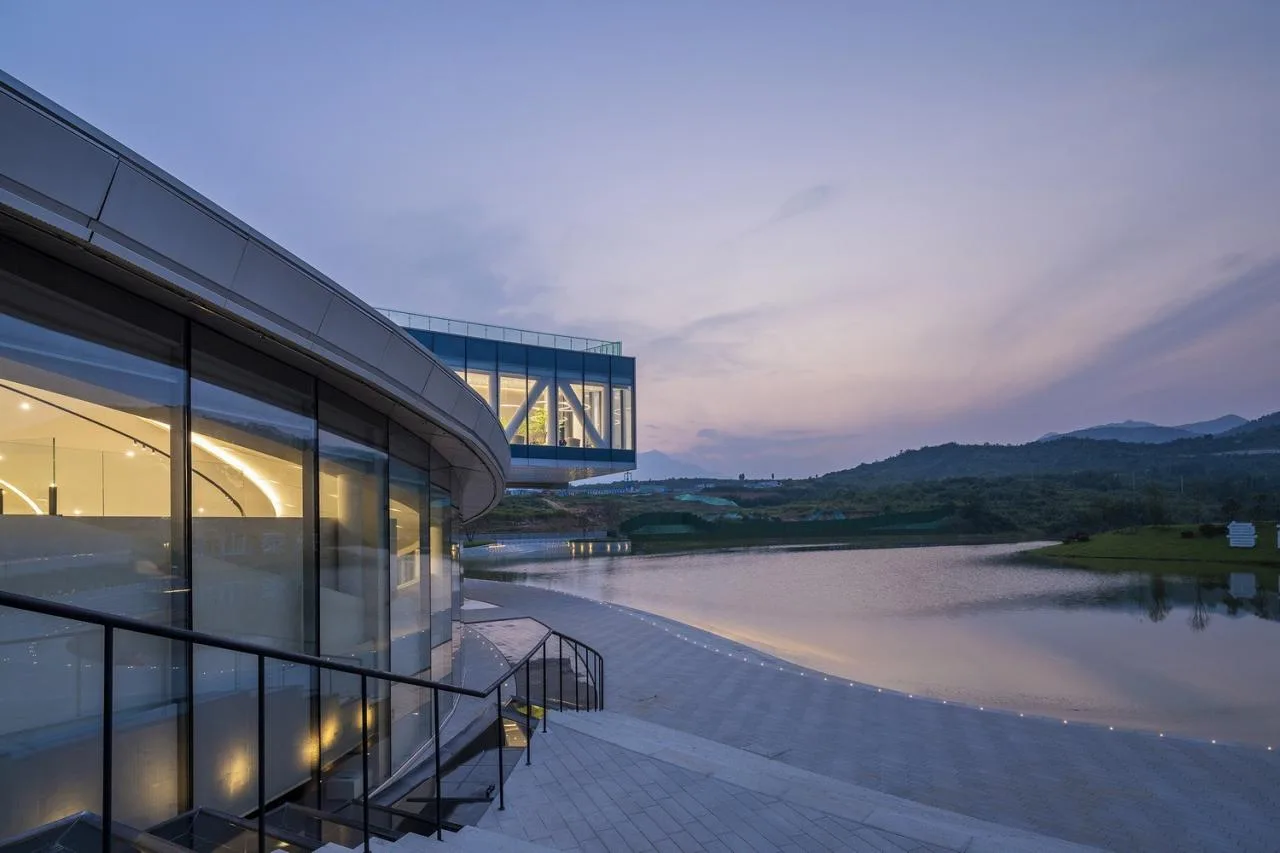
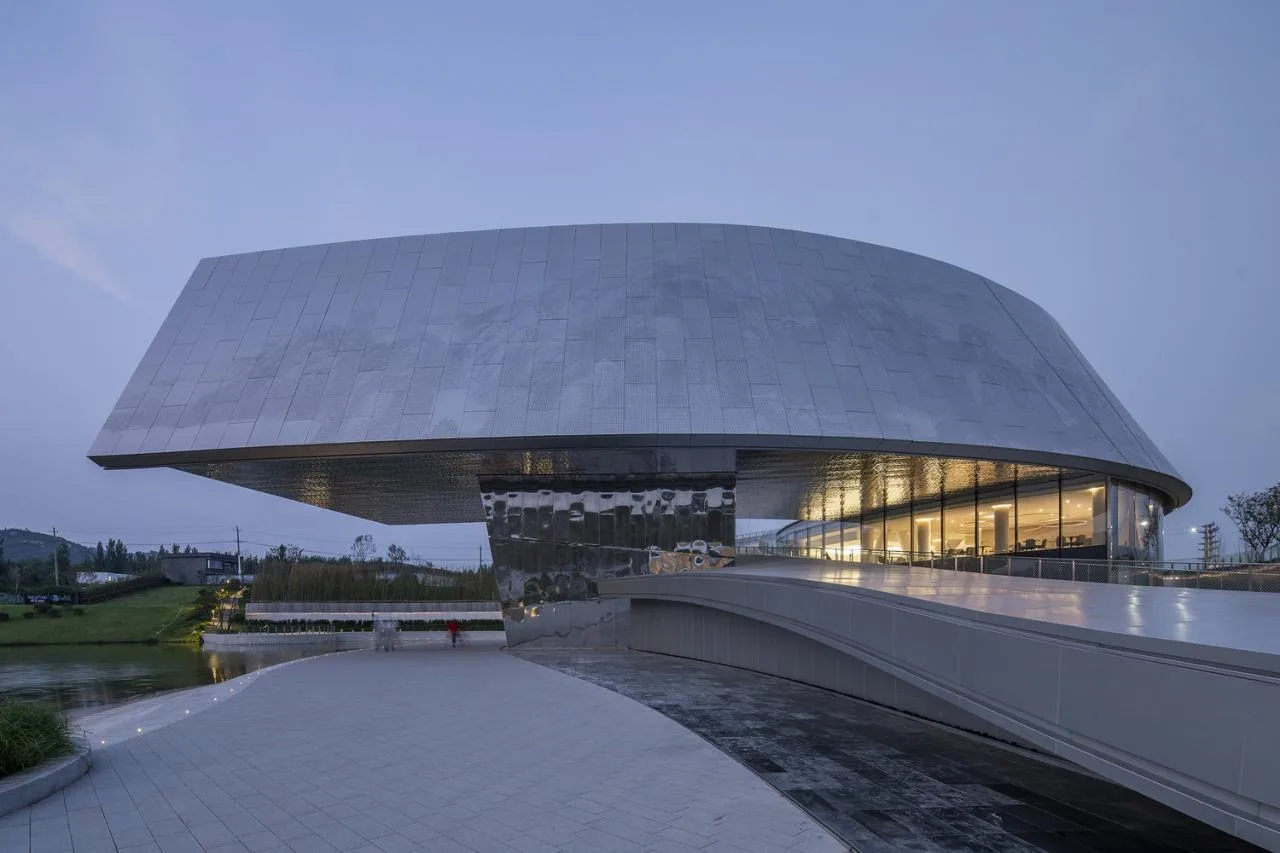
The elevated roof is clad with mirrored corrugated metal panels. This reflective surface captures and disperses the sparkling lake and continuous mountain scenery, fusing the natural landscape with the architecture itself.
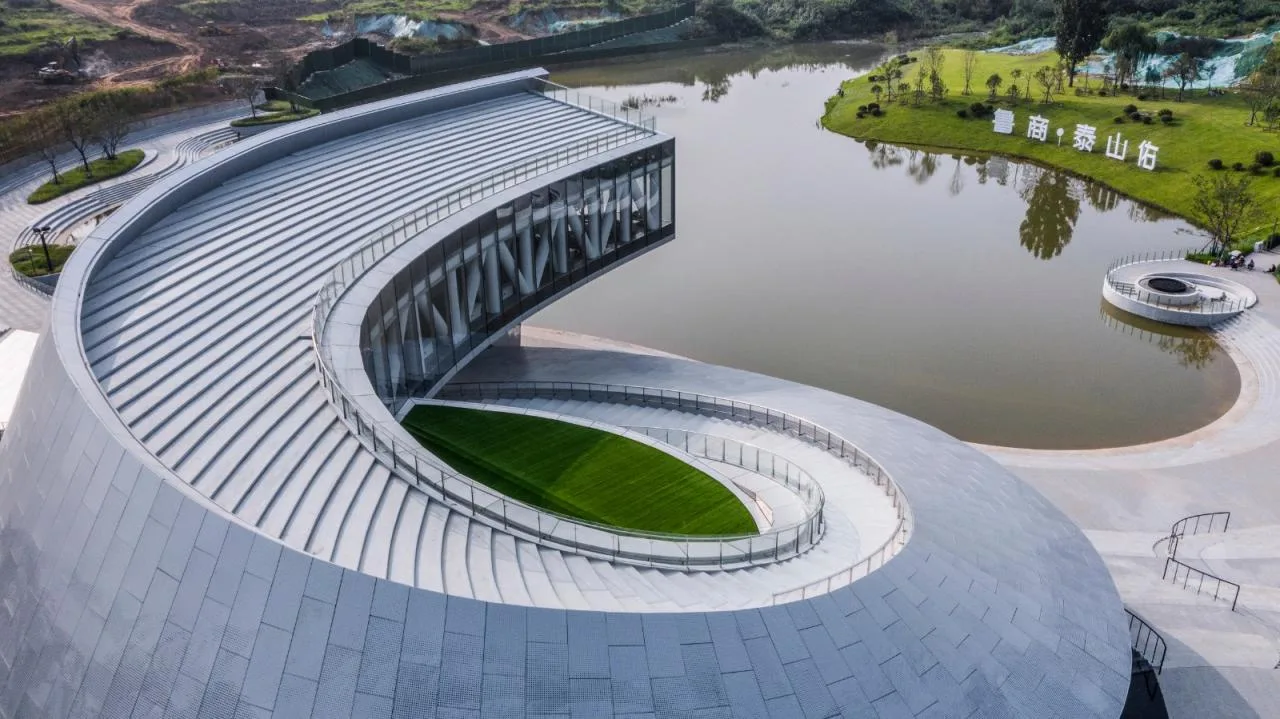
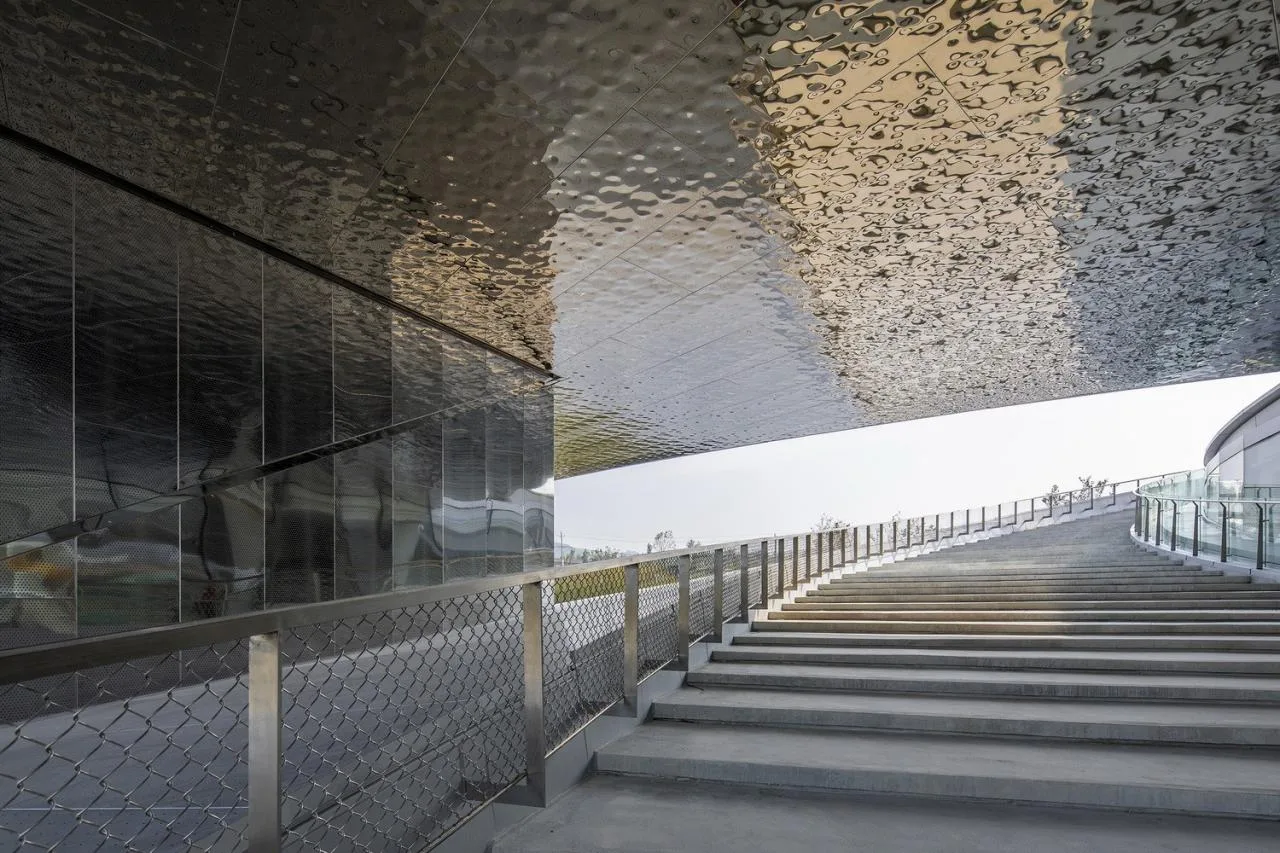
The building’s geometric form is defined by three primary curves. The use of contrasting materials on either side reduces the visual mass, lending a relaxed and smooth appearance. An inner circular curve creates a spacious, transparent area with large glass surfaces facing the mountains and rivers, extending the view. The outer arc transitions from the roof to the facade with perforated aluminum panels, enveloping the second and third floors. Geometrically, the facade and roof evolve from the same plane, achieving a high degree of unity.
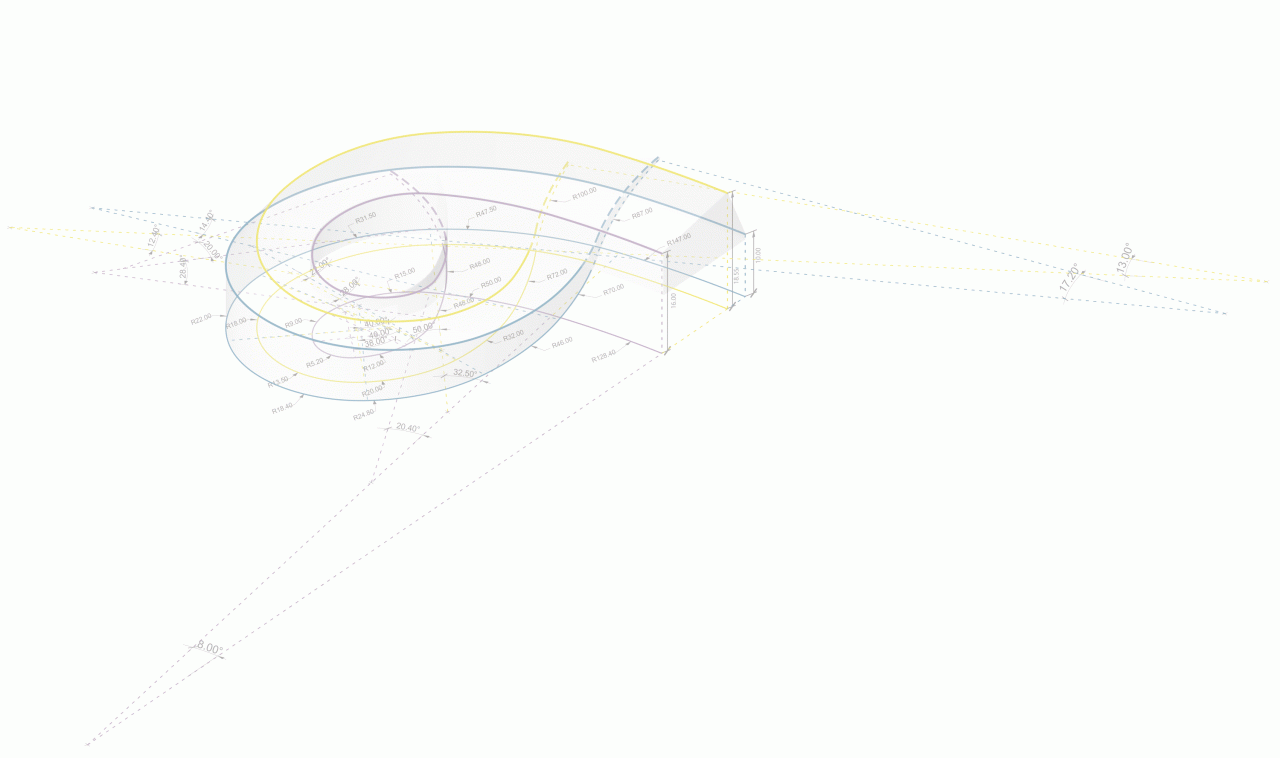
△ Floor Plan Positioning Diagram
The building’s east facade features a parametric skin, where modular aluminum panel perforations are designed to depict a magnificent image of Mount Taishan. The semi-transparent metal facade contrasts with the glass curtain wall below, creating a visual interplay between solid and void. The abstract mountain patterns overlay the distant natural scenery, enriching the visual experience across the park and enhancing fluidity on a larger scale.
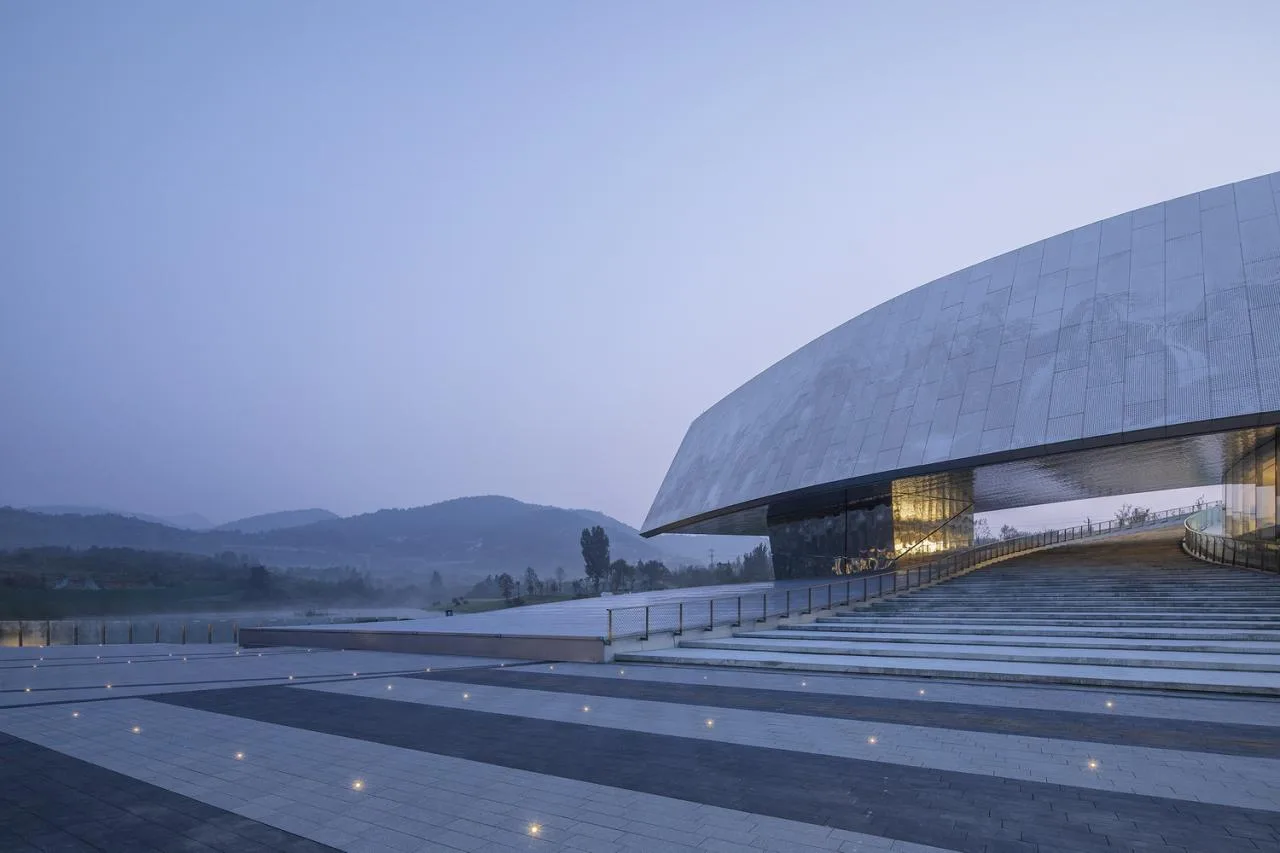
In this nature-dominated context, the smooth and flowing curves define the entire site’s creation. The building’s overall form is drawn with a single continuous stroke. The “Yunbi” or flowing clouds and water symbolize the movement of water and the richness of distant mountains. At the highest point, the nearly 13-meter-high “Dunbi” element aims to merge architecture and landscape. The “Huifeng” brushstrokes linger in the site, creating a lakeside trail that twists and extends outward, naturally transitioning the architectural form into the outdoor space through flowing curves.
02 Structure and Construction
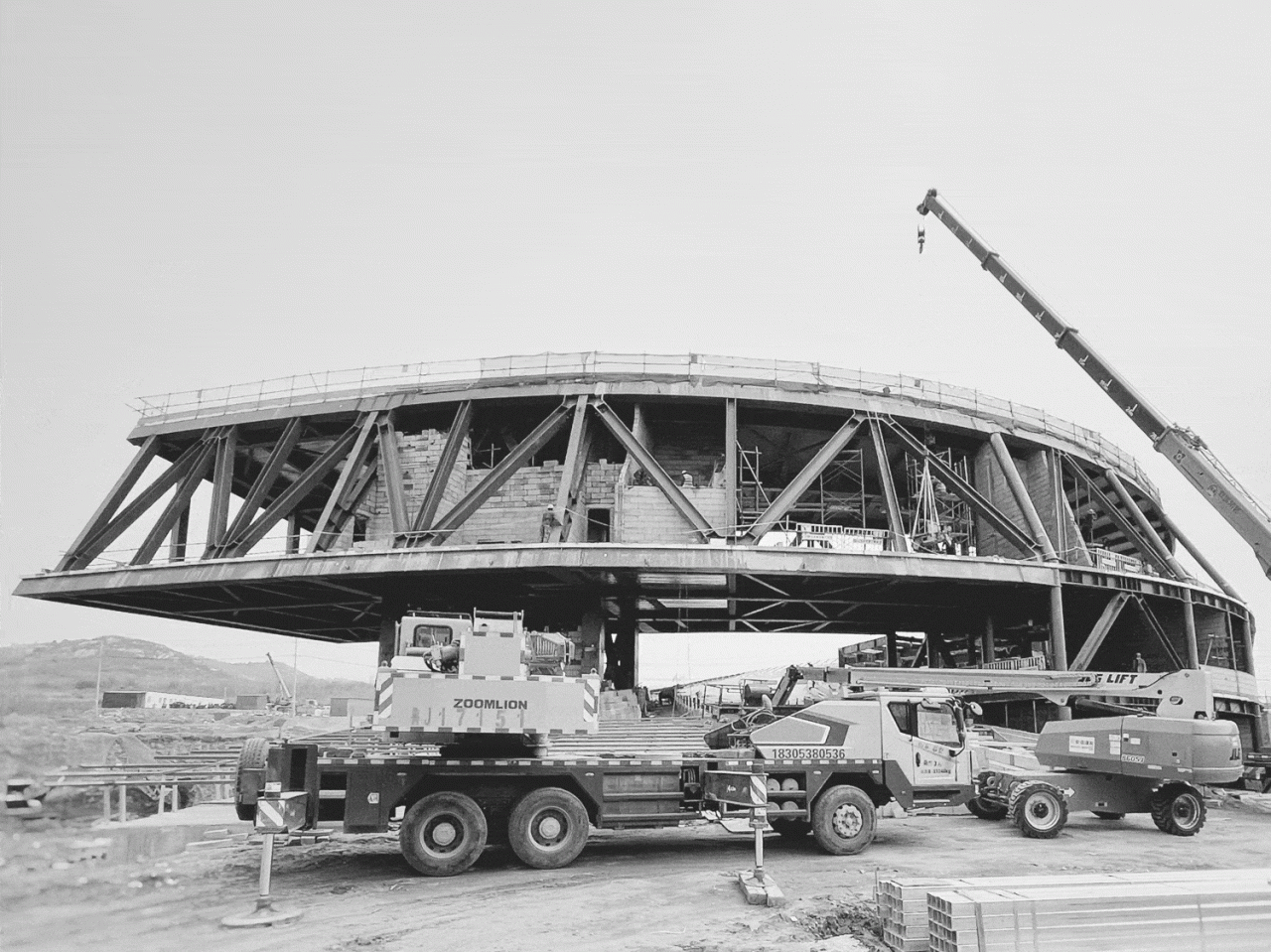
The building’s irregular form presented significant construction challenges. High standards were maintained through modular control of structural frameworks and detailed components.
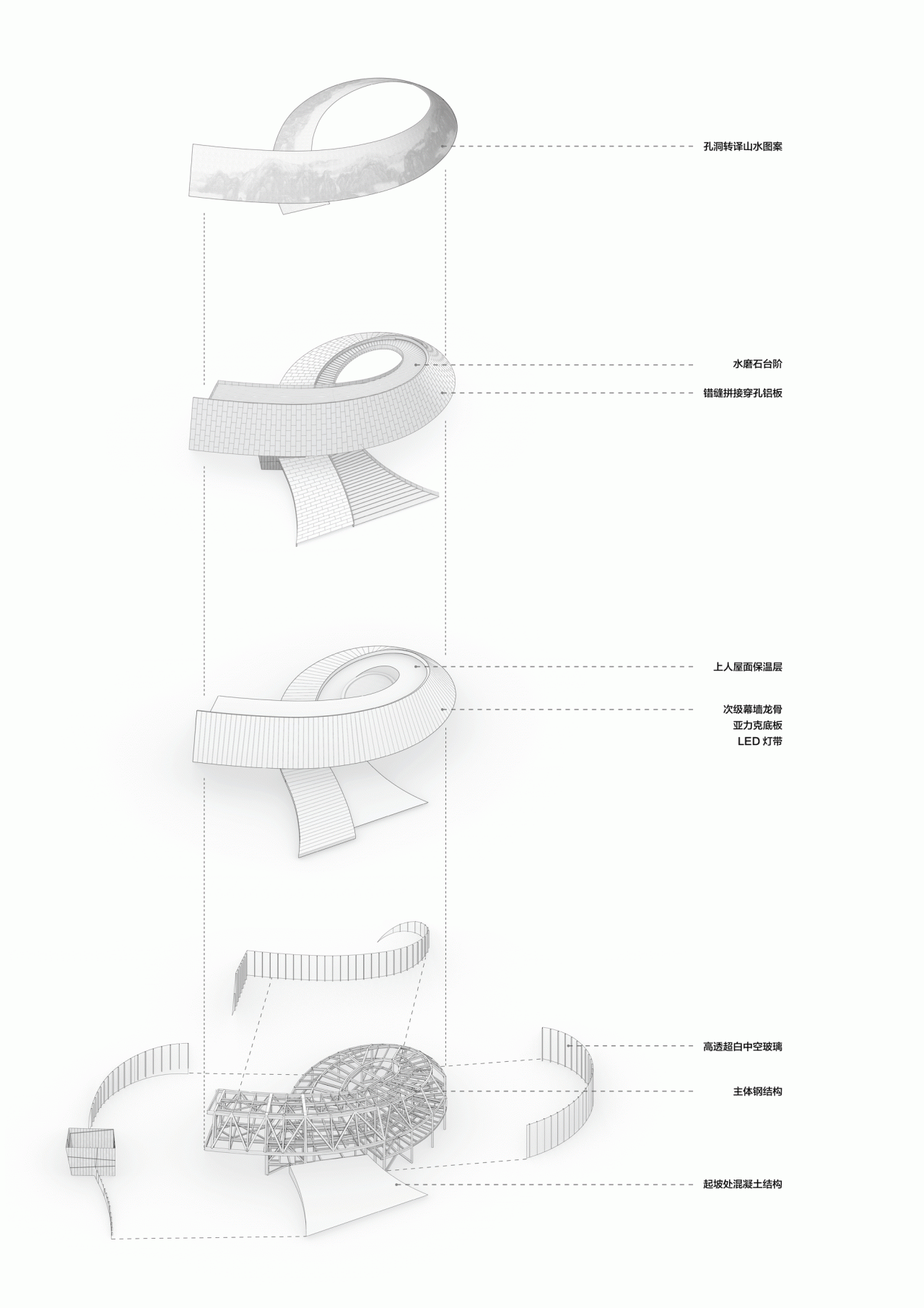
Exploded Axis Analysis
The building’s outline is defined by three basic curves composed of several tangent arcs joined together. After multiple optimizations, structural columns were evenly positioned at equal intervals and arc endpoints, ensuring uniform height between the main structure and the architectural form. This provided a foundation for spatial consistency both inside and out. Curved steel beams support the building’s irregular hyperbolic surface. Guided by precise digital models, over 600 nearly identical steel components were fabricated and transported for assembly. Through twisting, bending, and gradual modifications, a series of steel trusses accurately restored the design’s original curves.
The inner ring glass curtain wall is supported by T-shaped steel frames and composed of four layers of hollow ultra-white glass. The outer hyperbolic skin consists of 1,040 silver-gray perforated aluminum panels, with most panels manufactured as flat plates to reduce processing costs and ensure installation precision.
The staggered perforated panels display continuous landscape patterns. Ten different perforation sizes ranging from 10 to 35 mm increase density in shaded areas, enhancing delicacy and readability at a human scale.
03 Flowing Space
The project embodies unity between form, structure, and space. The building’s continuous exterior shape corresponds with the ascending interior volume, creating a courtyard enclosed within.
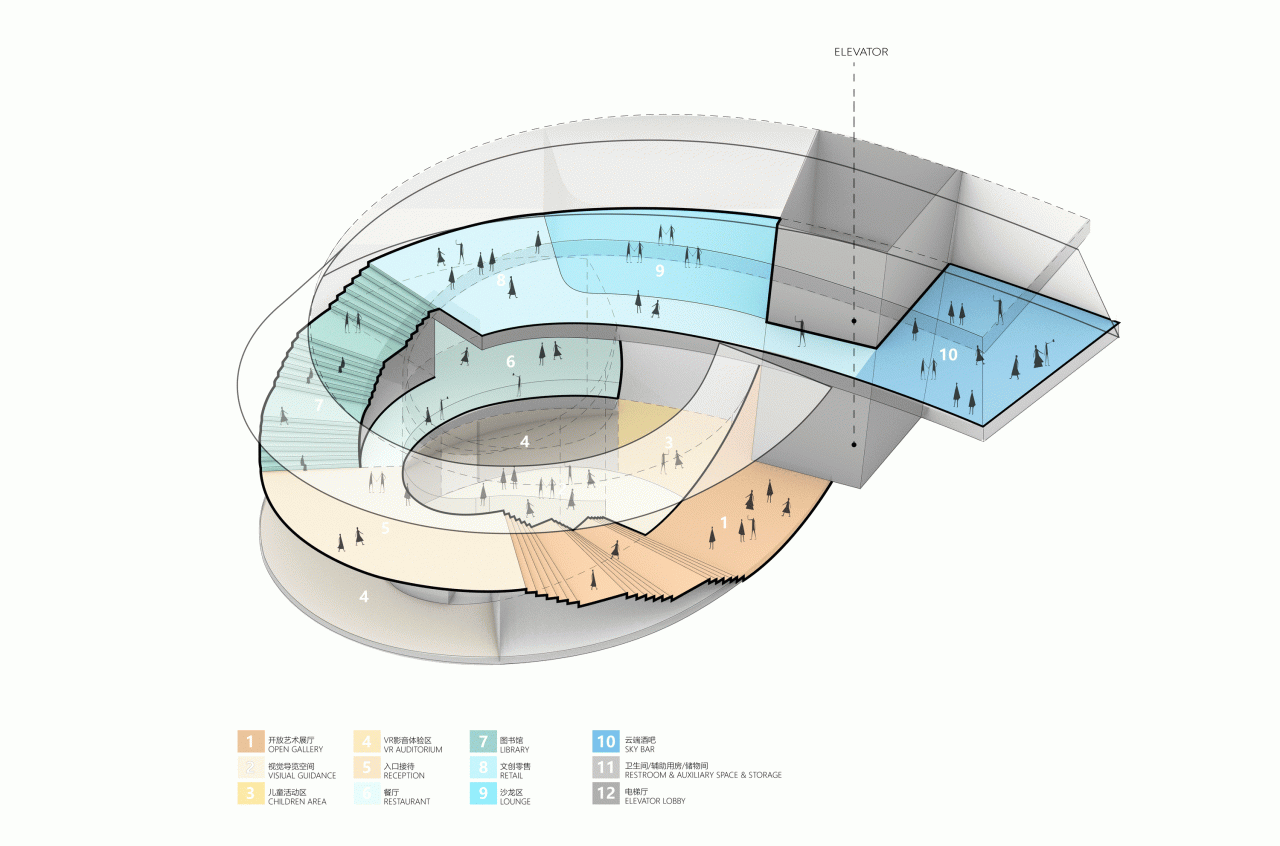
△ Circular Tour Route
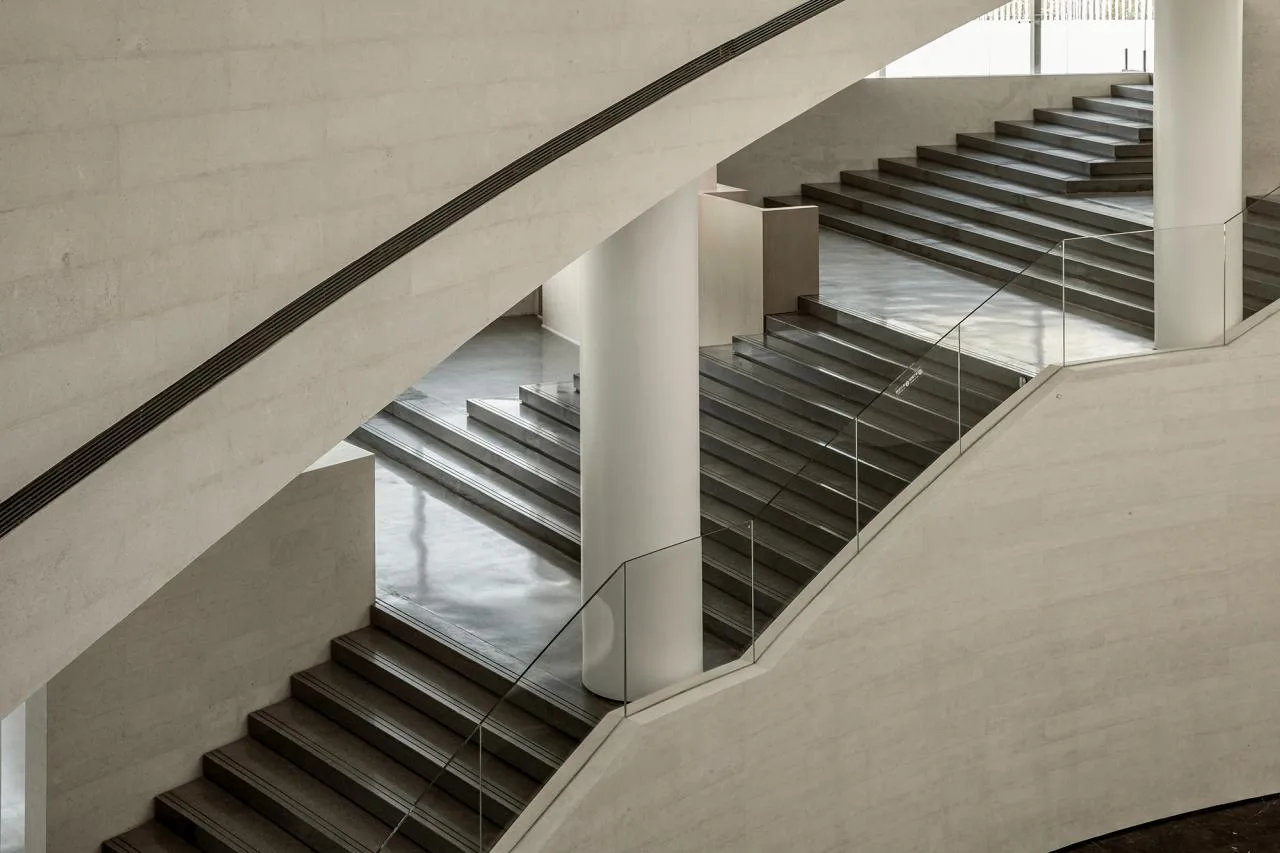
Indoor functions revolve around the central atrium, unfolding sequentially along large steps. Despite functional transformations, the spatial flow remains consistent throughout the visitor experience.
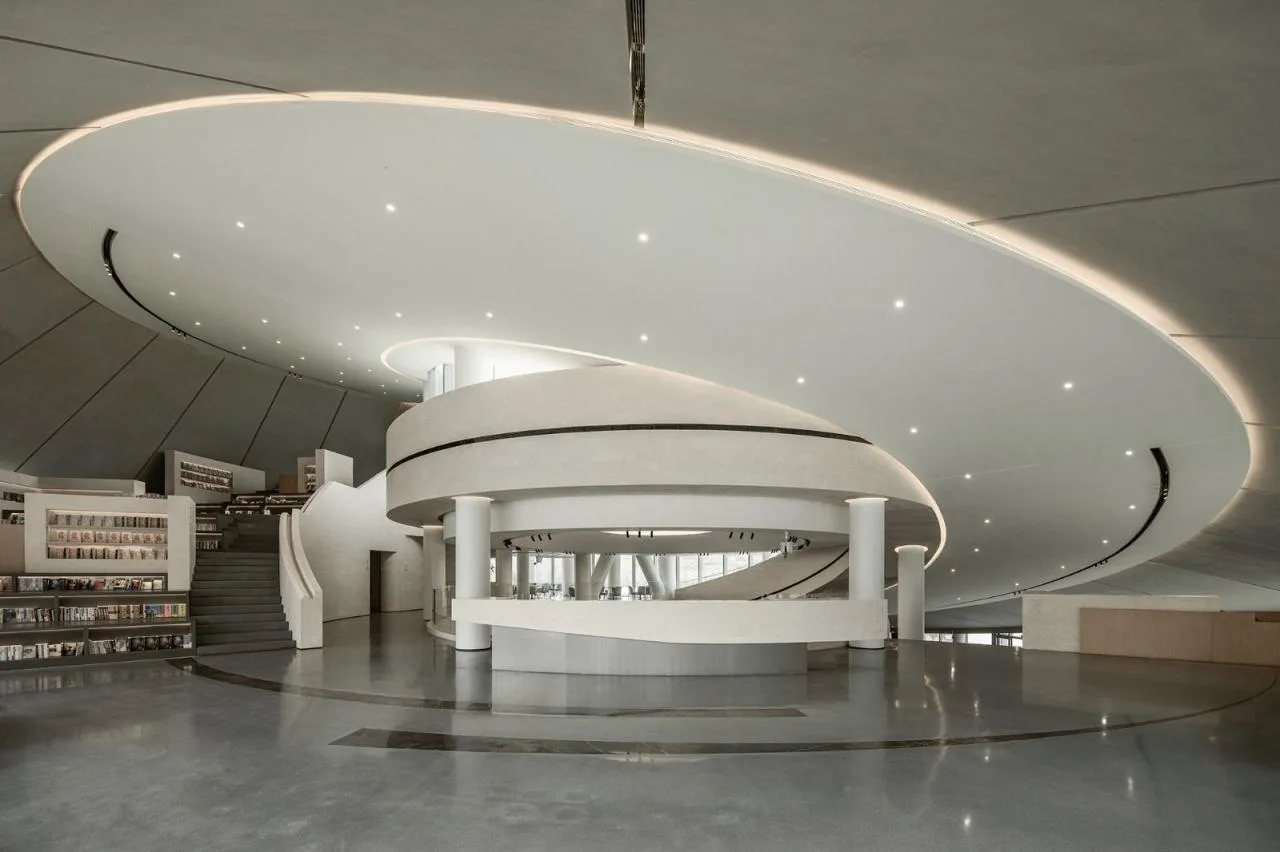
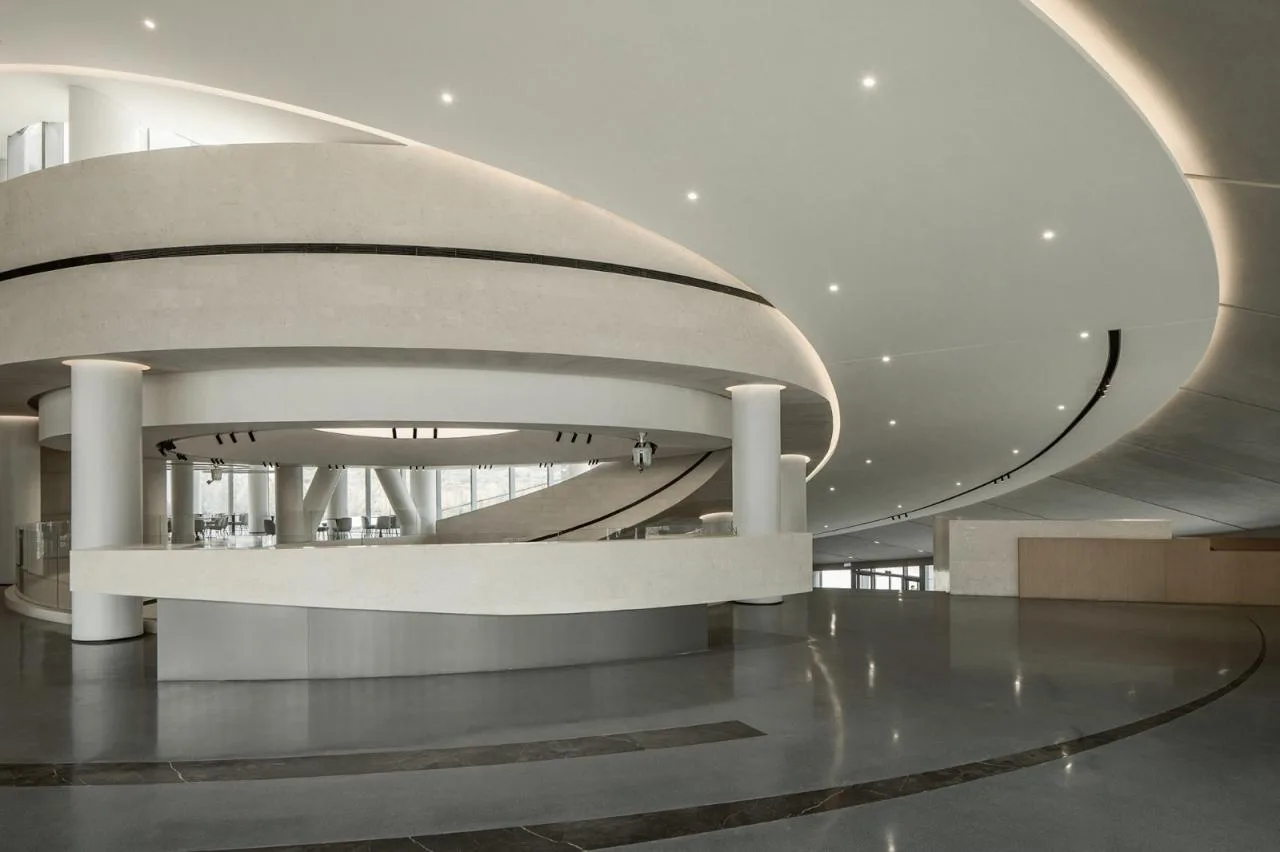
The open art exhibition hall and library are centered around the main staircase and connected via the entrance reception. Visitors proceed through a salon and cultural-creative sales area to reach the Cloud Cafe, which offers panoramic views of Mount Taishan.
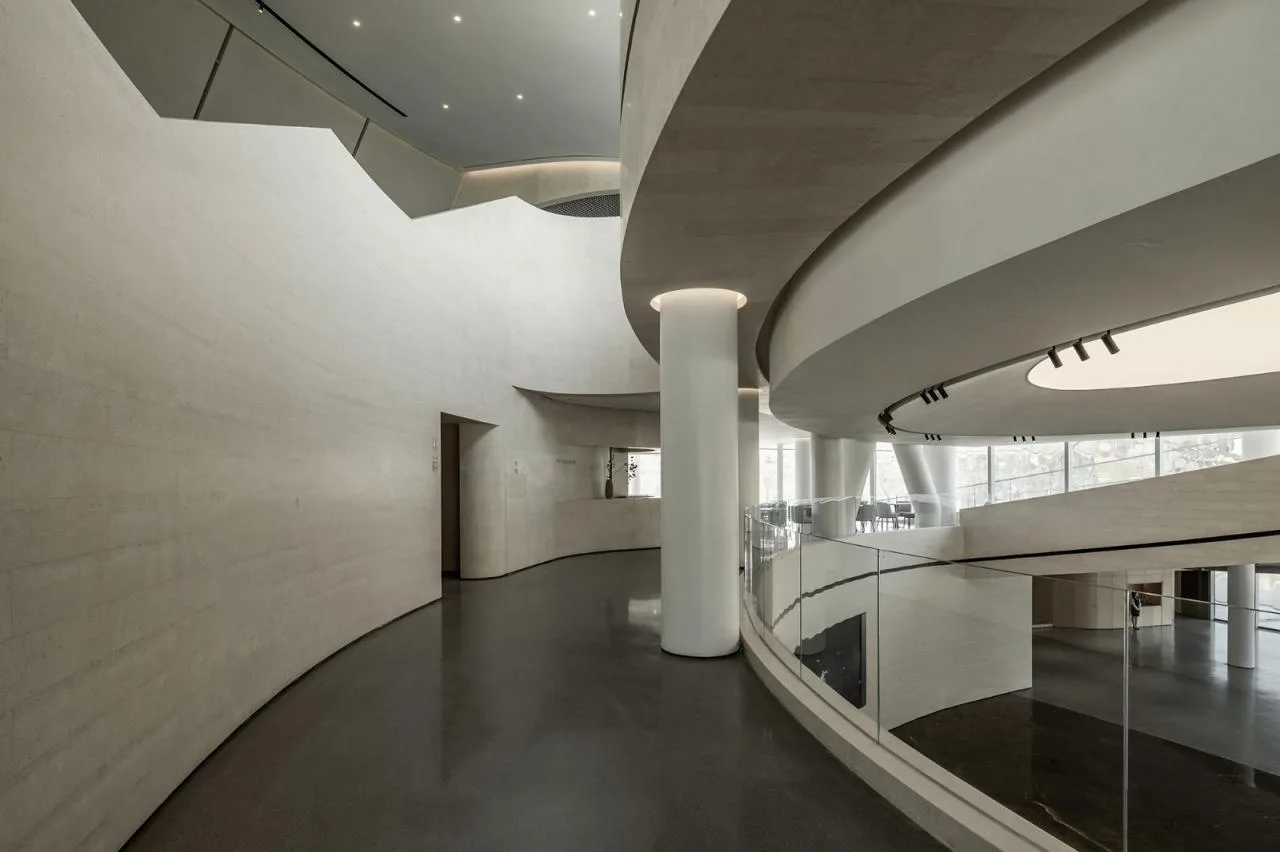
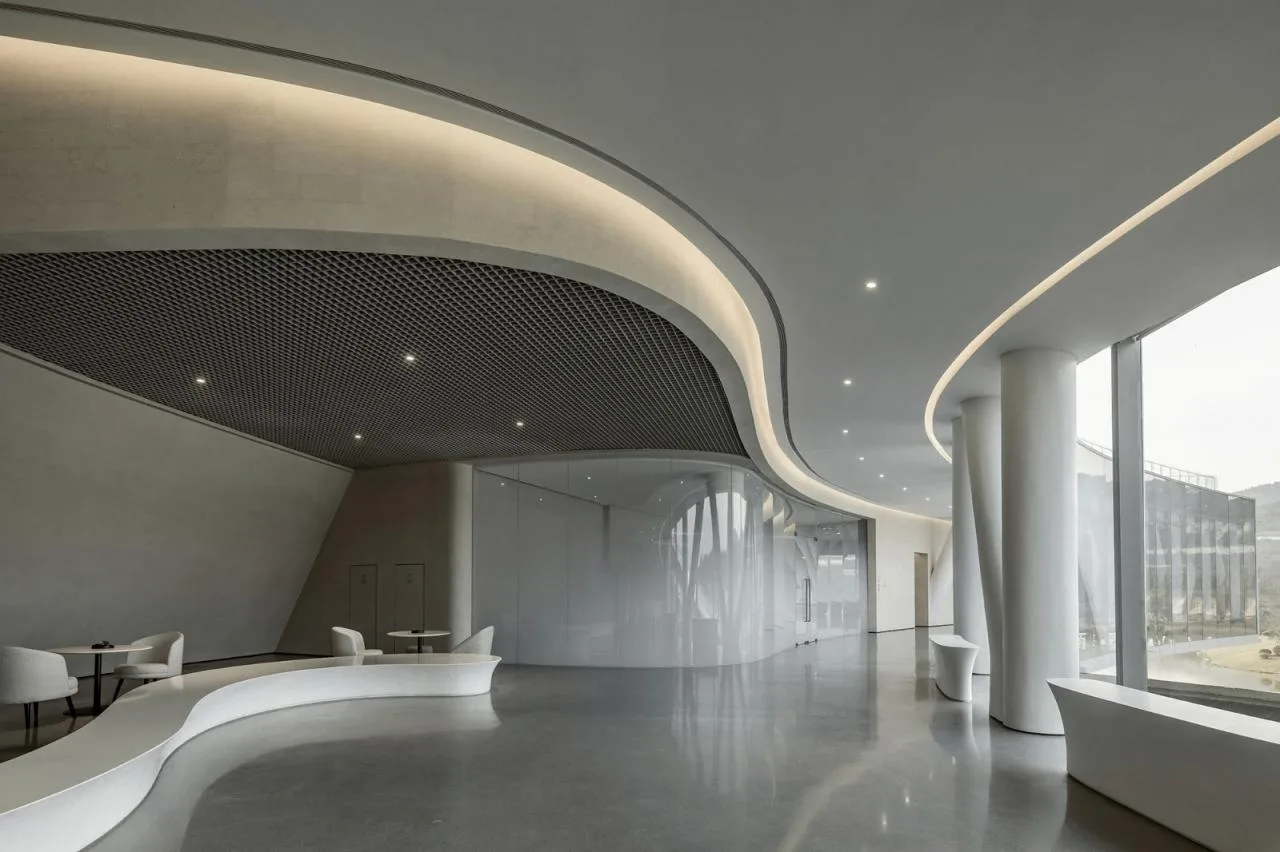
Soft, continuous curves define the interior design language. The solid, stable texture of stone enhances the space’s stability, while the monochromatic color palette creates a serene atmosphere.
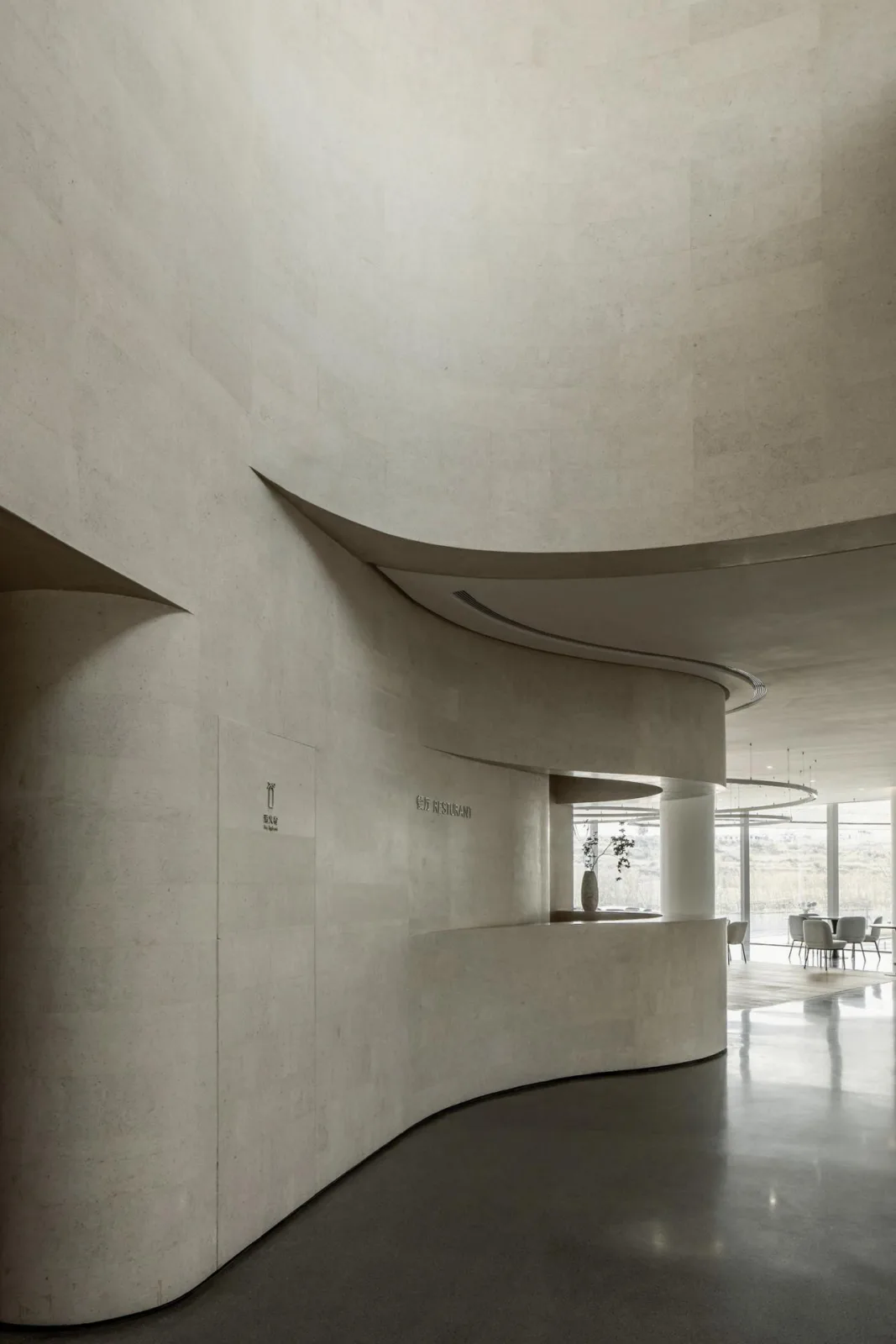
Dynamic lines organize the interior space into coherent layers, aiming to maximize views of the external mountain scenery and create a spatial experience that allows visitors to move through and engage visually with the surrounding landscape.
Conclusion
As Frank Lloyd Wright once said, “Internal space cannot be independent of the external image. Internal and external spaces share a fluid relationship. If separated, the integrity is completely lost.”
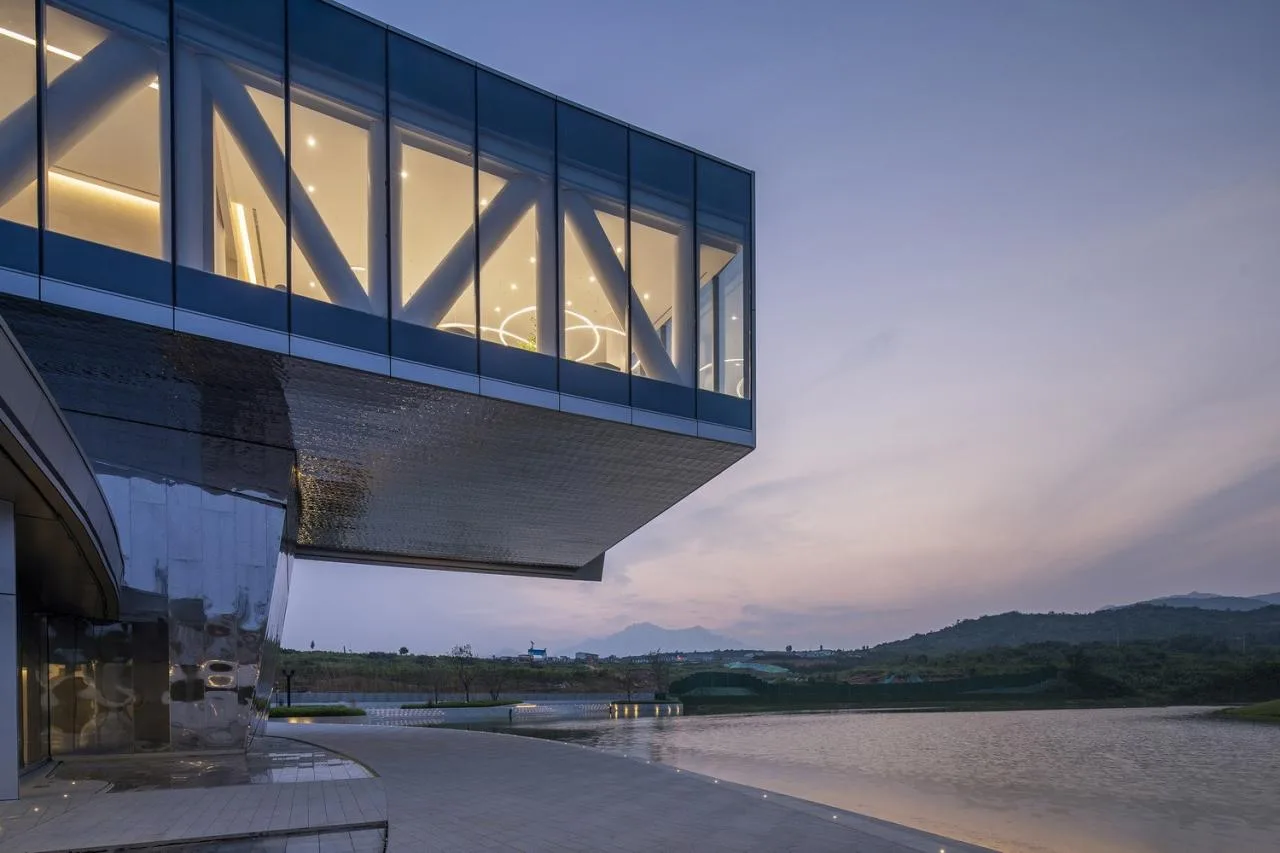
Fluidity is the core design logic permeating architectural form, spatial experience, and structural materials. Externally, the building’s undulating form flows naturally throughout the site, following organic lines. Internally, the integration and transition between ground floor, facade, and roof distribute human activity across different levels, creating a dynamic spatial system. The interior fully aligns with the exterior flow, with materials and spatial organization blending the experience seamlessly into the outdoor environment.
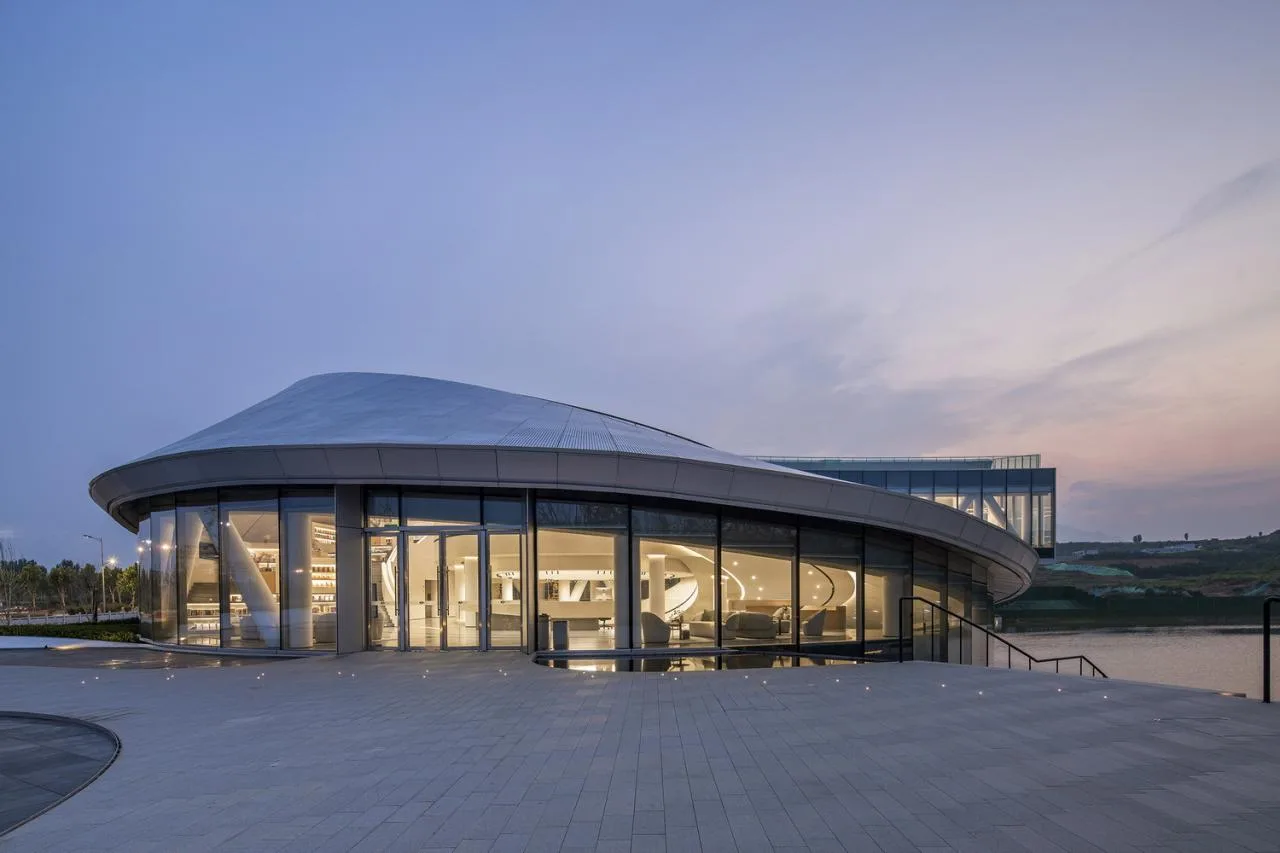
At night, the silver-gray curved curtain wall subtly shifts with the sky’s light, reflecting on the sparkling lake and echoing the rolling Mount Taishan, harmoniously integrating the building into its site and surroundings.
Project Drawings
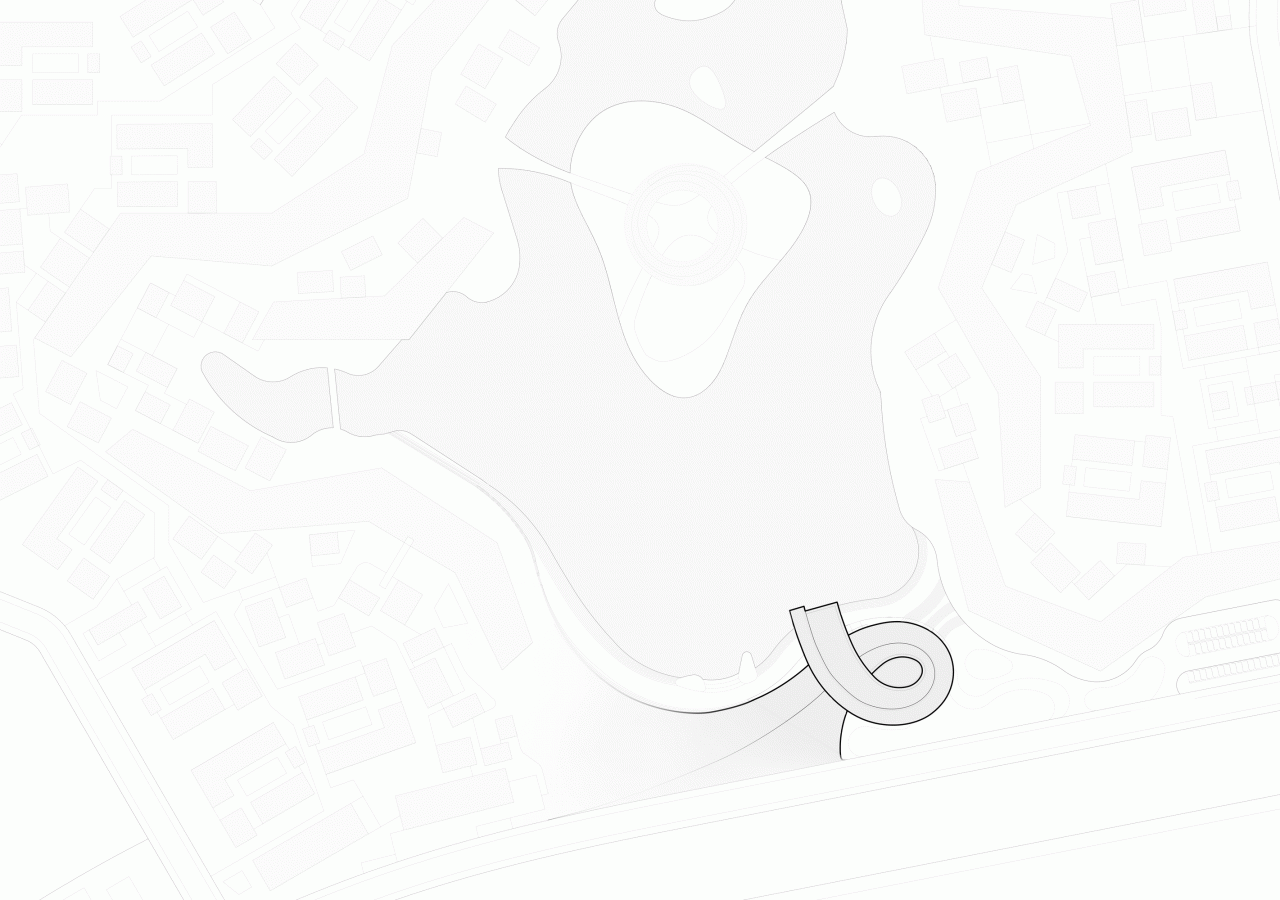
△ General Layout Plan
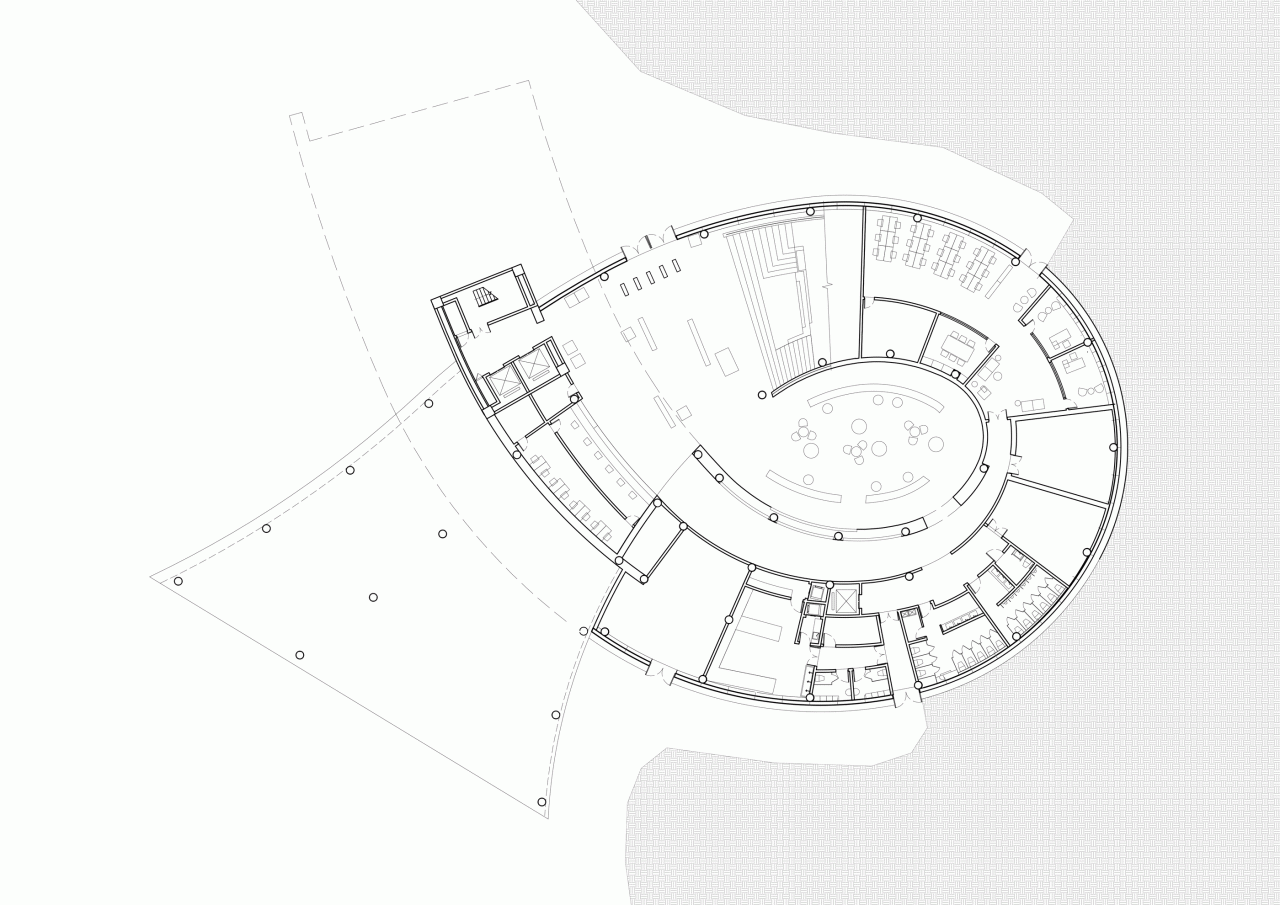
△ First Floor Plan
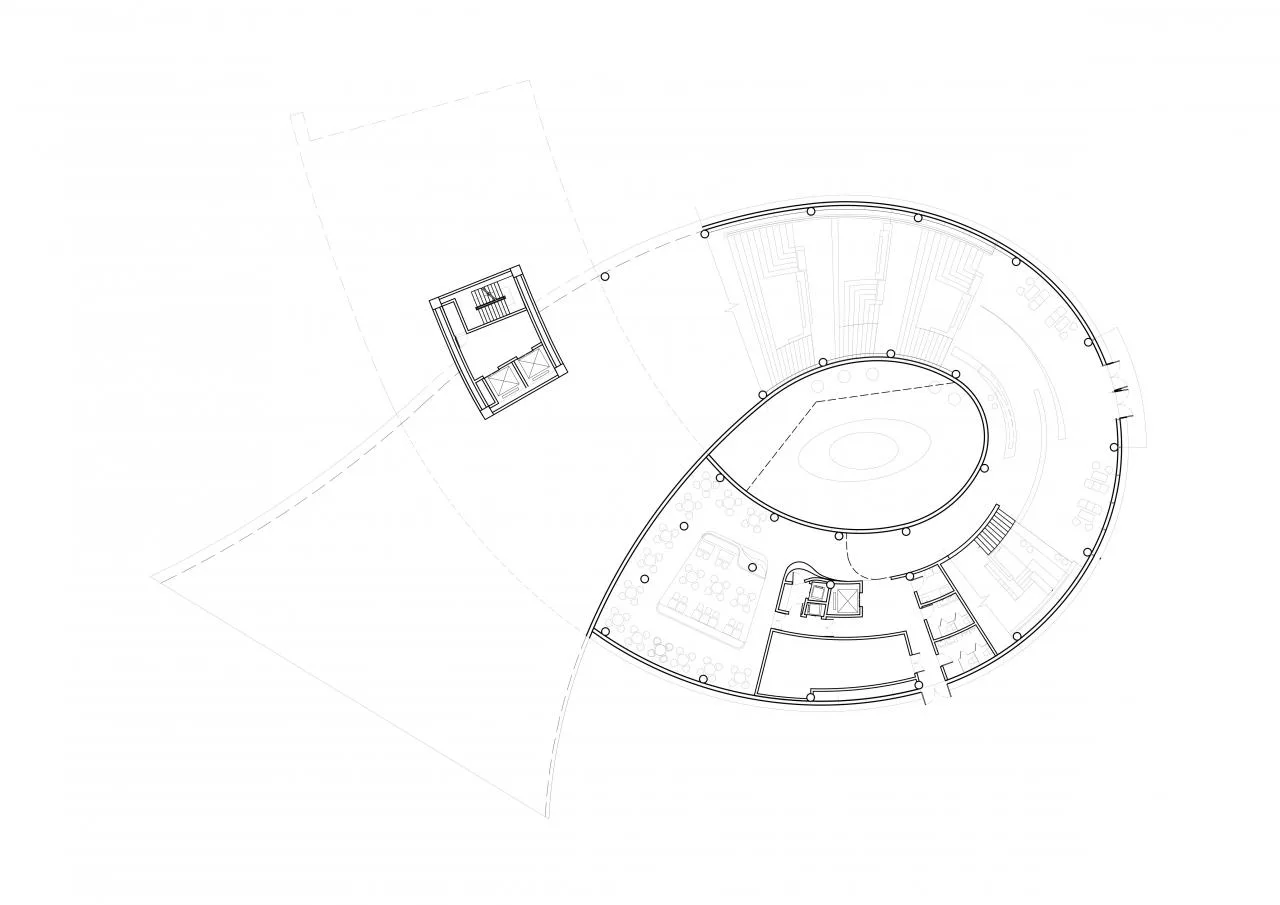
△ Second Floor Plan
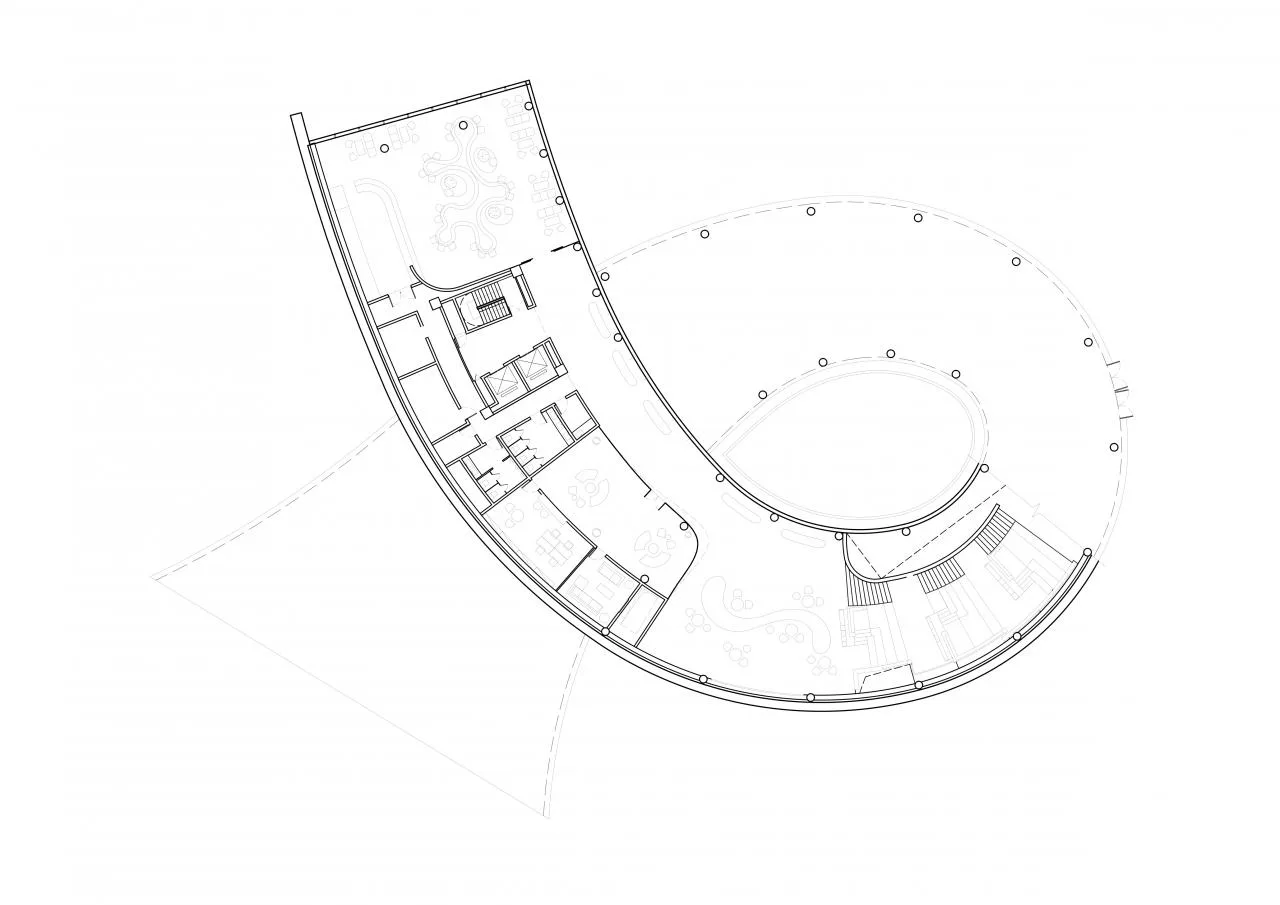
△ Third Floor Plan
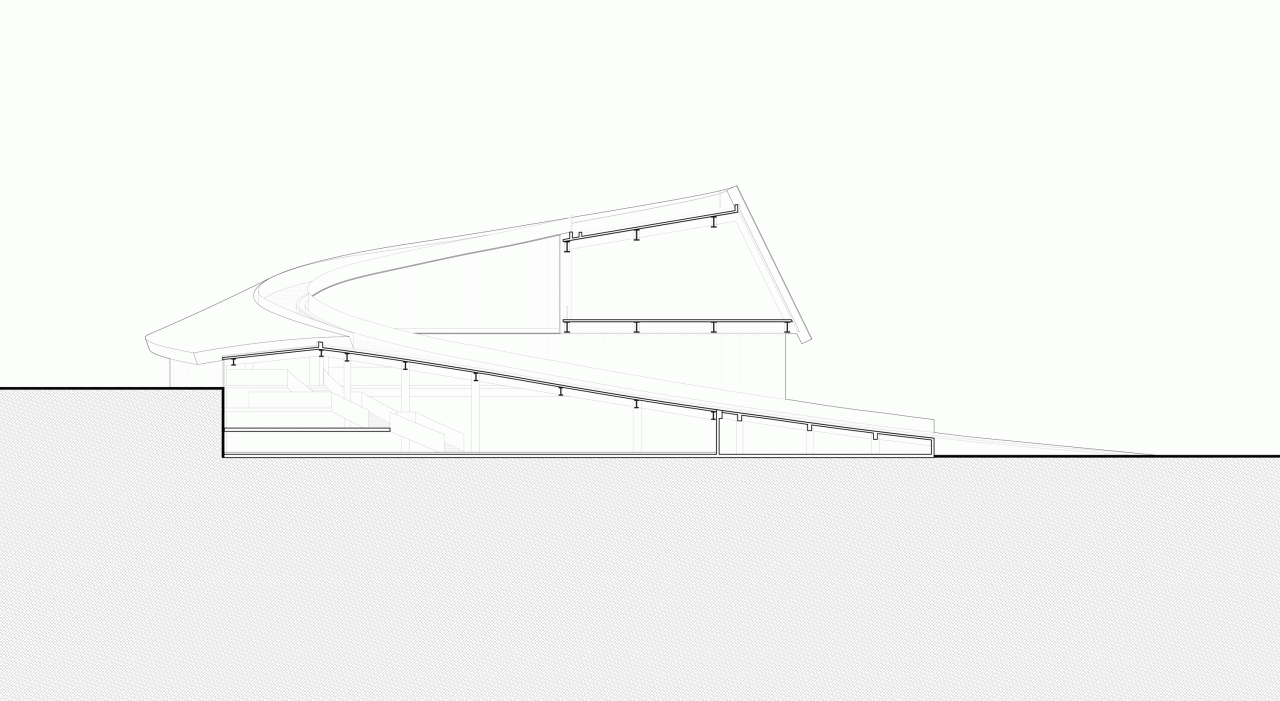
△ Section Diagram
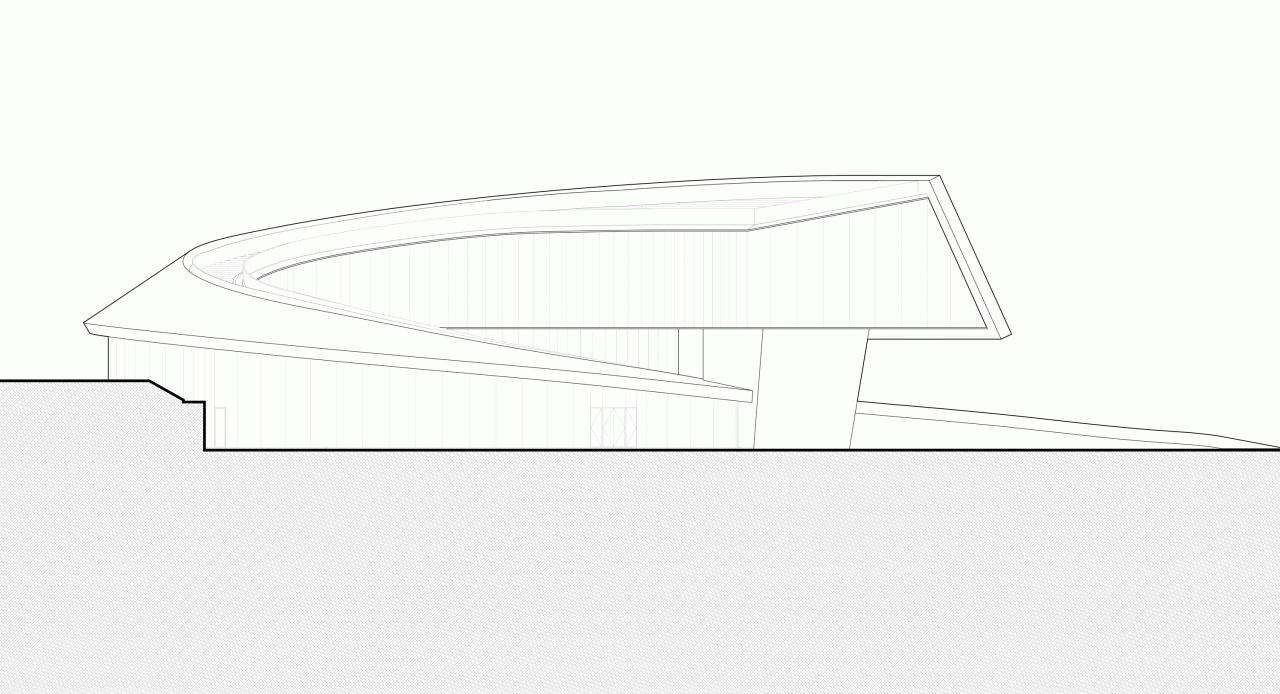
△ Elevation Drawing
Project Information
Project Name: Mount Taishan Youyou Tourist Center
Location: Tai’an, Shandong
Architecture, Interior, and Landscape Design: Line+ Architecture Firm gad
Lead Architect / Project Creator: Meng Fanhao
Professional Roles: Li Xinguang (Architecture), Zhu Jun (Interior), Li Shangyang (Landscape)
Design Team: Xing Shu (Architecture), Fan Xiaoxiao, Deng Hao, Ge Zhenliang, Yang Li, Zhang Sisi, Qiu Limin, Chen Wen (Interior), Jin Jianbo, Chen Xiaorong (Landscape)
Building Area: 4,402.75 square meters
Design Period: May 2020 – July 2020
Construction Period: August 2020 – August 2021
Owner: Tai’an Lushang Real Estate Co., Ltd.
Construction Drawing Design: Shandong Lushang Architectural Design Co., Ltd.
Structure: Steel frame and reinforced concrete frame
Materials: Perforated aluminum panels, mirrored stainless steel corrugated panels
Photography by Jin Weiqi
















Must log in before commenting!
Sign Up