
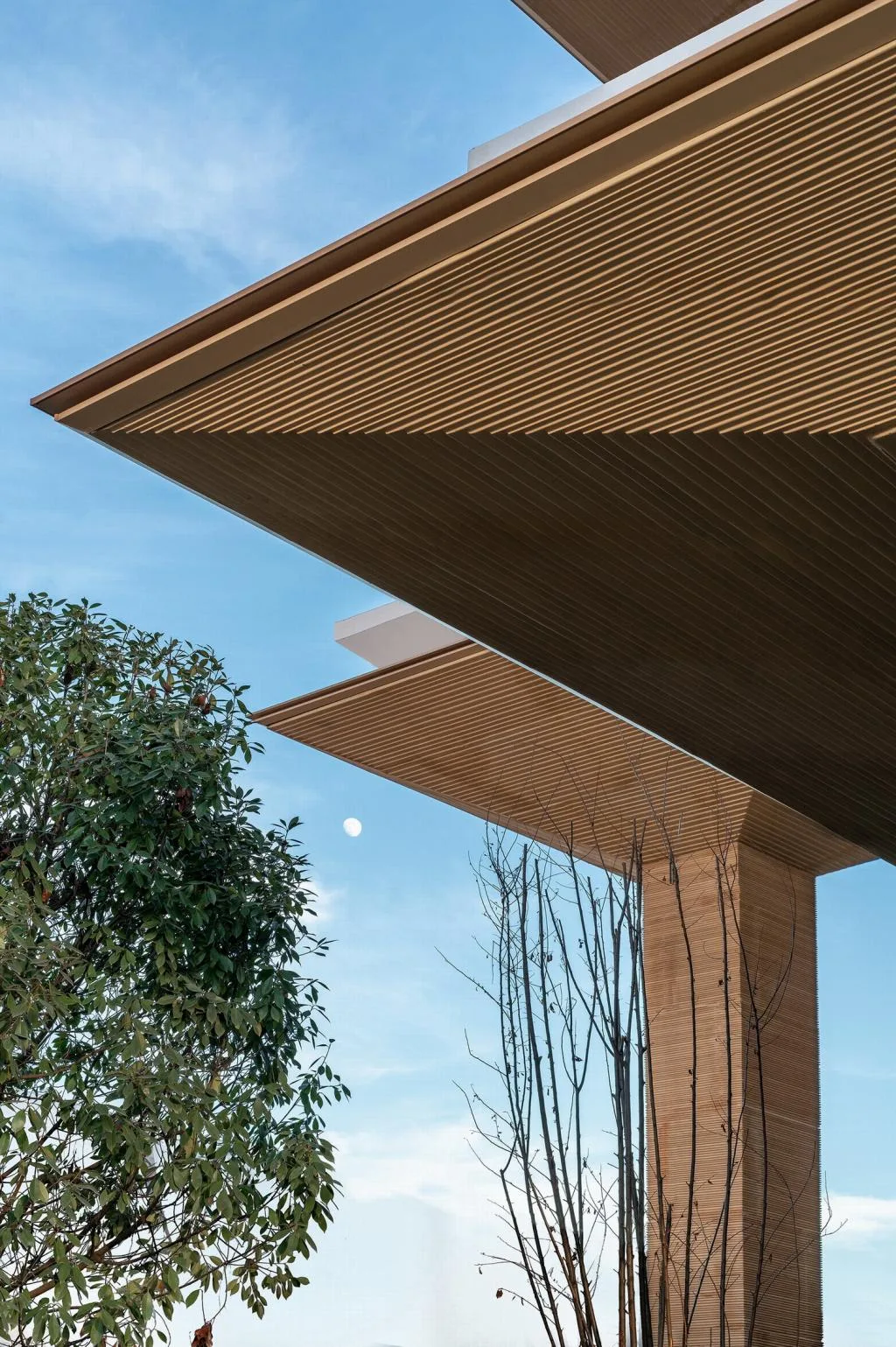
△ Photography © Xingzhi Image – Li Yi
Throughout our previous projects, we have consistently explored the harmonious relationship between man-made and natural elements—seamlessly blending architecture with its environment, abstractly responding to nature, or integrating natural elements into built forms. These endeavors have gradually shaped a holistic view where humans, architecture, and nature coexist harmoniously.
△ Photography © Xingzhi Image – Li Yi
Natural landscapes and ecological environments are not the sole means to maintain our emotional connection with nature. Thoughtfully designed artificial spaces that offer unique experiences of coexistence with nature can also inspire reflection and a deep yearning for the natural world.
— Zhu Peidong
△ Photography © Xingzhi Image – Li Yi
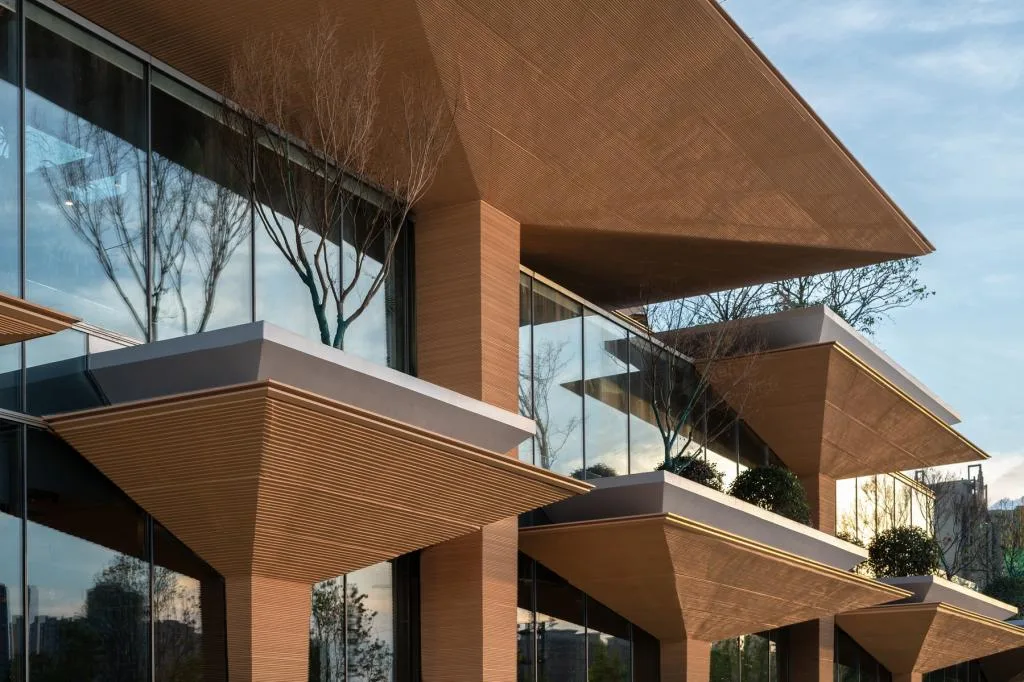
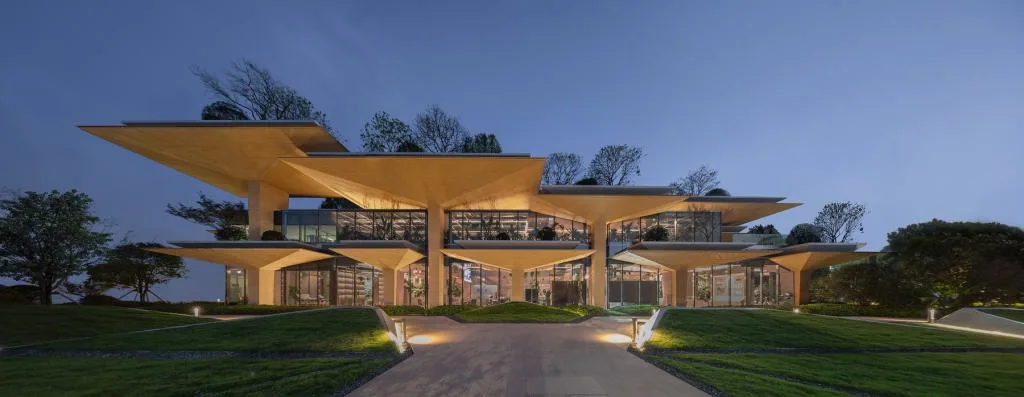
To foster a profound dialogue with nature within everyday urban settings, we drew inspiration from fractal geometry found in nature. We devised a new architectural prototype that uses the smallest structural units as fundamental spatial cells. These units, exhibiting a degree of self-similarity, grow and cluster under the influence of site conditions, functions, and circulation patterns, forming architectural forms akin to the organic growth of living organisms governed by natural laws.
These clearly defined structural units can be seen as the building’s cellular components, with internal logical order guiding their growth. By integrating human needs and layering real plants, the architecture gains the ability to “grow” continuously, much like living organisms.
△ Photography © Xingzhi Image – Li Yi
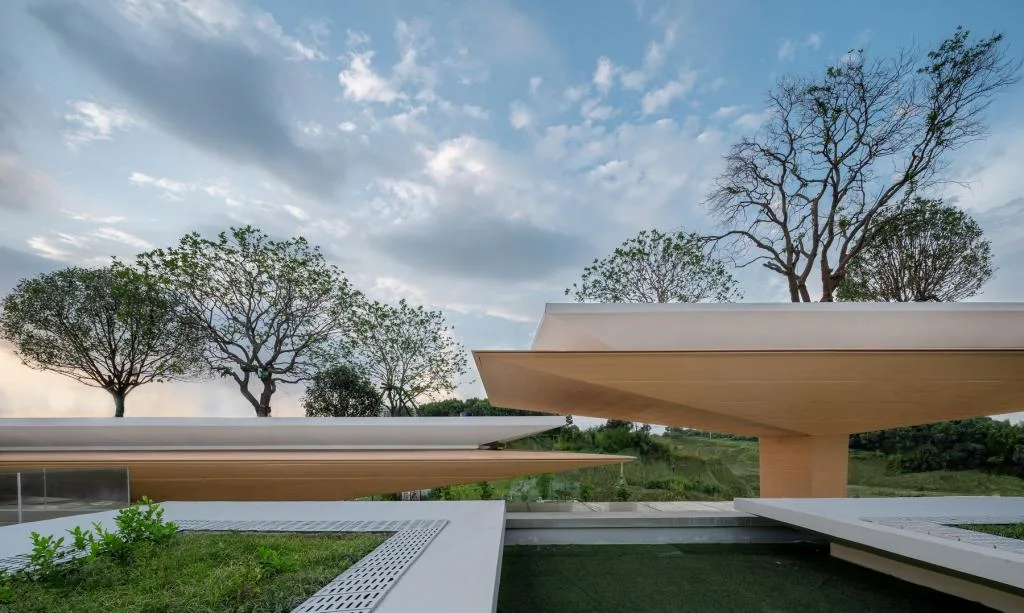
The “Umbrella Hill” lifestyle collection store, situated along a tributary of the Songya Lake Wetland in Changsha, embodies this prototype concept. We sought to reveal the inherent clarity of the basic spatial unit through explicit architectural form and authentic structural expression. By organizing the growth of these units, integrating multiple functions, and layering landscape vegetation, the project creates an extraordinary experience of artificial reconstruction within everyday urban scenery.
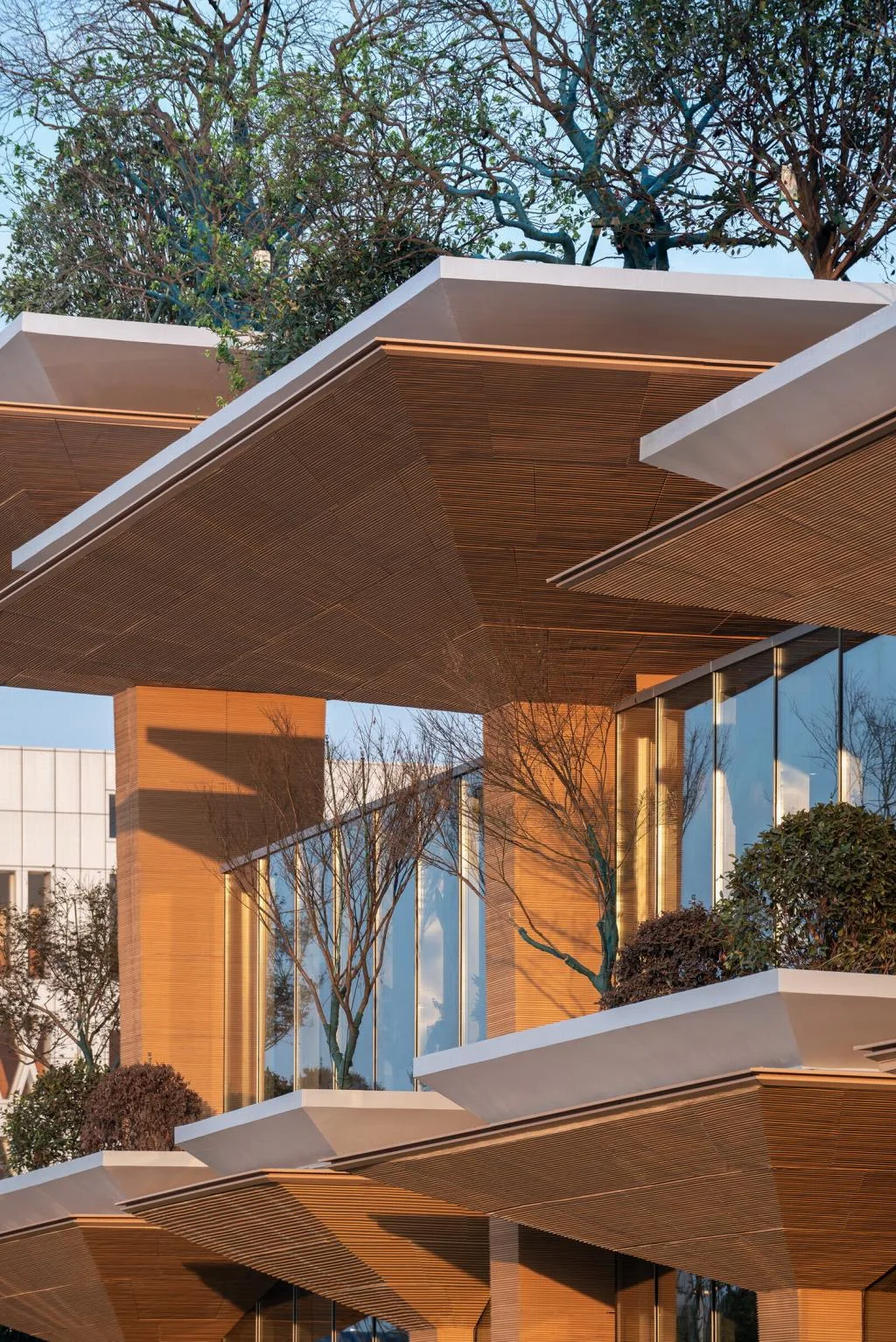
△ Photography © Xingzhi Image – Li Yi
01 Place and Prototype
Located approximately two kilometers from Songya Lake National Wetland Park in Changsha, Hunan, the site is bordered by two major urban roads to the east and north. To the south, a high-density residential community is under development, while the west side faces an urban river channel flowing from the wetland basin. The surrounding environment is a fragmented mix of artificial and natural elements amid rapid urbanization.
Faced with this site lacking distinctive characteristics, we aimed to invigorate the suburban everyday landscape by introducing a small, heterogeneous “hill”—the “Umbrella Hill.”
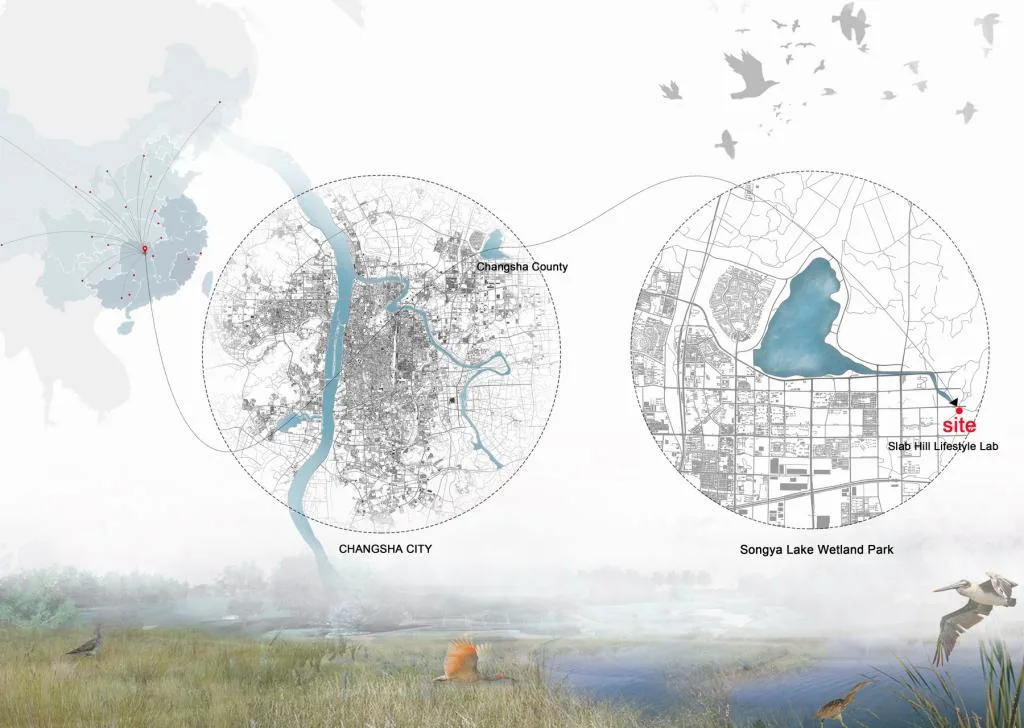
△ Location Map © line+
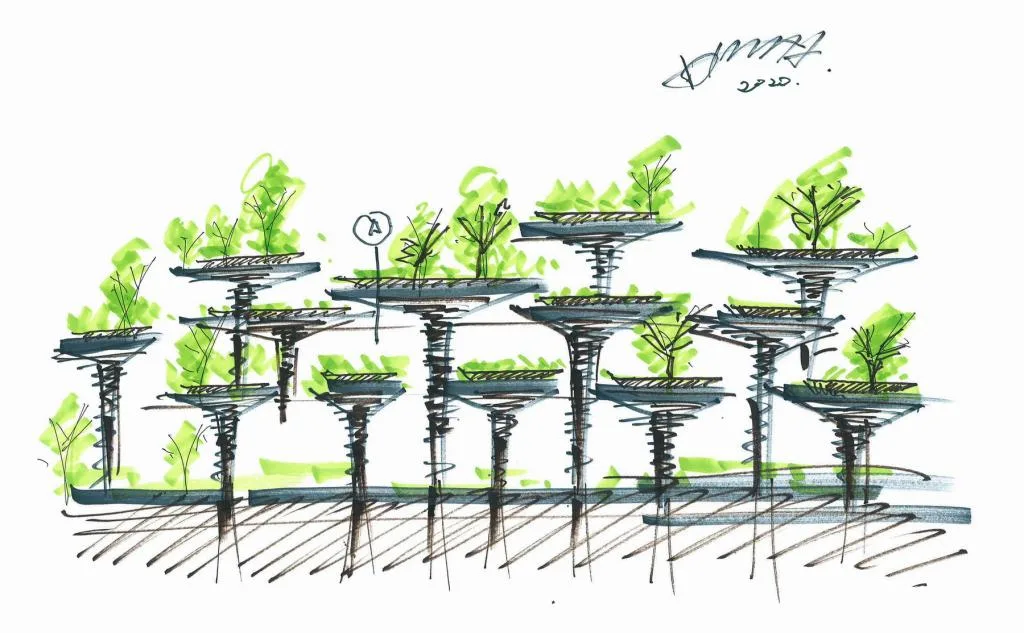
Concept sketch © line+
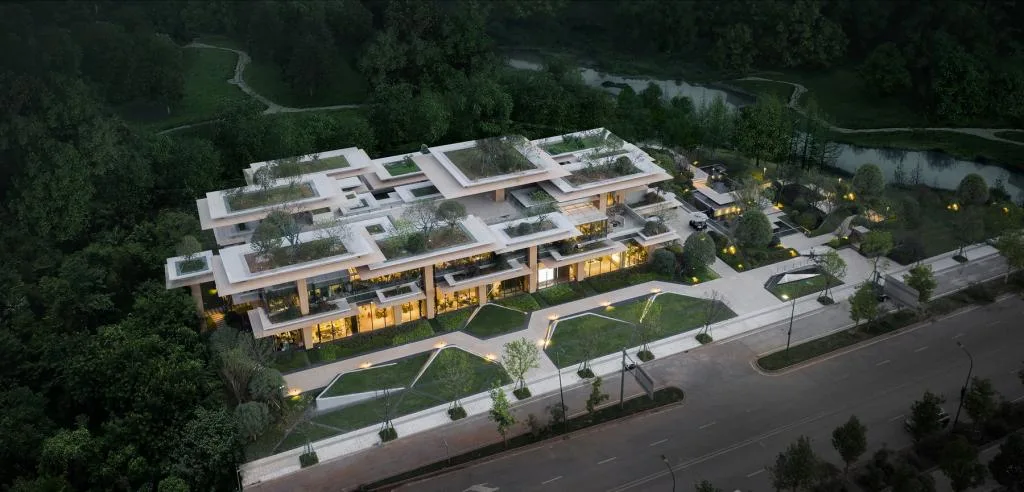
△ Photography © Xingzhi Image – Li Yi
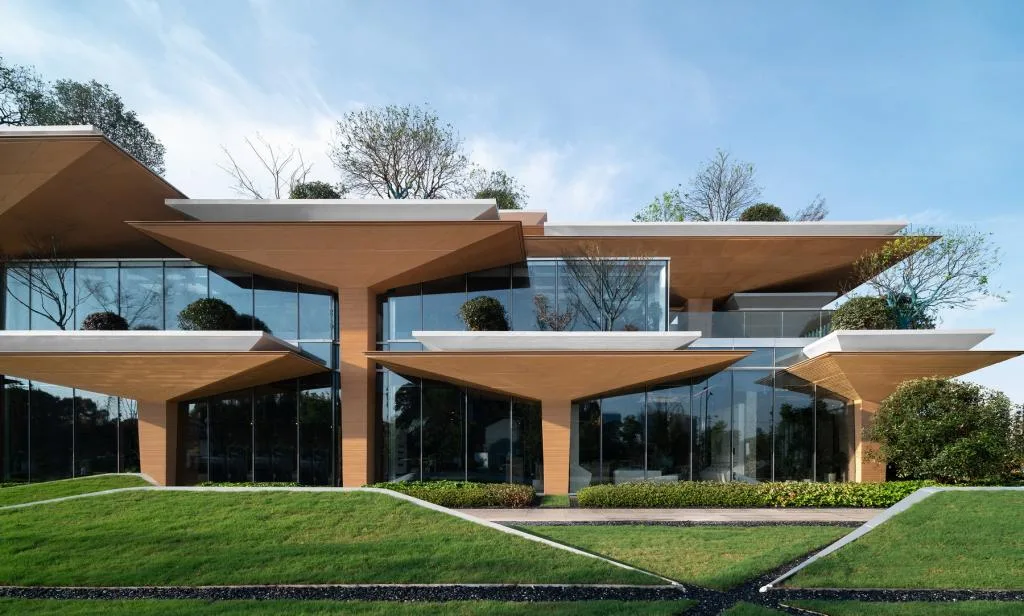
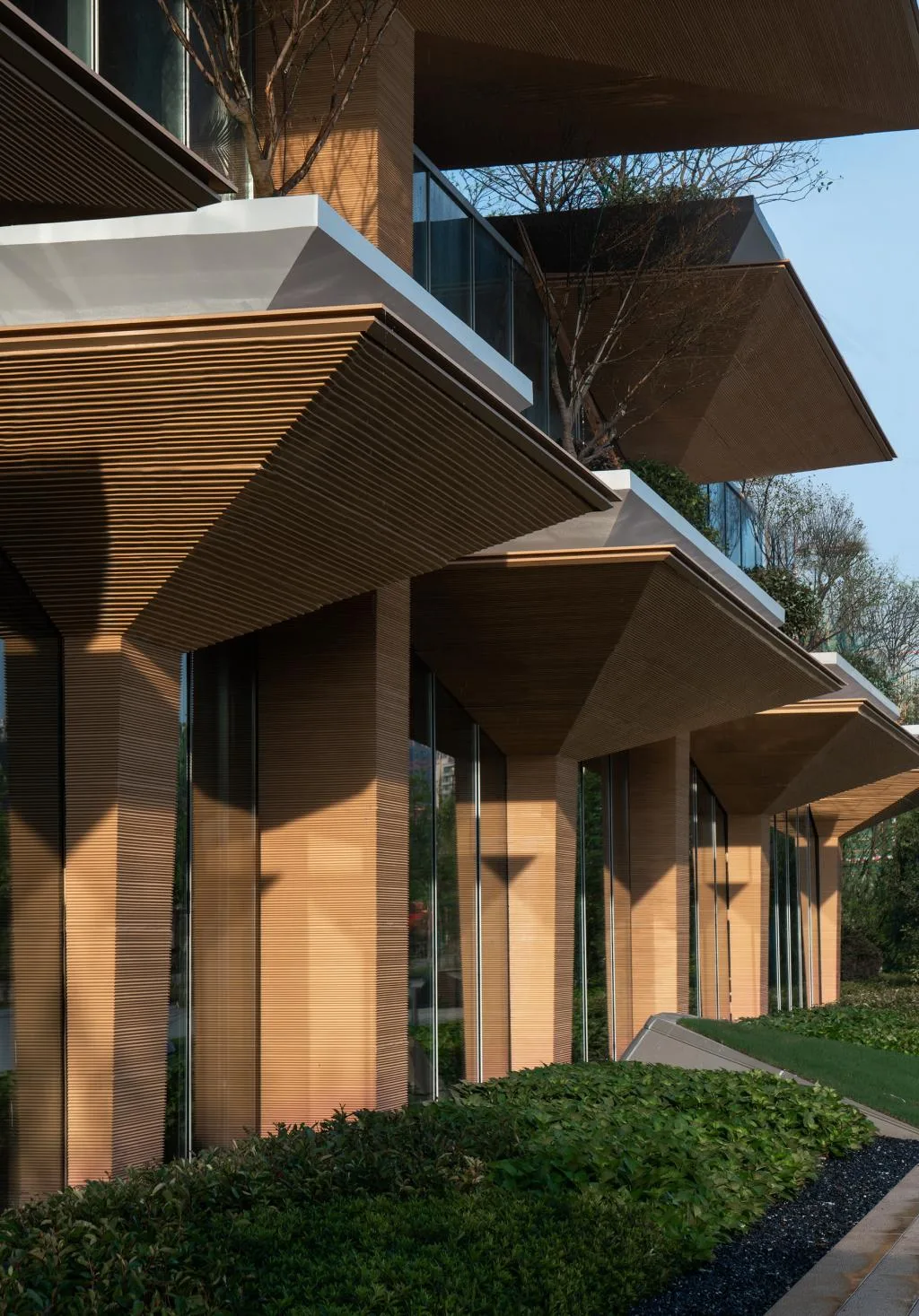
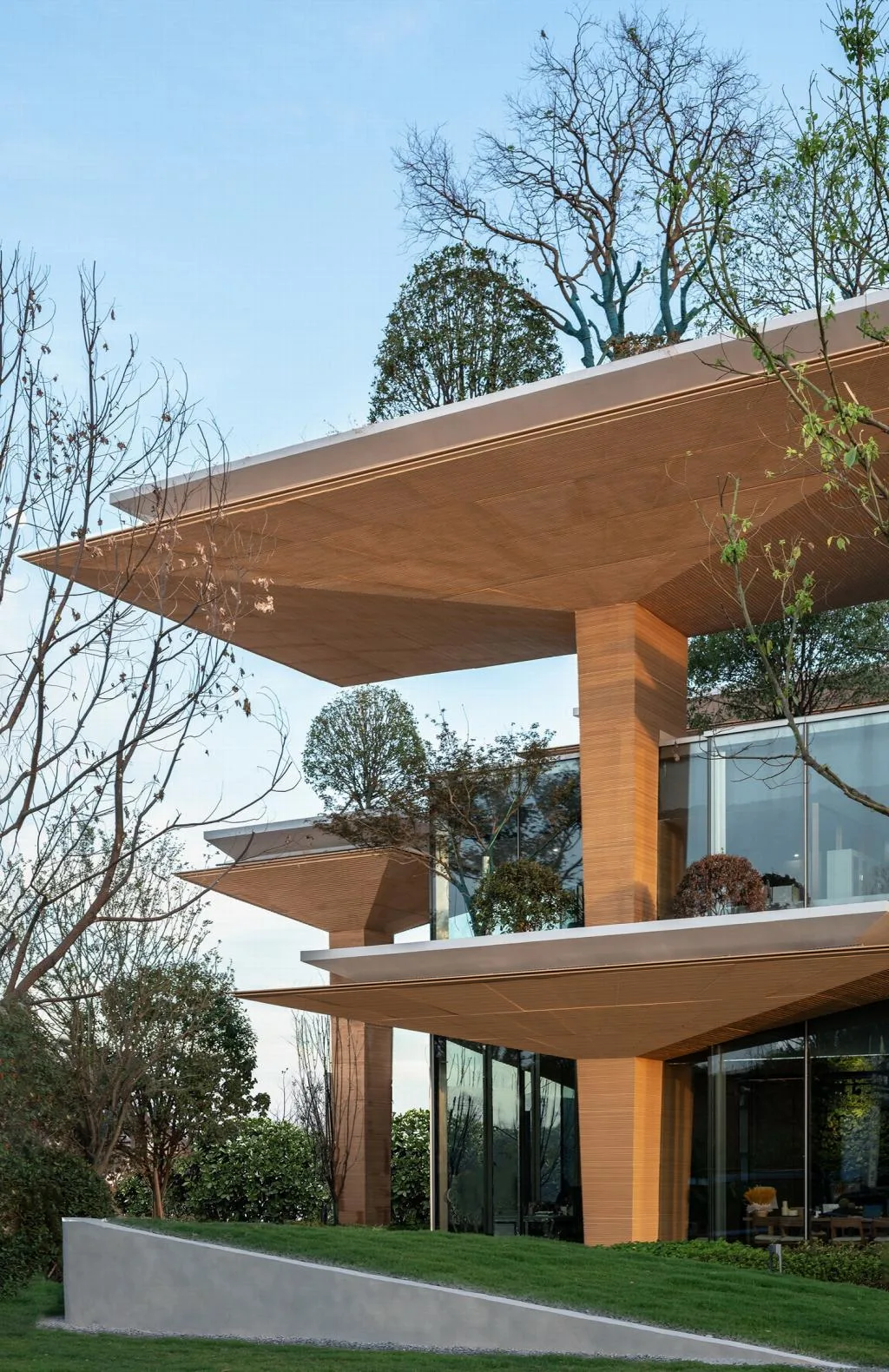
As its name implies, “Umbrella Hill” is an artificial hill formed by umbrella-shaped structural units. This shape was chosen for two reasons: firstly, its clear and concise structural system—an “umbrella handle” supporting an “umbrella canopy”—creates a distinct spatial domain; secondly, umbrella-shaped structures are common in nature, evident in various umbrella-shaped fungi and trees like the dragon blood tree.
This design imbues the umbrella-shaped structural system with both natural and rational qualities.
△ Photography © Xingzhi Image – Li Yi
02 Structure and Space
Building on the umbrella-shaped prototype as the basic cell, we developed three structural unit sizes: 6 × 6 meters, 6 × 12 meters, and 9 × 18 meters, all based on a 3-meter module. The design addresses spatial requirements by incorporating 45 umbrella-shaped units that meet seismic standards, featuring a uniform 2-meter canopy edge and limited connections. These units combine in modular sequences to form a cohesive “growth” plane.
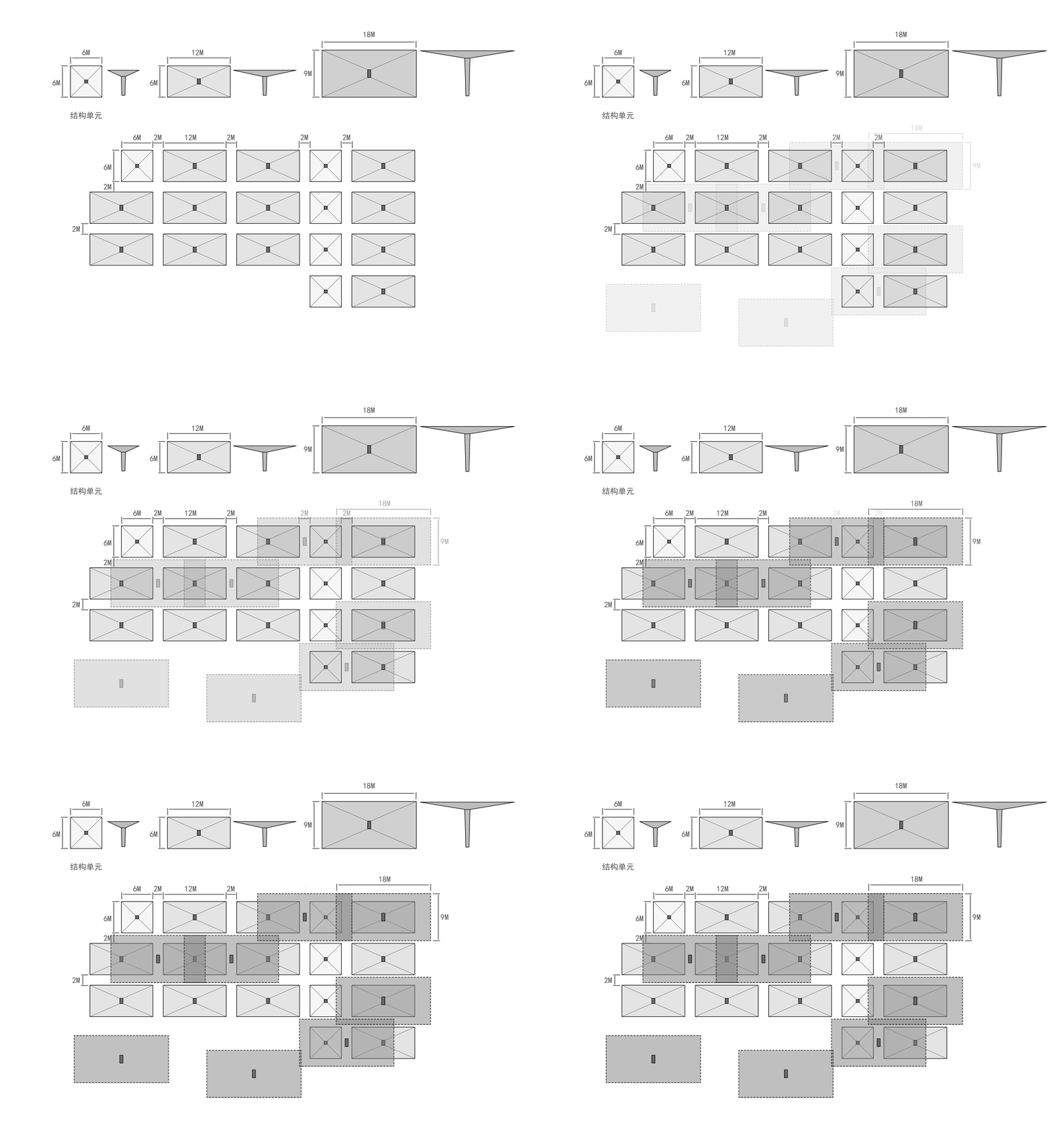
△ Structural unit © line+
△ Photography © Xingzhi Image – Li Yi
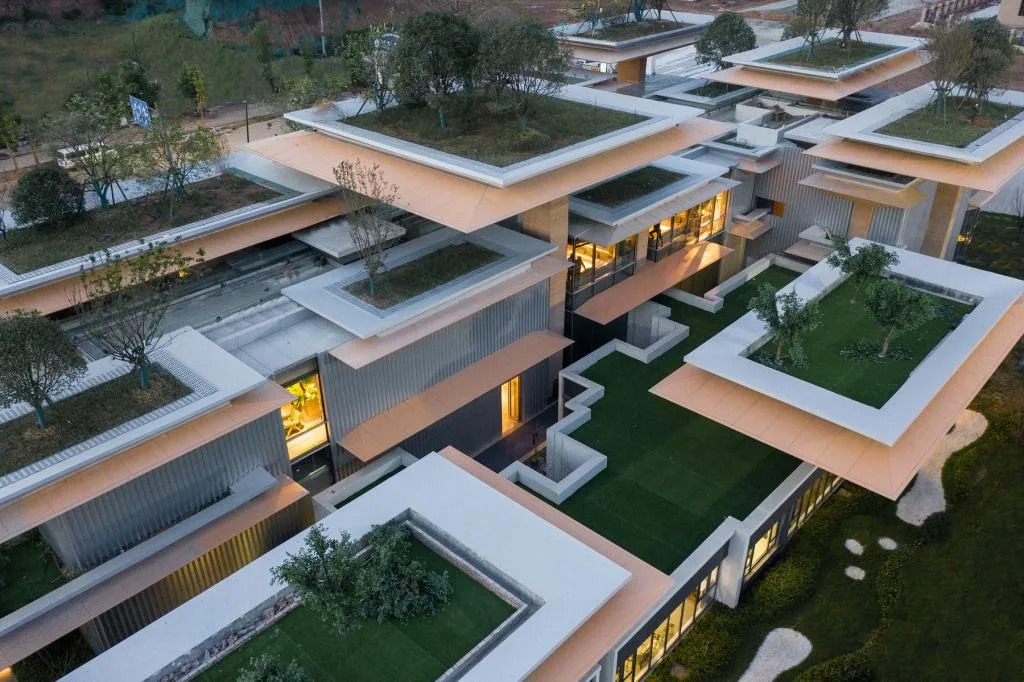
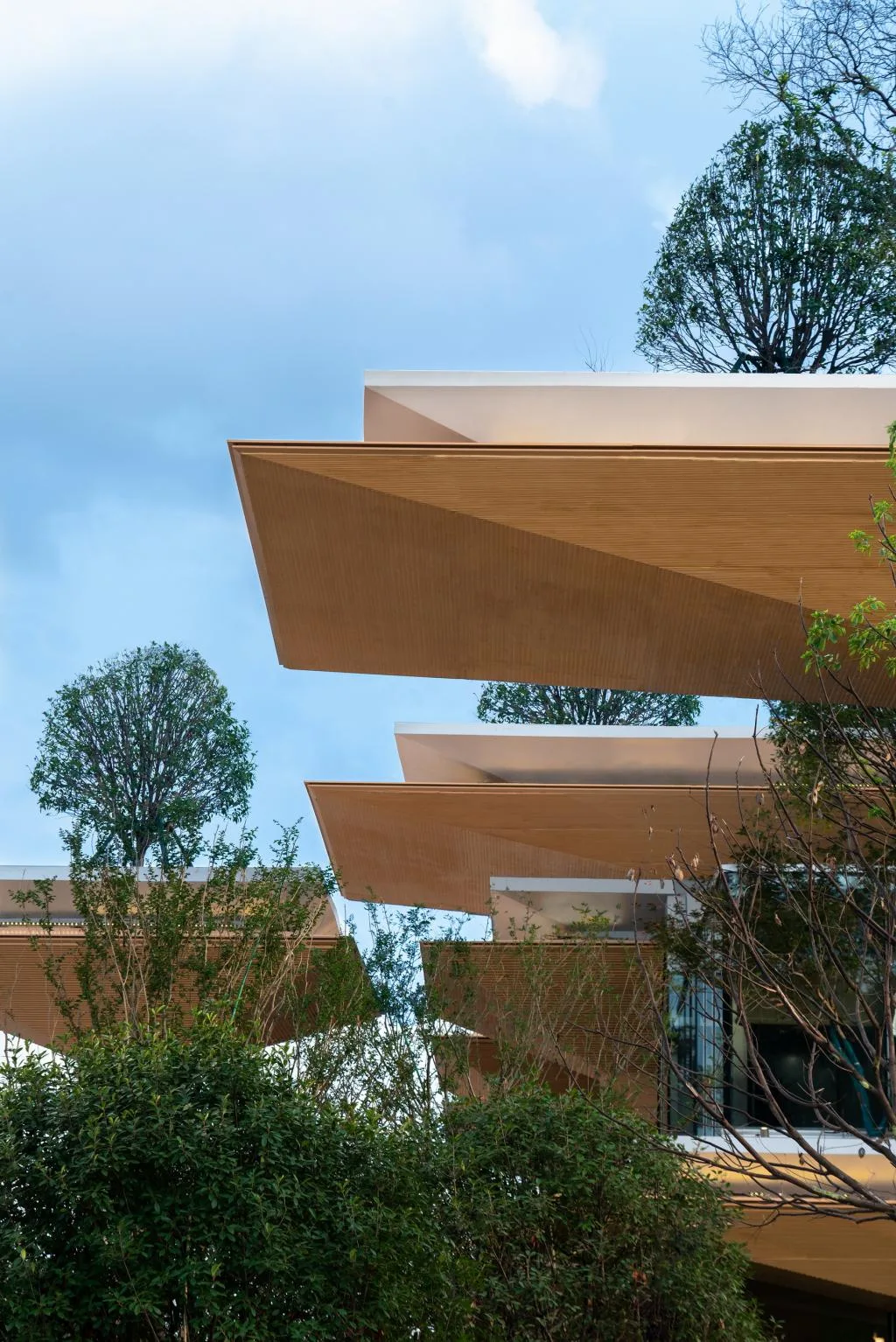
Due to site constraints and commercial needs, some functions are arranged vertically. To address floor placement in multi-story sections, umbrella canopies are staggered according to specific rules. This unified spatial order is intentionally disrupted locally to break homogeneity. This repetition and variation mimic nature’s randomness, creating a dynamic and varied atmosphere.
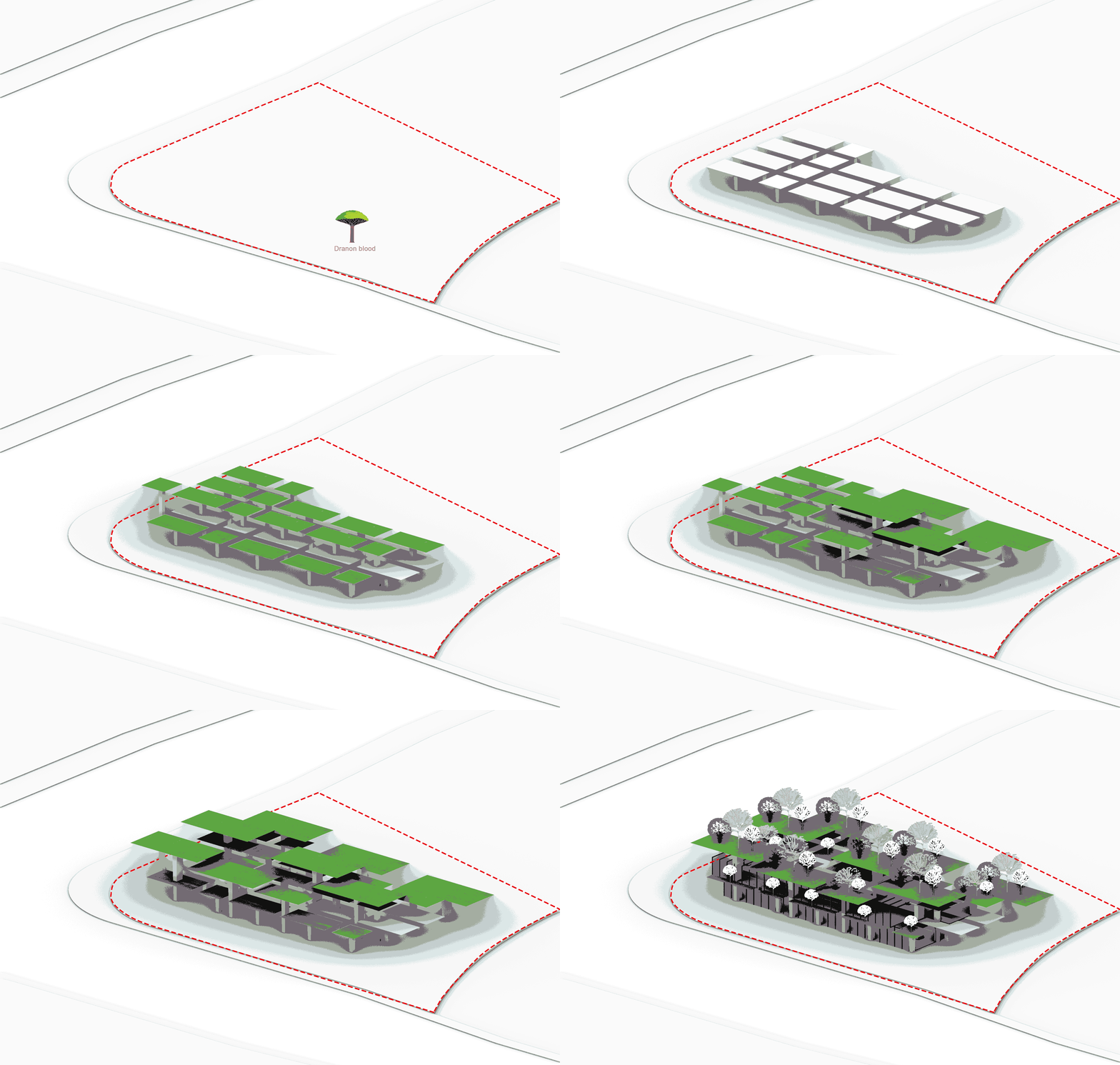
△ Block generation analysis © line+
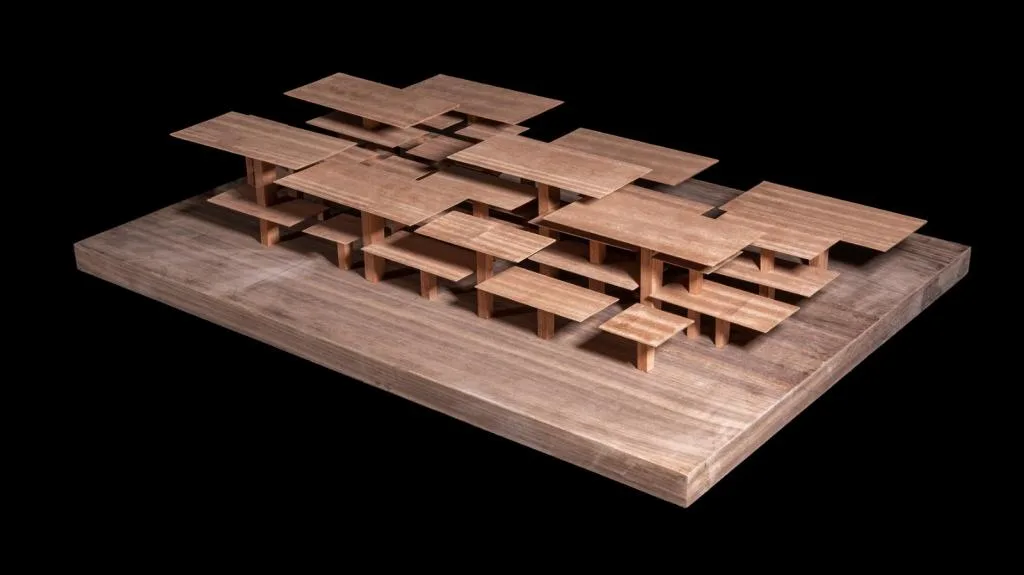
△ Model photography © Chen Xi
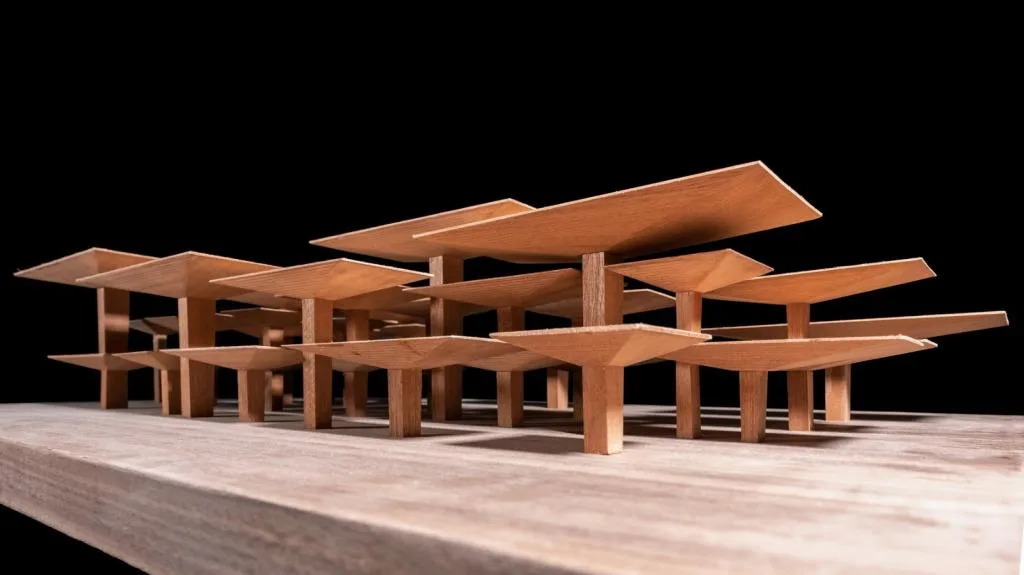
△ Model photography © Chen Xi
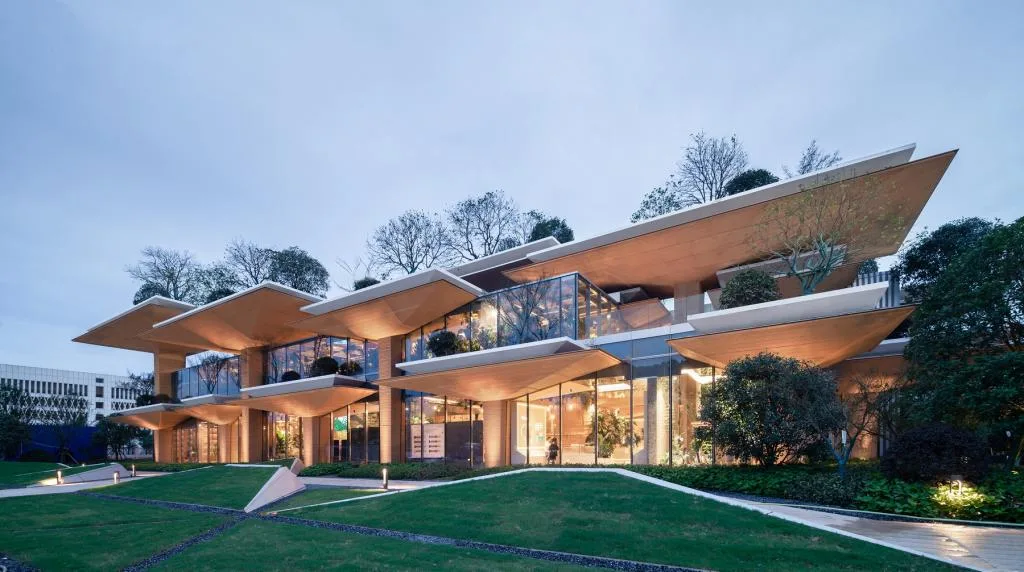
△ Photography © Xingzhi Image – Li Yi
Within this structural framework, multiple glass volumes nestle together to create transparent, blurred spatial boundaries, fostering a seamless visual connection between interior and exterior. The glass blocks fit between umbrella columns according to the column grid, and recessed joints highlight the structural articulation.
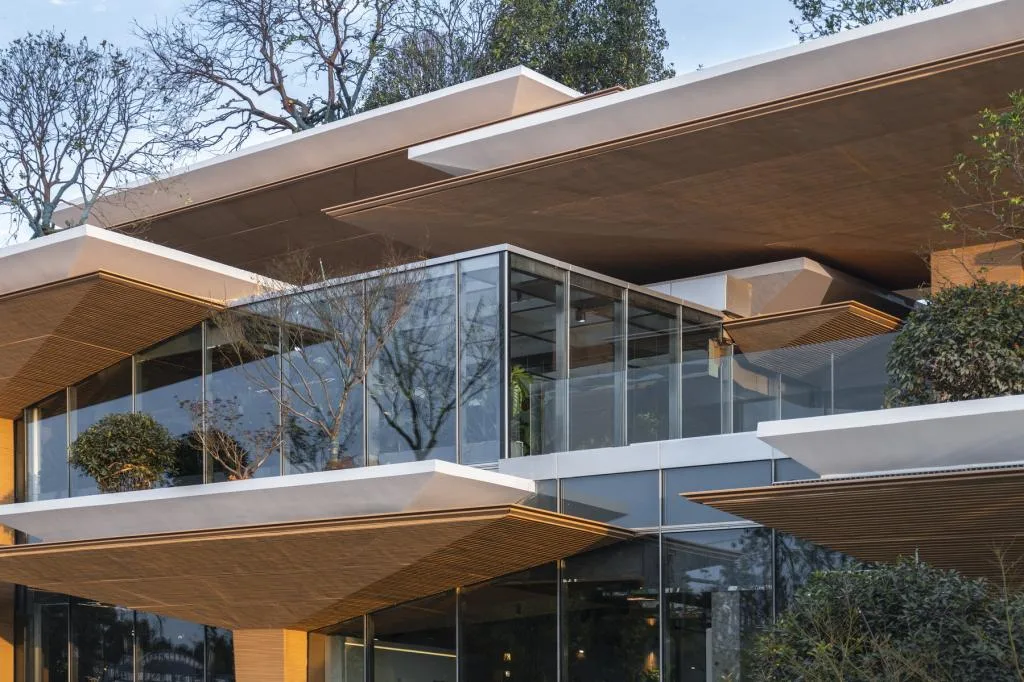
△ Photography © Xingzhi Image – Li Yi
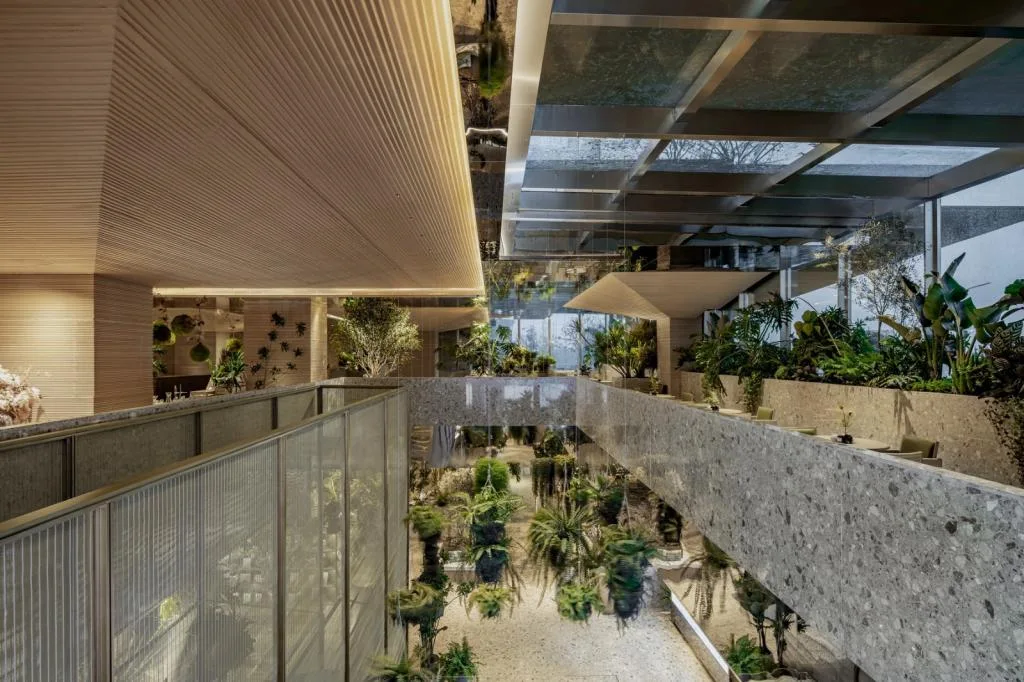
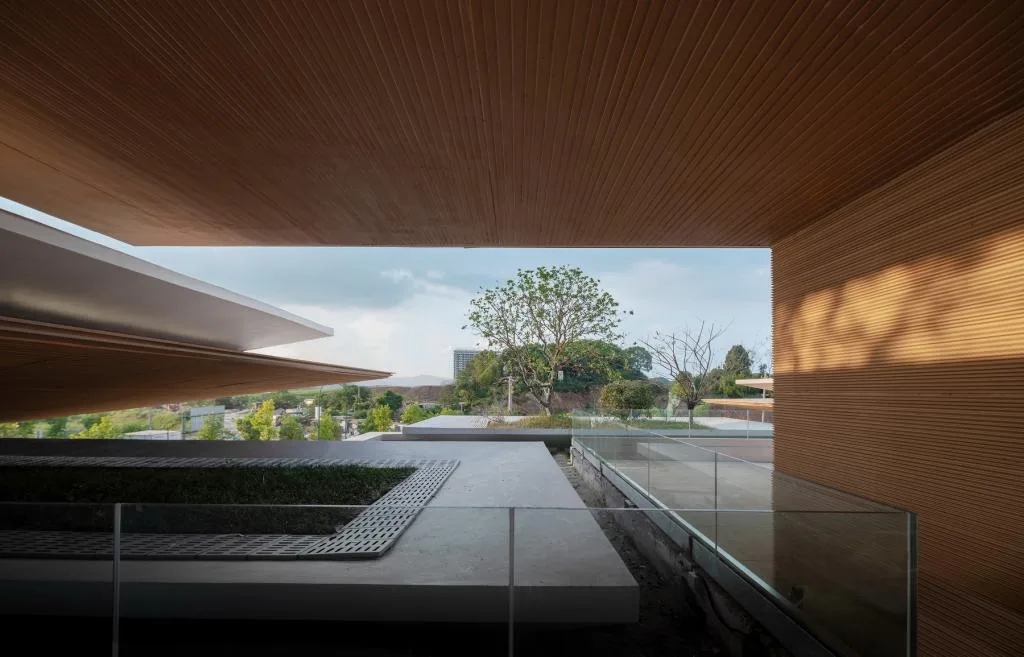
Inside, umbrella surfaces at the same elevation remain distinct, connected minimally by thin plates when necessary to enhance visibility of the structural units. Where umbrella canopies intersect at the highest indoor points, equipment pipelines are cleverly integrated and concealed, achieving an organic unity of architecture, structure, and systems. The staggered and layered arrangement of umbrella surfaces inside and outside allows natural light to filter through glass roofs, creating a unique semi-outdoor ambiance indoors.
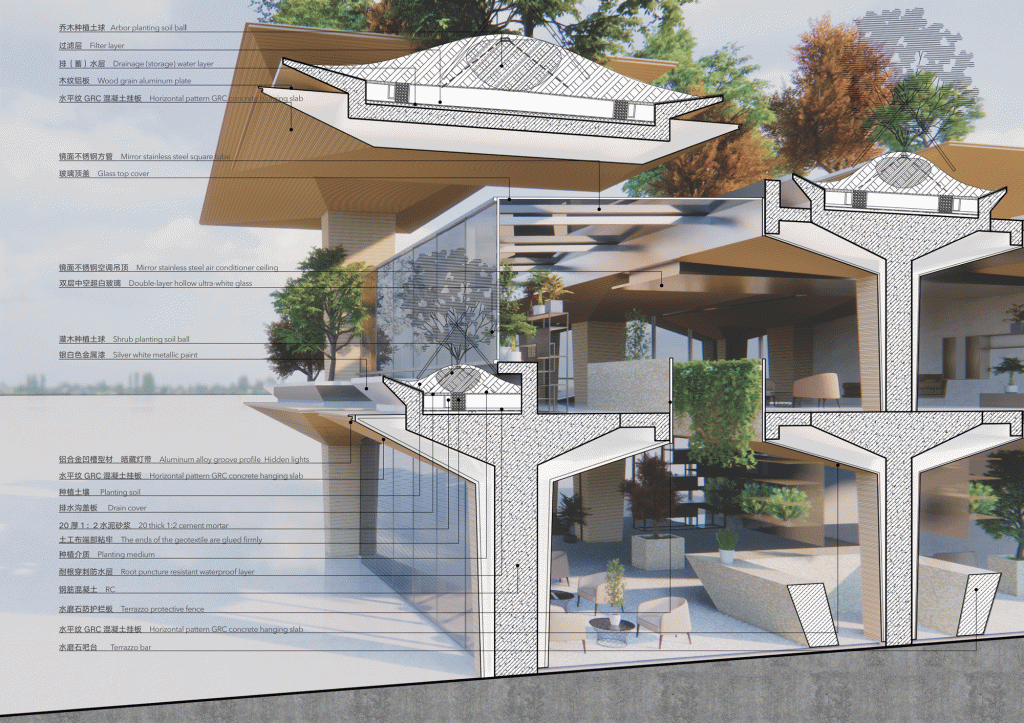
△ Sectional perspective © line+
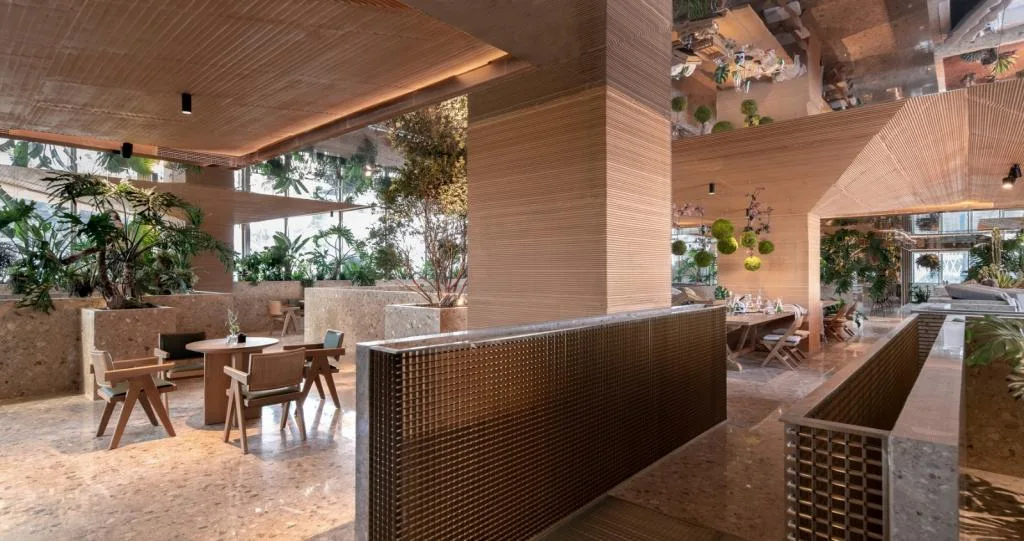
△ Photography © Xingzhi Image – Li Yi
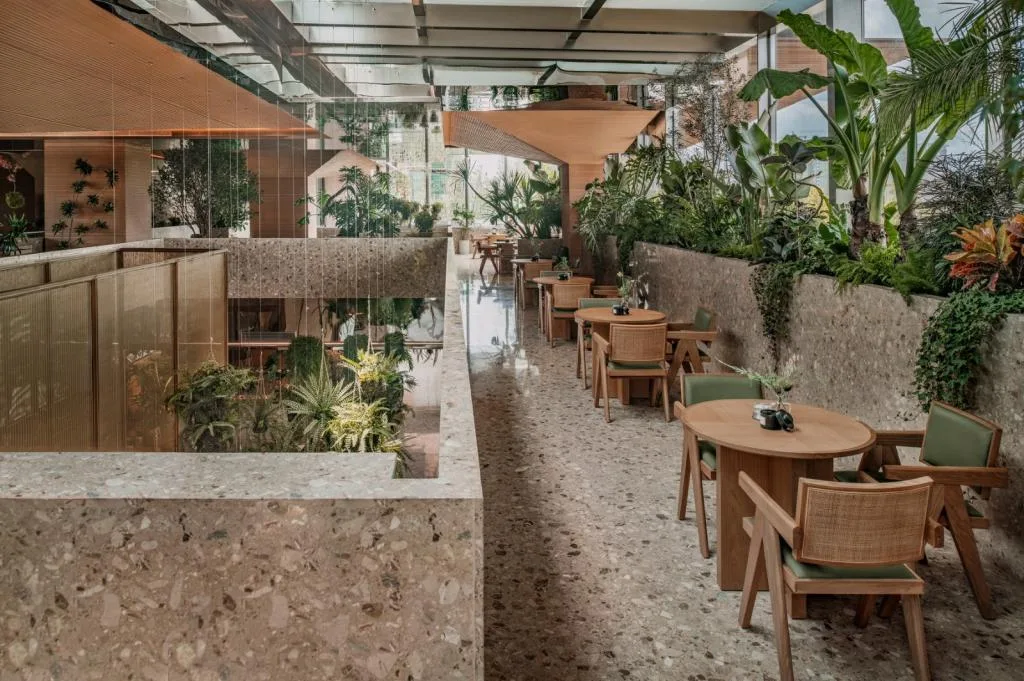
△ Photography © MZ STUDIOS
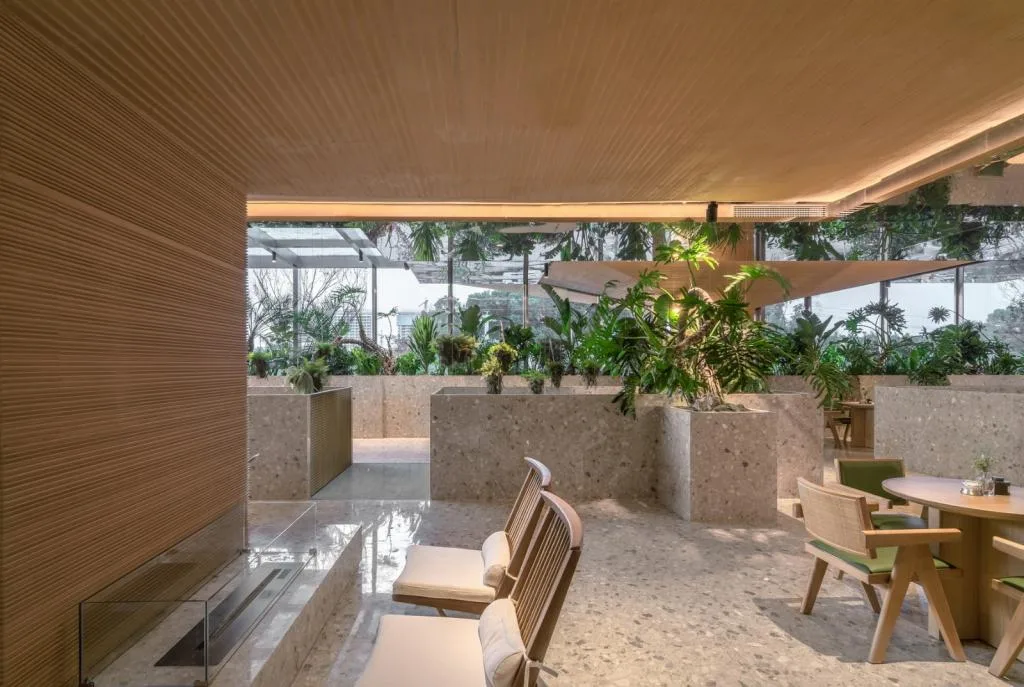
The repetition and similarity of the structural units, along with the honest expression of the building’s framework, naturally establish a spatial order that mirrors the structural logic. Together, the umbrella-shaped units and plant elements form the building’s genuine visual vocabulary. Each umbrella surface defines a spatial cell that invites infinite exploration and continuous growth in spatial experience.
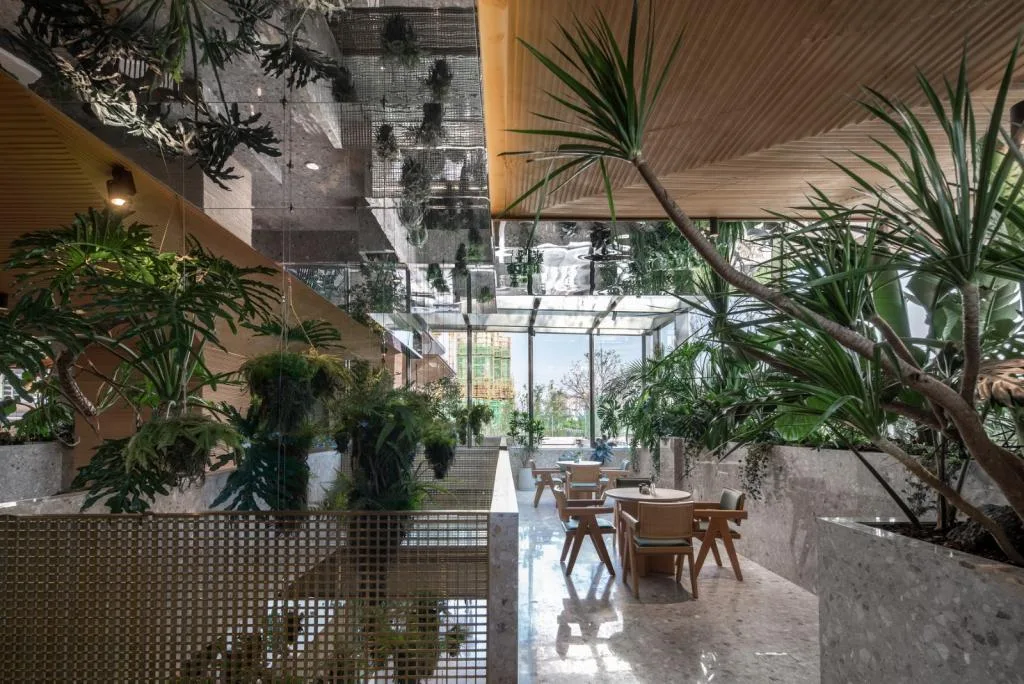
△ Photography © Xingzhi Image – Li Yi
△ Photography © Xingzhi Image – Li Yi
03 Materials and Construction
The GRC (Glass Fiber Reinforced Concrete) material used for the umbrella-shaped units complements the structural design. We selected a natural earth-tone palette and rigorously refined the GRC texture through computer simulations, 3D printing, and physical sampling to precisely control the horizontal texture, achieving a layered, tactile finish.
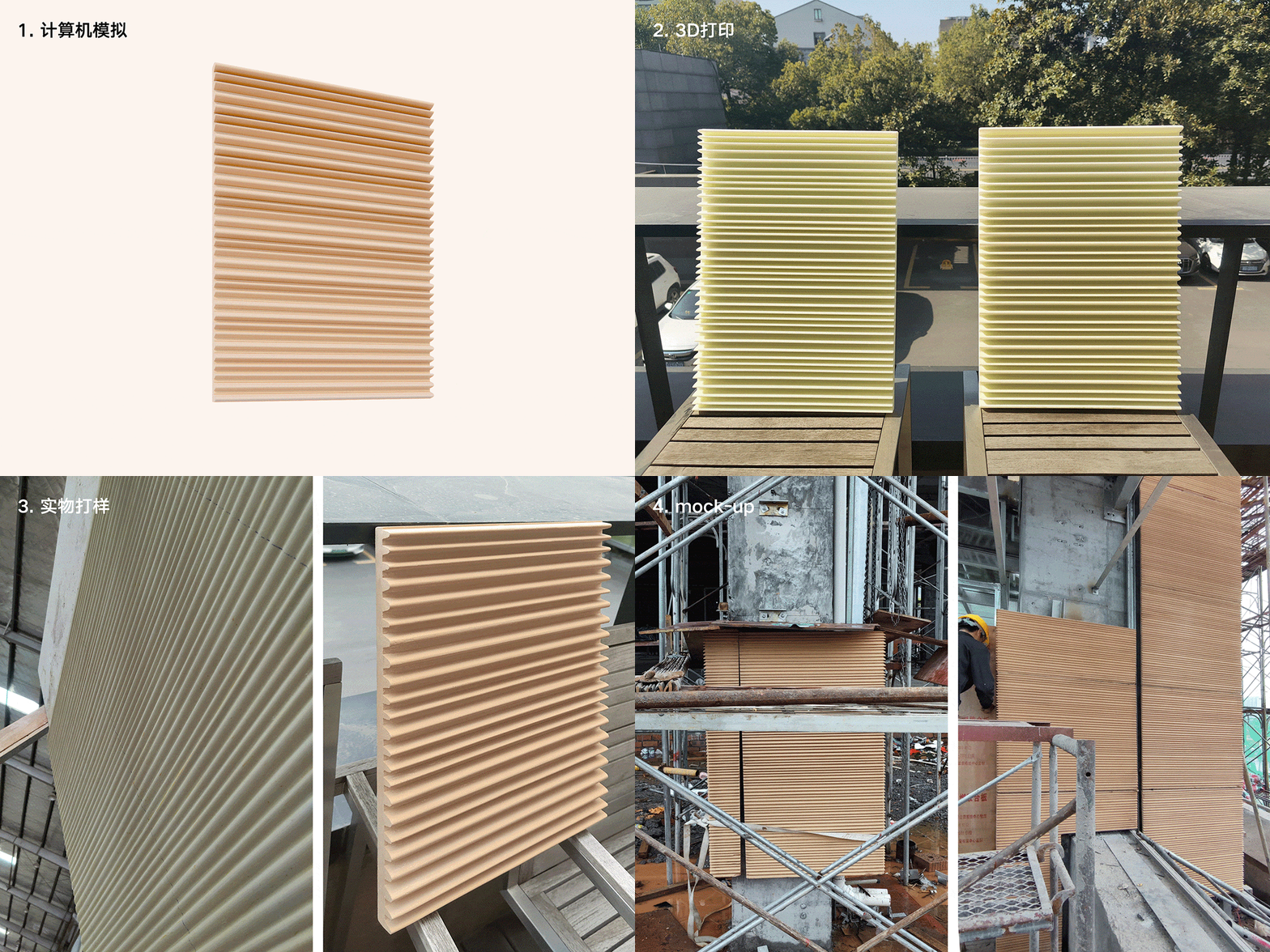
Multi-stage refinement of △ GRC hanging panel © line+
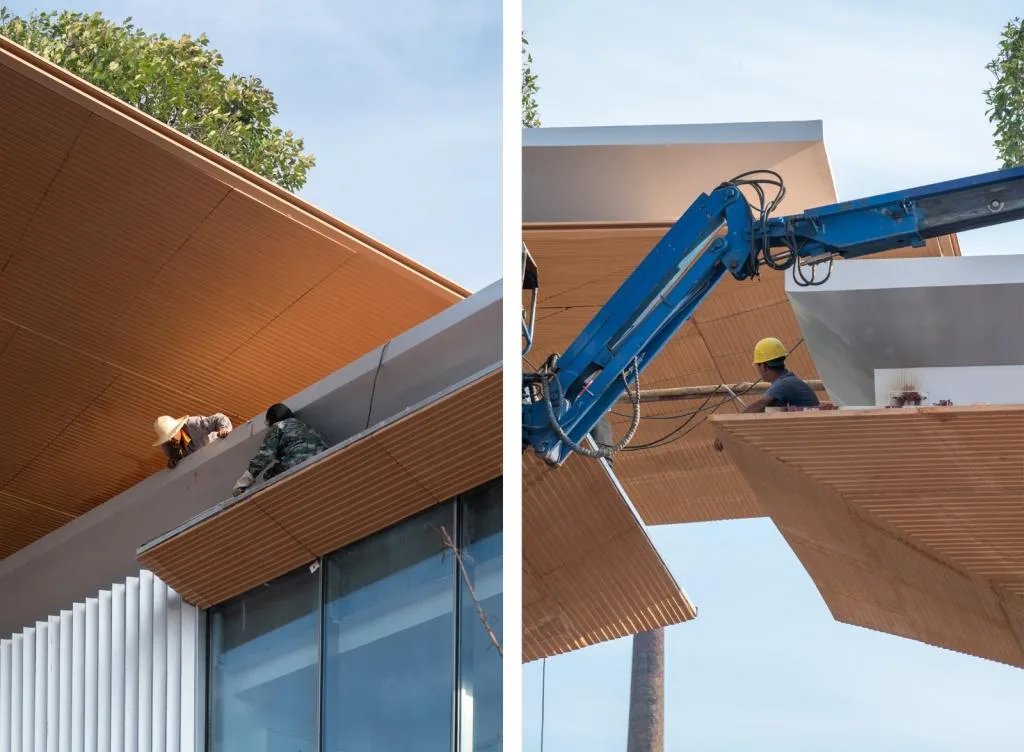
During construction, the umbrella-shaped structures were cast in concrete with precise texture modulation for each unit. Every umbrella-shaped form was separately molded and prefabricated with GRC panels, designed with visible joints that avoid the negative visual impact of adhesives.
△ Photography © Xingzhi Image – Li Yi
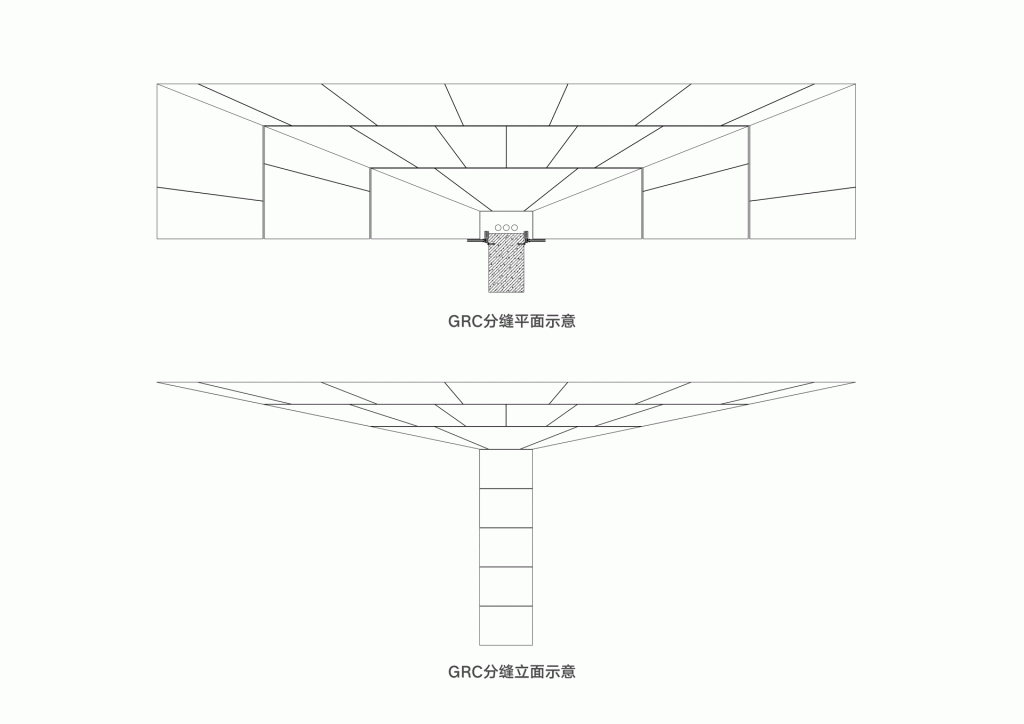
△ Material joint separation © line+
The horizontal texture of the GRC panels follows a “horizontal slicing” construction principle, adjusting line widths and angles according to the panels’ inclinations. This ensures the upper surface of each line is horizontal while the lower surface slopes inward, producing a layered wood-grain effect.
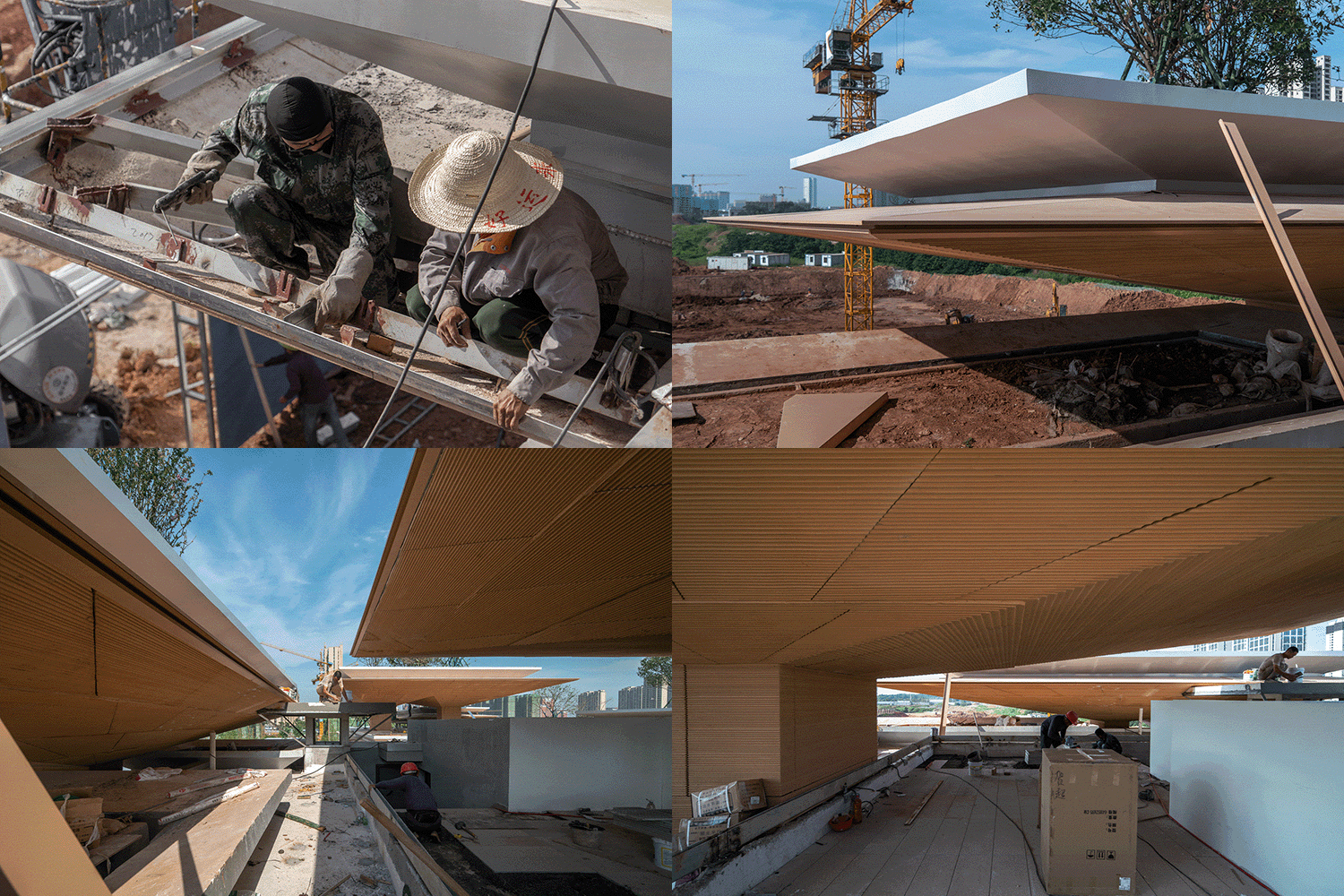
△ Construction process © Xingzhi Image – Li Yi
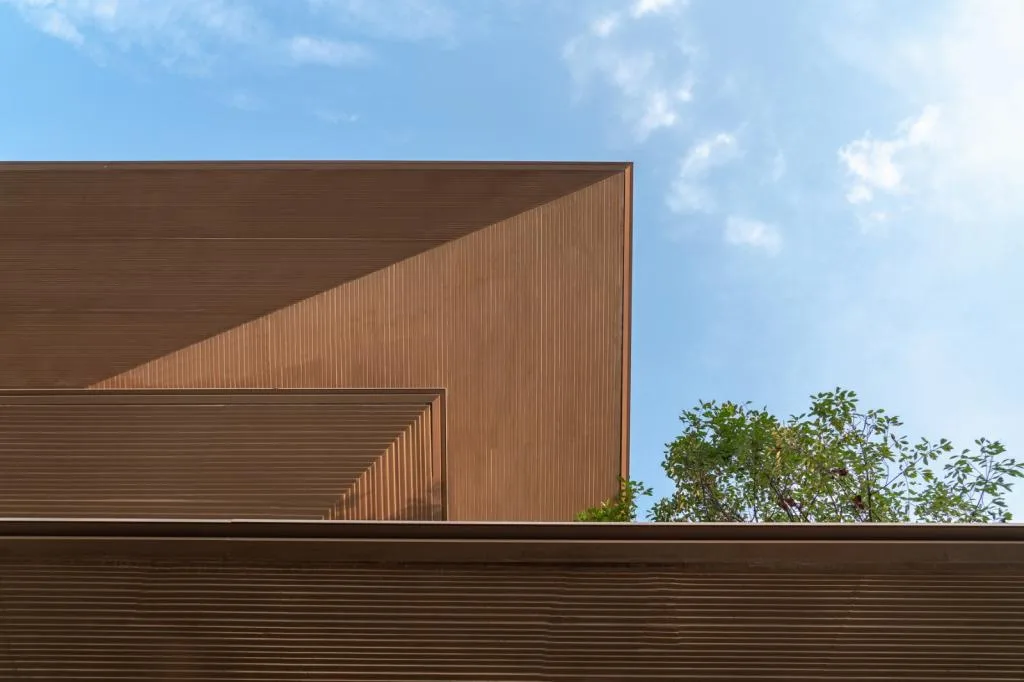
△ Photography © Xingzhi Image – Li Yi
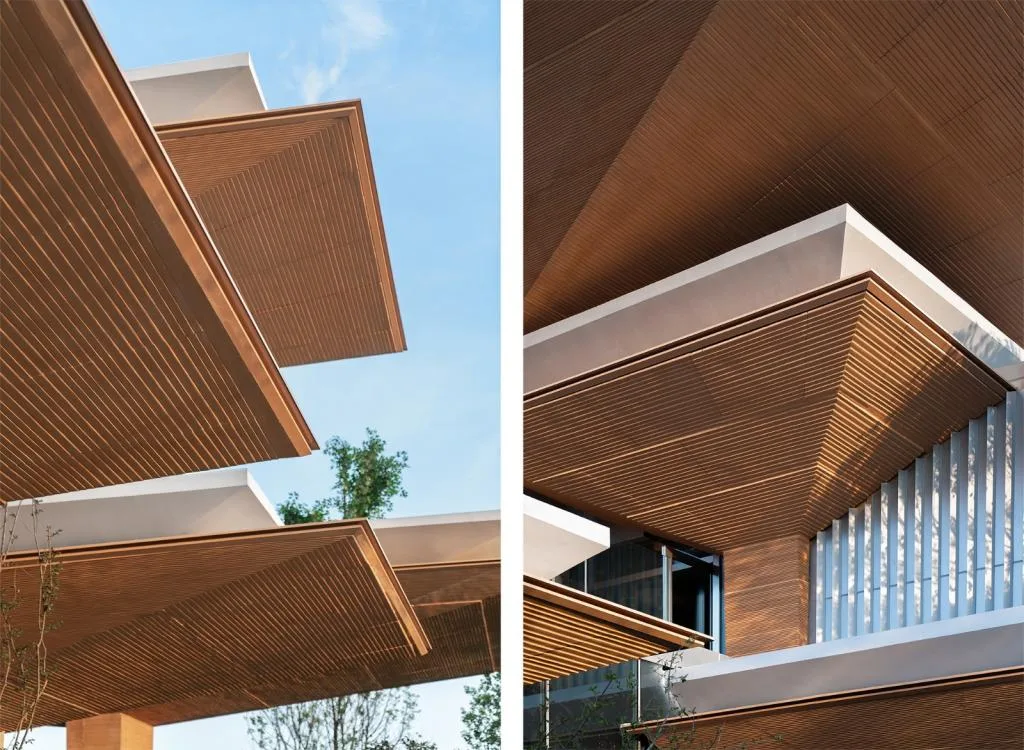
△ Photography © Xingzhi Image – Li Yi
The glass curtain wall is primarily supported by T-shaped steel frames, while all interior partitions are clad in mirror-finish stainless steel. This continuous, concealed interior detailing minimizes the presence of structural members and emphasizes the expansiveness of the glass surfaces. Where the glass curtain wall intersects with the umbrella structure, frame components are hidden within the GRC joint grooves, preserving structural purity and visual integrity.
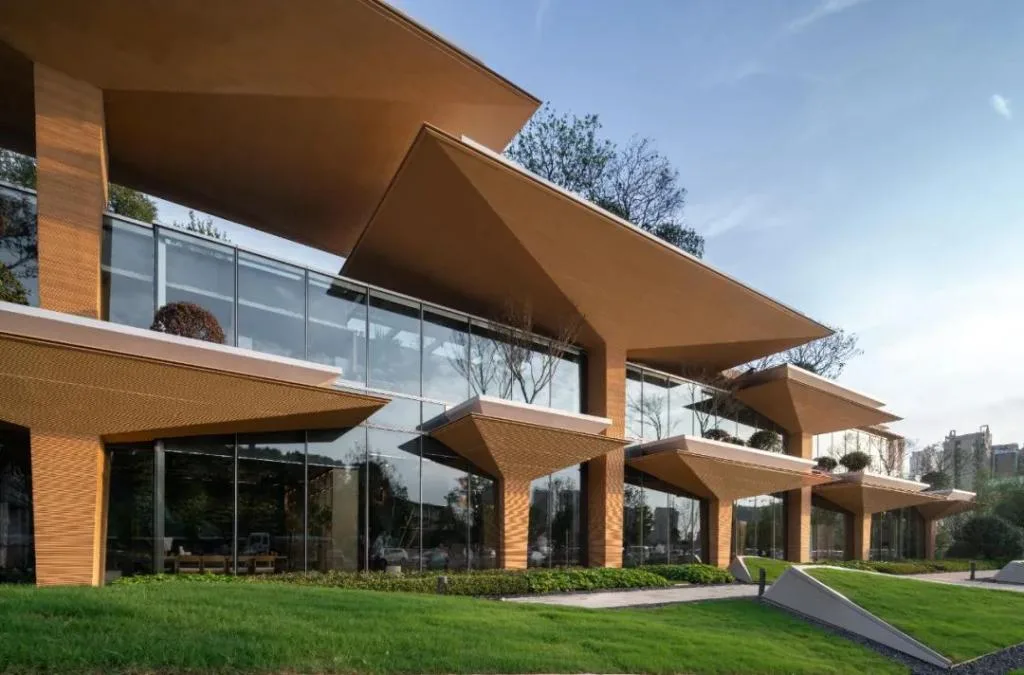
△ Photography © Xingzhi Image – Li Yi
04 Penetration and Overflow
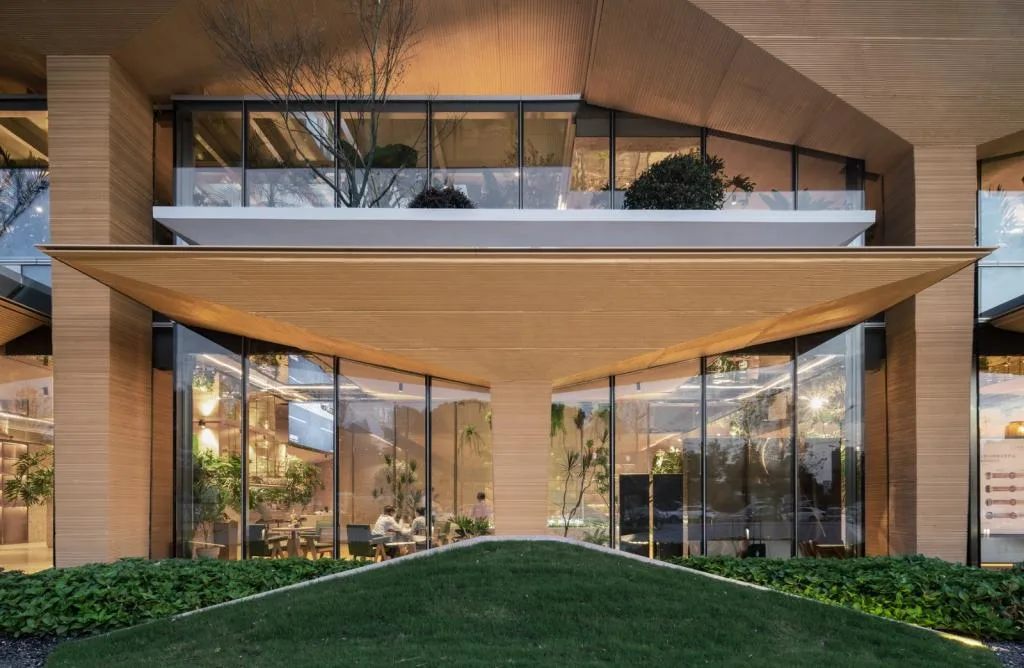
The staggered umbrella canopies at varying heights, combined with flat rooftop treatments, create ideal conditions for layering natural vegetation. By covering facades and roofs with soil and plants, the building achieves a striking visual contrast—earth-toned artificial umbrellas intertwined with lush green hills.
△ Photography © Xingzhi Image – Li Yi
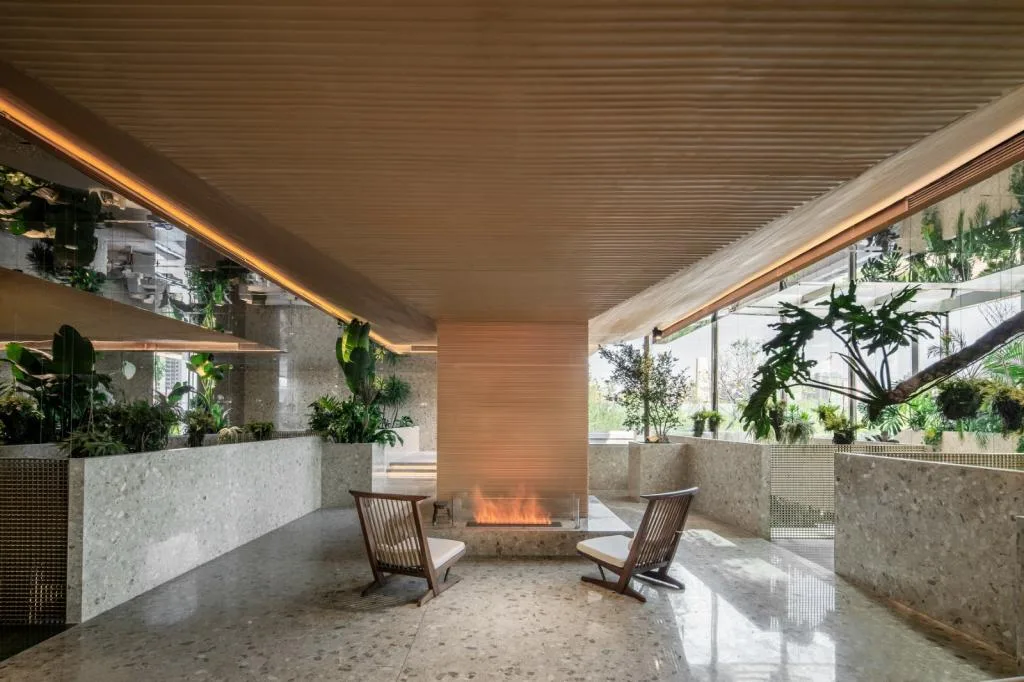
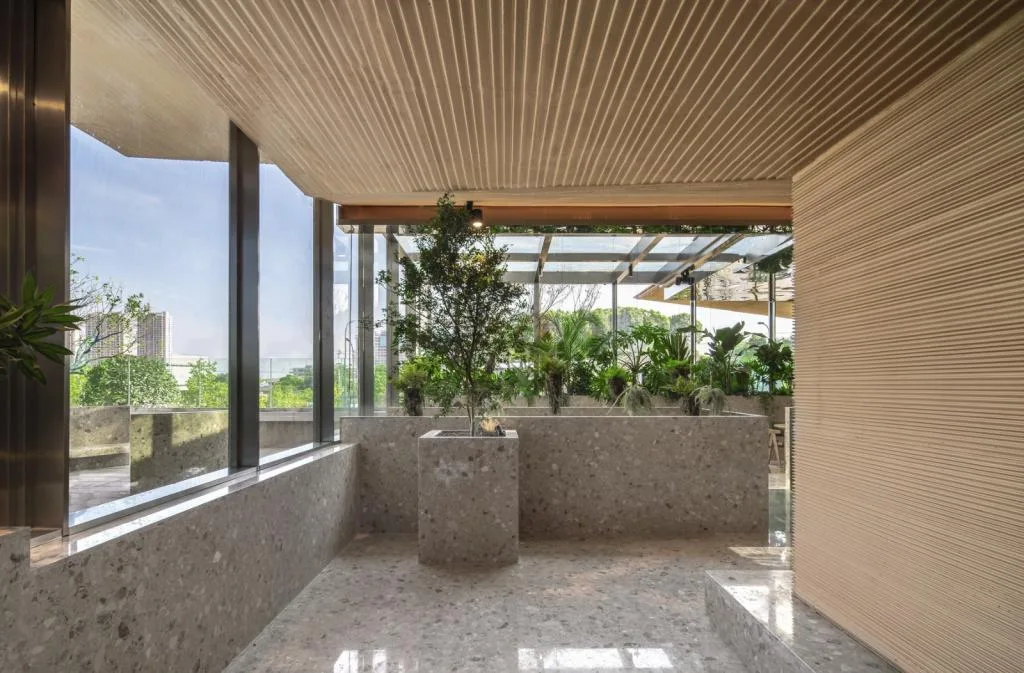
This lifestyle collection store concept has encouraged a trend toward mixed and fluid indoor functions. Supported by self-organizing structures, the design eliminates nearly all interior walls, allowing spaces between umbrella columns to be freely reorganized. Interior functions adapt to the shifting spatial experience. The flooring is terrazzo in a matching earth tone, complemented by copper screens, wooden furniture, and bookshelves in the same palette. The boundaries between building, structure, and interior seamlessly blend.
△ Photography © Xingzhi Image – Li Yi
△ Photography © MZ STUDIOS
△ Photography © Xingzhi Image – Li Yi
Under the pluralistic and “free” growth of umbrella clusters, diverse formats are distributed freely and staggered, each developing around its own umbrella space. The umbrella canopy and the programmatic displays beneath together form content-rich spatial cells that continuously attract visitors.
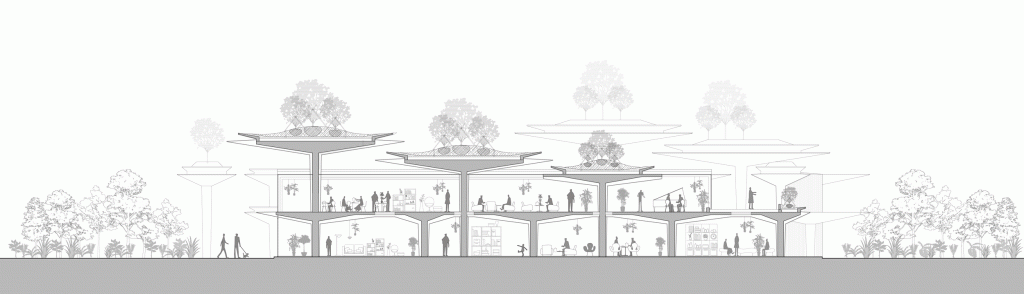
△ Section diagram © line+
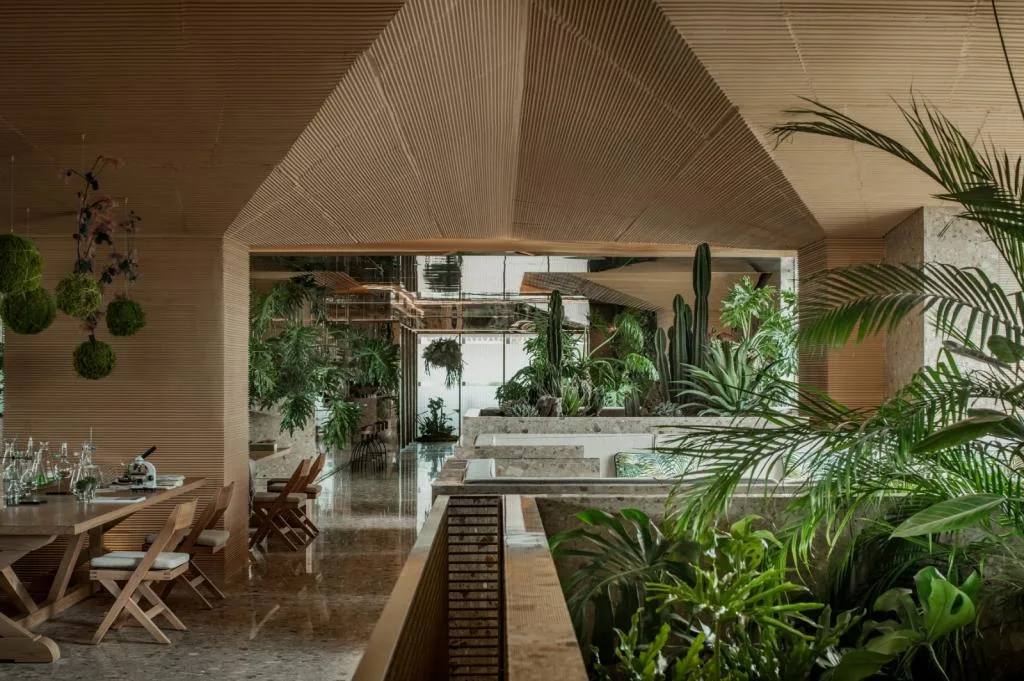
△ Photography © MZ STUDIOS
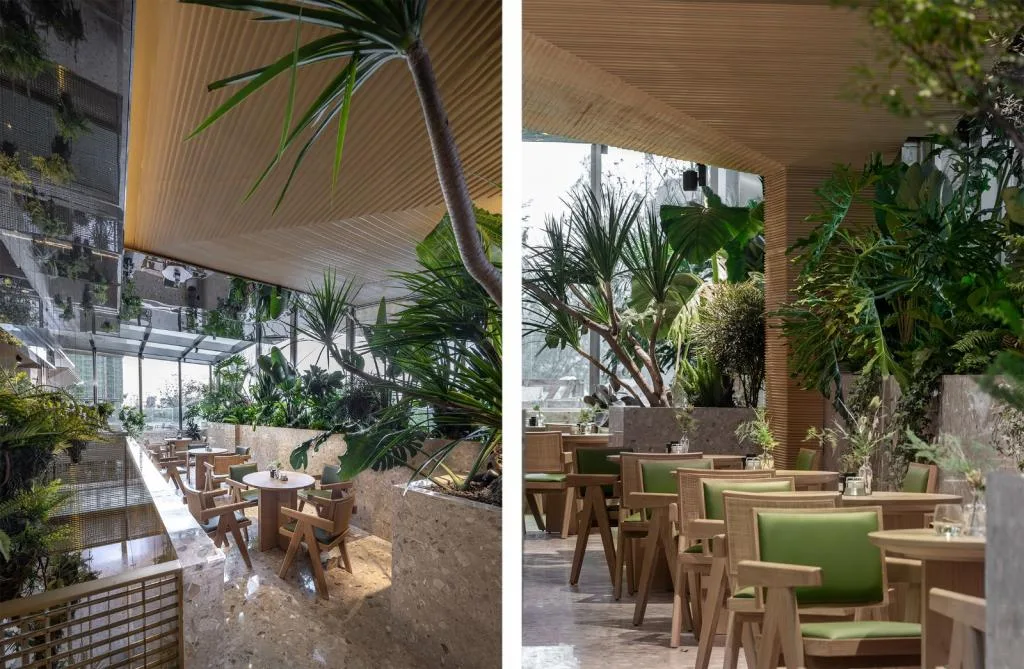
△ Photography © Xingzhi Image – Li Yi
To create atmosphere, greenery plays a vital role indoors as well. The highly transparent ultra-white glass curtain walls visually integrate outdoor greenery, while the reflective mirror stainless steel surfaces amplify indoor and outdoor plant views. This interplay connects interior and exterior atmospheres, blending real plants with their reflections to evoke a unique, immersive natural experience.
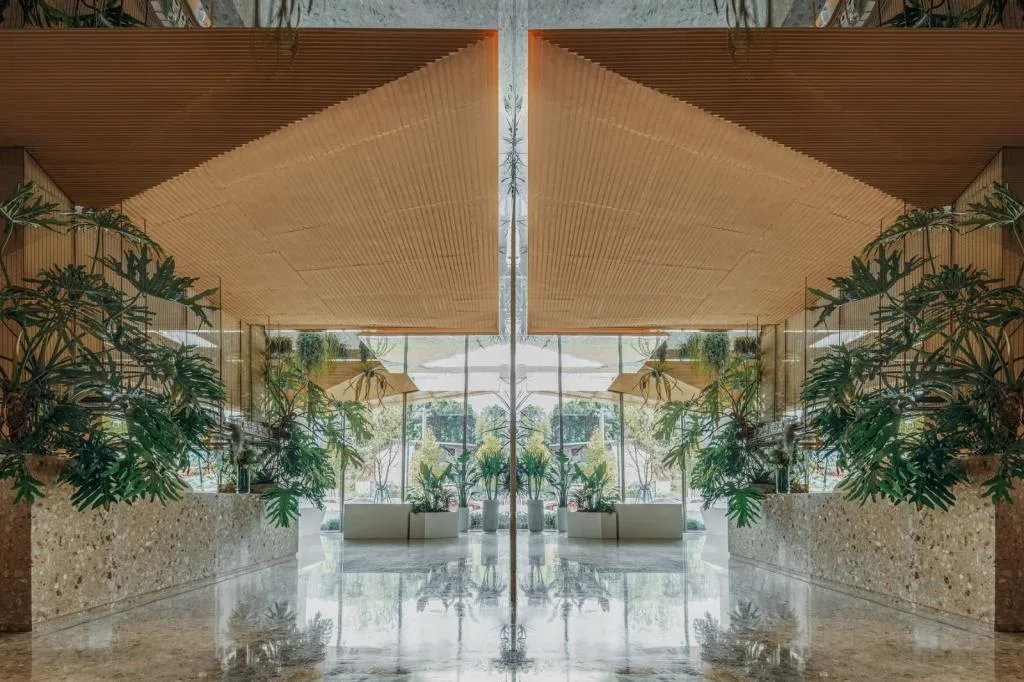
△ Photography © MZ STUDIOS
△ Photography © Xingzhi Image – Li Yi
05 Conclusion
As Louis Kahn famously said, “The responsibility of an architect is to discover this thoughtful property of space, not just to accept conventional plans, but to try to create something that can be understood as effective even if it is unconventional.”
△ Photography © Xingzhi Image – Li Yi
“Umbrella Hill” represents a spatial reconstruction rooted in primal intuition, abstracting aesthetic values from natural laws. It is simple—starting from a structural prototype, redefining naturally growing buildings, and realized through a construction practice that transcends everyday experience. It is also complex—seeking to establish a symbiotic condition satisfying human emotions, natural integration, and construction demands simultaneously.
In a broader context, it reflects a complex social system prevalent in contemporary urban environments involving land, demand, capital, and ecology.
△ Photography © Xingzhi Image – Li Yi
Although construction is complete, the building’s natural growth is just beginning. As plants continue to flourish inside and outside, the “Umbrella Hill” form will increasingly resemble a genuine hill. As the building matures and visitors engage with its lively scenes, their emotions and experiences breathe true life into the architecture, potentially planting new seeds for urban construction within everyday landscapes.
△ Photography © Xingzhi Image – Li Yi
Project Drawings
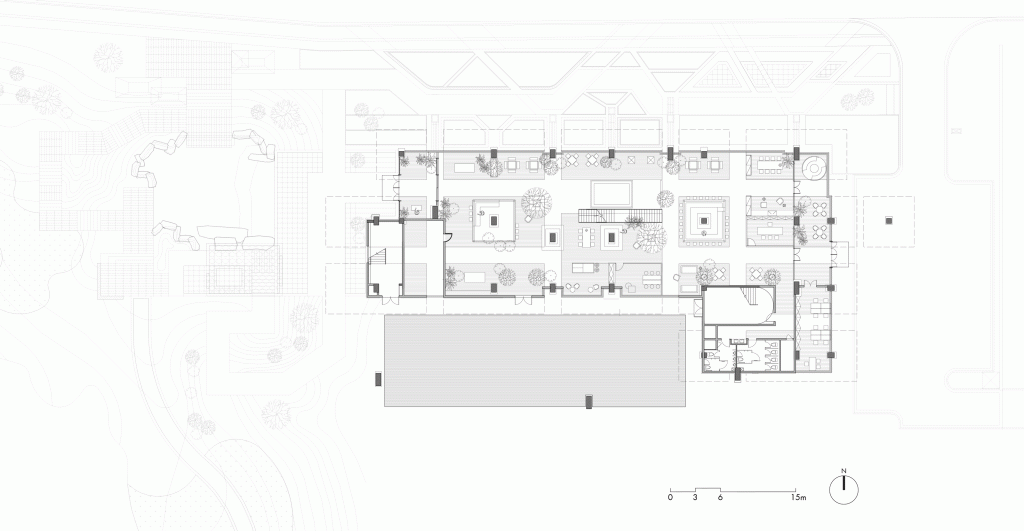
△ First floor plan © line+
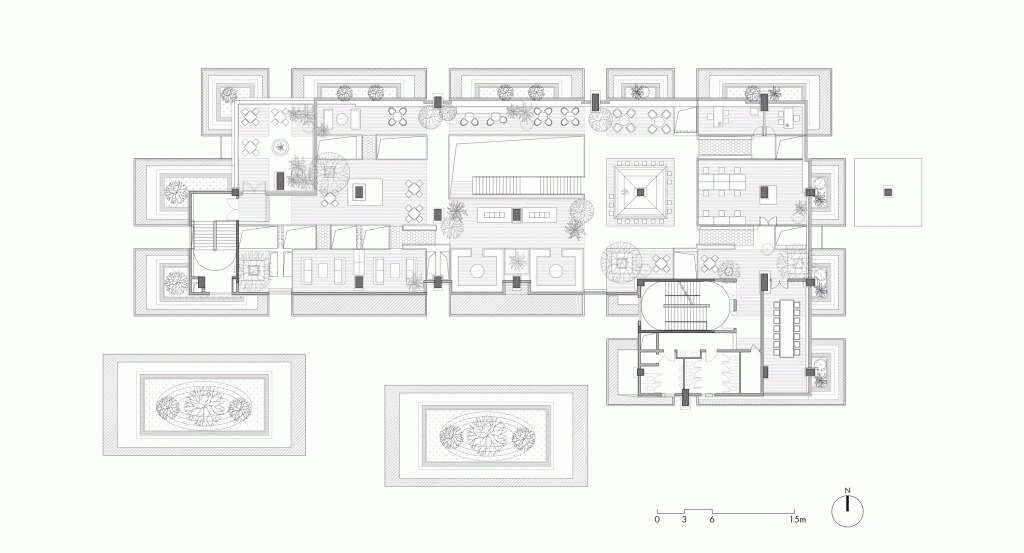
△ Second floor plan © line+
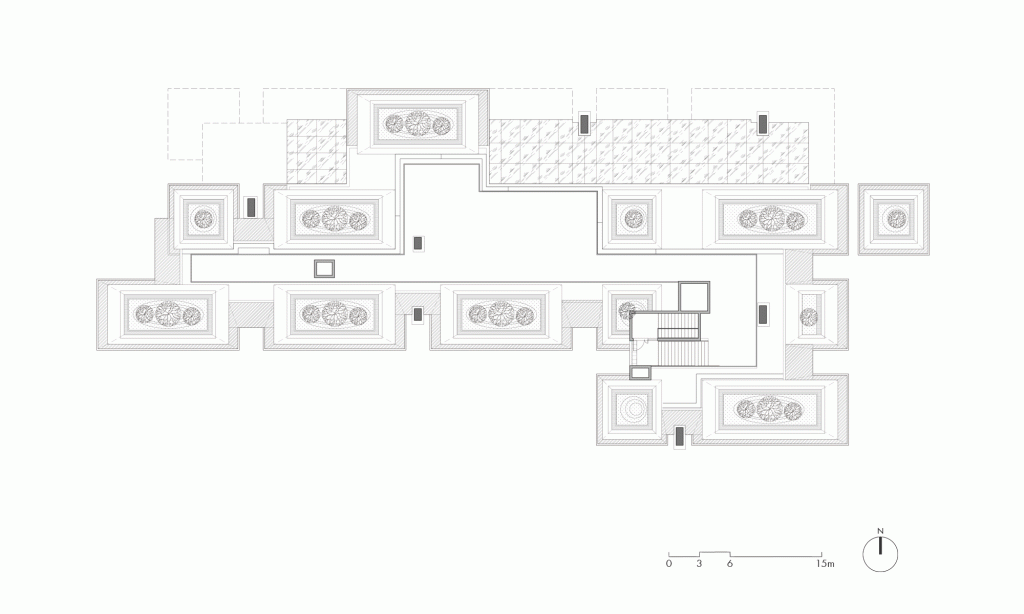
△ Third floor plan © line+
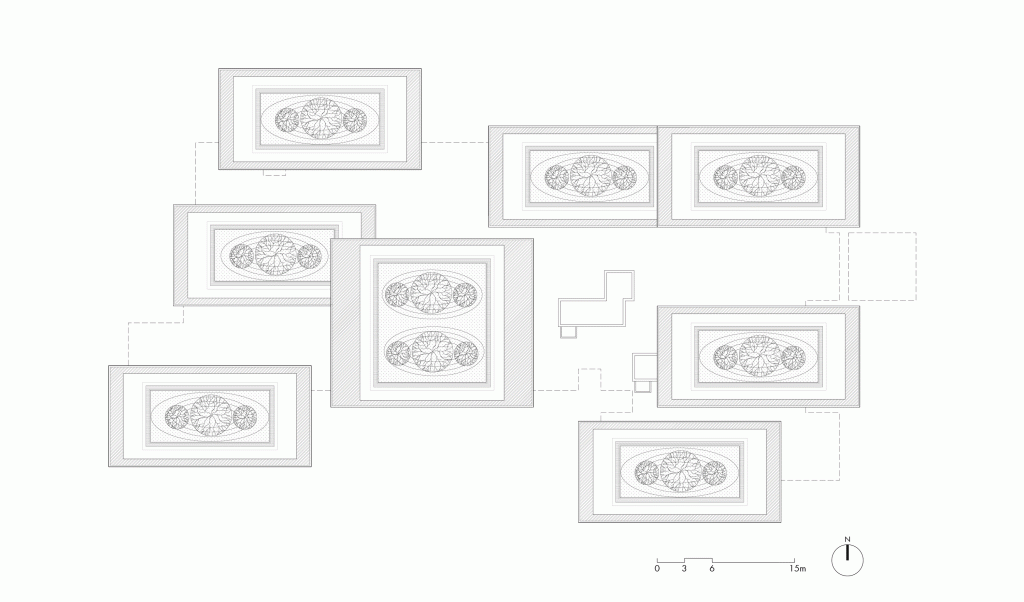
△ Roof floor plan © line+
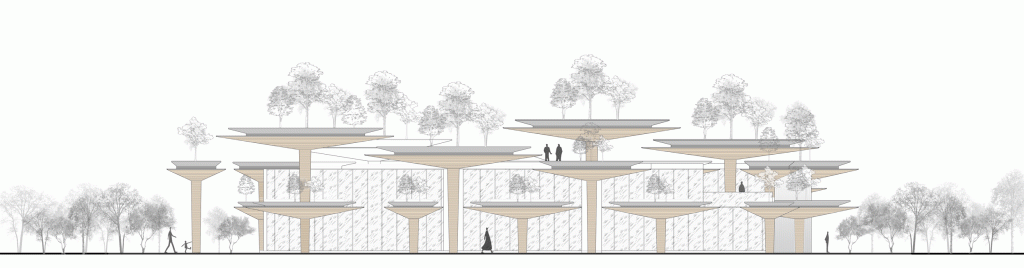
△ North facade © line+
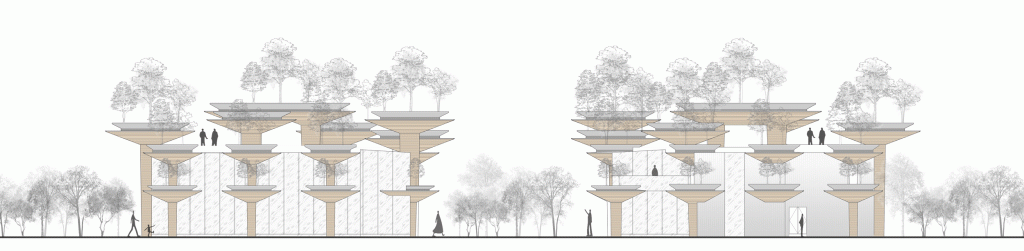
△ East-West facade © line+
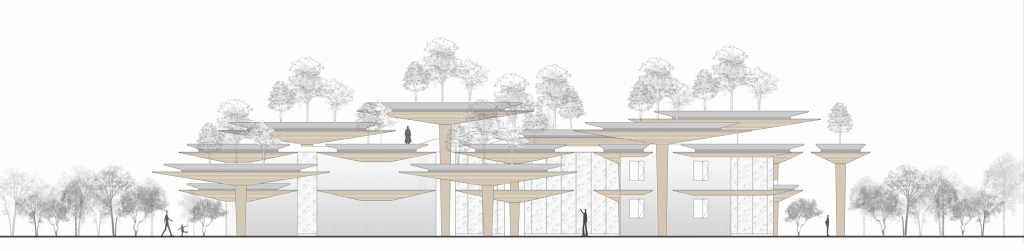
△ South facade © line+
Project Information
Project Name: “Umbrella Hill” Lifestyle Collection Store
Location: Changsha, Hunan
Design Team: Line+ Architectural Firm gad
Website: www.lineplus.studio
Email: pr@lineplus.studio
Lead Architect / Project Creator: Zhu Peidong
Design Team Members: Sun Xiaoyu, Yang Xiaoyu, Sun Jin
Building Area: 2,071 square meters
Design Period: October 2020 – December 2020
Construction Period: January 2021 – August 2021
Clients: Greentown China, Midea Real Estate
Construction Drawing Partner: Chengdu Benchmark Fangzhong Architectural Design Co., Ltd.
Interior Design: Interior Architecture Design Firm
Soft Decoration: Hangzhou Cuishi Design Co., Ltd.
Landscape Design: Hangzhou Yajing Landscape Design Co., Ltd.
Structure: Reinforced concrete frame
Material: GRC hanging panels
Photography: Xingzhi Image – Li Yi, MZ STUDIOS, Chen Xi (model)















Must log in before commenting!
Sign Up