
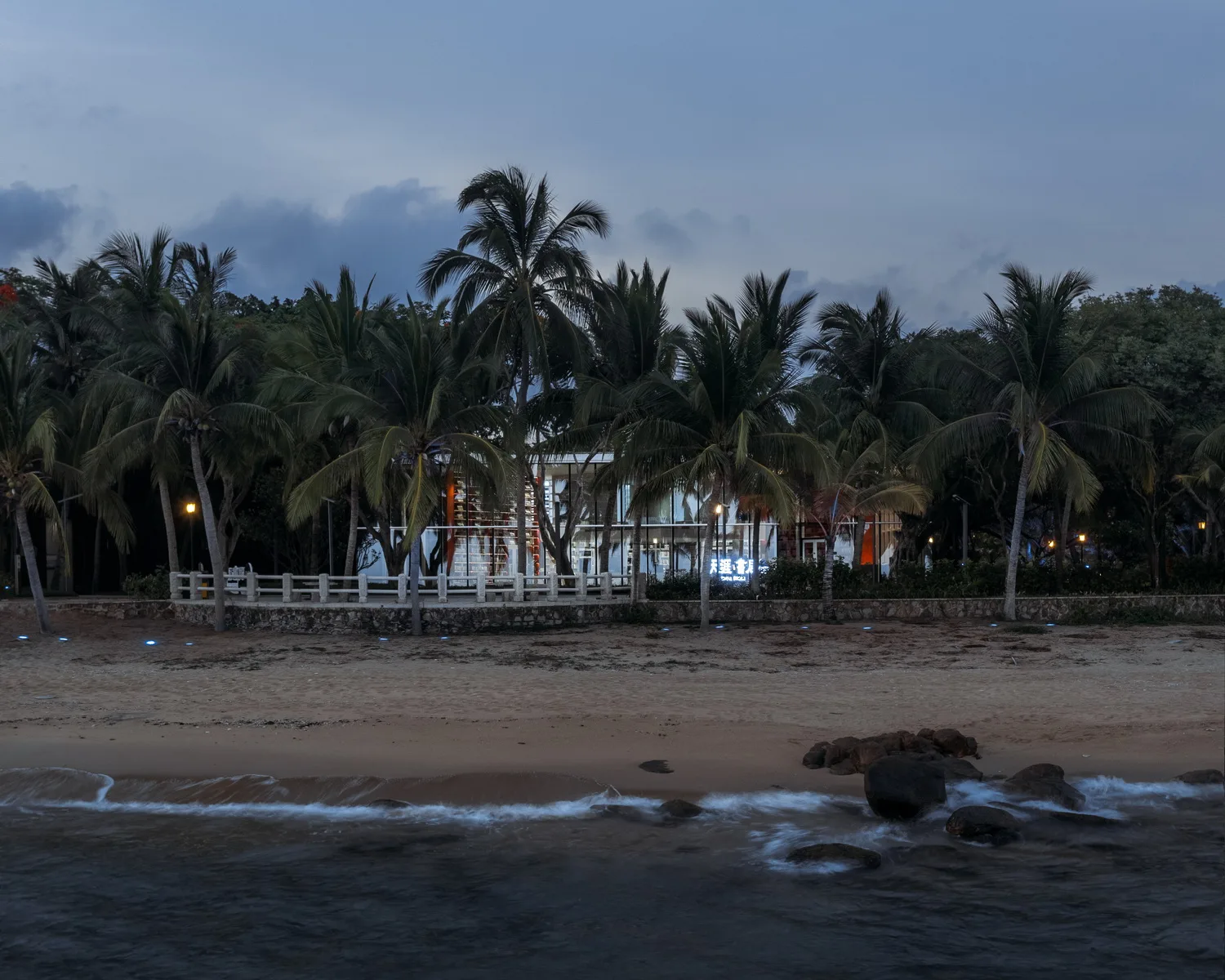
The Tianya Bookstore, designed by Wutopia Lab for the Tianya Haijiao Scenic Area in Sanya, officially opened in June 2021. Known as the “ends of the earth,” Sanya was once considered China’s southernmost point of land. Today, it is not only a renowned scenic spot but also the most popular wedding photography and confession destination in southern China.
Located within this scenic area, Tianya Bookstore is far from a place where a few might lament homesickness, sorrow, or loneliness. Instead, it stands as a celebration of the naturally optimistic Chinese spirit—transforming remote, culturally unfamiliar corners of the sea into a positive and romantic paradise, regardless of the times.
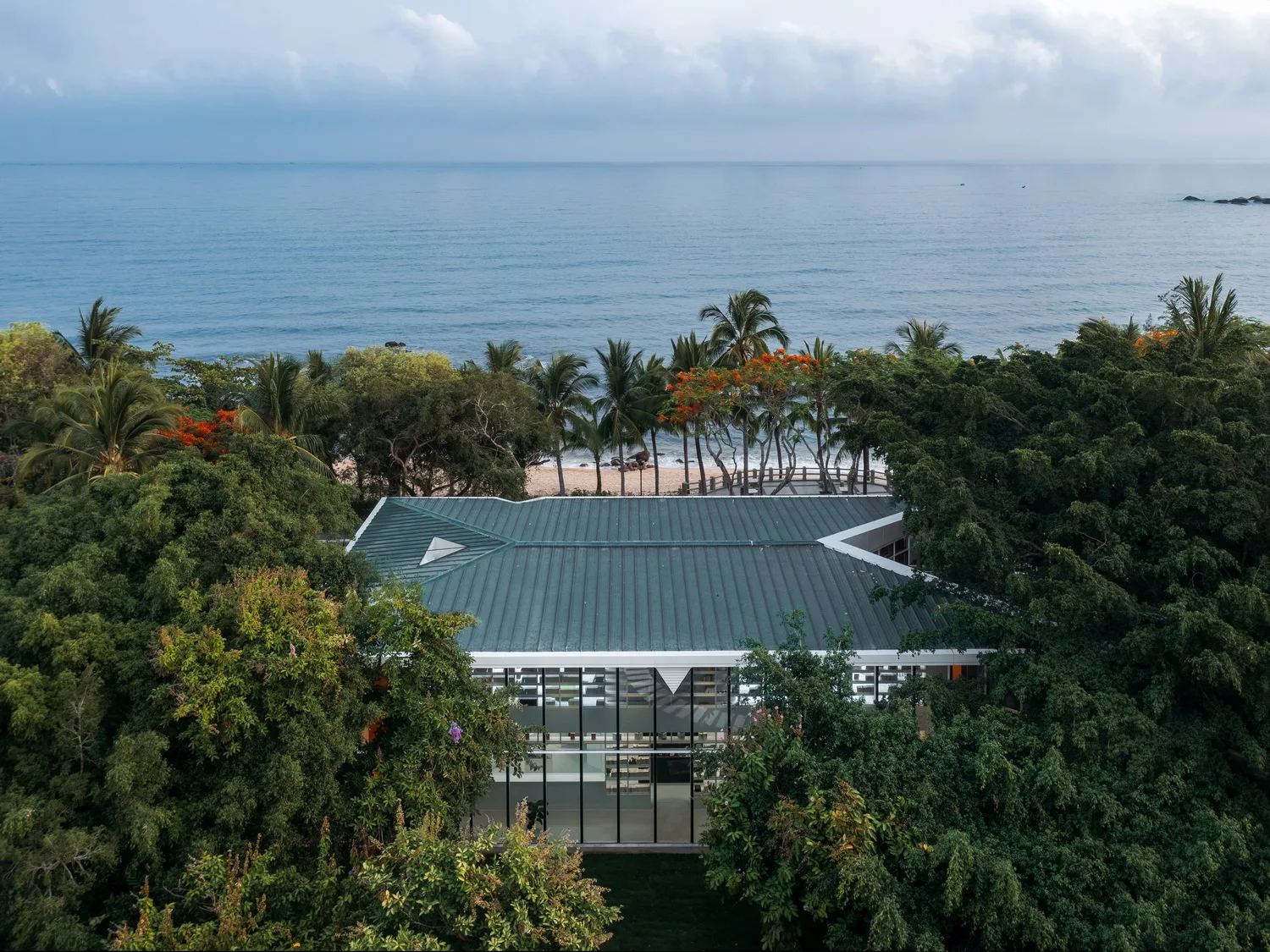
In the deep blue of the sea, one can sense sadness, loneliness, beauty, and freedom.
—From the film “Blue Sea and Blue Sky”
Design begins with emotion; bookstores represent an attitude.
Standing before the vast, ever-changing sea in Sanya, I realized that many of humanity’s self-righteous actions are nothing more than fleeting entertainments. Yet, human ideals, thoughts, and emotions are worthy of the ocean’s depth.
In that moment, my heart surged like the sea, though its surface remained calm. I restrained outward expressions in the face of nature, inspiring me to capture this complex relationship through design. I chose delicate, fragile glass to embody the bookstore’s attitude toward the sea: a transparent interface and climate boundary, creating a pure, clean space amidst stunning natural beauty.
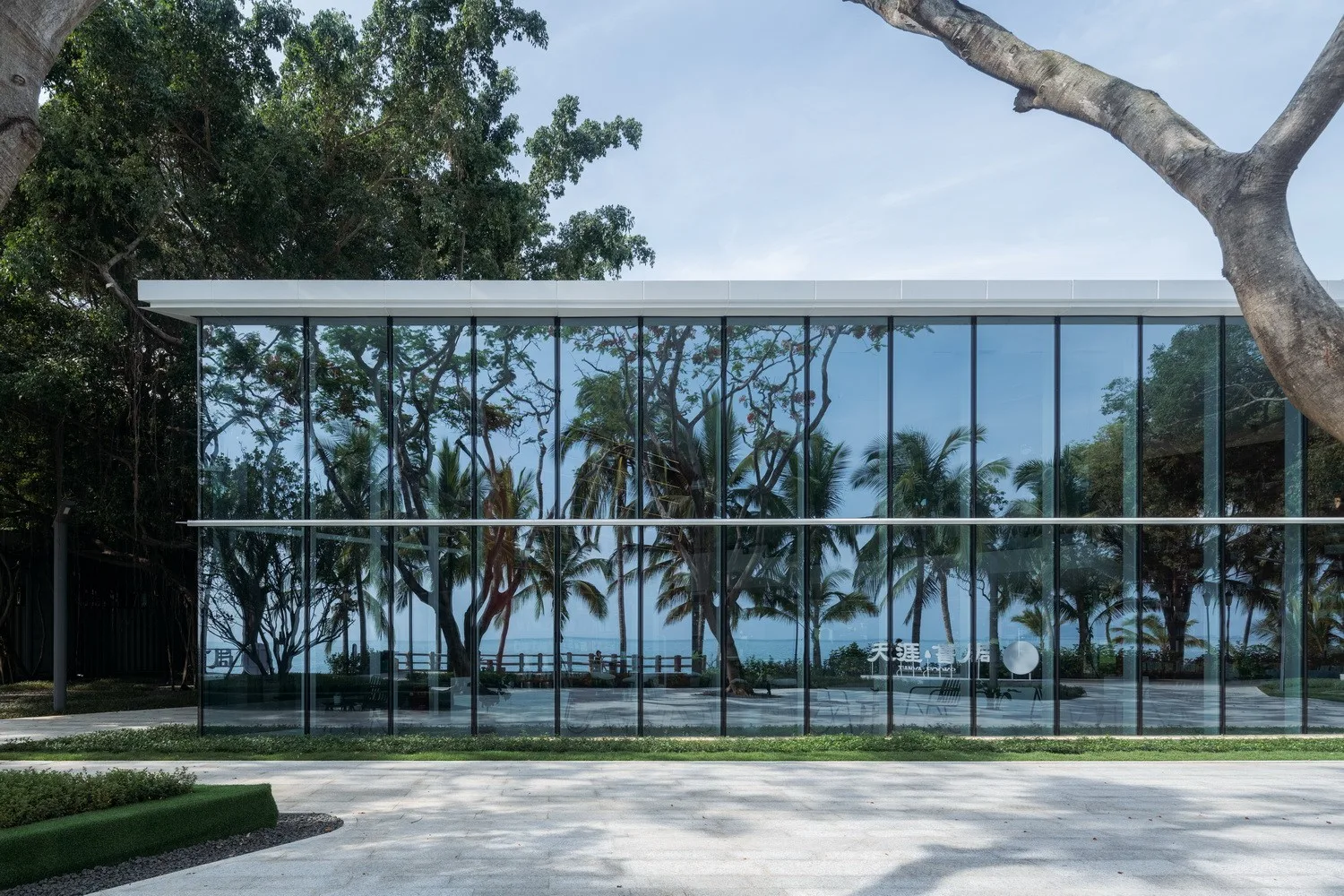
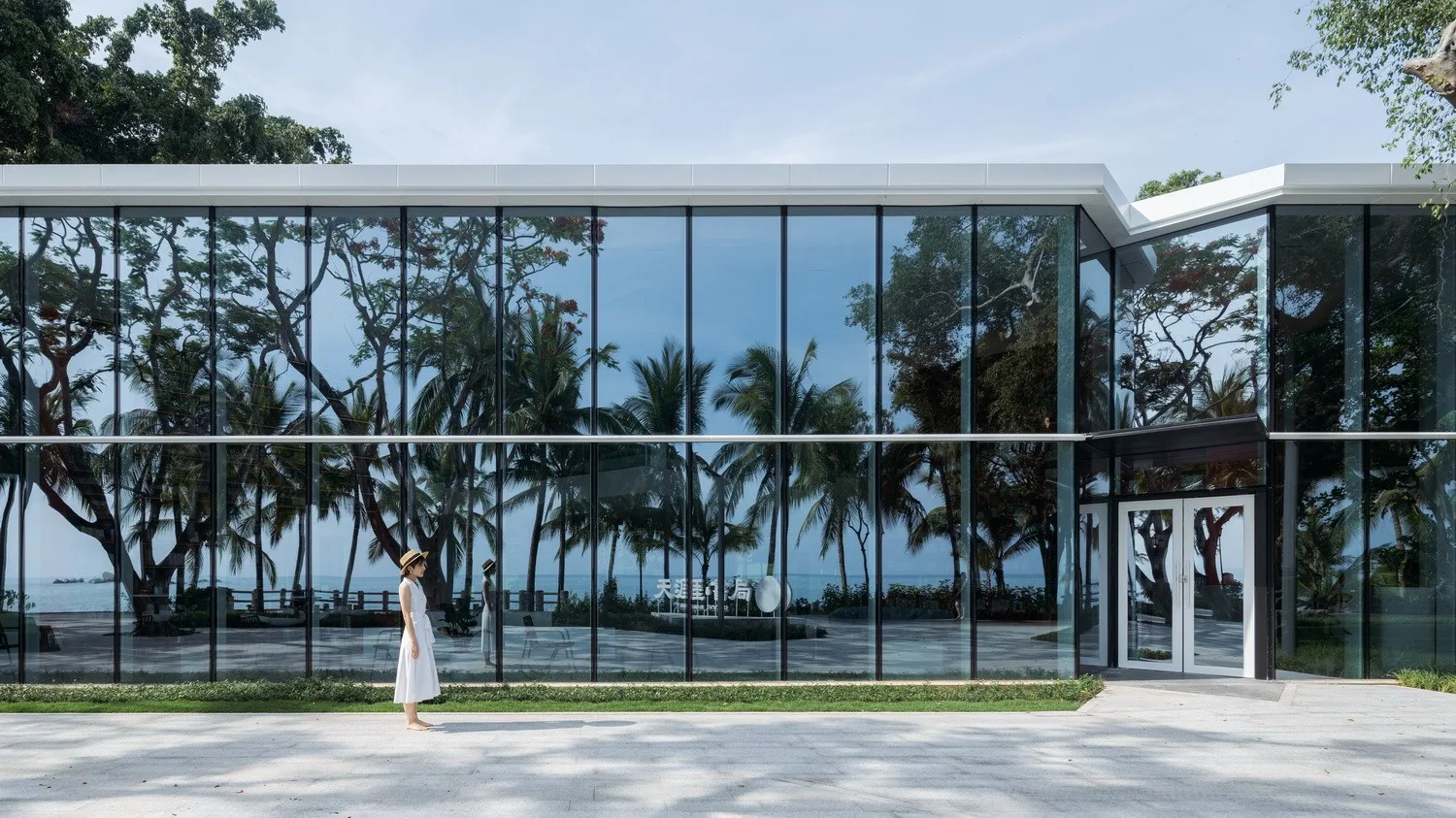
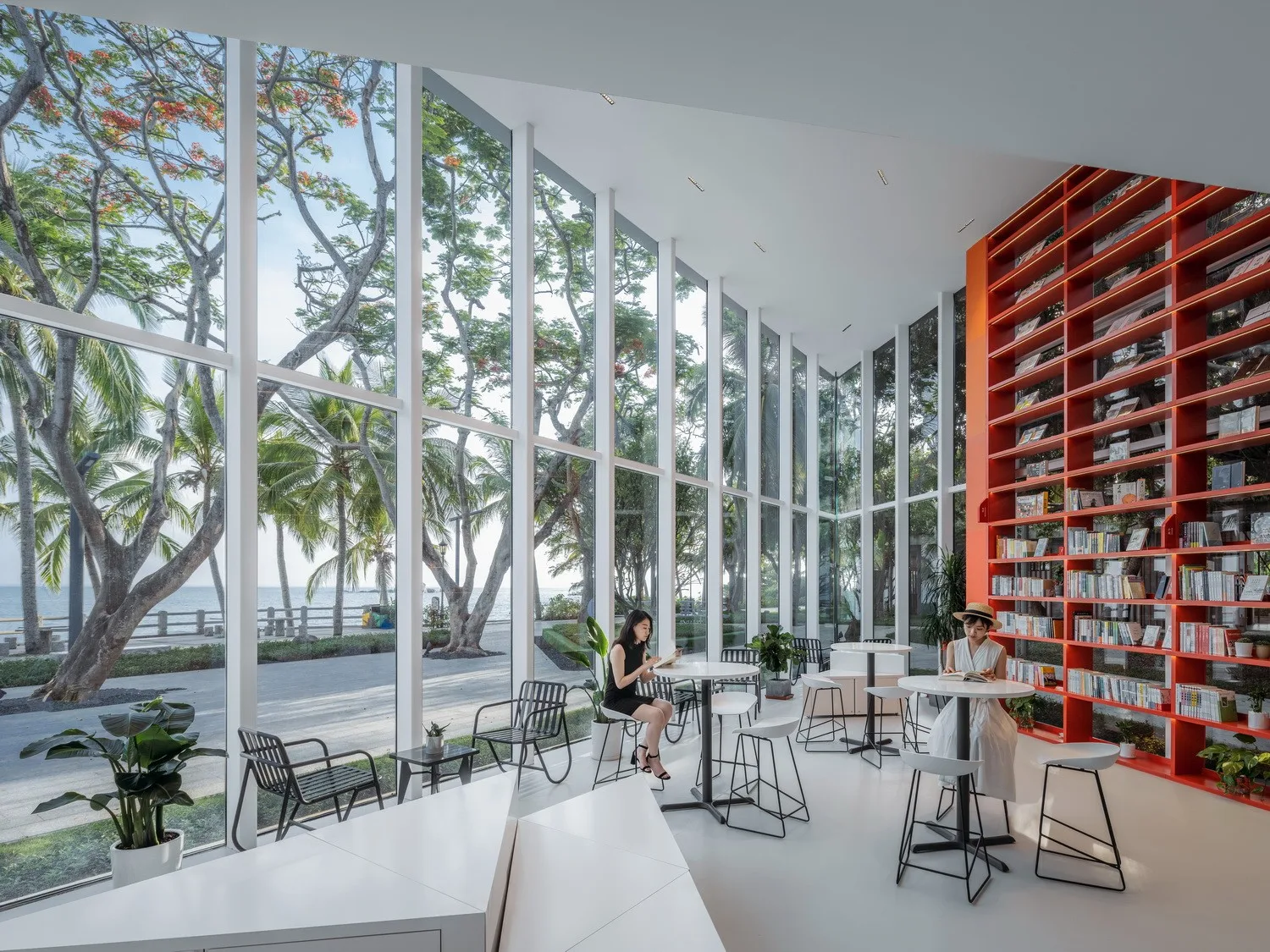
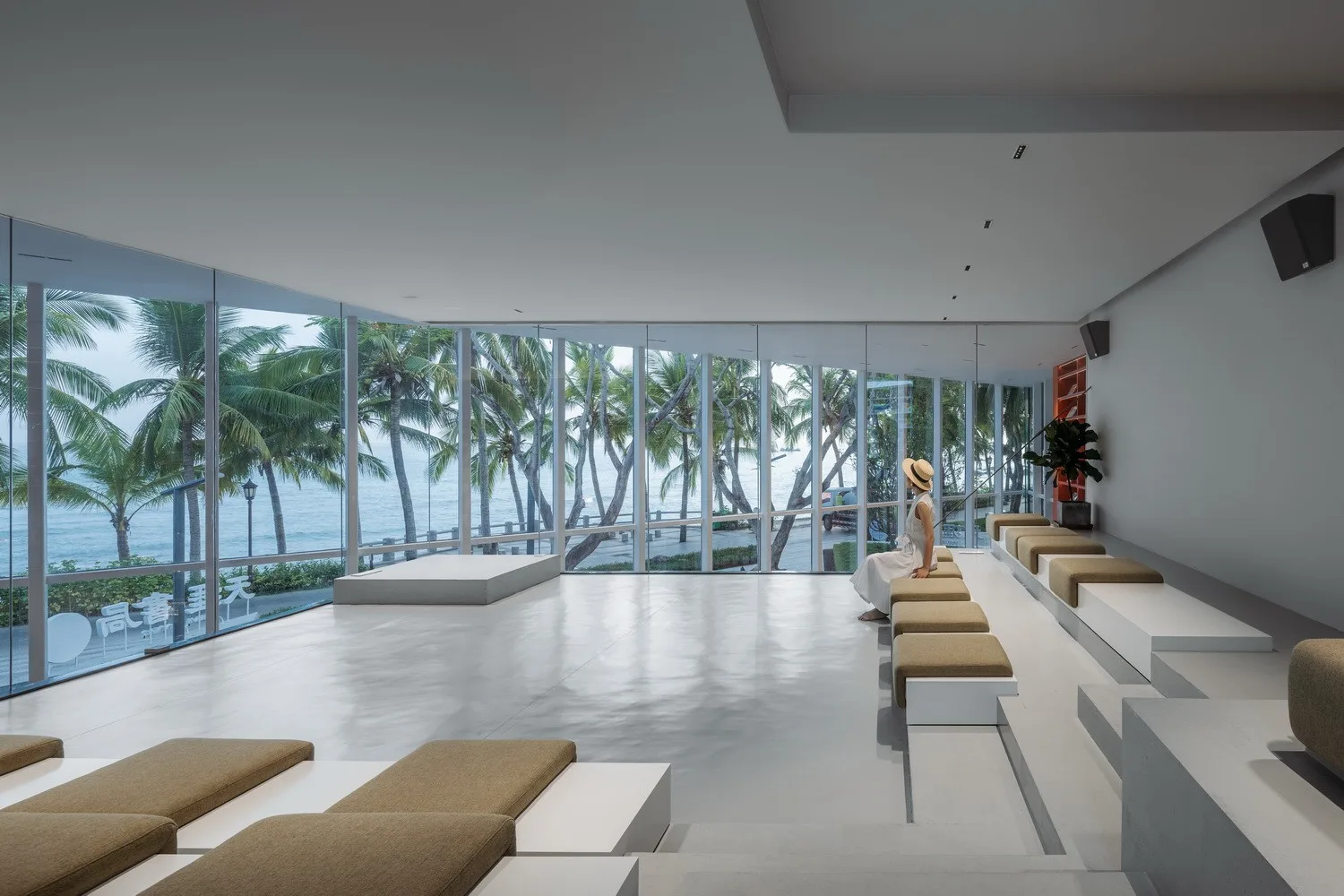
During the day, the bookstore’s glass reflects the surrounding coconut groves, rendering the building humble and unobtrusive. Inside, visitors can calmly observe the vast, open sea behind a fragile protective barrier.
At night, the sea that dominated the daylight fades into darkness. Moonlight dances on the waves, casting flickering reflections that stir emotions and memories. Stepping outside, the bookstore’s glass façade disappears amid the warm interior lighting, while red bookshelves glow like the morning sun along the beach. It’s a powerful reminder of human ambition and pride in challenging nature.
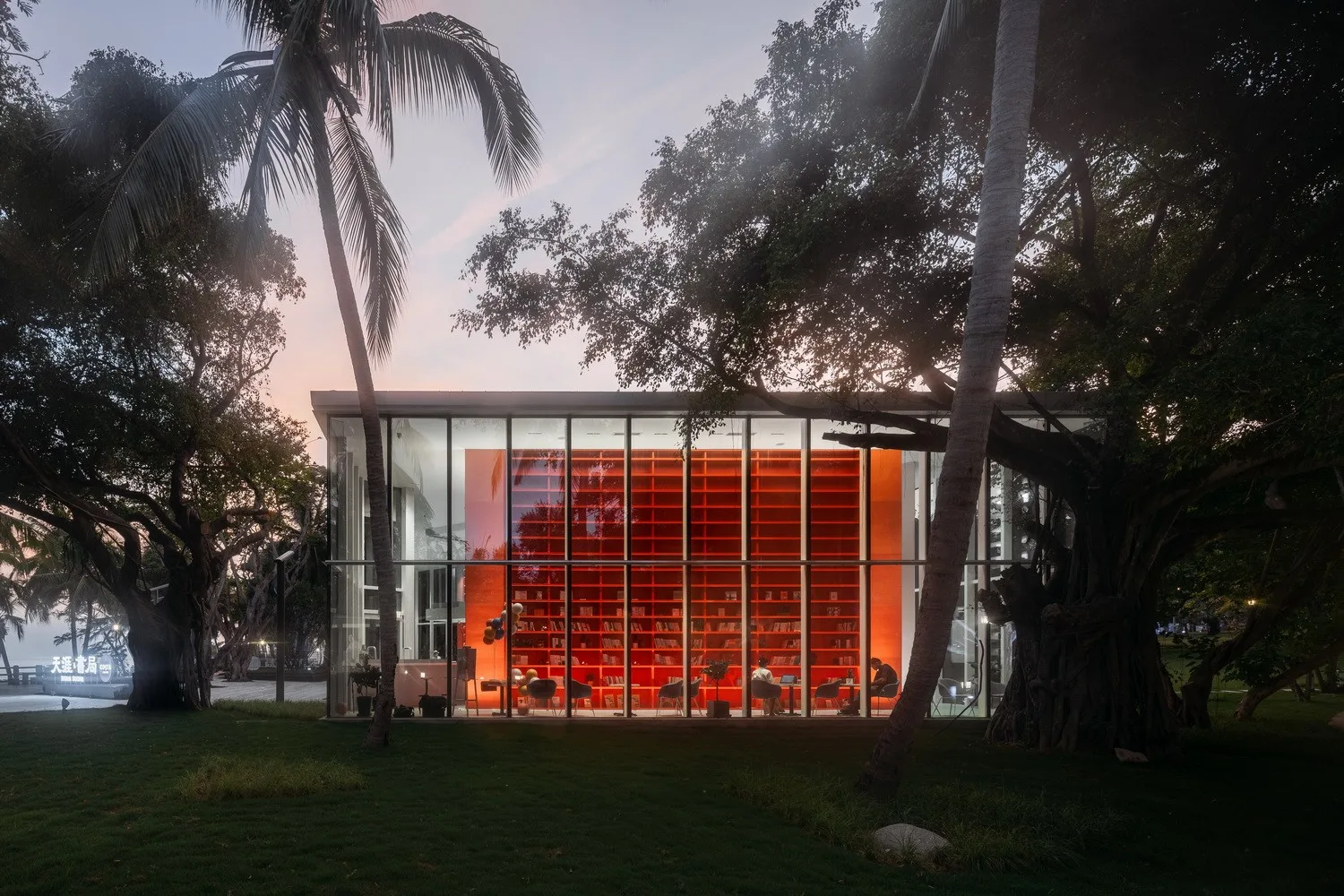
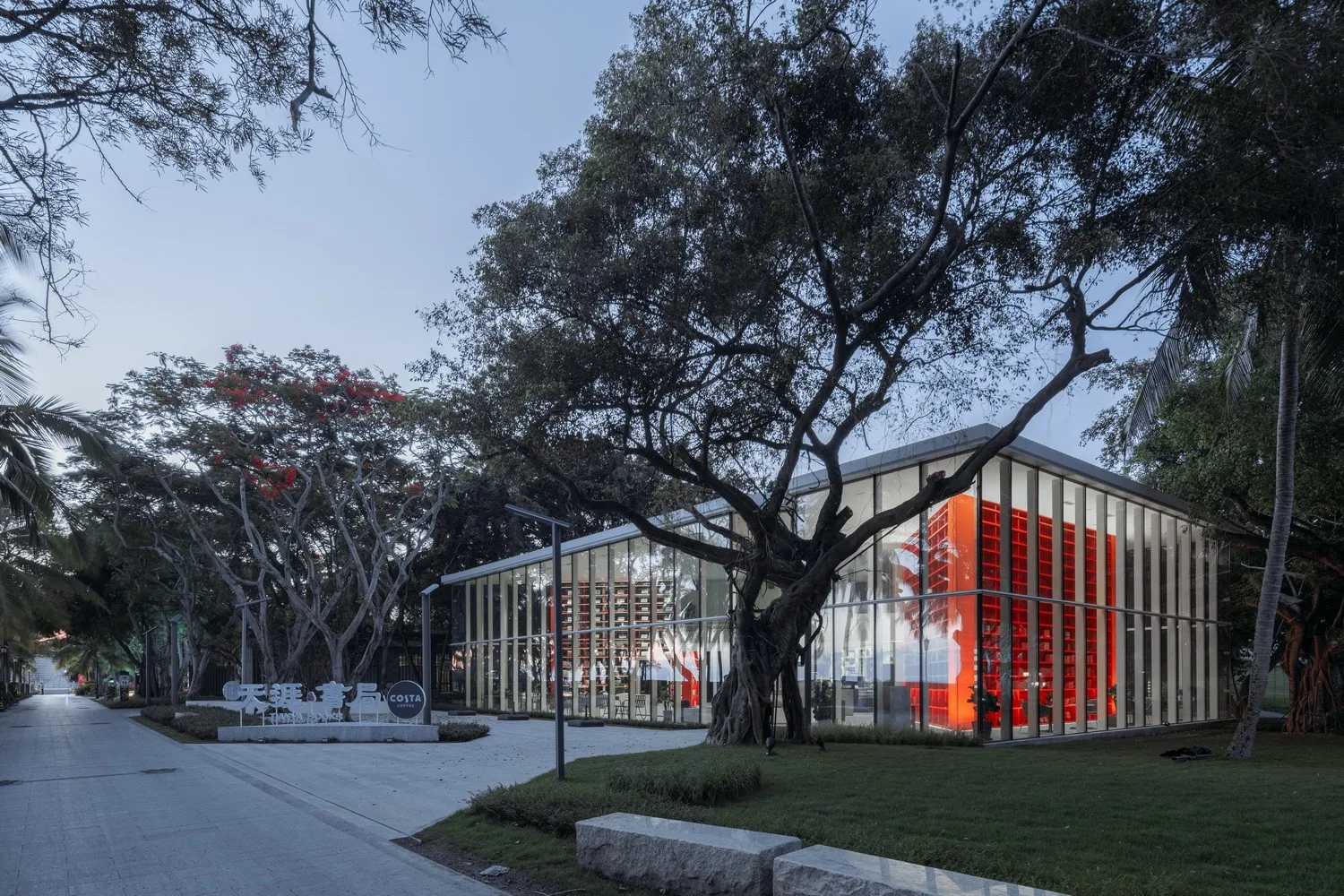
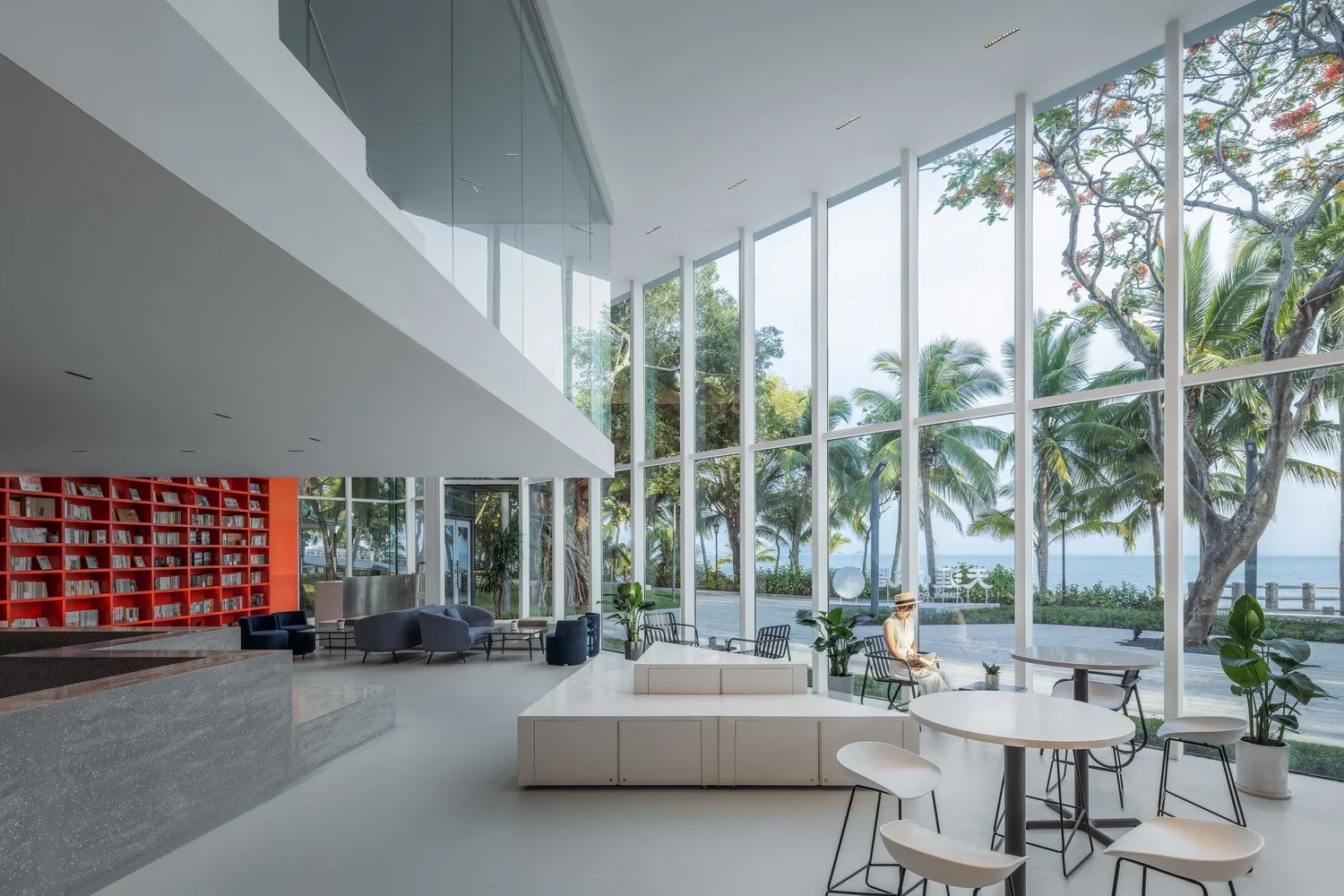
The bookstore’s glass acts as the interface between humanity and nature. Inside, emotions find form in an abstract triangular space. These interlocking triangular shapes create a subtle balance on the delicate glass surface, allowing visitors to sit on benches or stand on the stage while gazing at the stars beyond.
This is the sea before us — and the sea we aim to conquer. Stars twinkle and waves surge, their silent rhythm echoing deep within our consciousness. The bookstore’s attitude can be summed up as, “Our journey is like a sea of stars.”
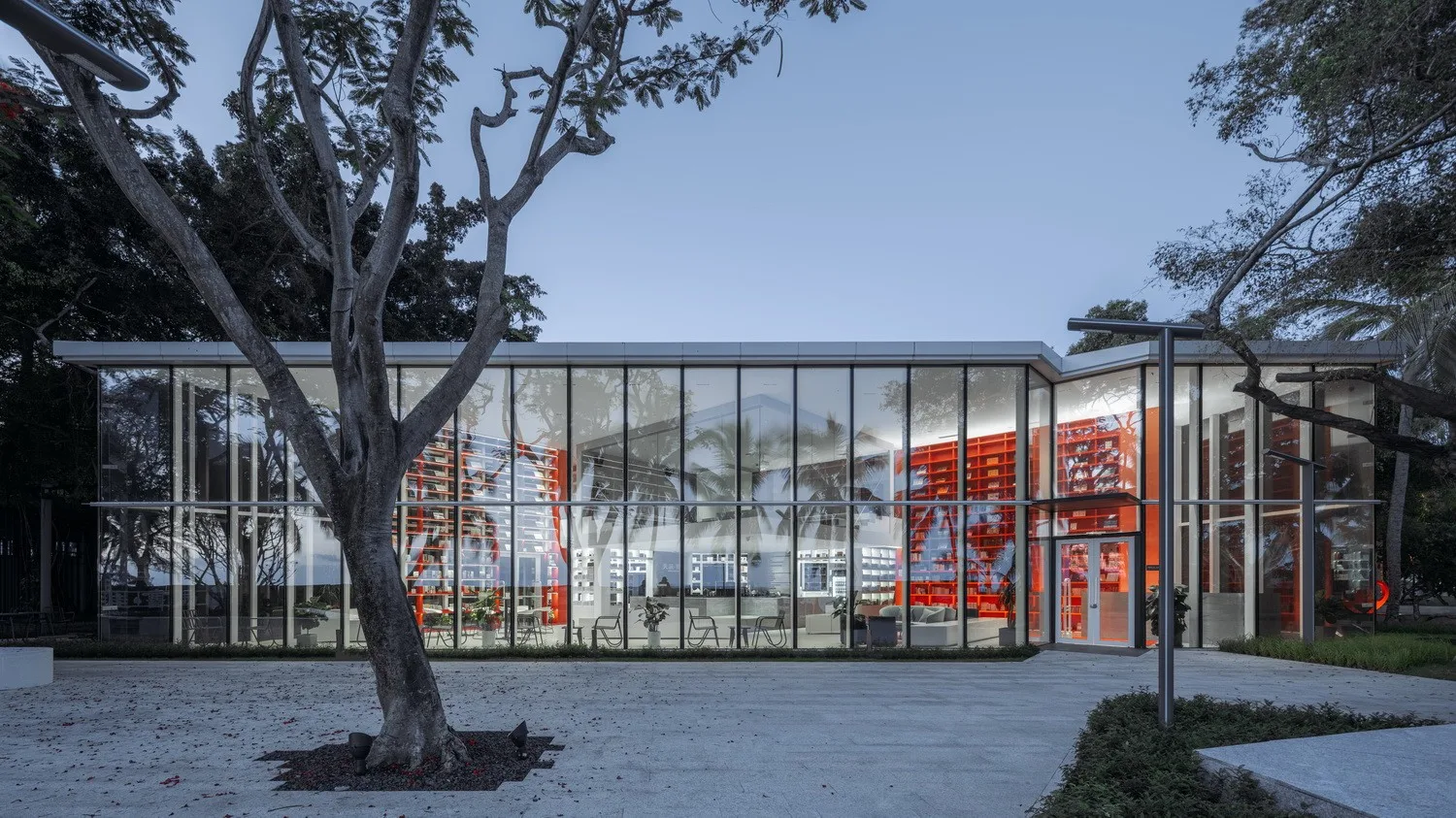
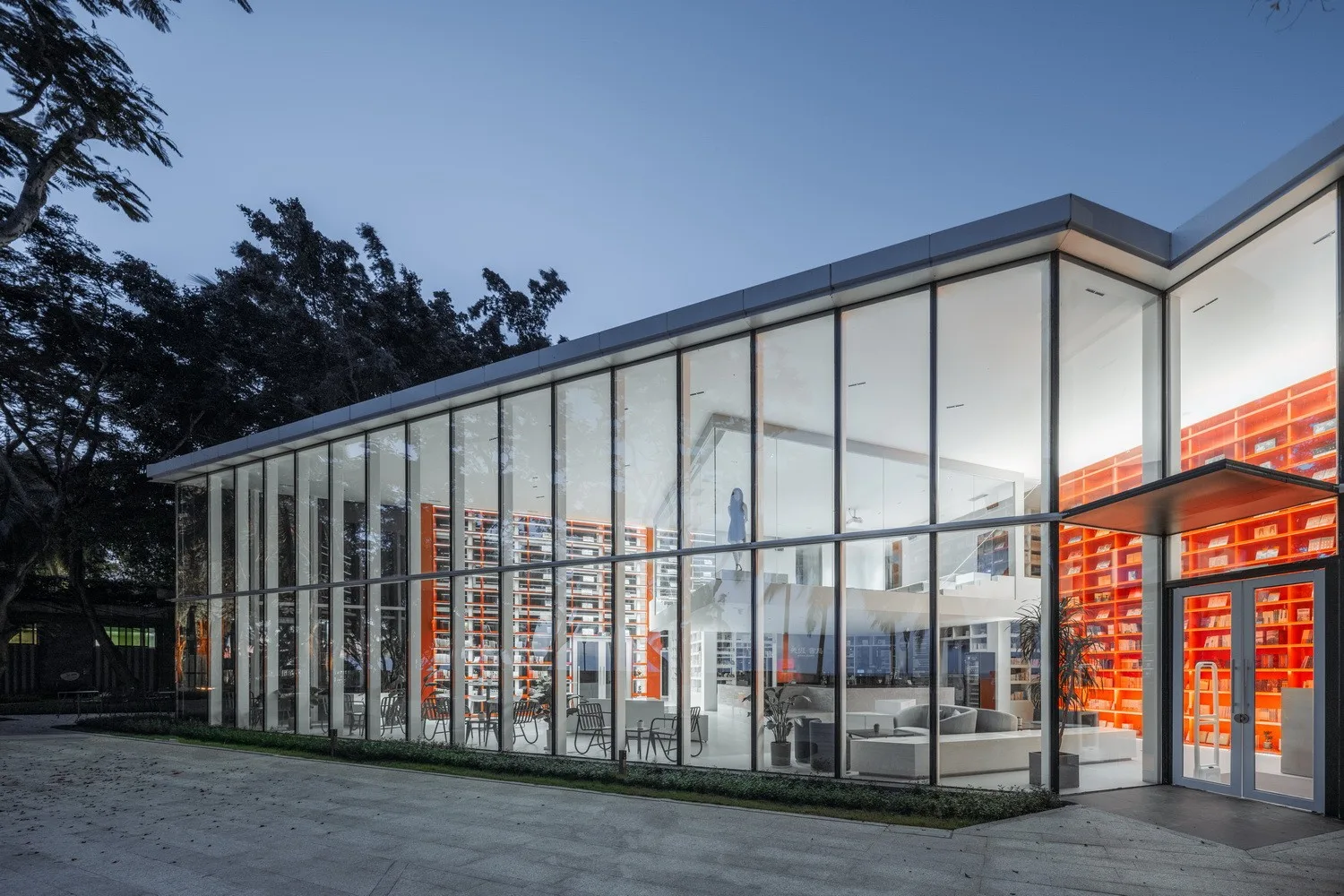
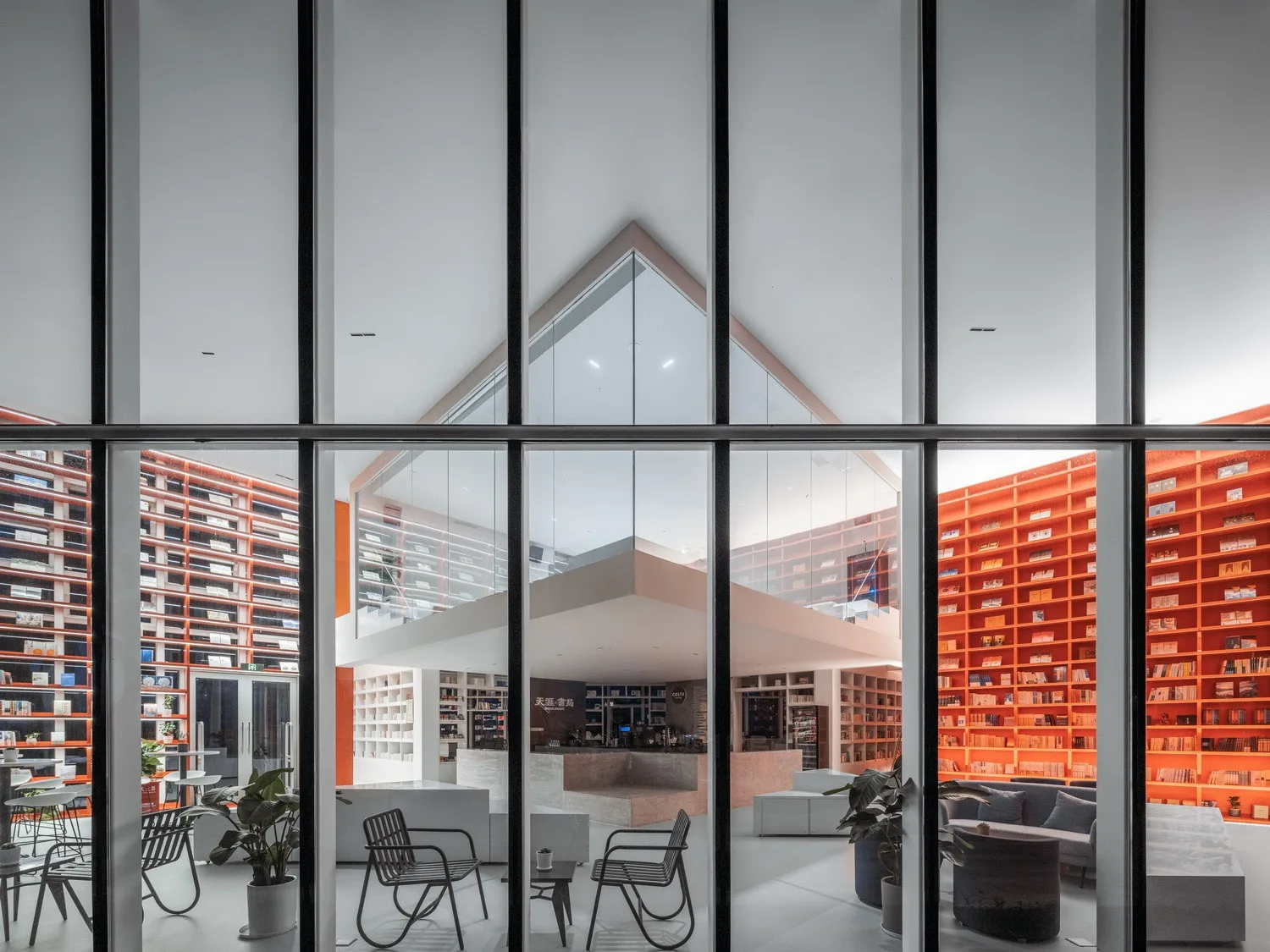
Designing for the southernmost bookstore in China presented unique challenges. Situated geographically at the country’s southern tip, the project demanded thoughtful adaptation.
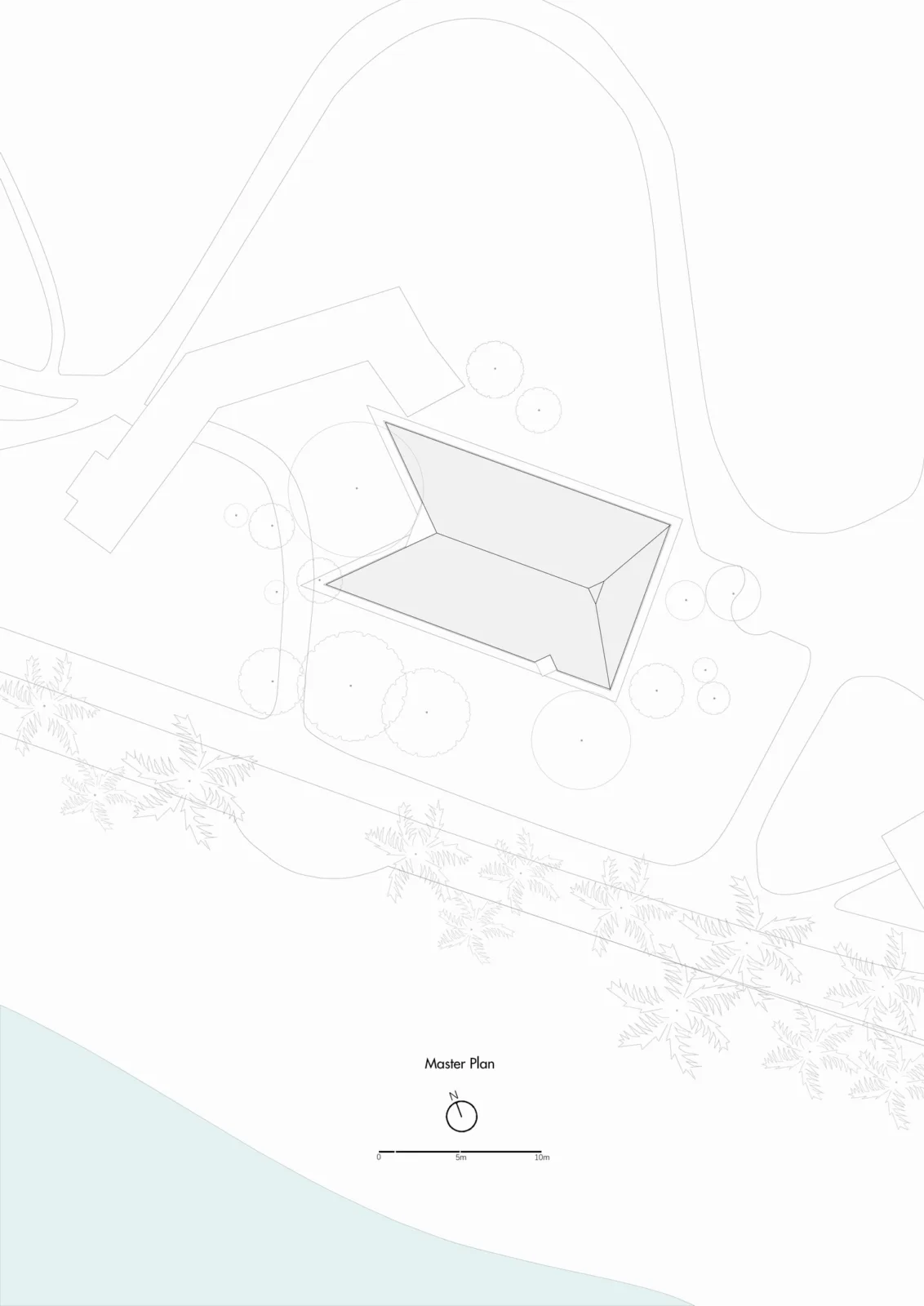
The owner and I chose a site nestled in the forest near the beach rather than directly on the sand. Initially, my design envisioned a pure transparent glass box, a structure that harmonizes abstract geometric forms with the rich natural landscape.
However, a large banyan tree on the site required adjustments. I had to remove a triangular section from the bookstore’s rectangular footprint to preserve the tree, while maintaining the 27-meter-long façade facing the sea.
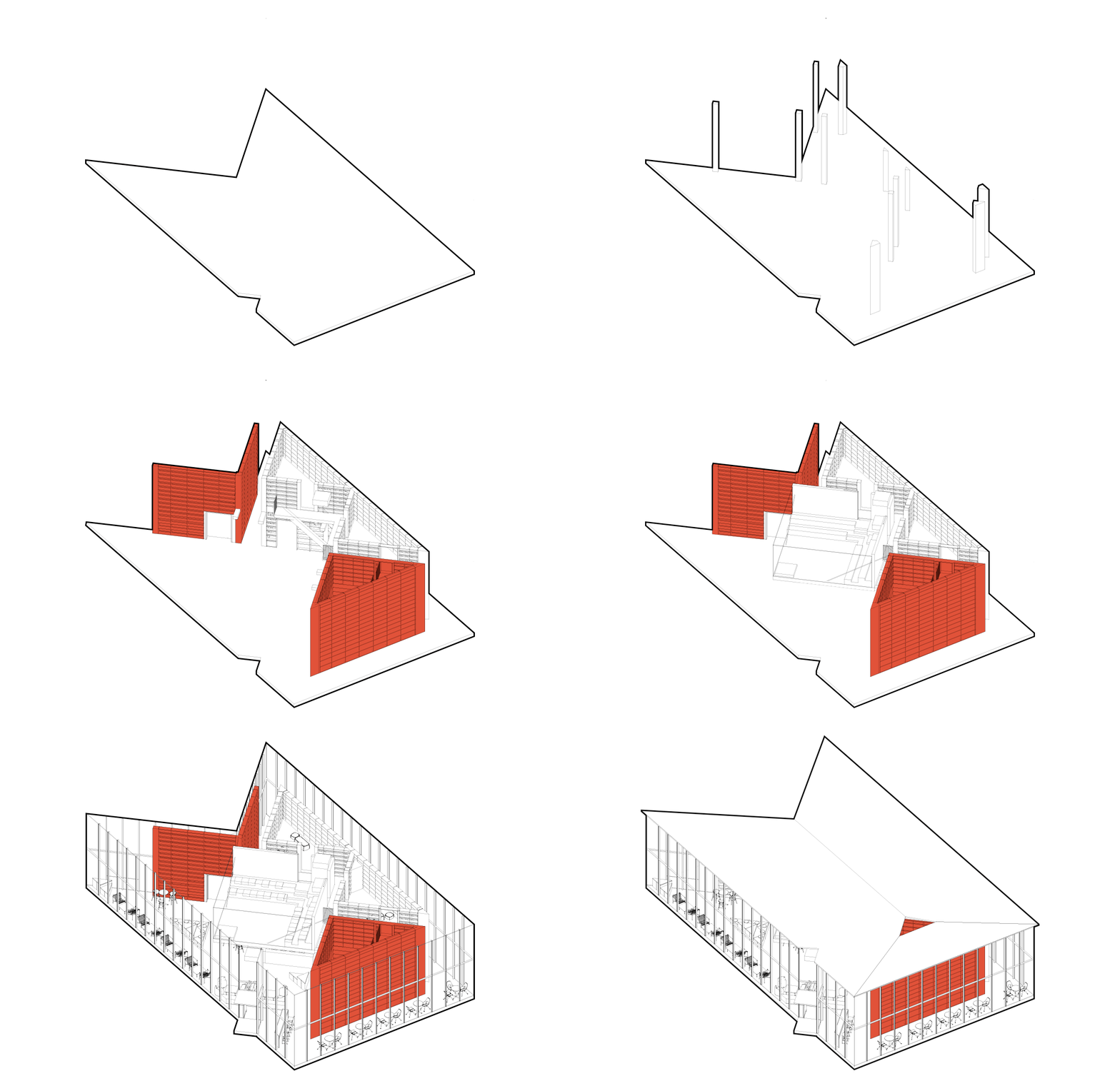
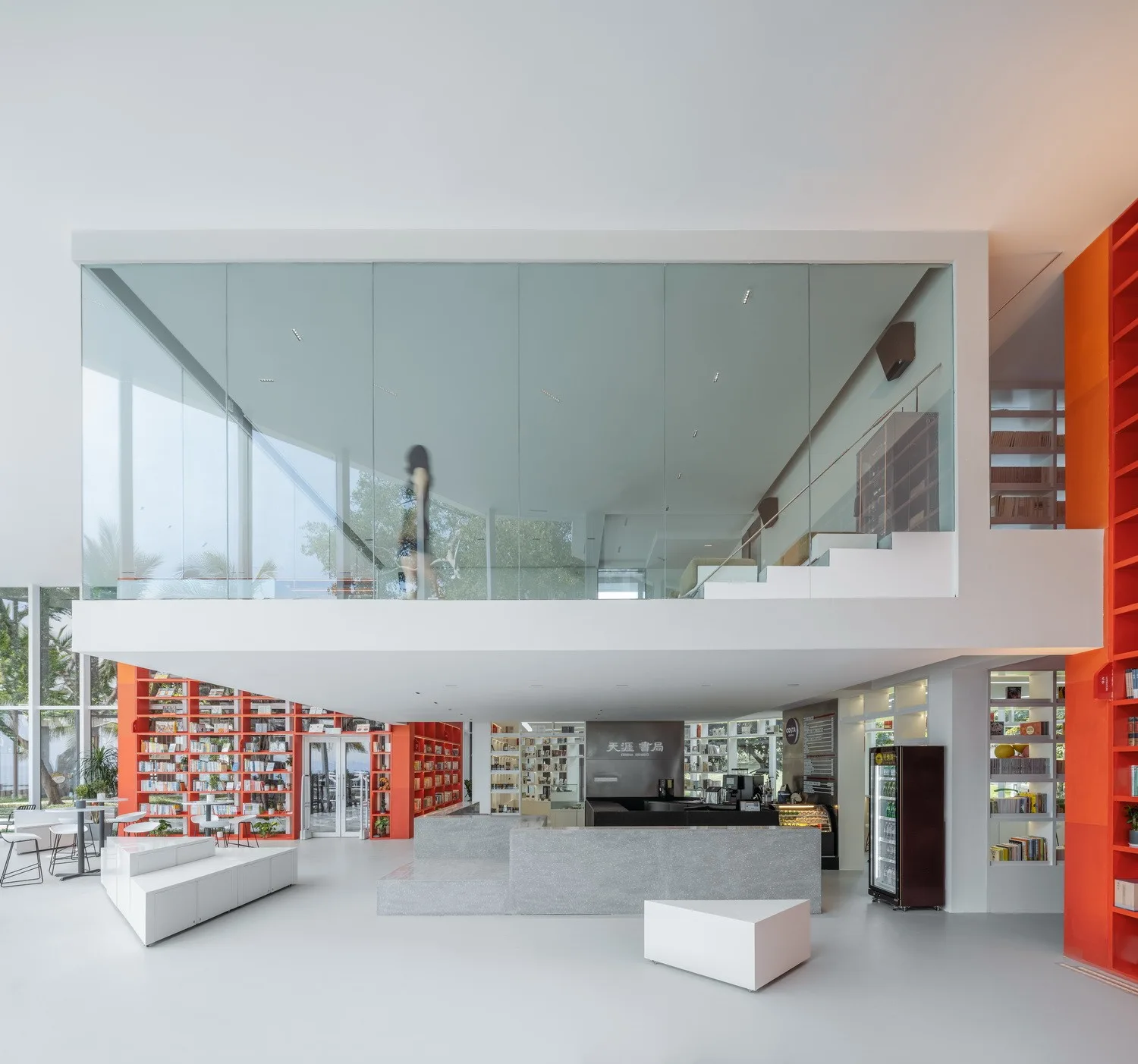
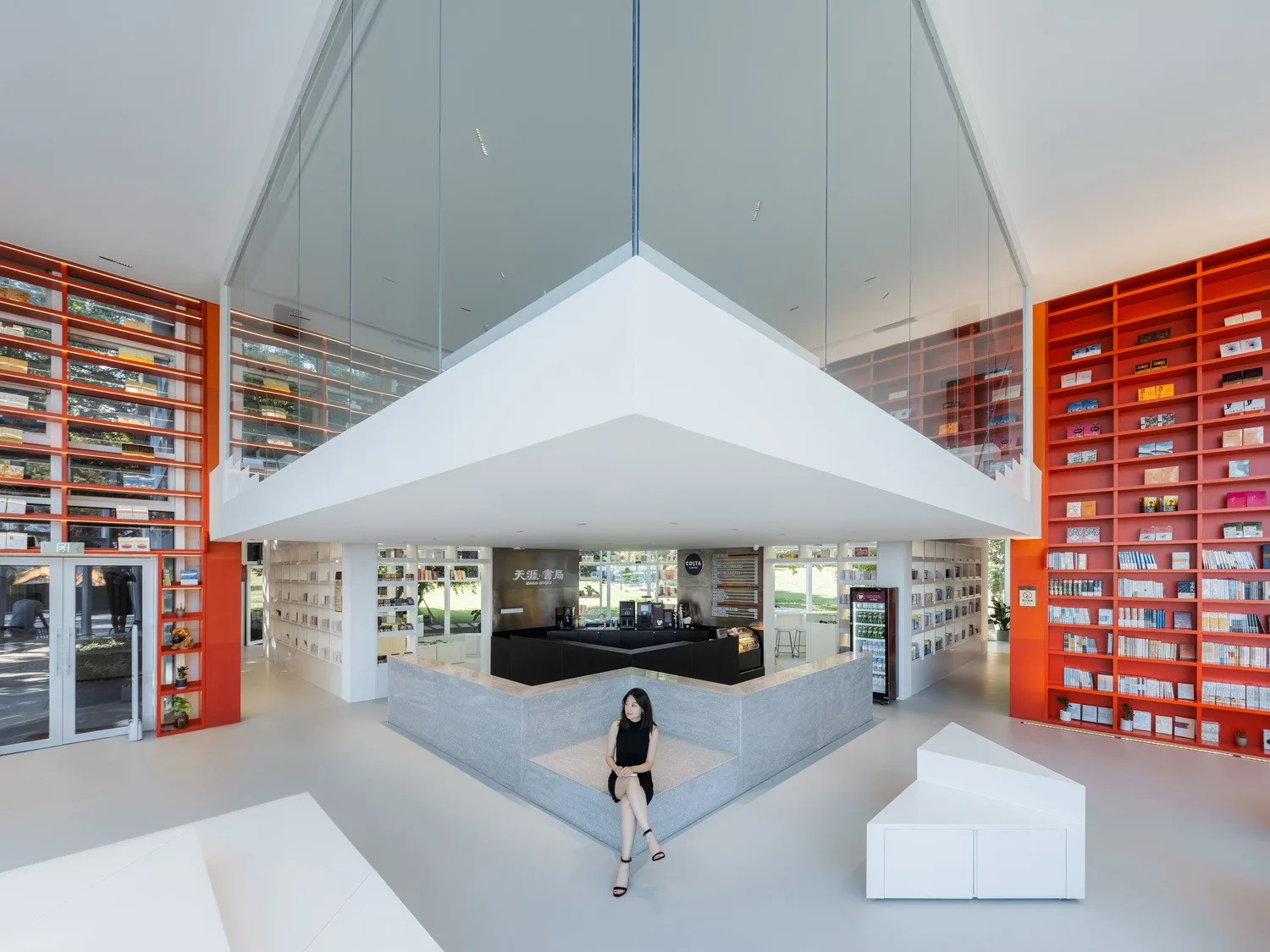
The bookstore combines coffee, lectures, and reading spaces. The ground floor features separate areas for regular and private reading, while the second floor houses the children’s reading room and lecture hall—helping recover space lost to tree preservation and maintaining the continuous glass box.
This second-floor section is fully detached from the main façade, creating a “house within a house.” The architect chose a triangular layout for the staircase and second floor, echoing the triangular outdoor space on the west side preserved for the banyan tree. The interplay between the triangular and rectangular forms creates dramatic tension and a unique experience.
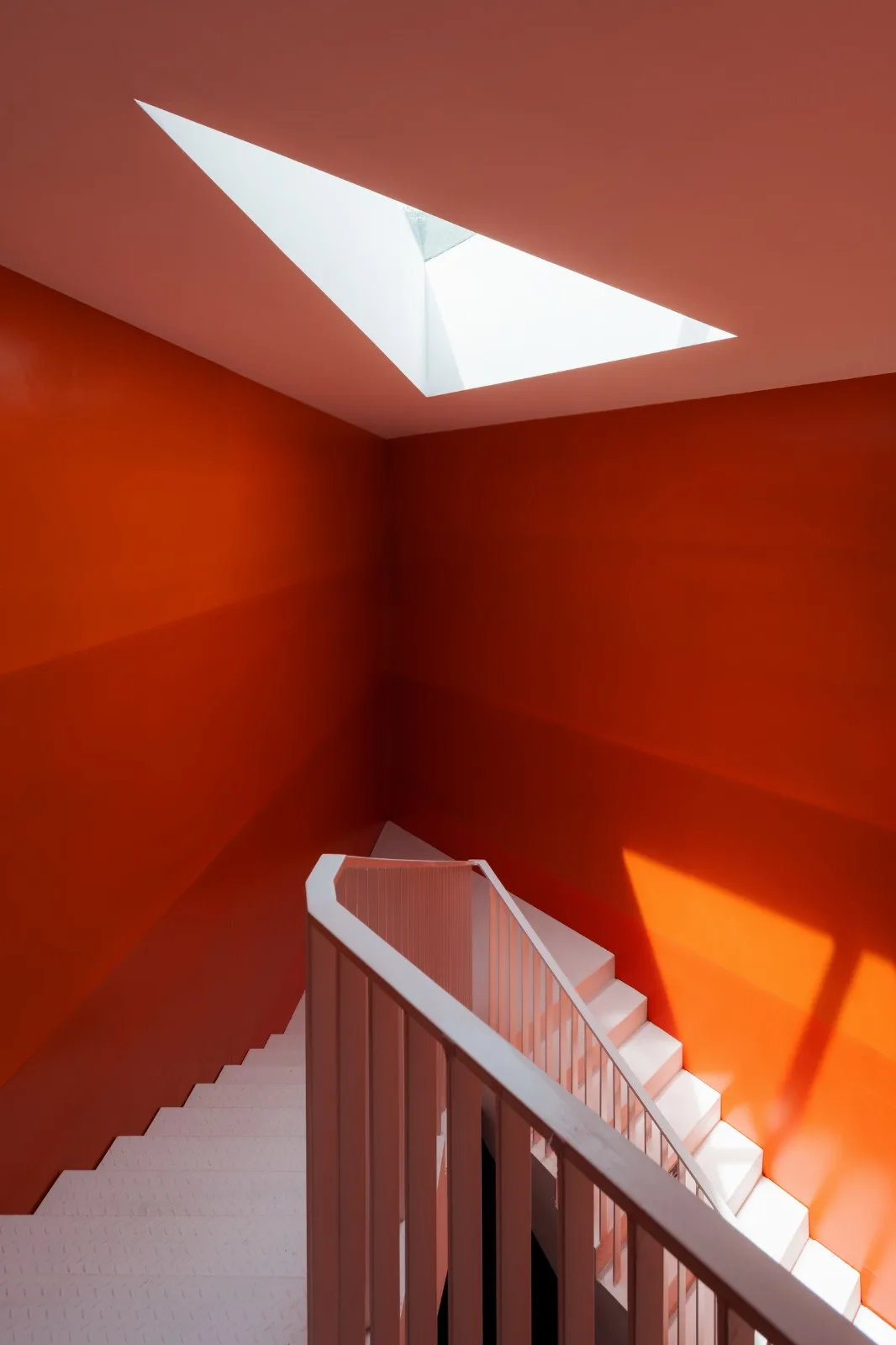
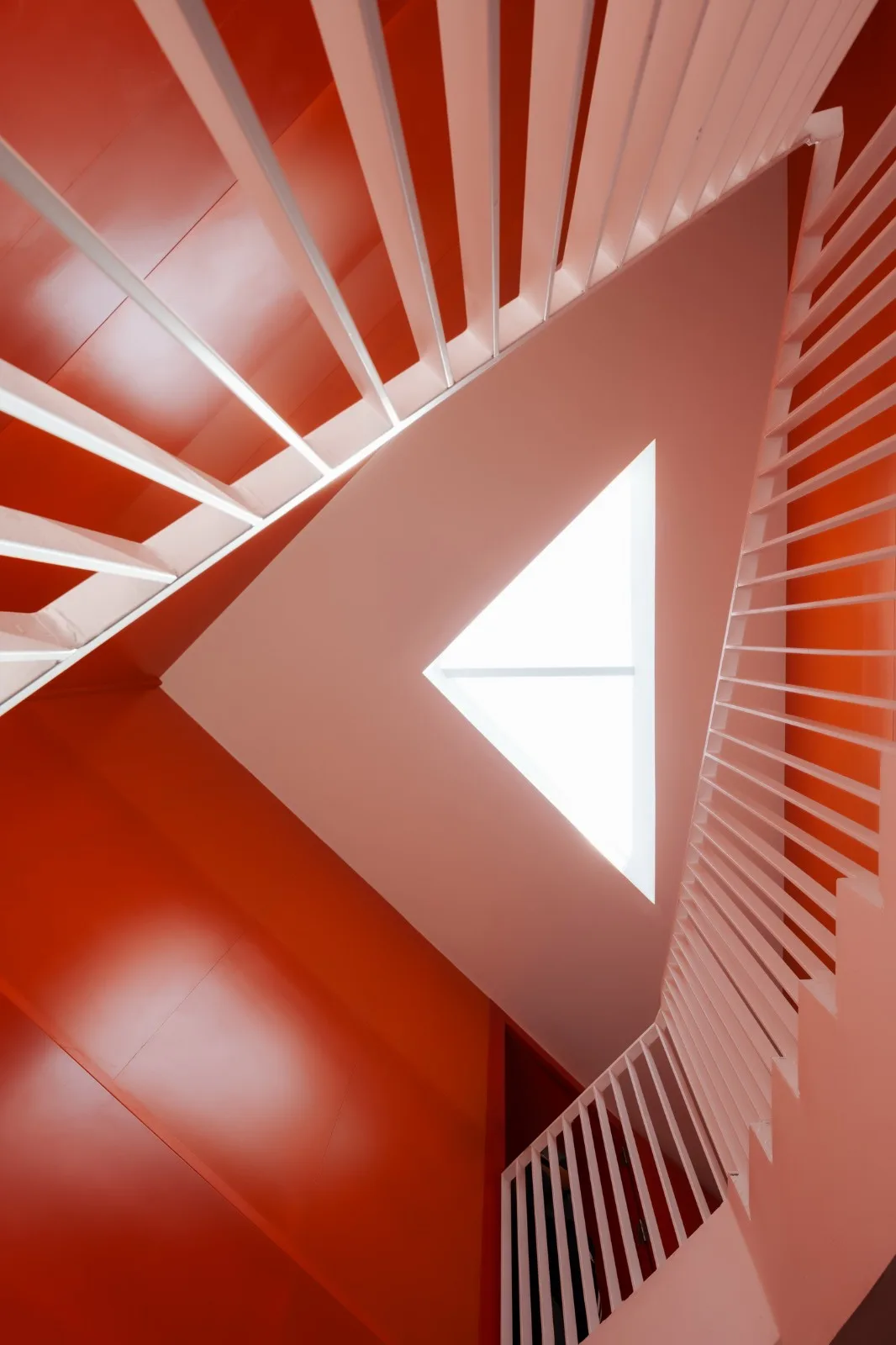
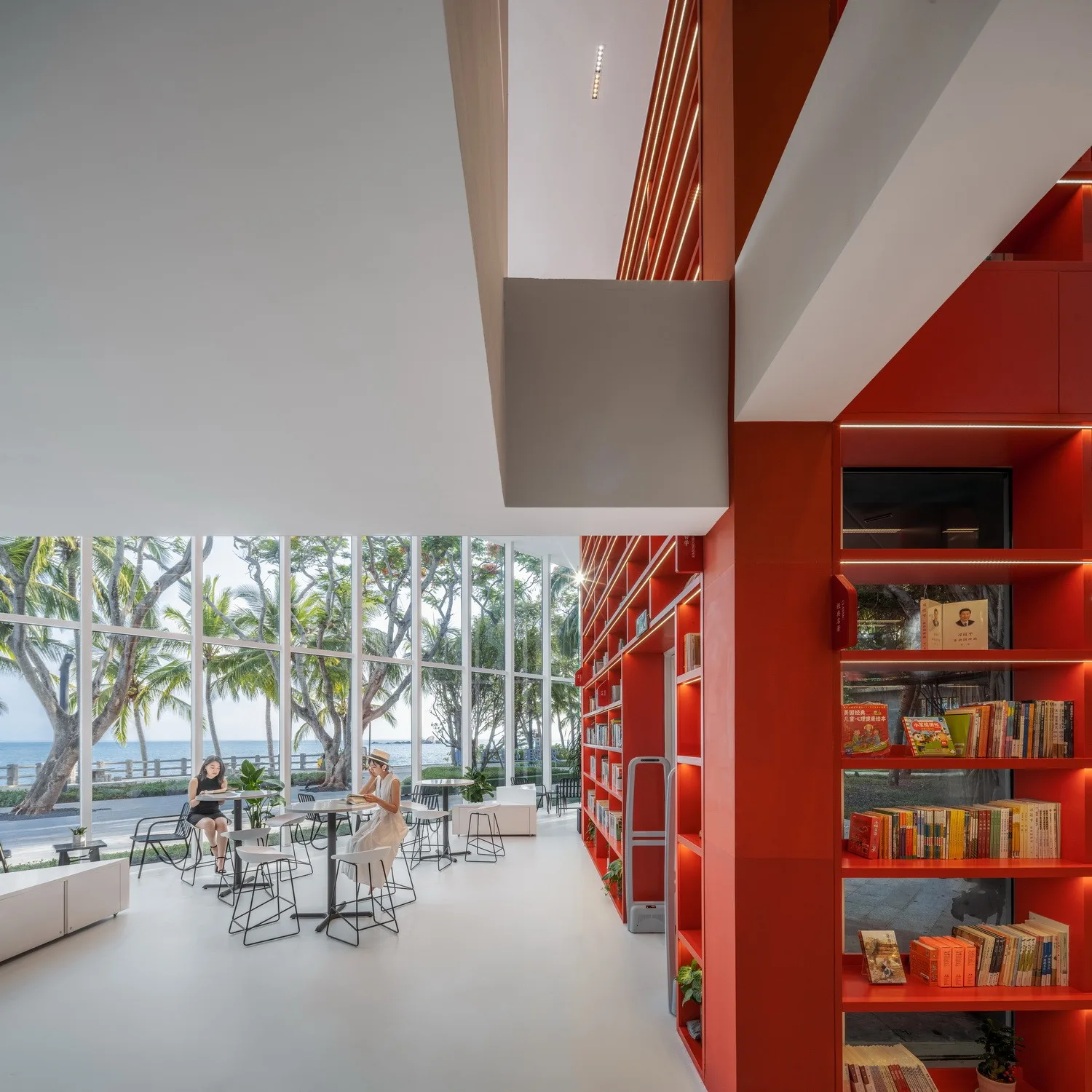
The bookstore’s heart is the controlling triangular space. On the first floor, coffee and private reading areas flank the sides. Above, the suspended lecture hall and children’s reading sections form the visual center.
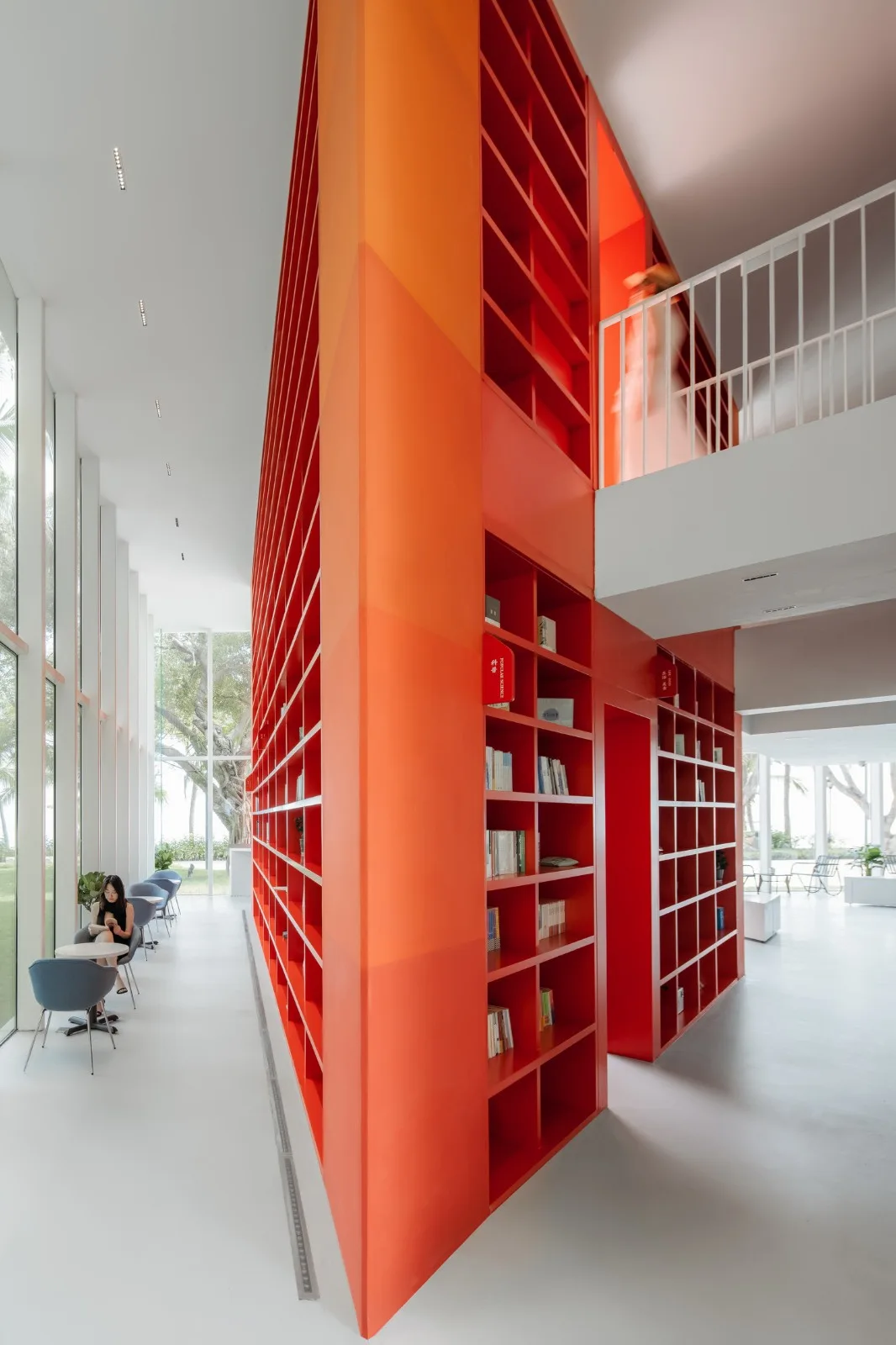
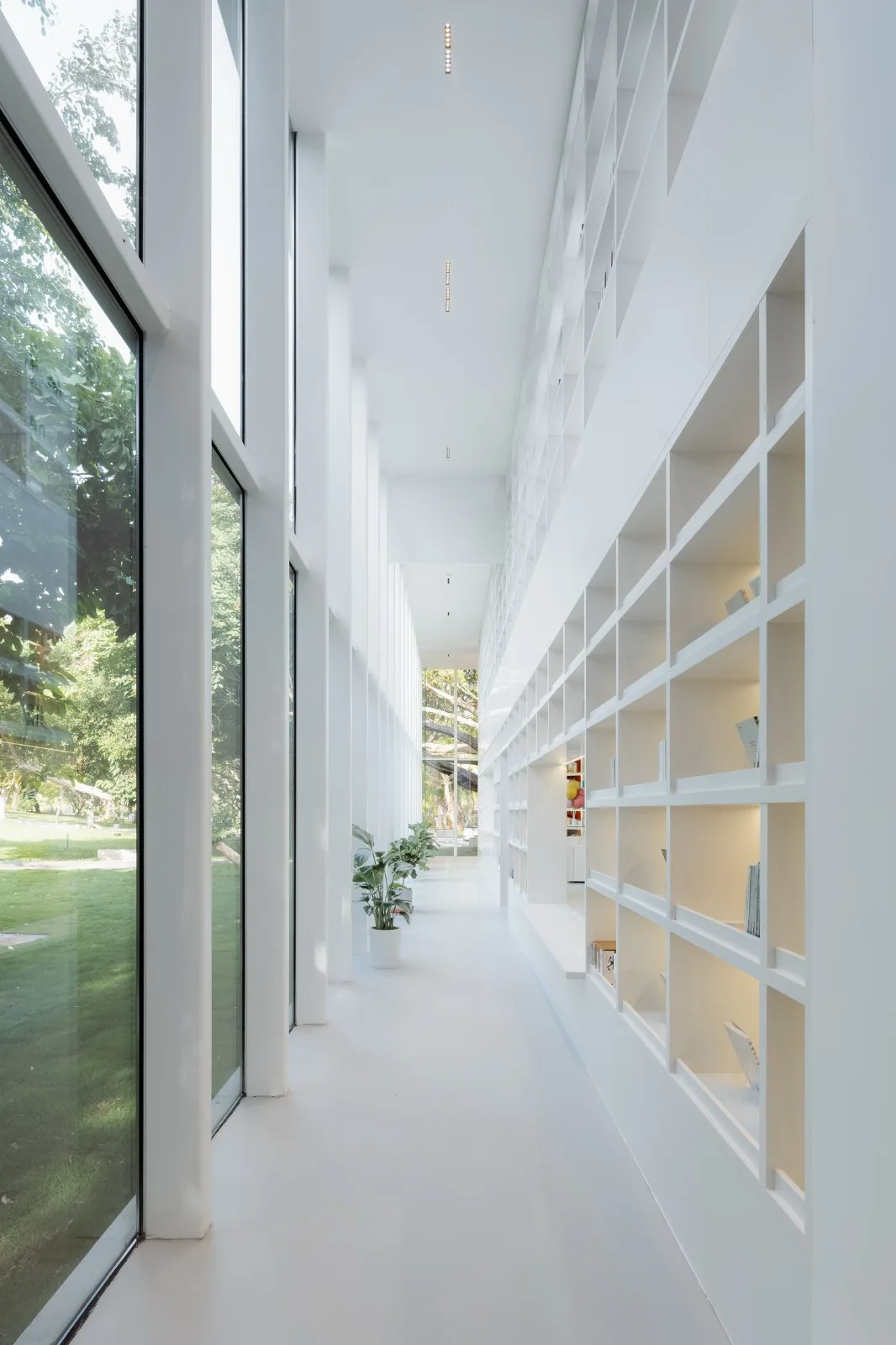
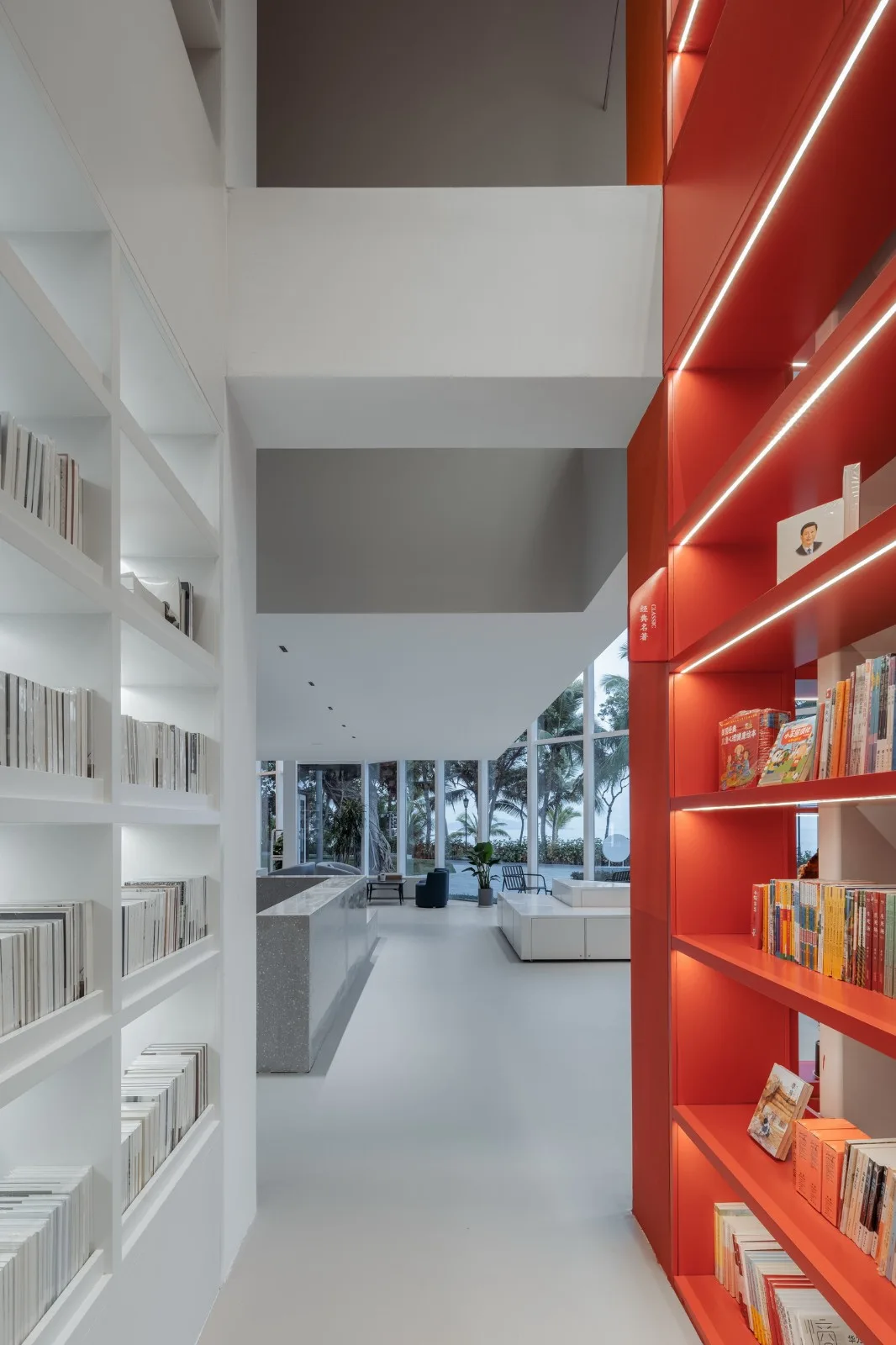
I insisted on an unobstructed view from both levels. To preserve the glass box’s transparency, I asked the structural consultant to avoid visible support columns, curtain wall keels, or canopy rods. This invisible structural design posed a challenge—Miao Binhai cleverly concealed twelve 340 mm square pillars within the bookshelves. Longitudinal beams cantilevered up to 8 meters from the center beam, with the curtain wall keels connected to these cantilevers. The curtain wall was hung from the roof structure, integrating seamlessly with the canopy structure for a continuous, clean design.
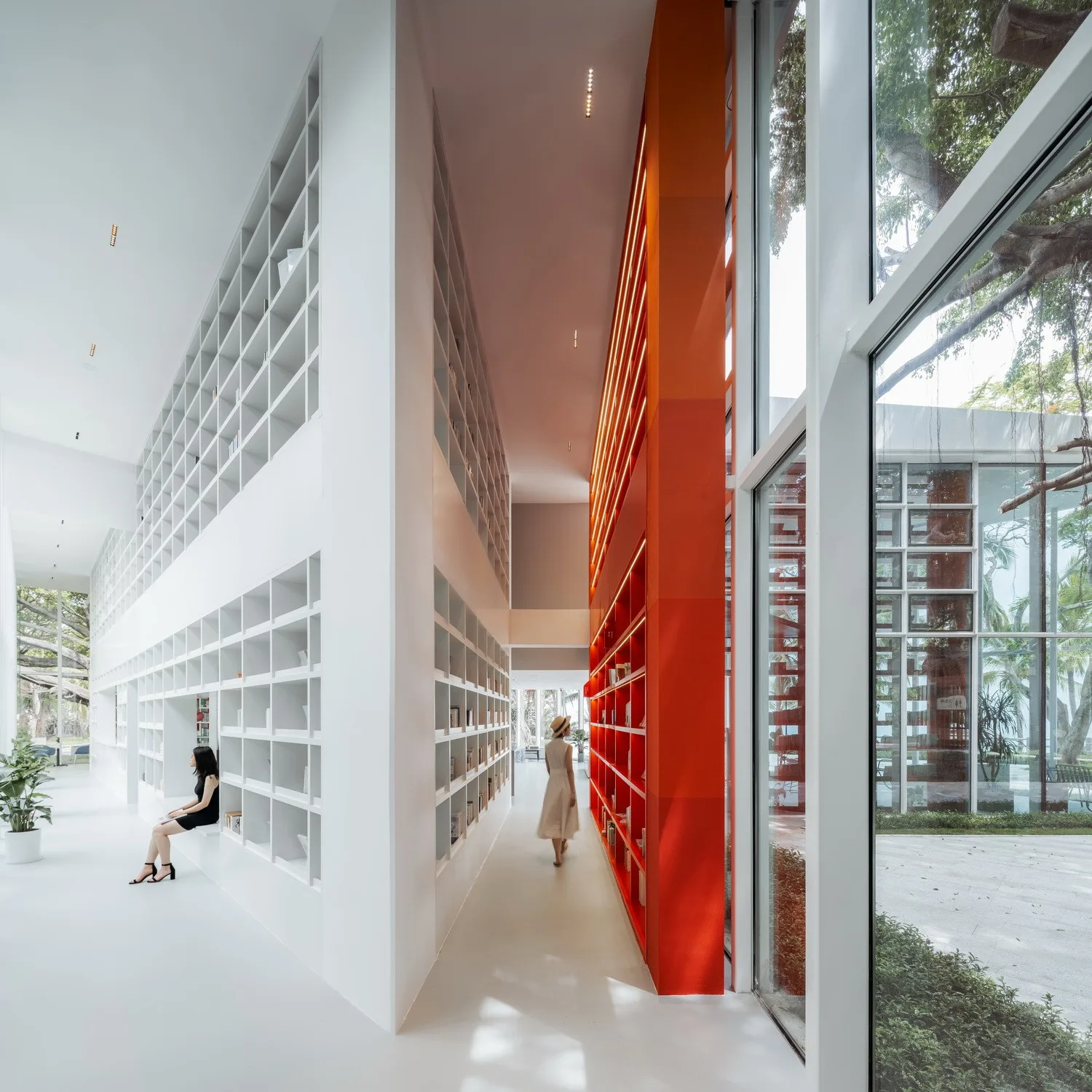
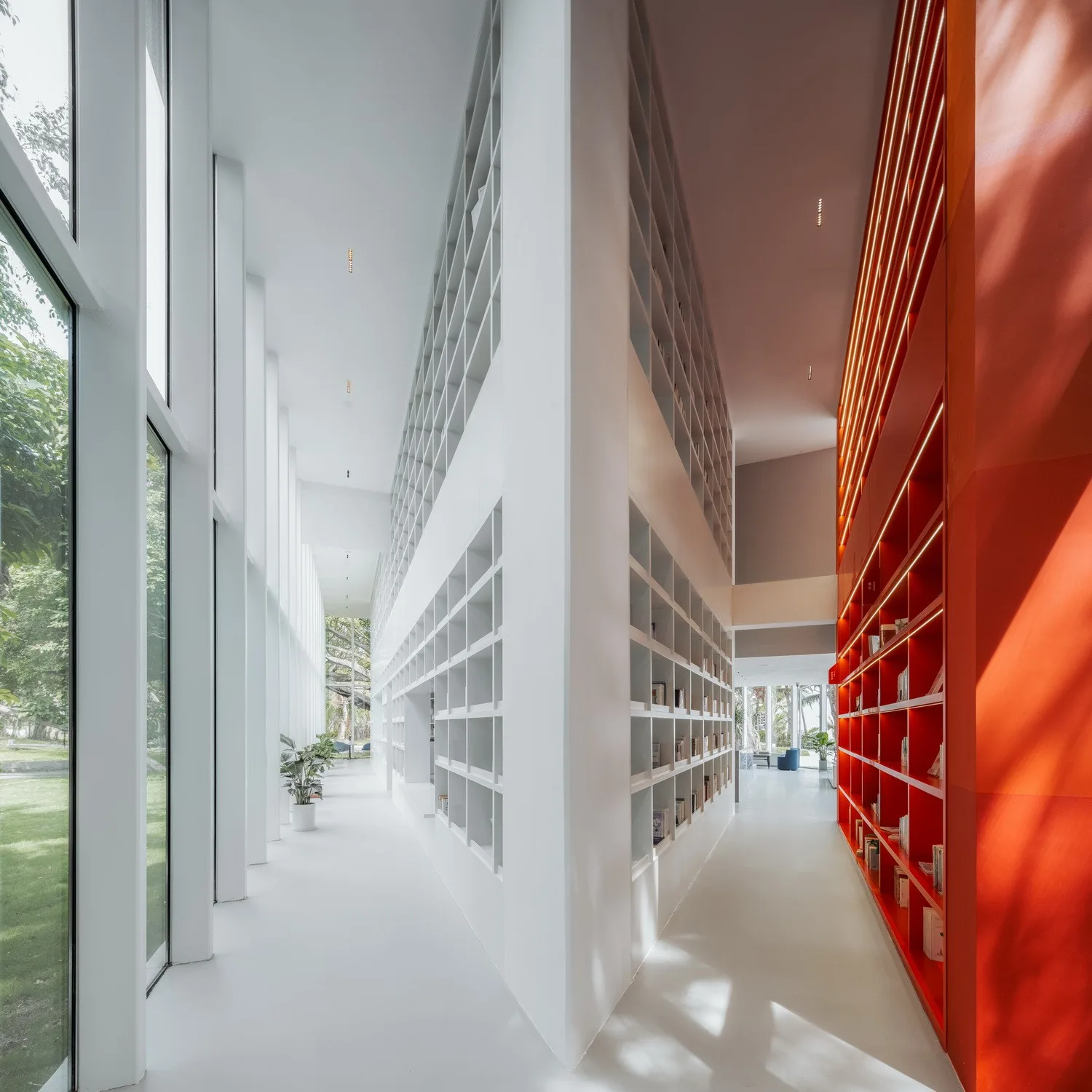
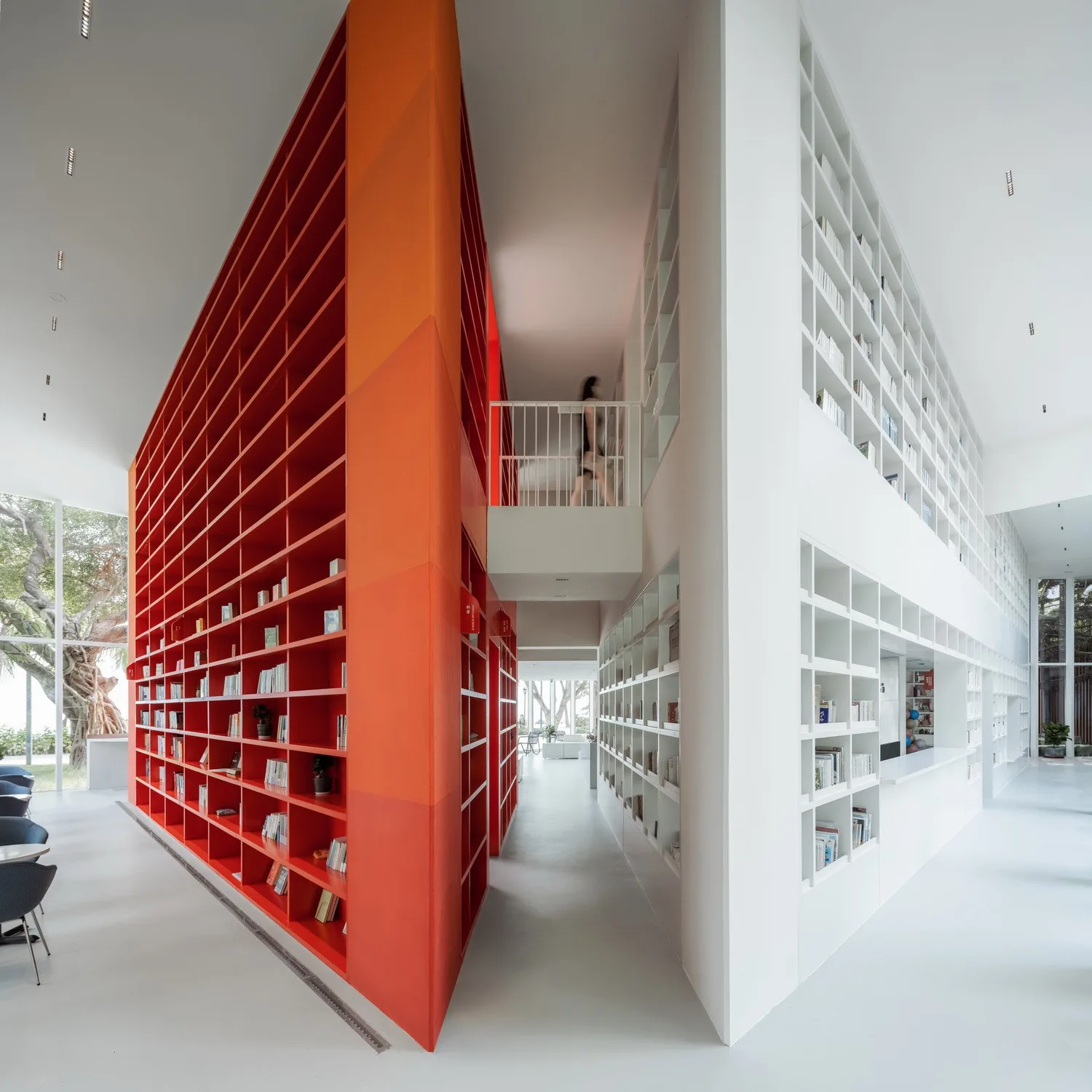
I requested a horizontally leveled ceiling so the roof’s variable cross-section beams could form a proper structure and slope for natural drainage. The architect proposed letting the roof’s water flow freely, eliminating the need for downspouts and preserving clean indoor-outdoor visuals.
After consulting the plumbing engineer, the minimum roof overhang width was established to prevent dirty water from contaminating the glass during early rainfall, while maintaining clean edges.
Through collaboration, the thickness of the longitudinal beam at the eaves was limited to 350 mm. Ultimately, the roof became a gentle four-slope design. Equipment engineers cleverly concealed fire protection, air conditioning, fresh air units, and ducts within the ceiling space. The risers were hidden alongside bookshelves, visually separating the second-floor space and the building’s airspace, creating a “house within a house” and preserving the glass box’s purity.
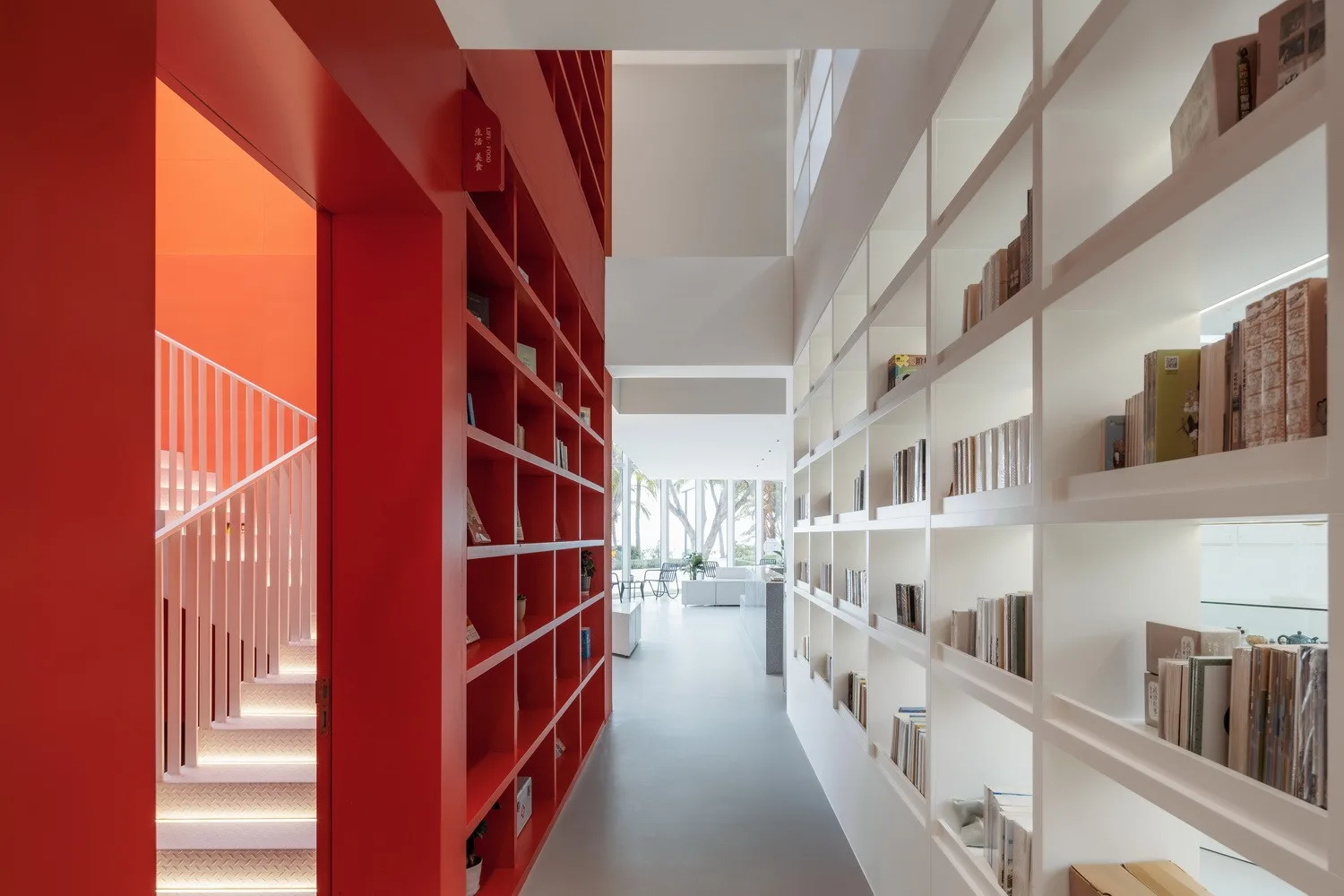
Initially, I was dissatisfied with the curtain wall keel size. However, the project architect explained that the curtain wall must withstand a level 17 typhoon. Without exterior mullions, the internal keel’s size had to increase slightly—a compromise understood by those familiar with typhoon forces in Shanghai.
The only visual link between the ceiling and the four facades is the new air vent. The ductwork is wrapped in a triangle, forming a triangular air vent on the façade, echoing the building’s flat triangular layout.
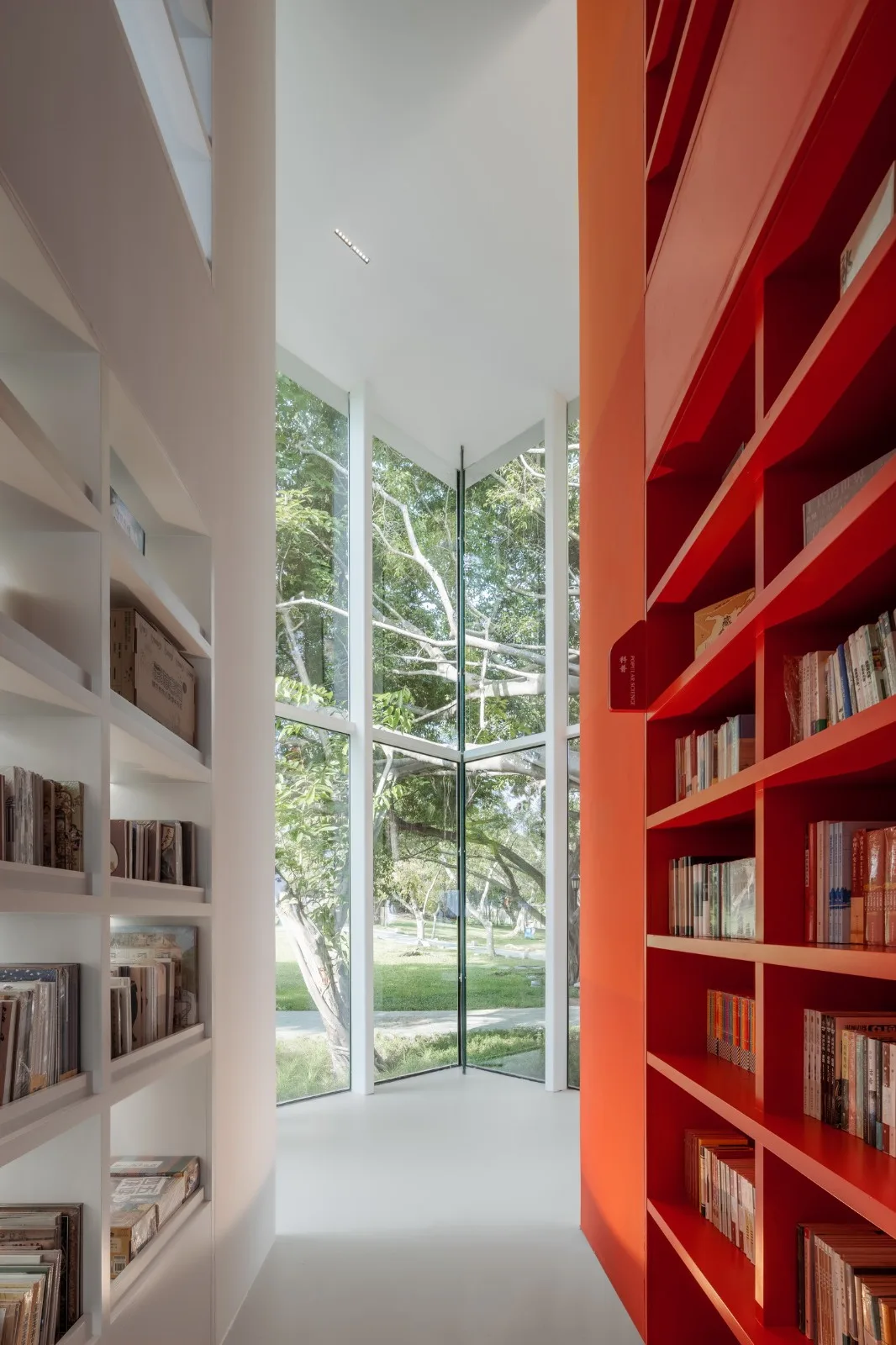
Building on the beach presented additional challenges. Excavation revealed the soil’s bearing capacity was much lower than expected. Miao adjusted the foundation plan twice, locally strengthening it without raising costs, and replaced and compacted soil to address these issues.
Standing on the second-floor lecture stage facing the sea, speakers feel as if they are suspended in the sky—thanks to a 6.2-meter cantilever beam cleverly concealed by the architects and engineers.
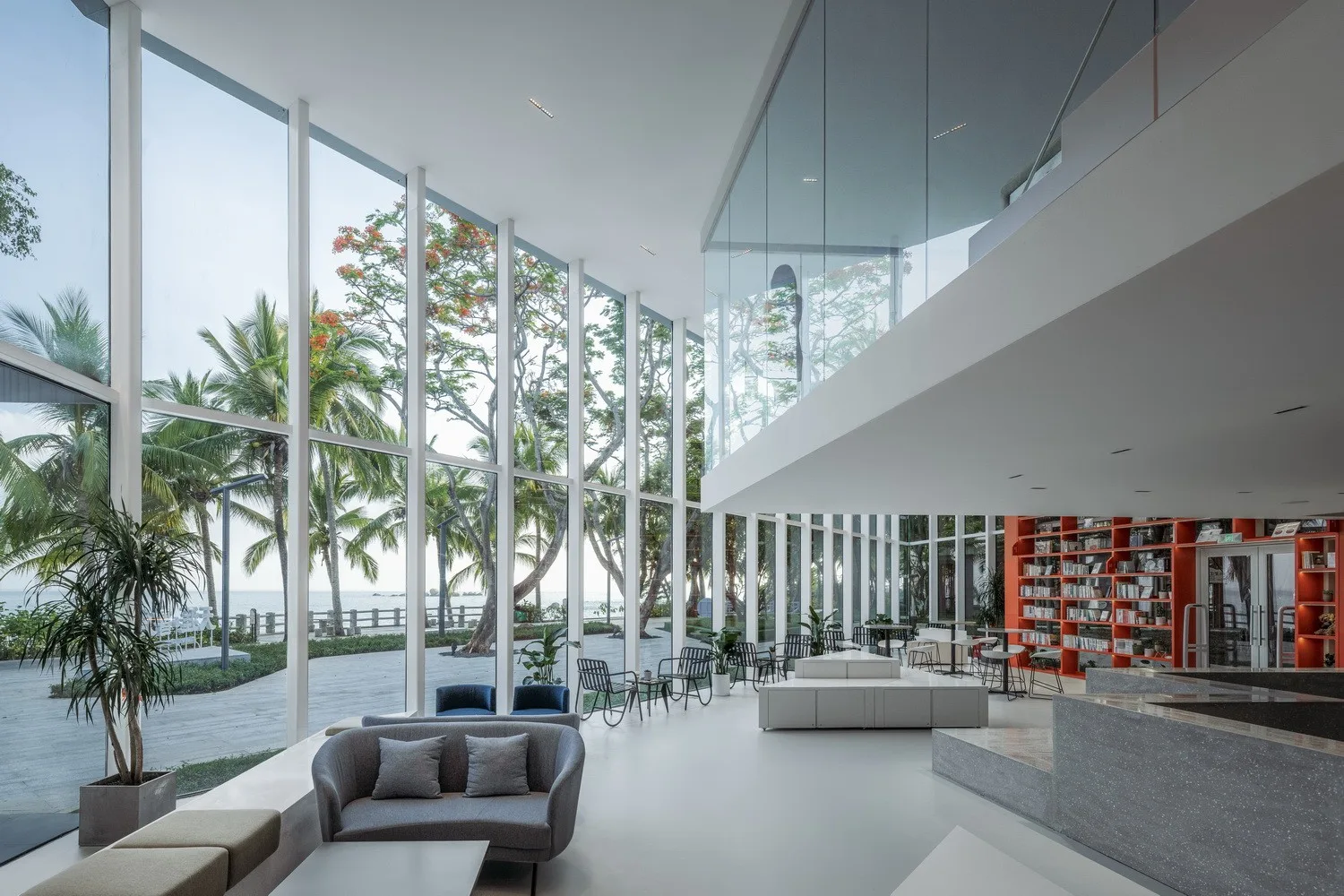
New fire regulations presented design challenges as well. To minimize the smoke exhaust window area, the indoor net height was reduced to 6 meters. The 573-square-meter glass curtain wall requires only a 12-square-meter smoke exhaust window, all placed on the west façade.
The west side features a symmetrical staircase and bookshelves inside. The curtain wall keel and bookshelves were carefully arranged to visually conceal the exhaust window opening.
Thus, a pure yet complex bookstore was created, perfectly embodying Wutopia Lab’s aesthetic: difficult ideas and challenges expressed with incredible ease. This bookstore, housing many subtle design details, represents a quiet southward journey—facing the sea and advancing despite adversity, hidden within a forest by the beach.
Designing as a form of expression, the bookstore became a manifesto.
The glass façade appears fragile before a storm but almost disappears under clear skies. This fragile and changing nature reflects my feelings when confronting the sea.
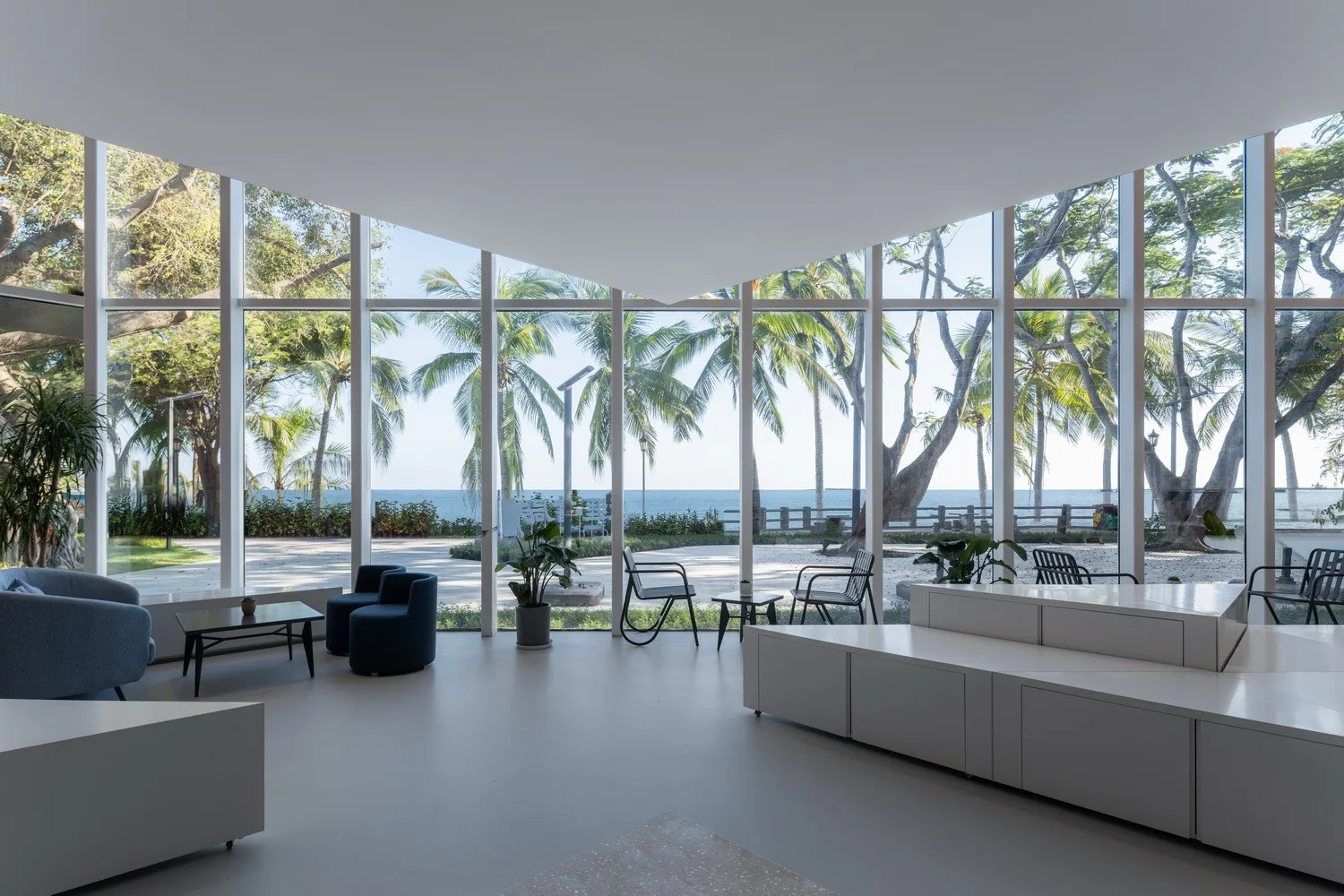
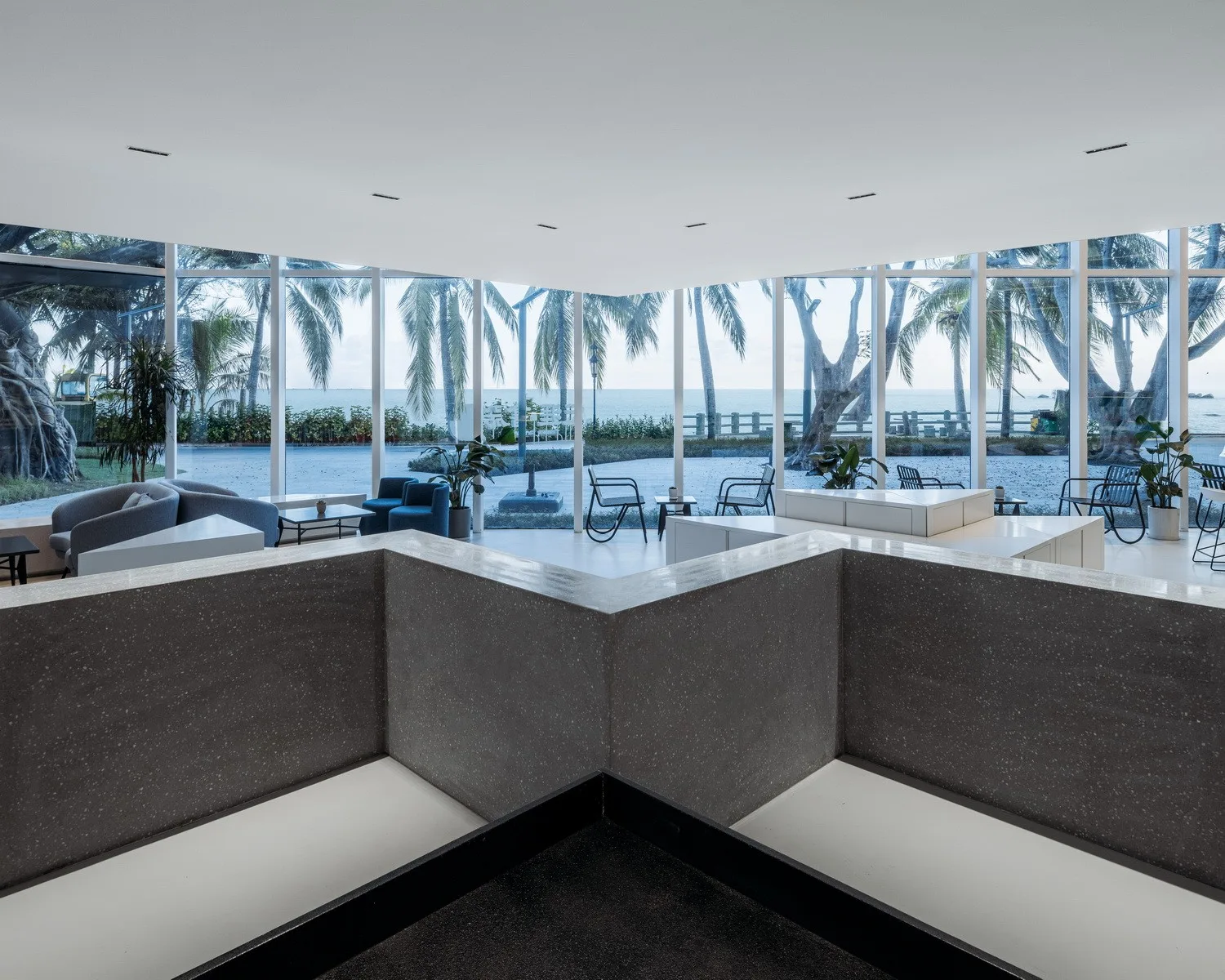
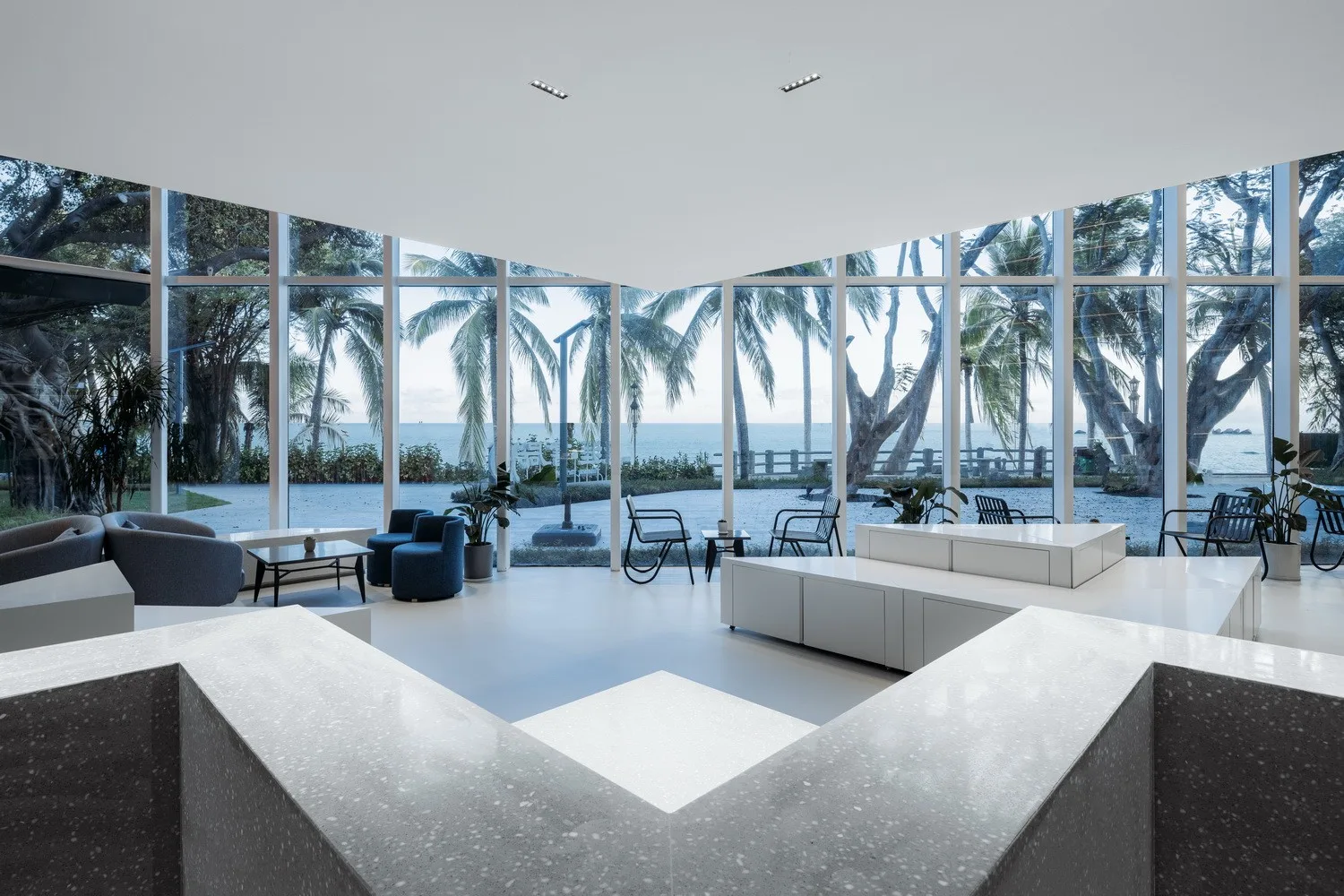
Triangles symbolize the corners of the sea at the ends of the earth and are a recurring motif throughout the bookstore. The exhibition hall, stairwell, cultural tables, bar counter, custom book desks, and seating all feature right angles of varying sizes, each pointing toward the sea.
They express the sharpness and richness of human thought and emotion, ultimately stopping abruptly before the glass—calling out to the sea beyond.
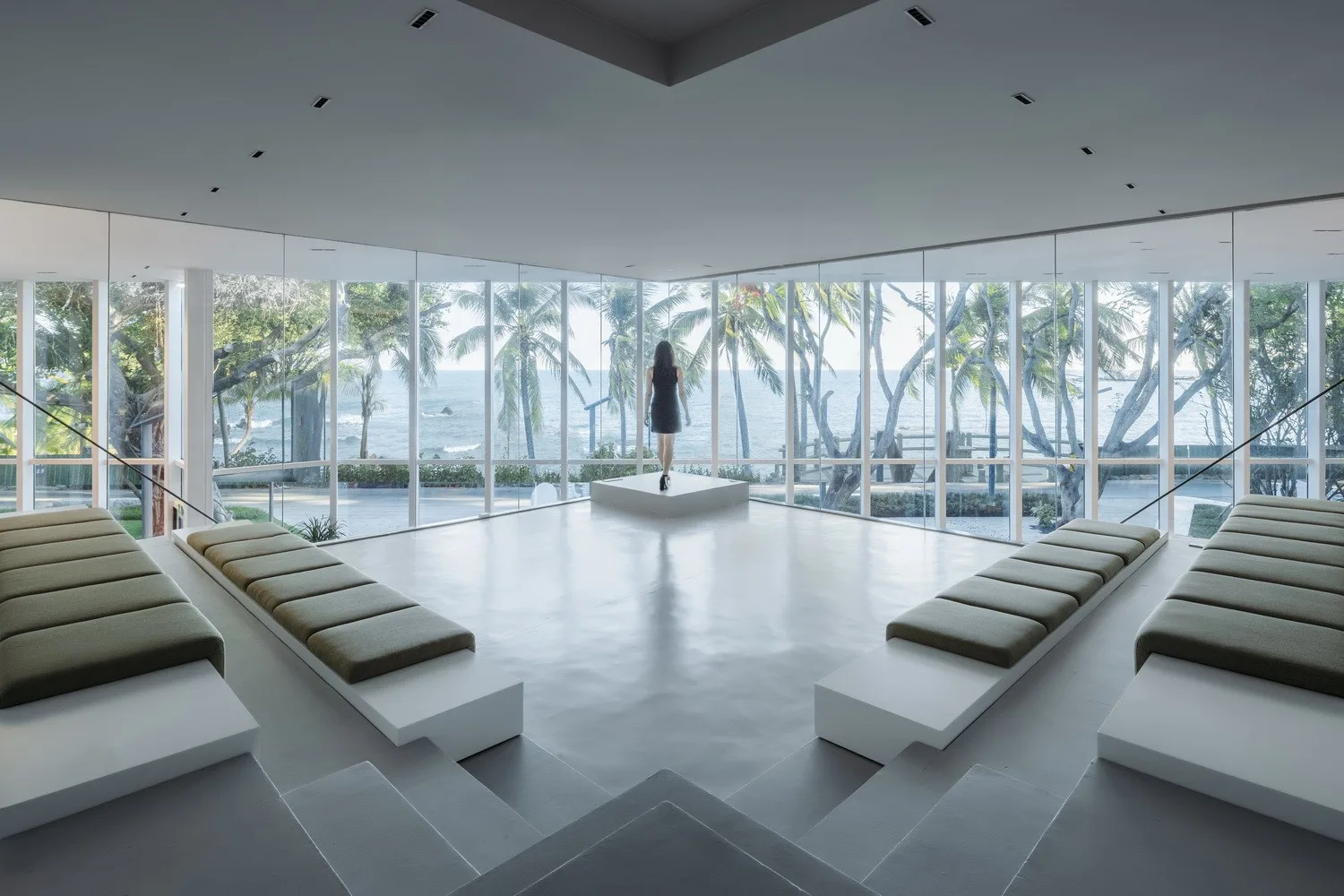
On the diagonal of the lecture hall stage is a small elevated platform—an idea inspired while reading the book Underland. I envisioned this as a throne on the bookstore’s central axis. Placing a chair here allows one to sit, feeling as if the floor beneath connects directly to the ocean, breaking physical boundaries and sparking imagination.
The lecture hall stage is the bookstore’s centerpiece, almost touching the façade as its sharpest corner but inaccessible. Standing on the stage, one becomes part of the scenery—a protagonist both in the view and in life.
In contrast to the calmness of the glass façade, the symmetrical gradient red bookshelves flanking the central triangle symbolize the burning fire of ideals within people’s hearts.
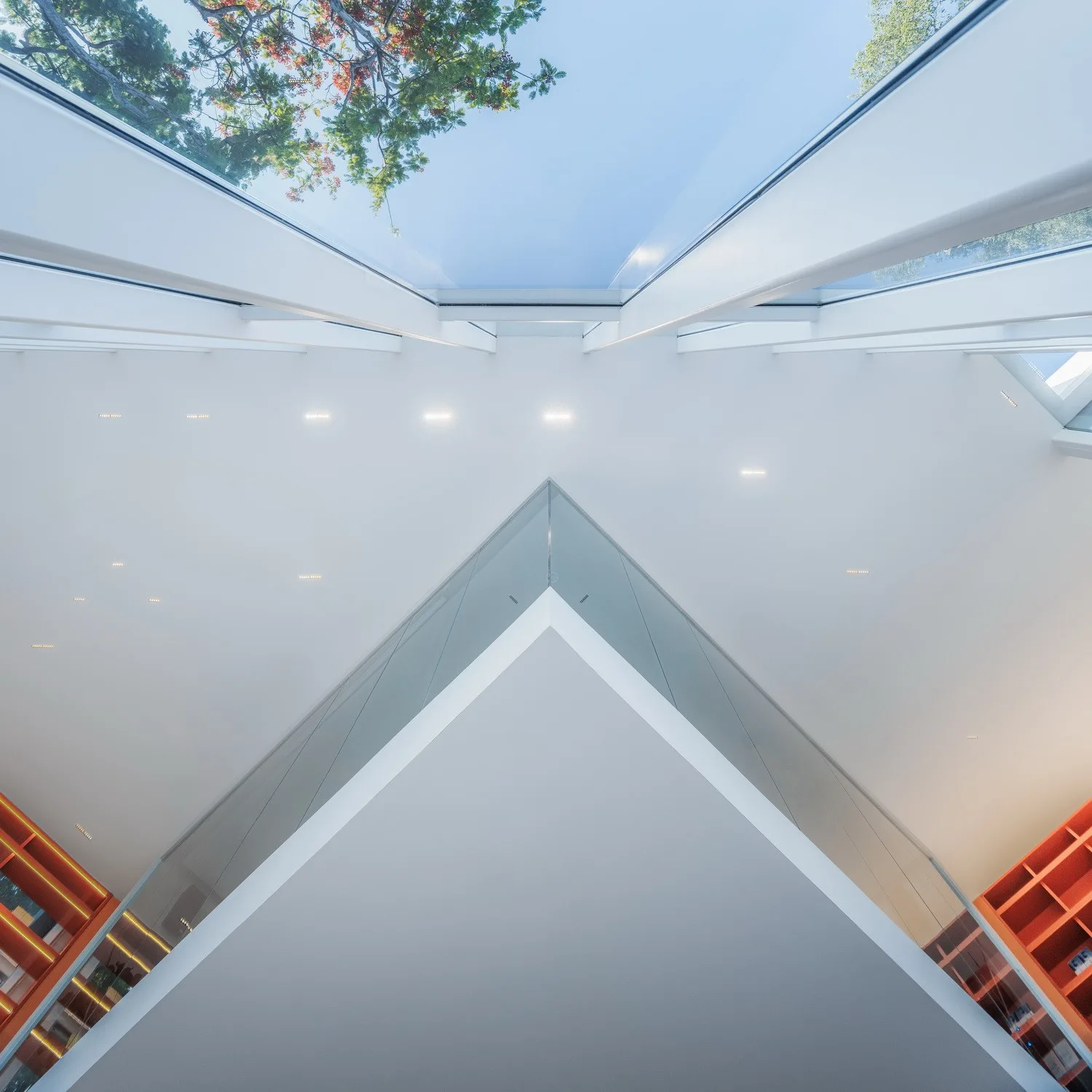
The stairwell is hidden within this fiery space, and as you ascend, sunlight streams through the triangular skylight, silently witnessing your growing desires and ambitions.
This is a song of ice and fire before the vast blue sea. The initial design became a prophetic reality: a 400-square-meter glass box built during strict pandemic controls. We all understand the challenges and the optimistic significance of overcoming them.
Humble and calm yet strong, hidden in the forest by the beach, the Tianya Bookstore stands as a small cultural declaration of humanity: do not meekly enter the vast blue; as the day ends, let your heart roar and burn.
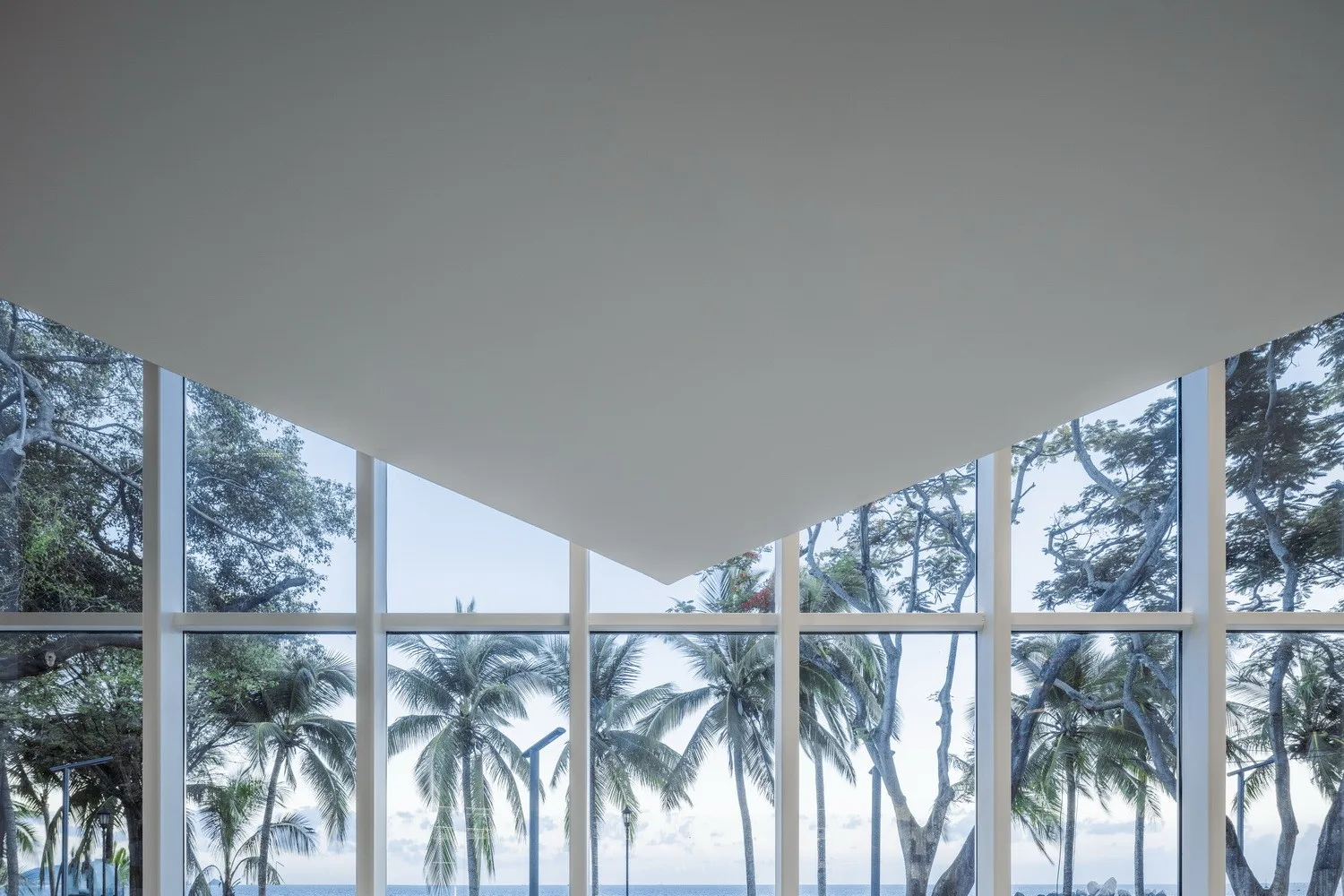
Perhaps everyone harbors a lonely, free sea within their hearts—often diving into it alone at night, sometimes missing the distant lights of land due to the depths of their dive. Most spend their lives navigating these two worlds alone.
—From the film “Blue Sea and Blue Sky”
Project Drawings
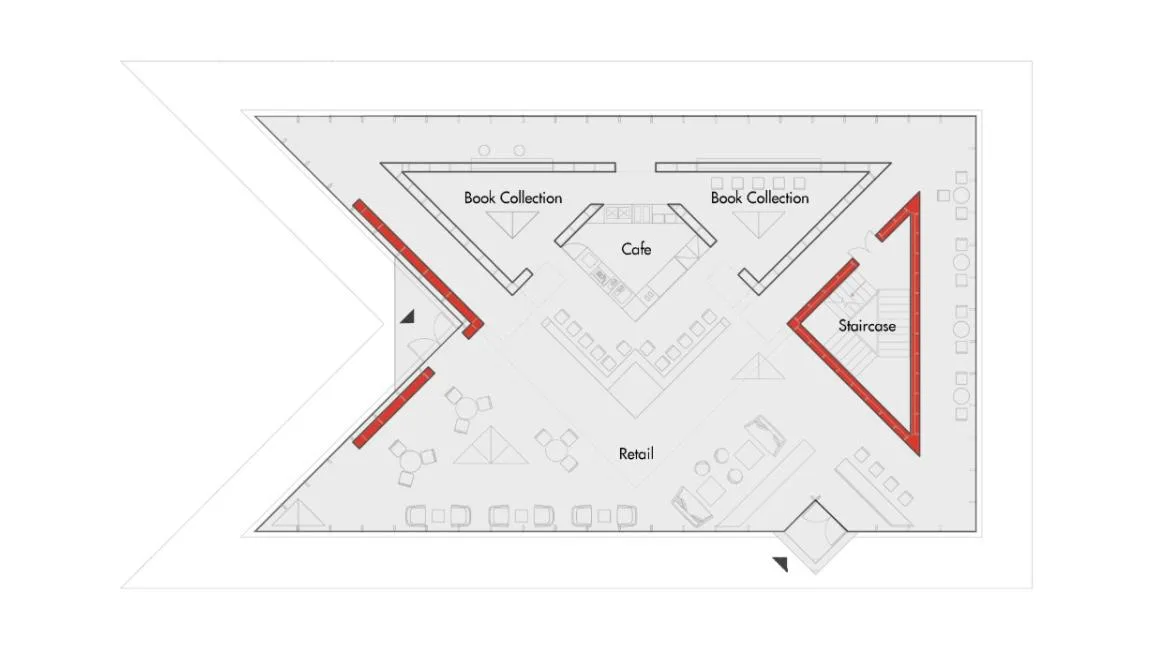
△ First Floor Plan
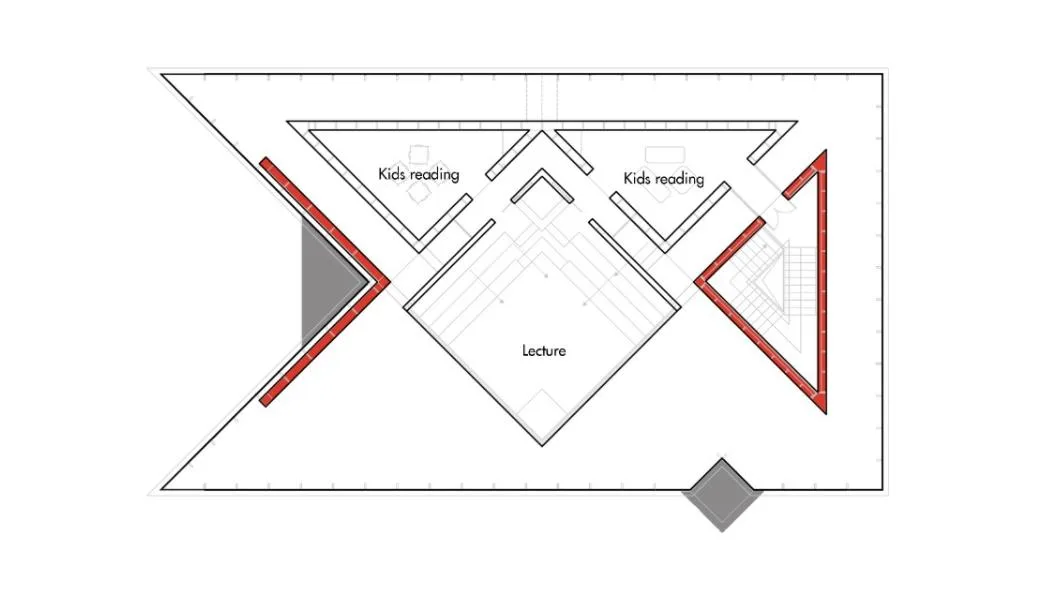
△ Second Floor Plan
Project Information
Design Company: Wutopia Lab
Lead Architect: Yu Ting
Project Architect: Sun Liran
Design Team: Kuang Zhou, Pan Dali, Chen Ruoyue (Intern), Zhang Naiyue (Intern), Xiong Jiaxing (Intern)
Deepening Company: Shanghai Zhumeng Architectural Design Co., Ltd.
Deepening Team: Wang Liyang, Jiang Qiqing, Ge Yong, Lu Tao, Li Xiangyun, Xu Fangting
Structural Consultant: Miao Binhai
Lighting Consultant: Zhang Chenlu
Construction Team: Hainan Jianpin Construction Environment Engineering Co., Ltd.
Project Manager: Wei Wei
Owner: Sanya Tianya Haijiao Tourism Development Co., Ltd.
Location: Tianya Haijiao, Sanya City
Area: 478 square meters
Construction Started: May 2021
Materials: Terrazzo, Cement Self-leveling, Glass, Steel
Photography: CreatAR Images
Video: CreatAR Images
















Must log in before commenting!
Sign Up