
“Nature wishes for children to remain children before they become adults.”
— Jean Jacques Rousseau, Emile
△ Space video
Moi Education is dedicated to nurturing and educating preschool children aged two to six. In early 2020, TOPOS DESIGN was commissioned to create Moi’s first innovative, comfortable, safe, and natural kindergarten in Shanghai. The three-story building, located in Huangpu District, offers 1,200 square meters of indoor space and an additional 420 square meters of terrace.
The design team chose to avoid complex colors and trendy shapes, instead focusing on textures that resemble skin and a balanced sense of proportion. Their goal was to craft a children’s city full of memorable, soft, sponge-like spaces.
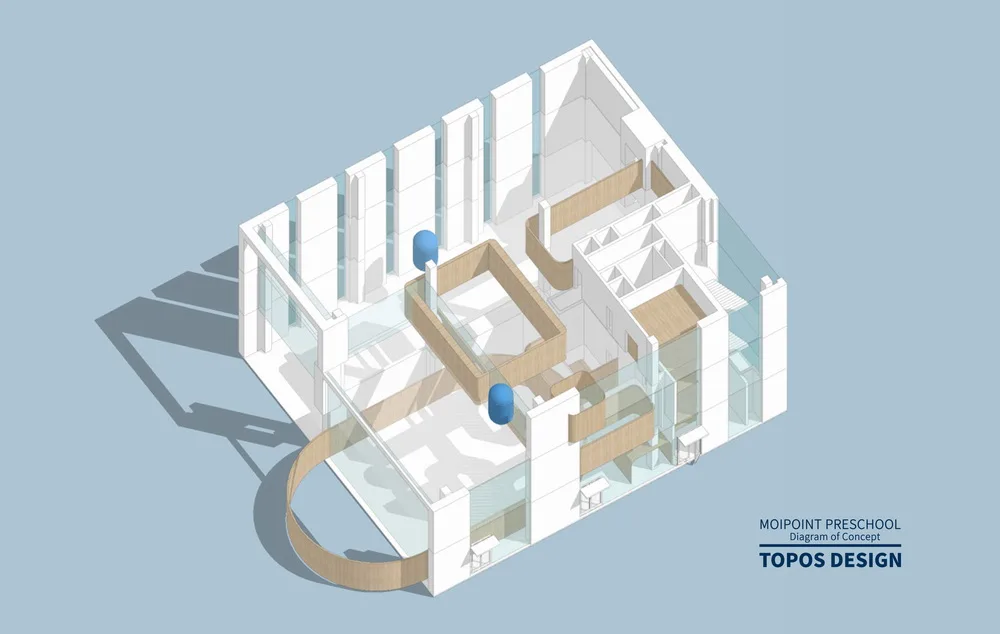
△ Concept axis measurement
Textured Spaces
Situated along the Expo Riverside in Shanghai’s Huangpu District, the standalone three-story building lies between Zhongshan South Road at the lower end and the Inner Ring Elevated Road at the higher end, adjacent to the Beyond Expo Park. Outside, vehicles rush by and commercial buildings stand indifferent in color, creating an intimidating urban environment.
In contrast, Moi Education Center introduces a capsule-shaped spacecraft that offers a warm and free space specifically designed for children.
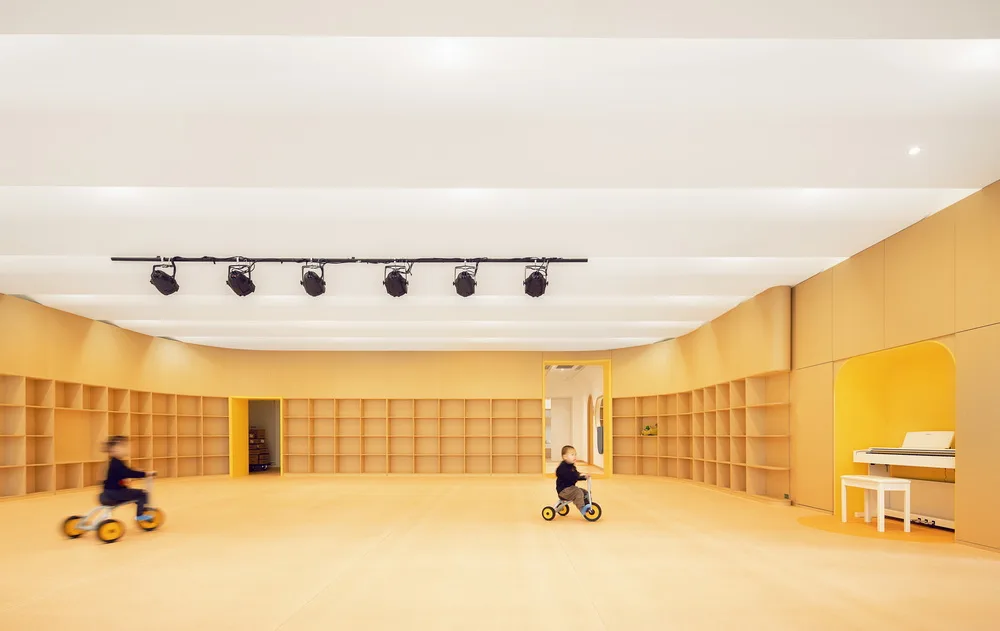
△ Multi-functional room
The entrance is discreetly tucked away behind a row of green and wooden walls, shielding it from the park’s public roads and establishing a clear boundary between inside and outside. Within this boundary, light wood grains dominate, accompanied by circular arches, grooves, and rounded corners applied throughout doors, walls, and the front desks.
This design contrasts the softness of wood with the hardness of cement, and the gentle curves with rigid right angles and endless straight lines. The textures evoke a map that guides children into a world of movement and experience.
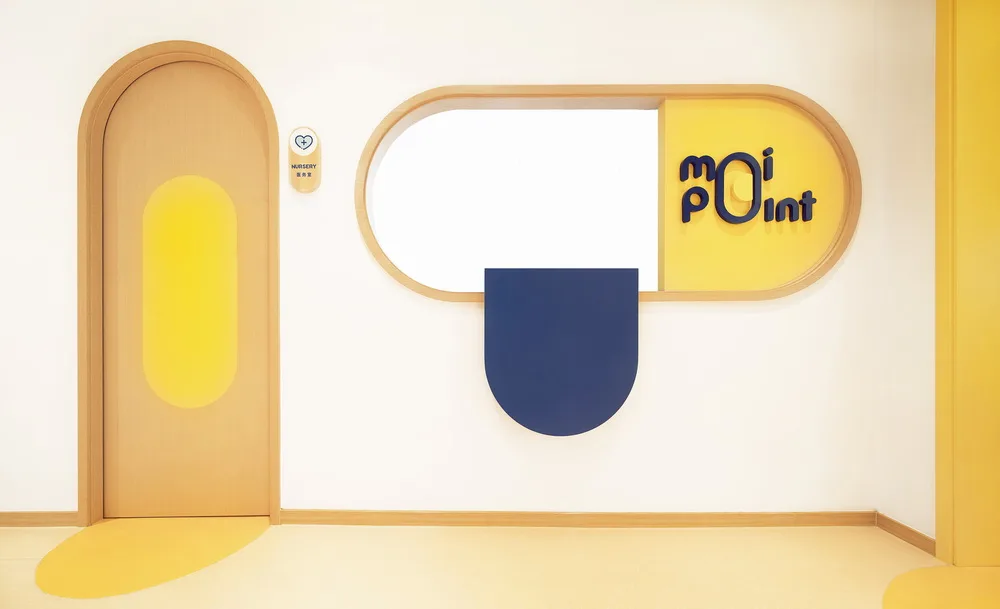
△ Front Desk
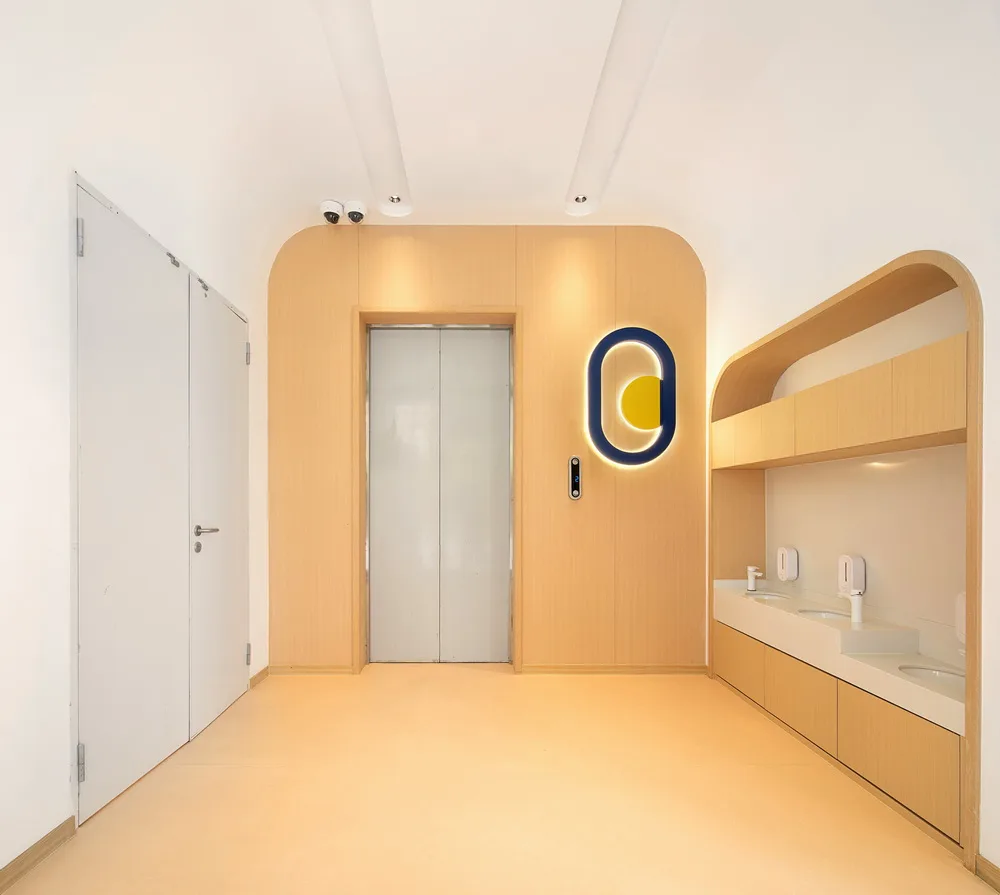
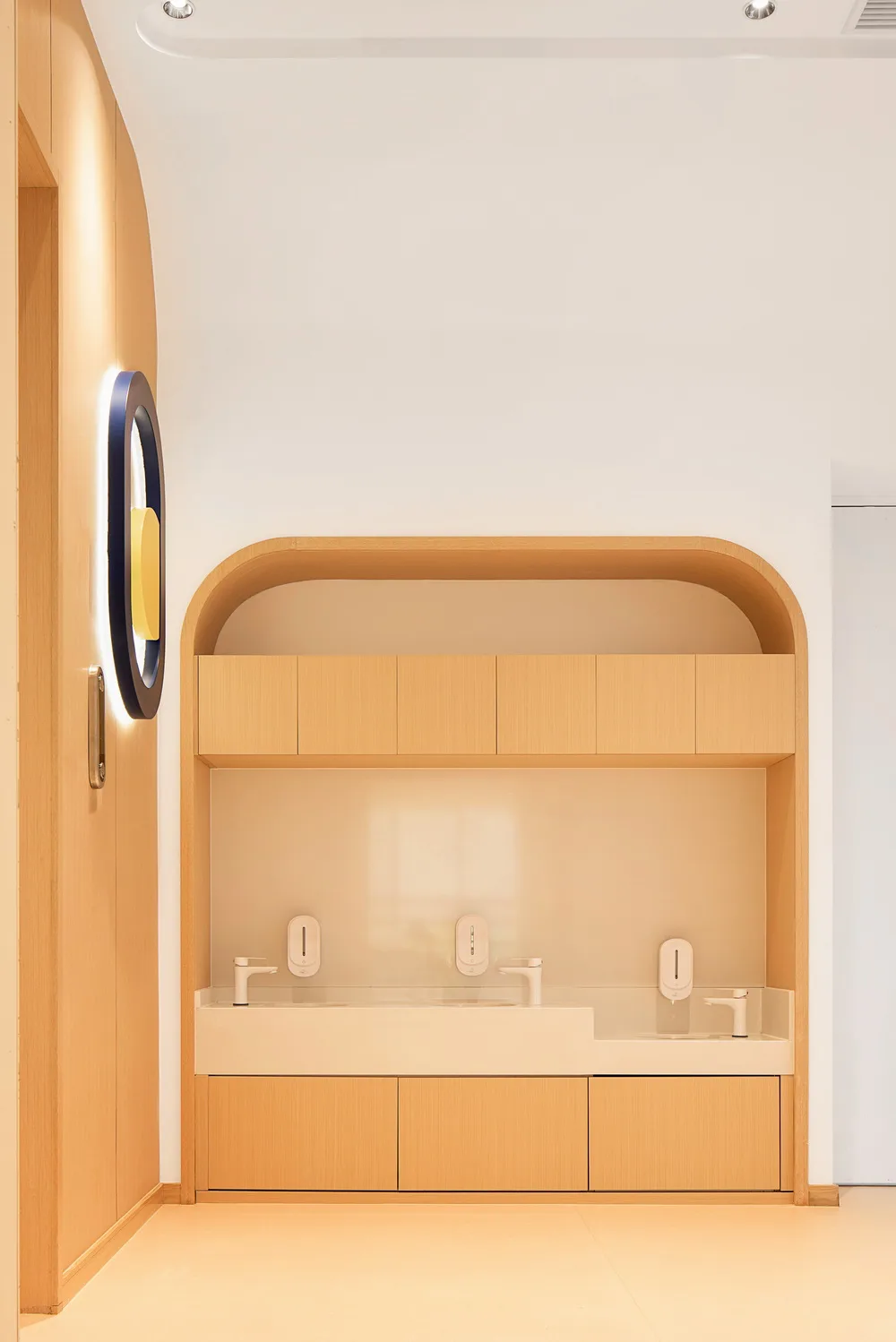
△ Front Desk
Ascending the stairs from the capsule-shaped multipurpose hall on the first floor to the second floor reveals game rooms, classrooms, and baking areas. The designer used different room sizes and orientations to further distance the spaces from adult interference, allowing children to fully enjoy the joy of exploration as they move through diverse environments.
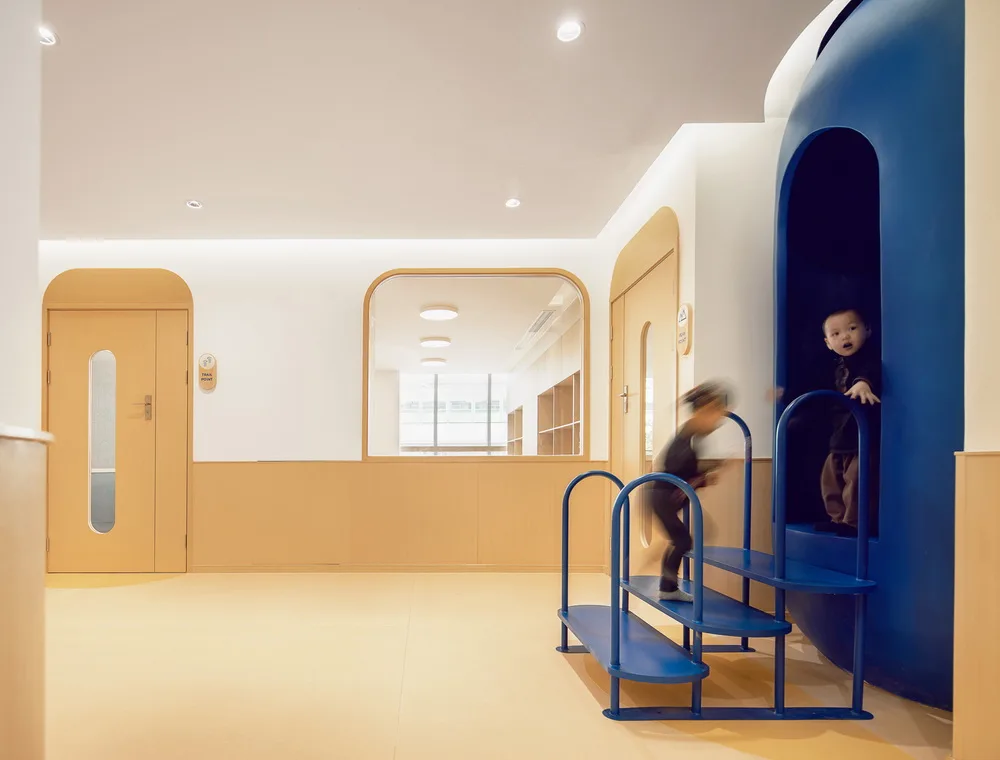
Indoor space blue capsule
From this point, the use of sea blue introduces hidden spaces: a child-sized cool room, a lunar module-inspired passage, and a set of walkways seemingly lowered from a space module—all creating a dynamic and constantly engaging environment.
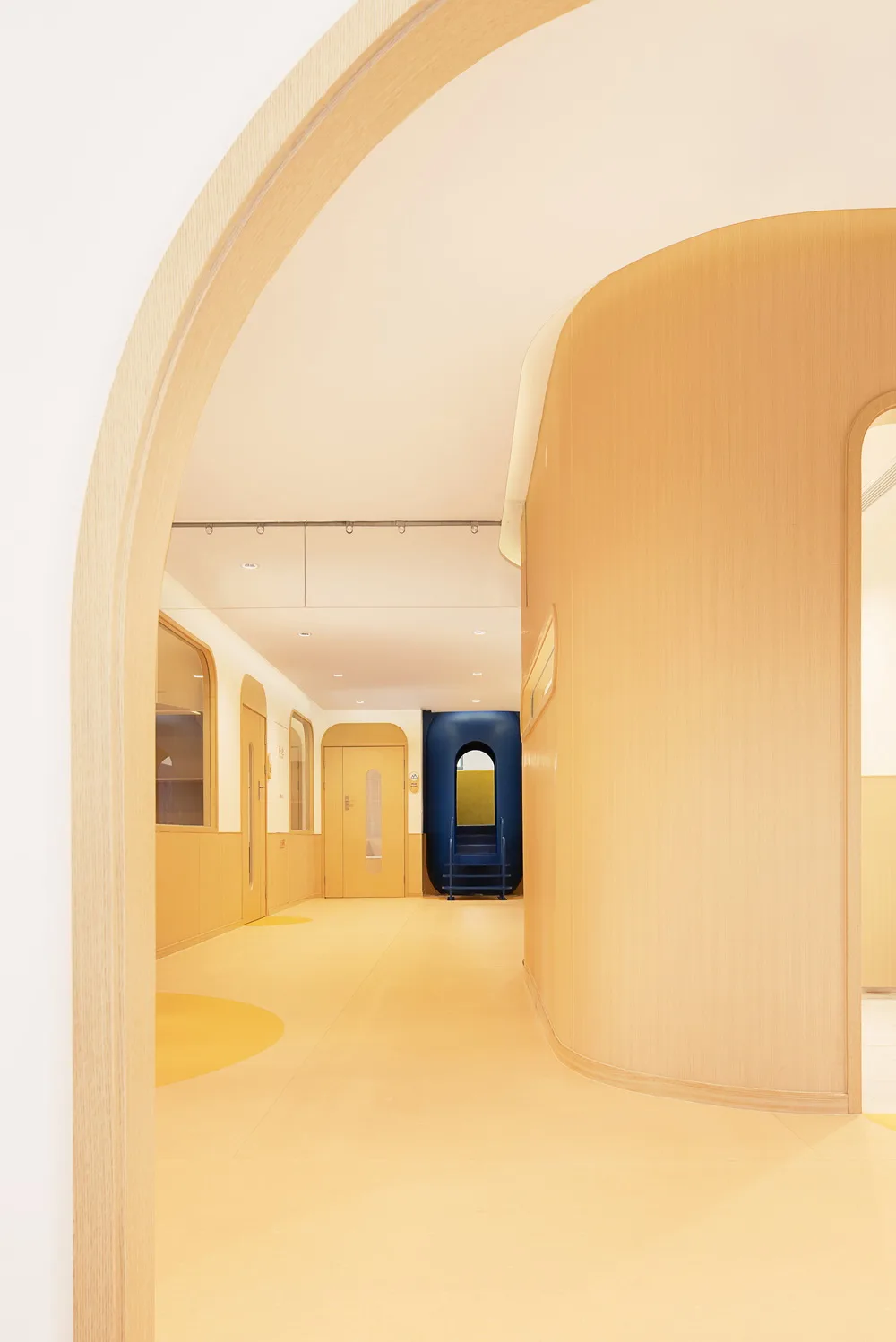
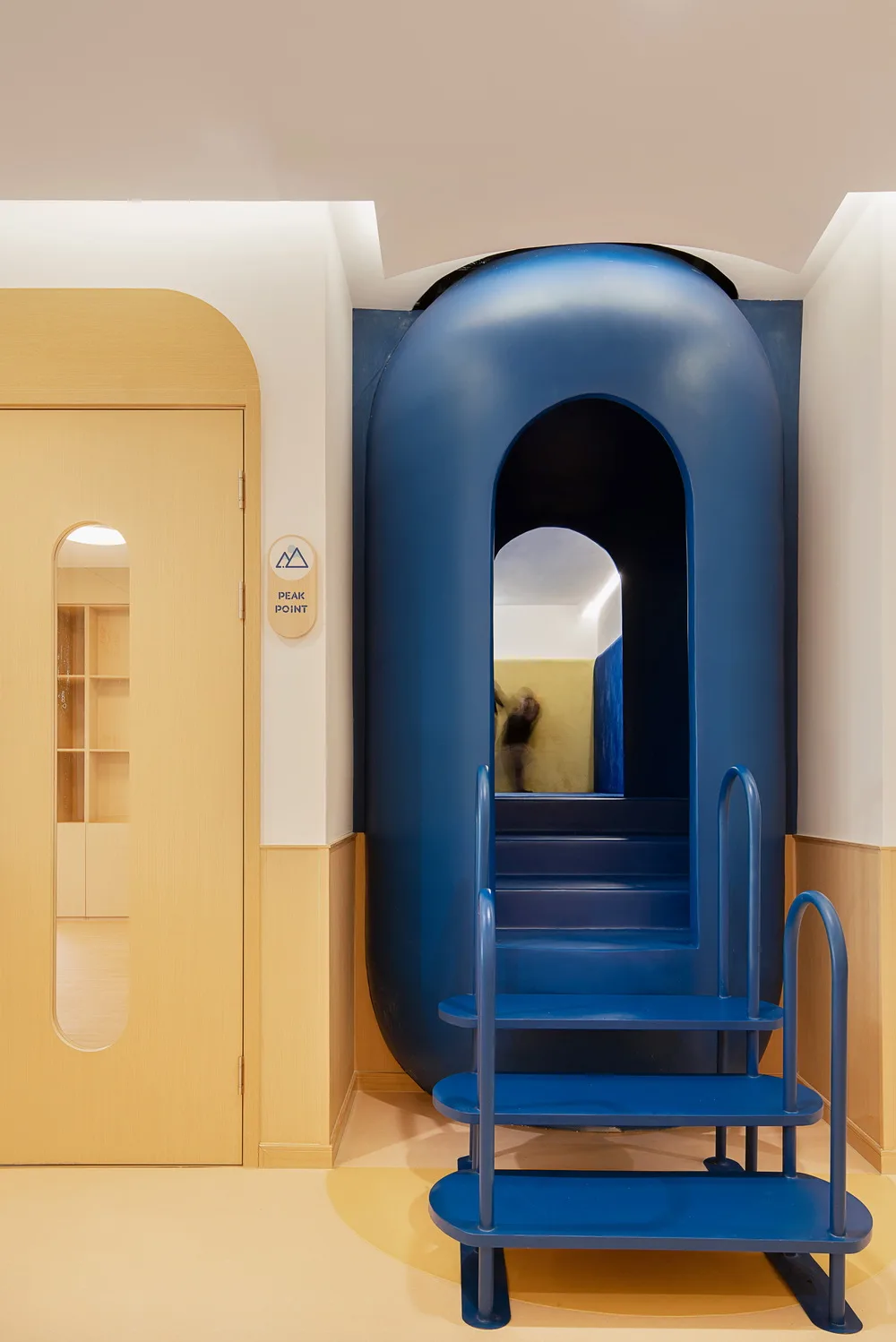
Indoor space blue capsule
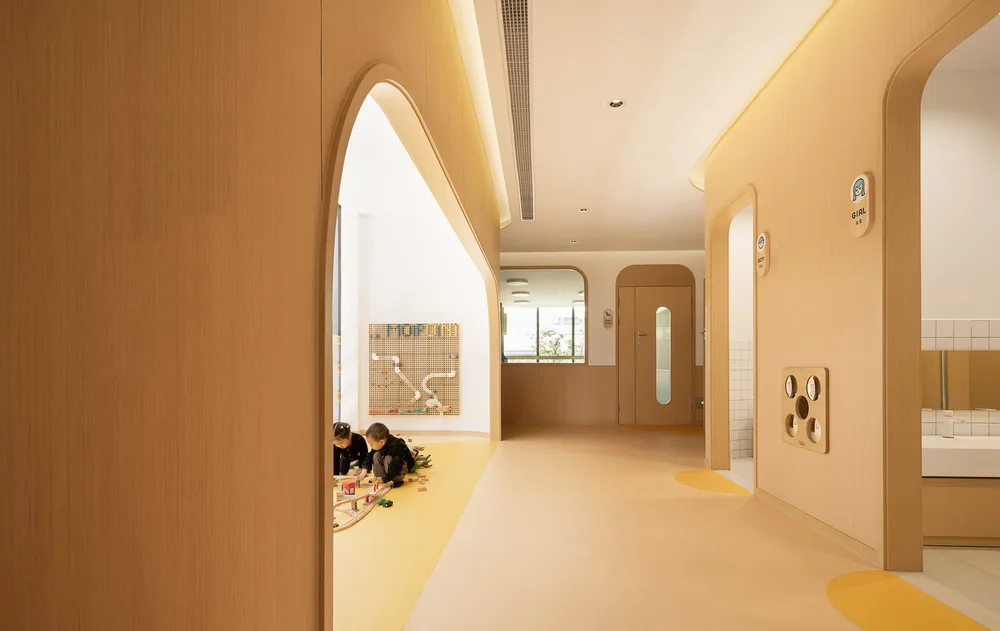
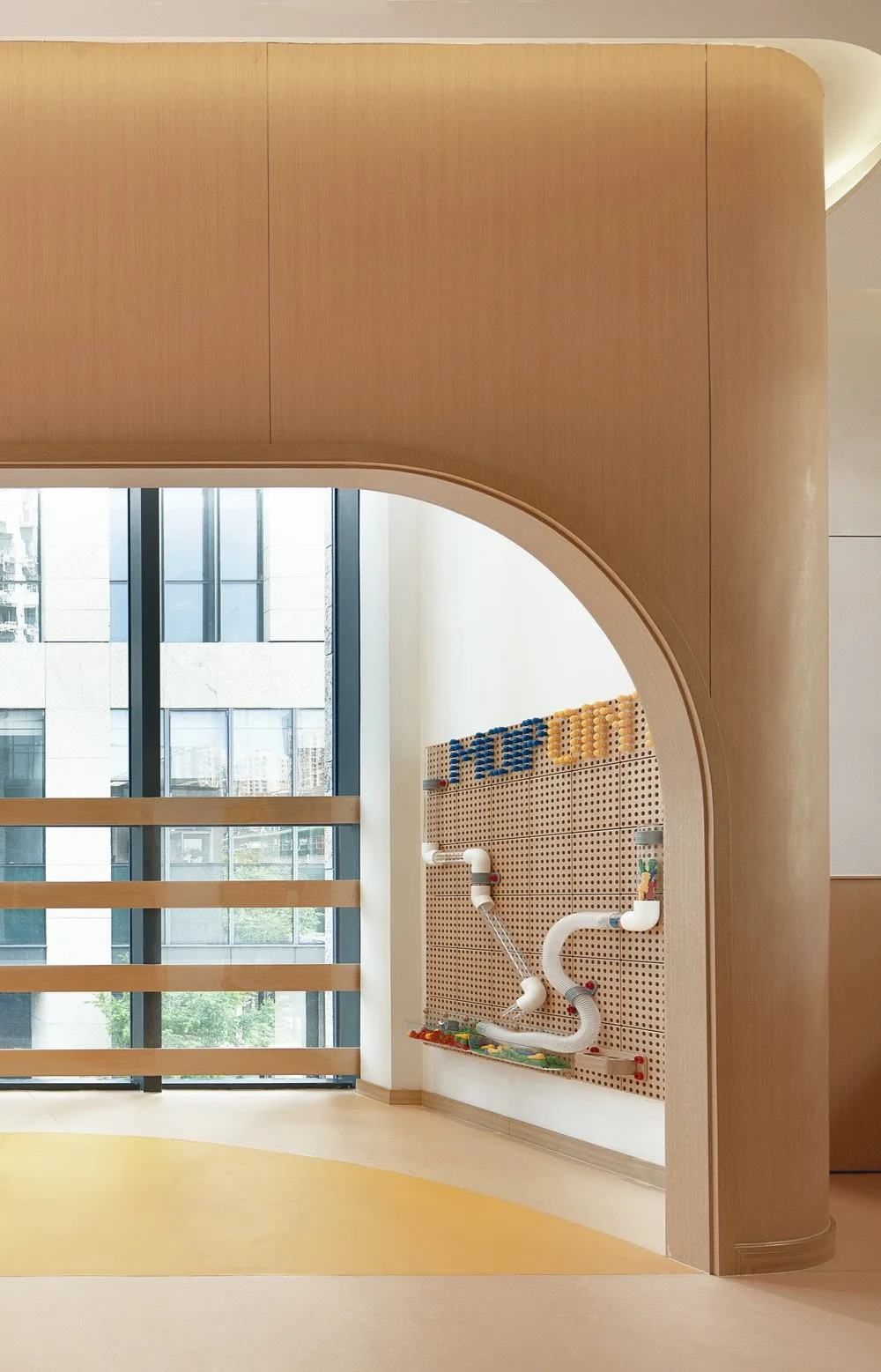
△ Game House
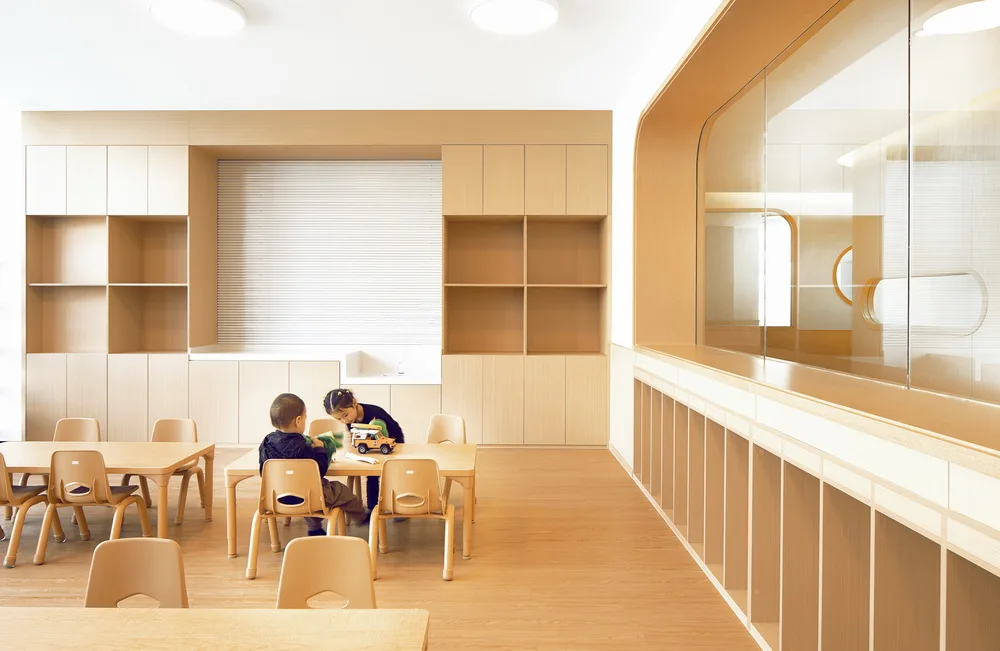
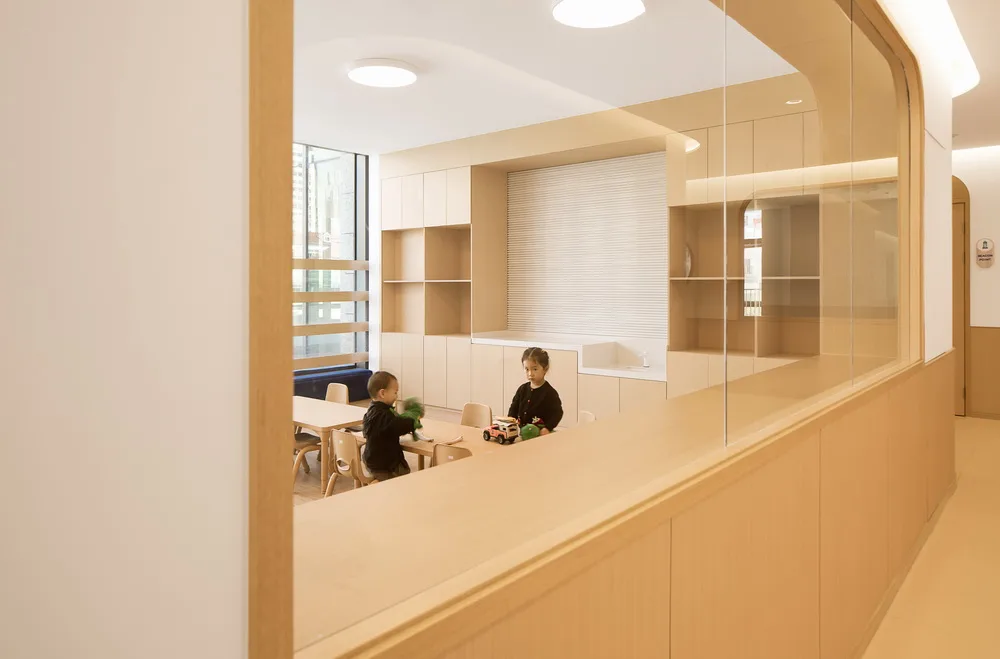
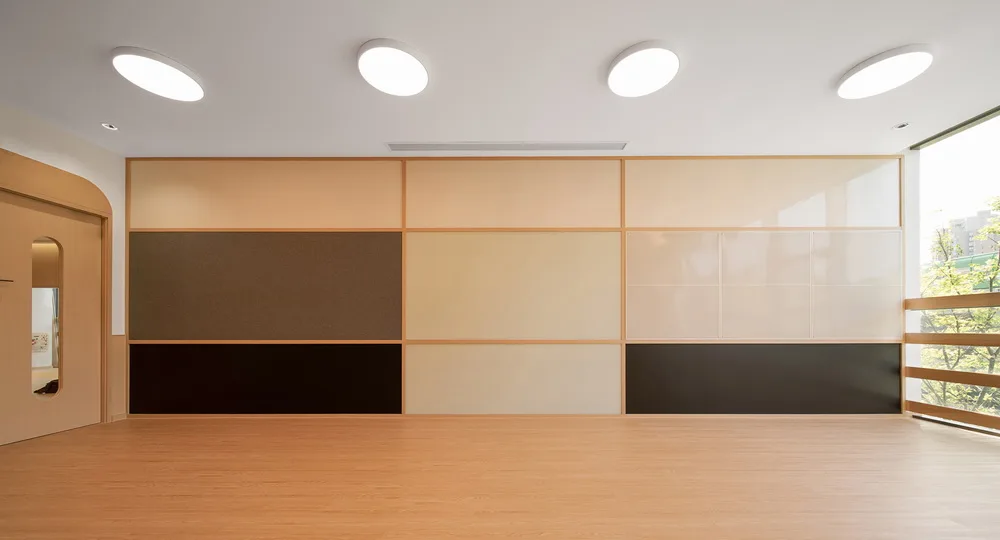
△ Classroom
On the third floor, bright classrooms and studios complement the blue capsule passage, which leads to the terrace sports area. Here, the outside world reappears, but children’s perspectives on it have transformed.
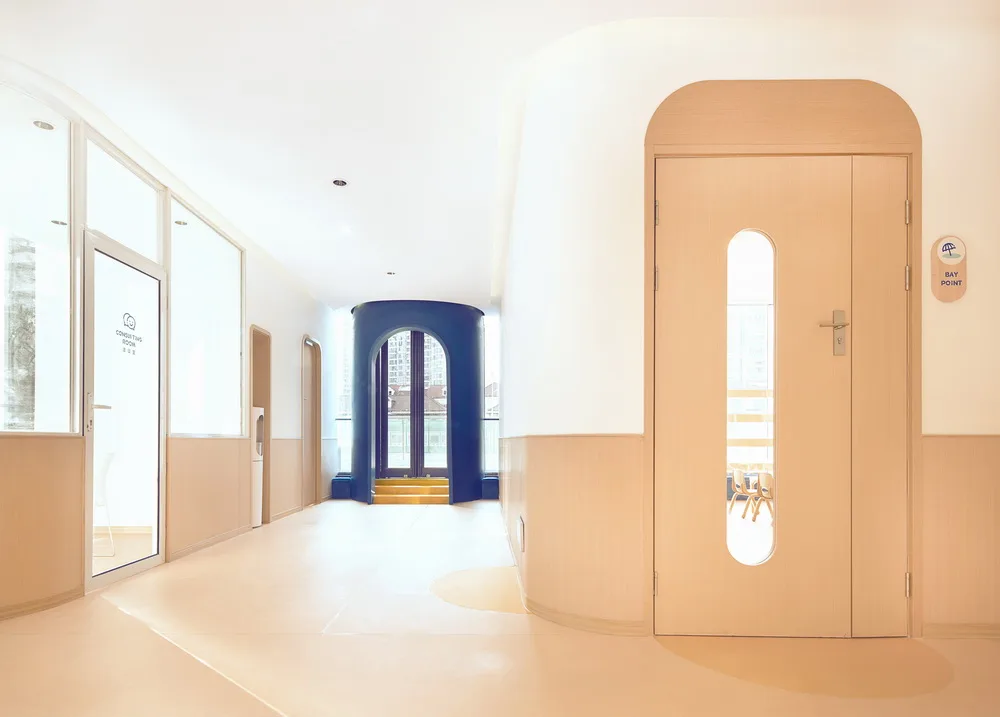
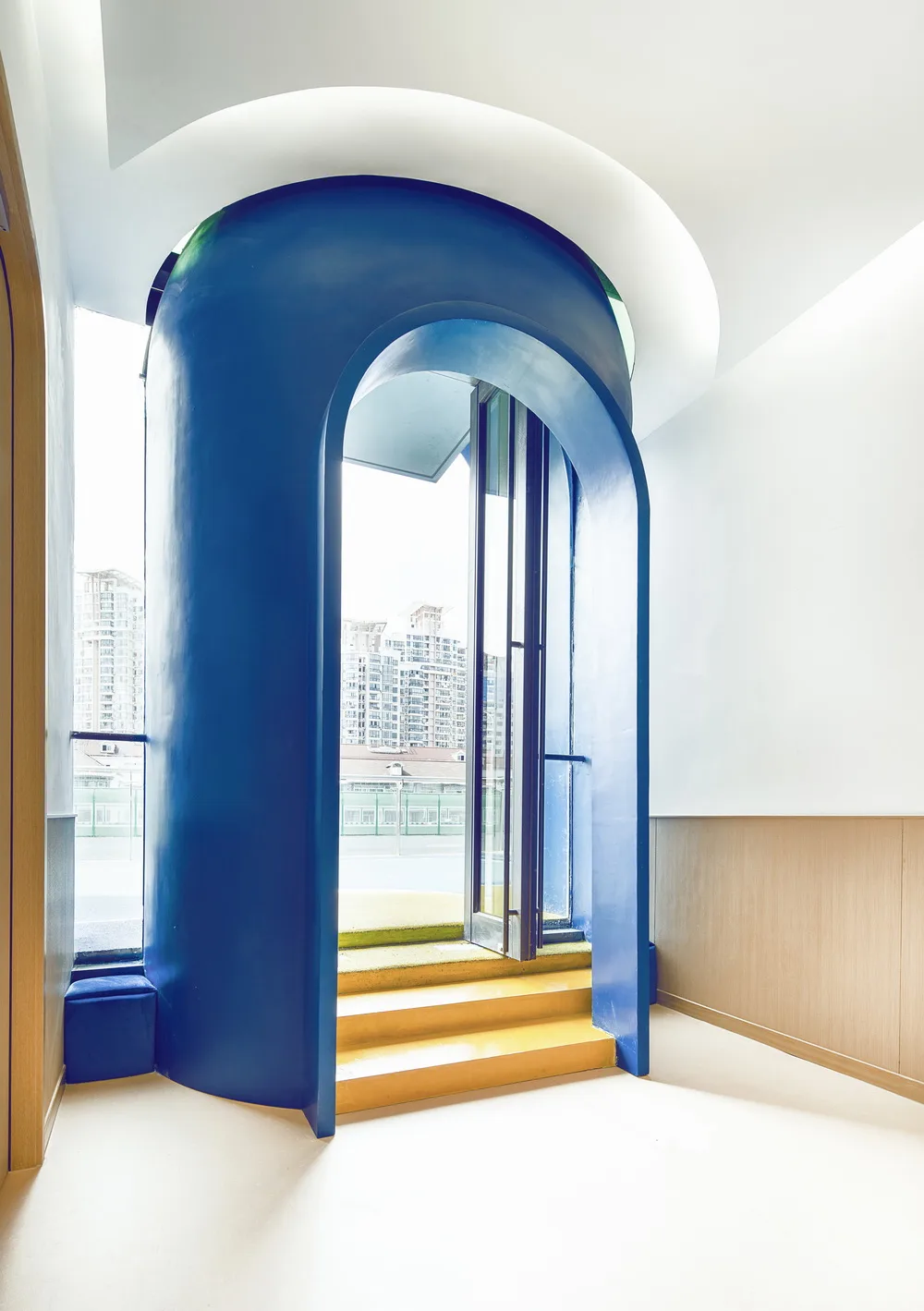
△ Terrace Space Blue Capsule
The perspective shift is most evident on the expansive top-floor terrace. Wooden guardrails adorned with greenery serve both safety and visual guidance roles. From a child’s eye level, the varying heights and curves of the railings transform the surrounding plants into a lush, layered jungle.
Nearby streets, overpasses, and commercial buildings become newly imagined objects within the children’s landscape.
Children become the true protagonists of this textured environment.
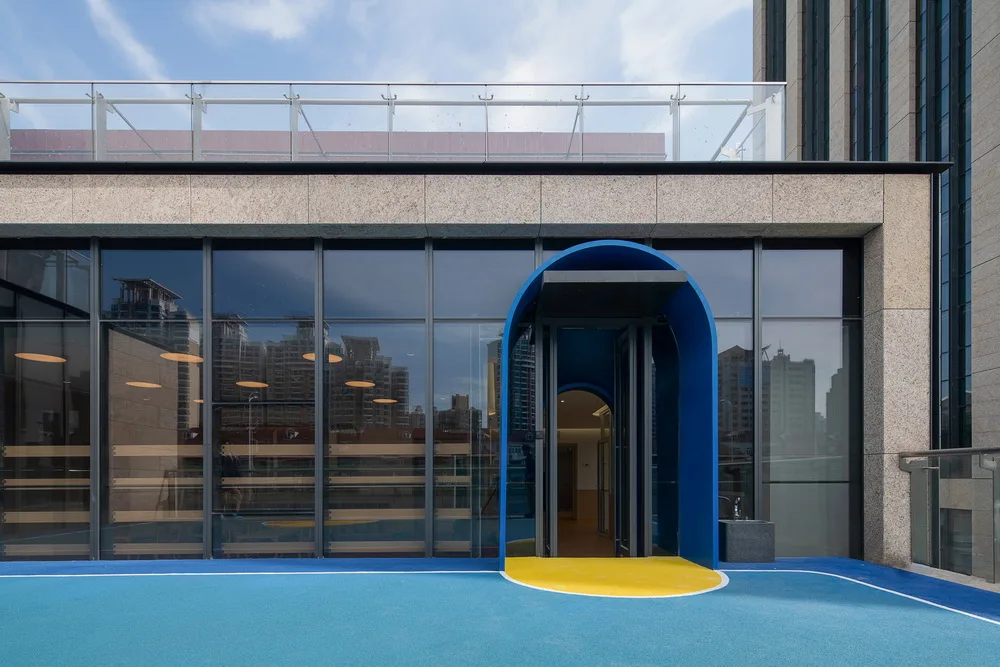
△ Terrace Space Blue Capsule
Exploring Inside and Outside
The designer invites children to engage in a game exploring the concepts of “inside” and “outside”.
Unlike most traditional school buildings, the corridors at Moi Education Center are not mere connectors between rooms. Instead, they are rediscovered as vibrant, functional spaces in their own right. These corridors are wider and more complete, featuring the capsule’s signature curved elements throughout.
In some areas, corridor widths subtly change, transforming these passages into places to experience detail, movement, and play, whether walking, running, or simply lingering.
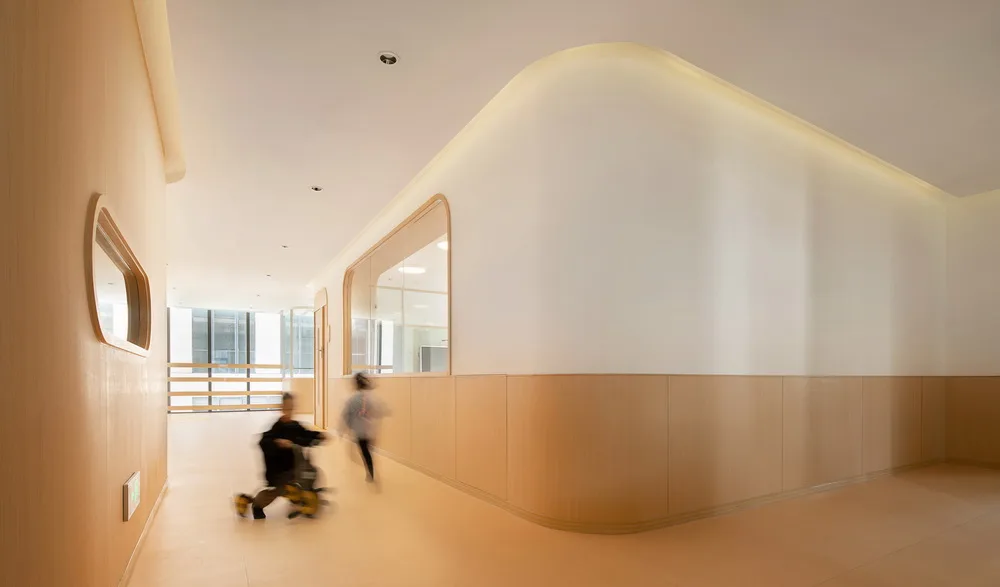
△ Activity Corridor
While each functional room represents the “inside,” the corridors—separated by doors—are naturally the “outside.” If the building is viewed as a spaceship on an adventure, then the corridors are at its core, more central than the individual rooms.
Here, the function of the corridors is not defined by adults; instead, they serve as shared public spaces for children growing and learning within.
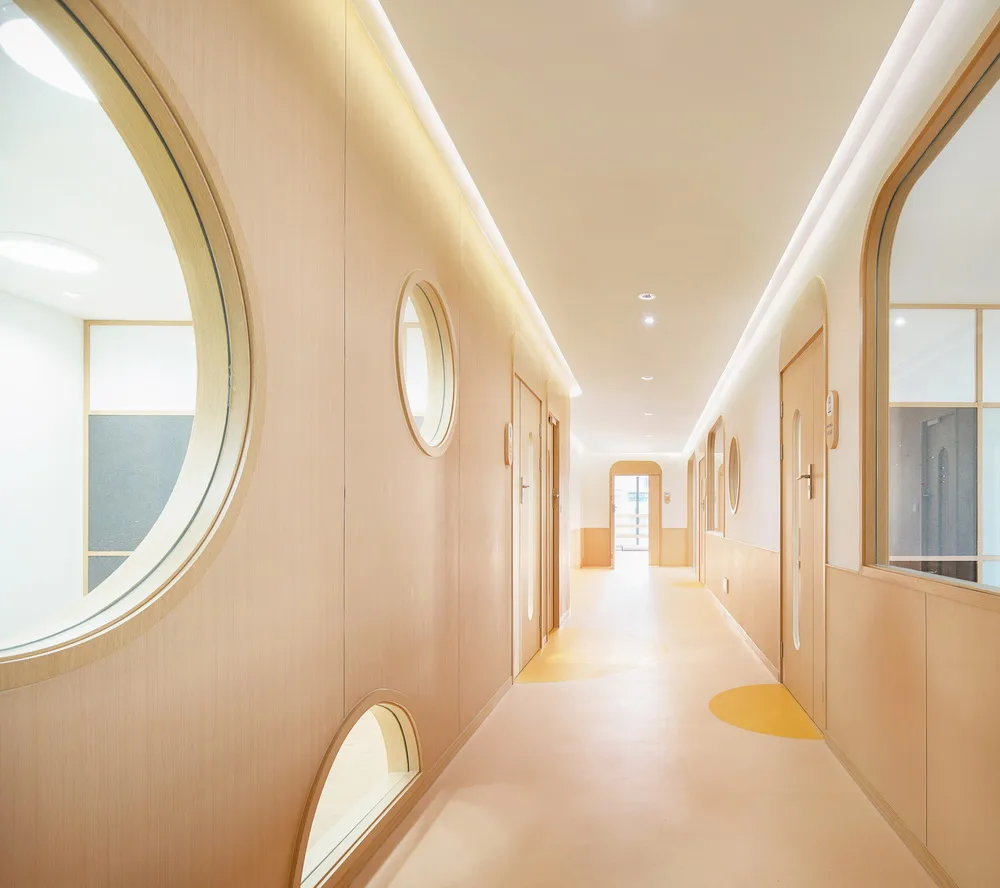
△ Activity Corridor
Function Through Form
What should early childhood education spaces embody? Whether referencing Piaget, Vygotsky, or other theorists, there is consensus that such spaces should not be mere collections of abstract concepts.
Instead, they should be like a giant toy—intuitive, interactive, and inviting children to discover or invent hidden functions through exploration.
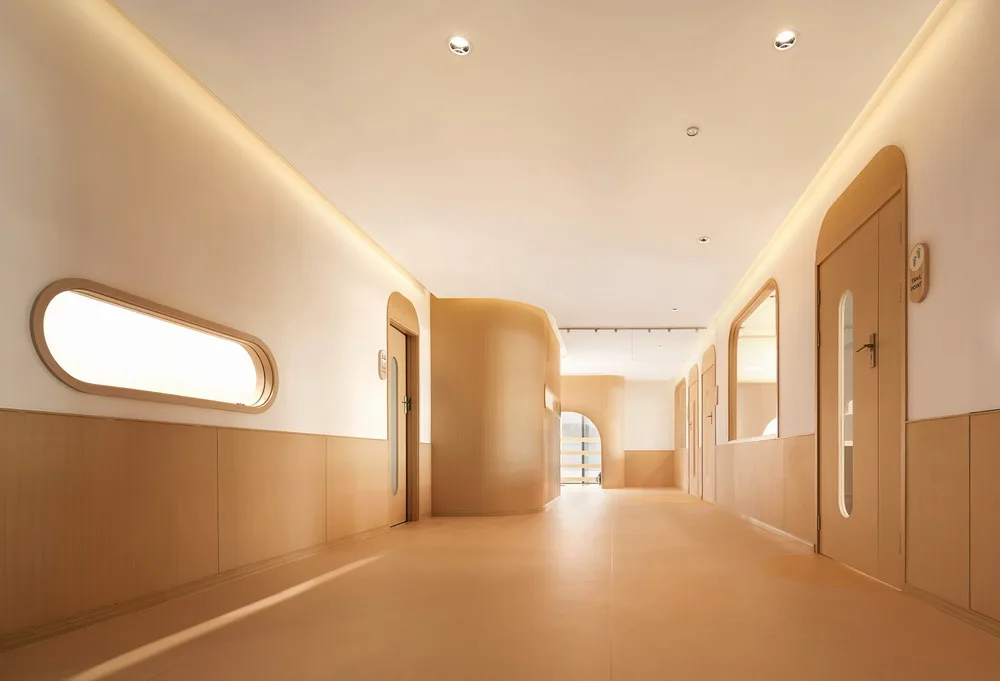
△ Activity Corridor
Different areas within Moi Education Center are defined by circles, arcs, line segments of varying lengths, and blocks of different sizes. Without relying on signage or text, children’s natural curiosity, observation, and trial-and-error lead them to identify and redefine these spaces in their own unique ways.
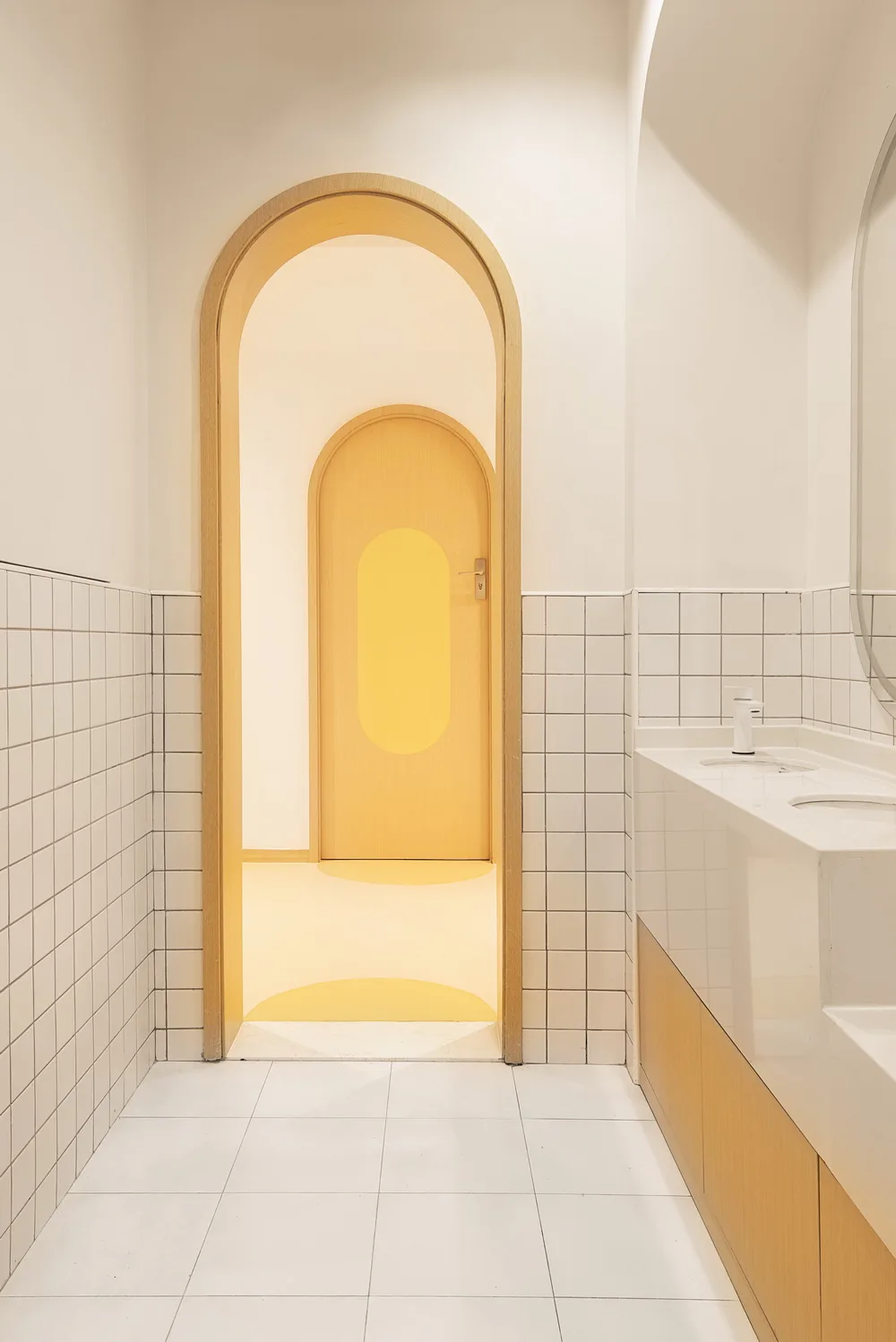
△ First-floor bathroom
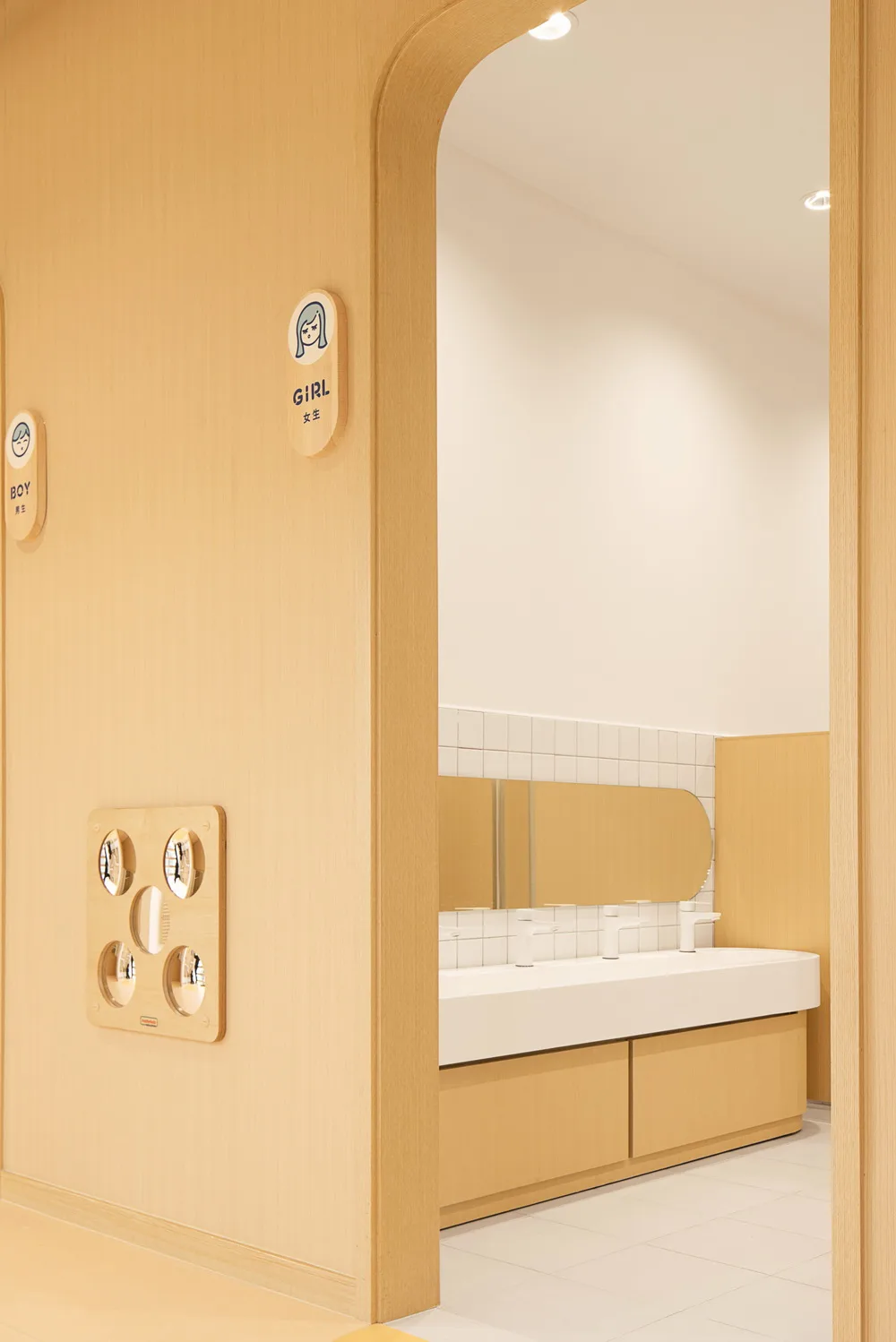
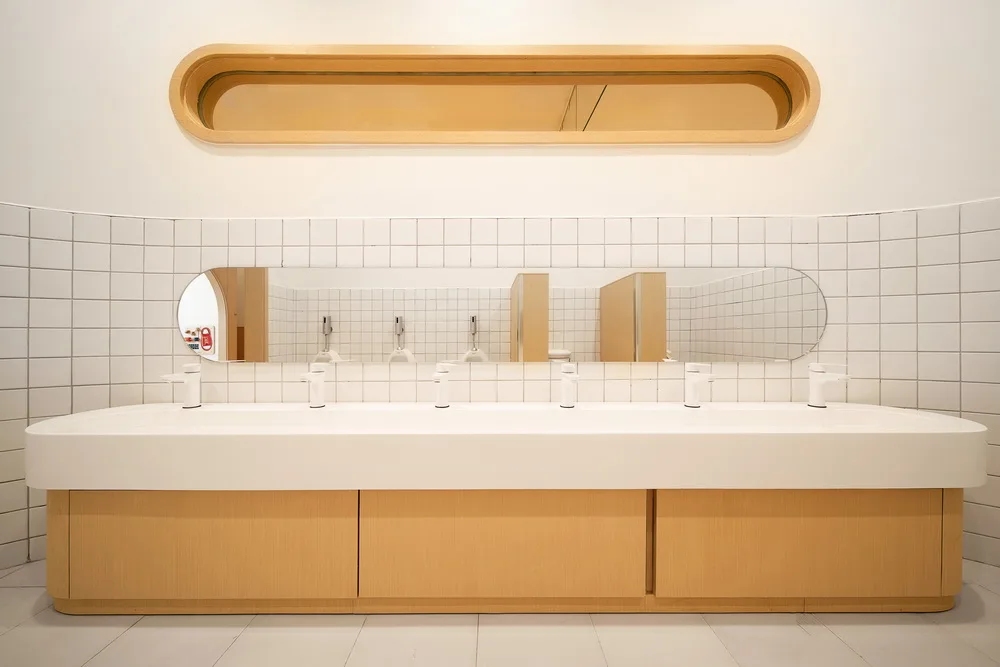
△ Second-floor bathroom
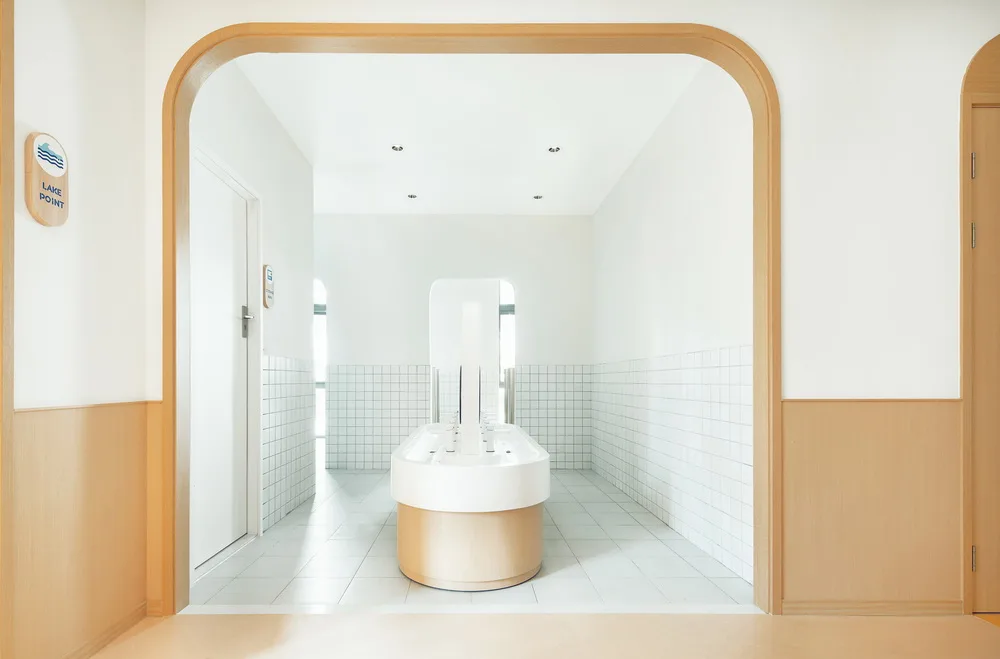
△ Third-floor bathroom
A prime example is the multifunctional hall.
In the architectural blueprint, it appears as a horizontally oriented arch-shaped structure. One arc end, combined with a covered bookshelf, forms an open capsule children’s library surrounding an arc-shaped stage. On the opposite side, mirrored walls and handrails define a dance rehearsal space.
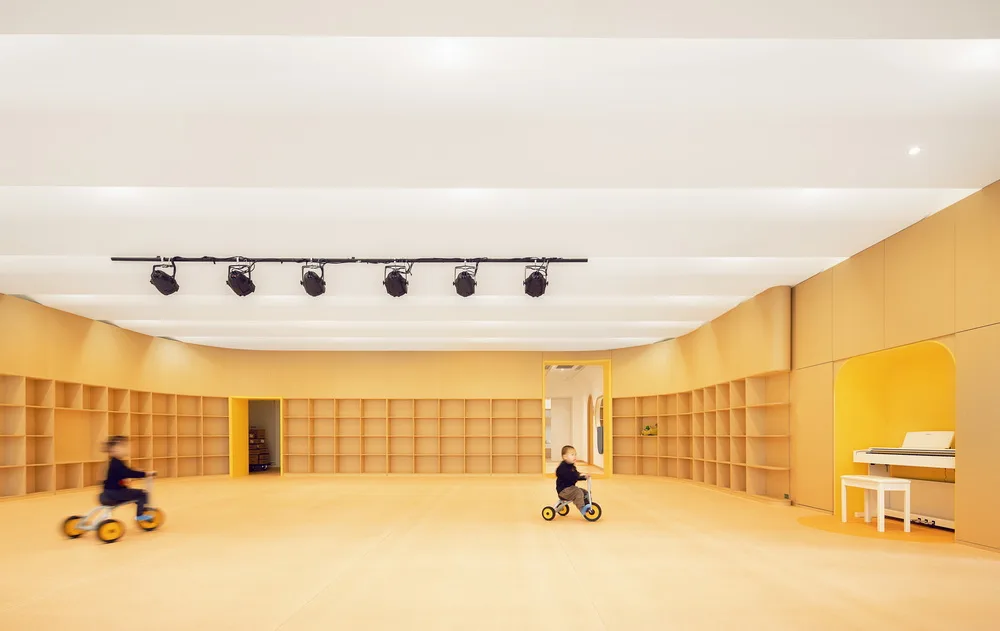
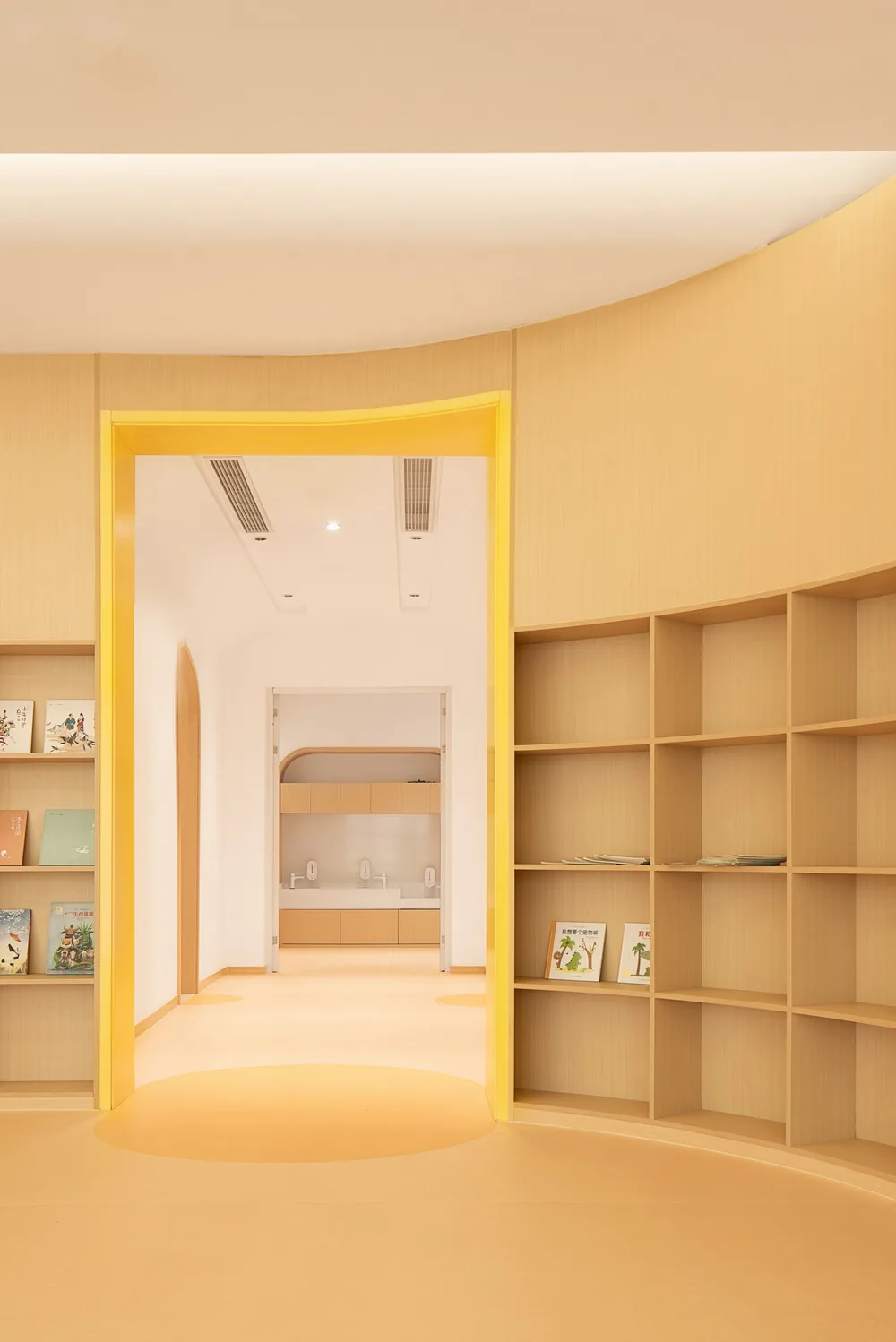
△ Multi-functional room
To children, this space offers far more possibilities. When softly illuminated by wave-shaped ceiling lights, the hall reaches its peak as a public space. The stage front signifies display, while partners act as spectators or collaborate behind the scenes to prepare—these actions occur seamlessly within a shared environment.
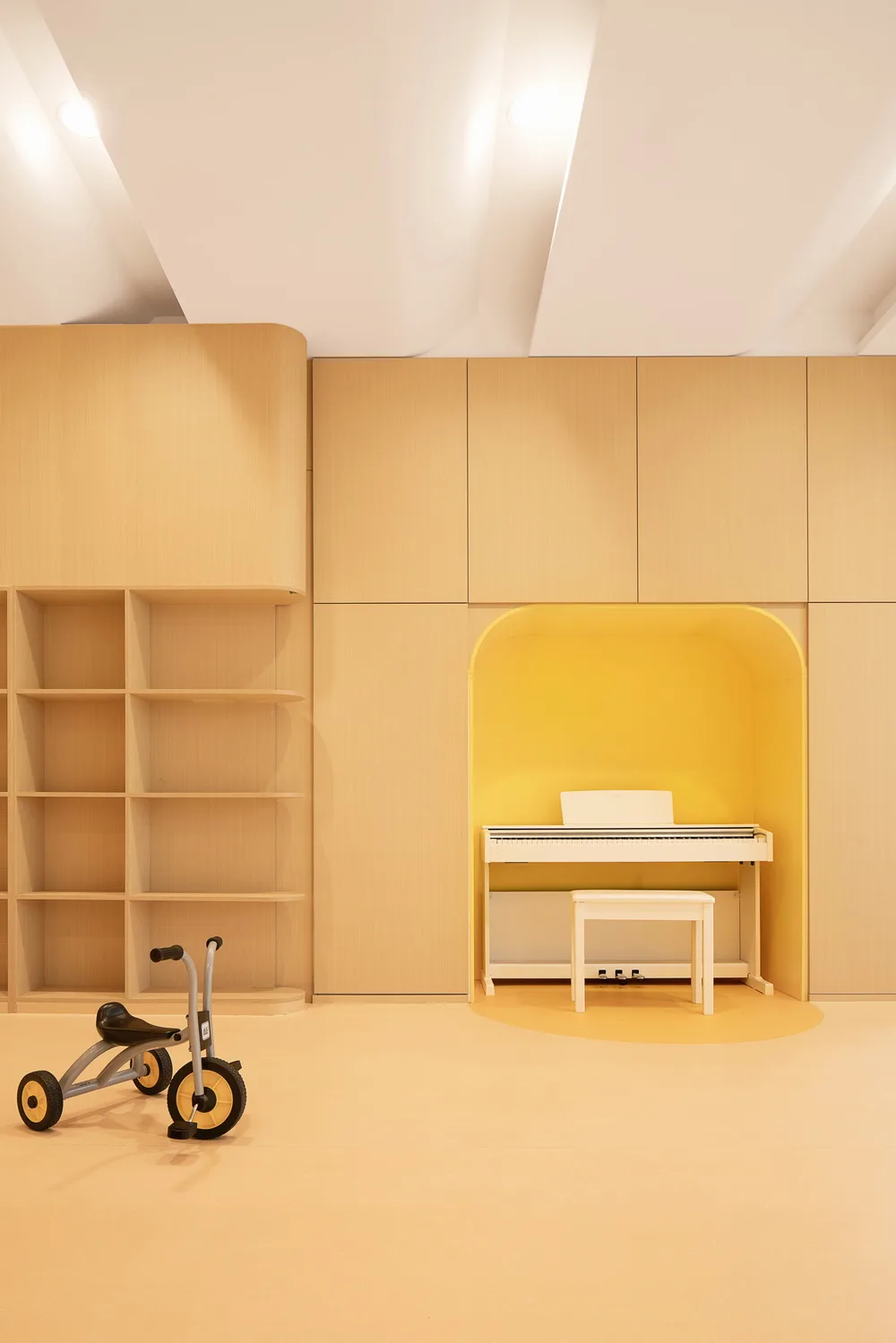
△ Multi-functional room
Alternatively, when the stage is the only brightly lit area, it transforms into an isolated island in the dark.
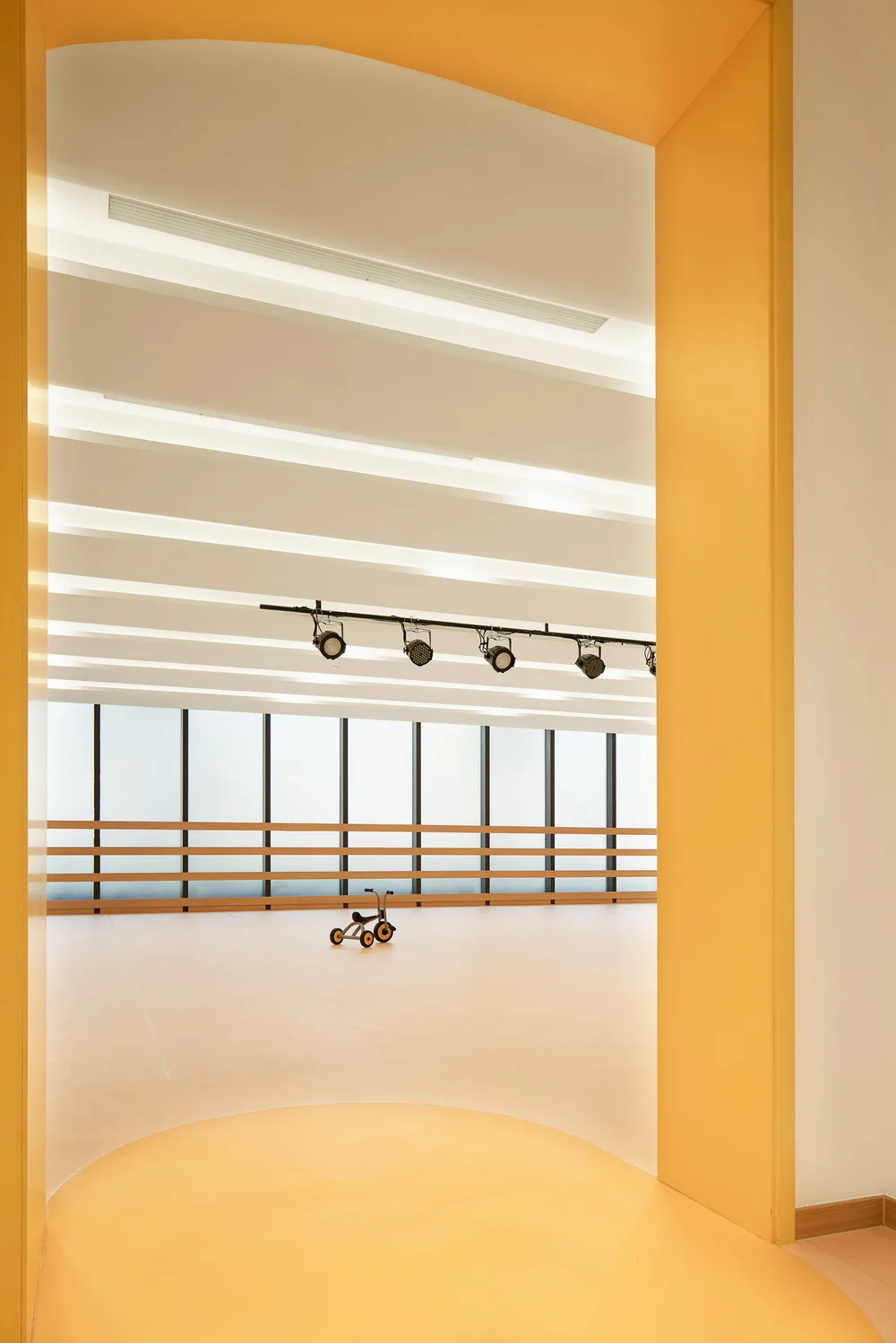
△ Multi-functional room
Beautiful Moments
“Moi” in Moipoint means “beautiful things” in Dutch. This name, chosen by the owner and design team, reflects their aspiration to create beauty. Every child at Moi is embraced with wholehearted dedication, evident even in the smallest details.
The founder has years of experience in education, and the design team worked closely with her to preserve a genuine sense of propriety throughout the design.
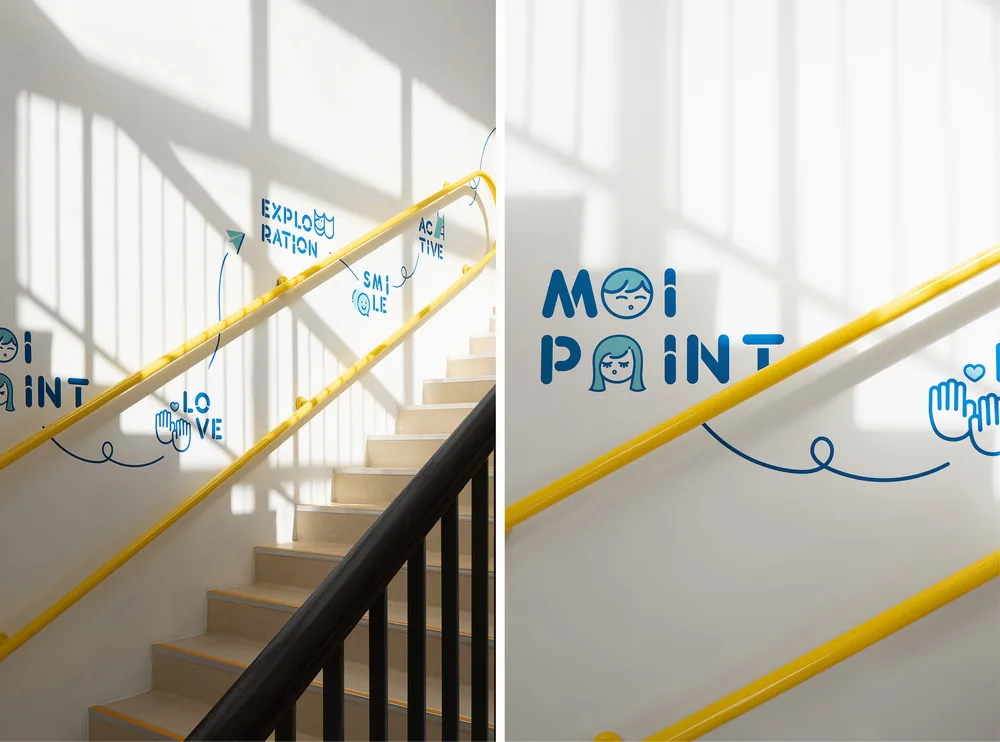
△ Staircase identification
In this project, designers focused on simple but meaningful choices. What is the purpose of every corner, every measurement, every centimeter in this three-story early childhood education building? Is it designed for external viewing, especially from a distant, internet-driven perspective? Or is it created to serve the child who inhabits it?
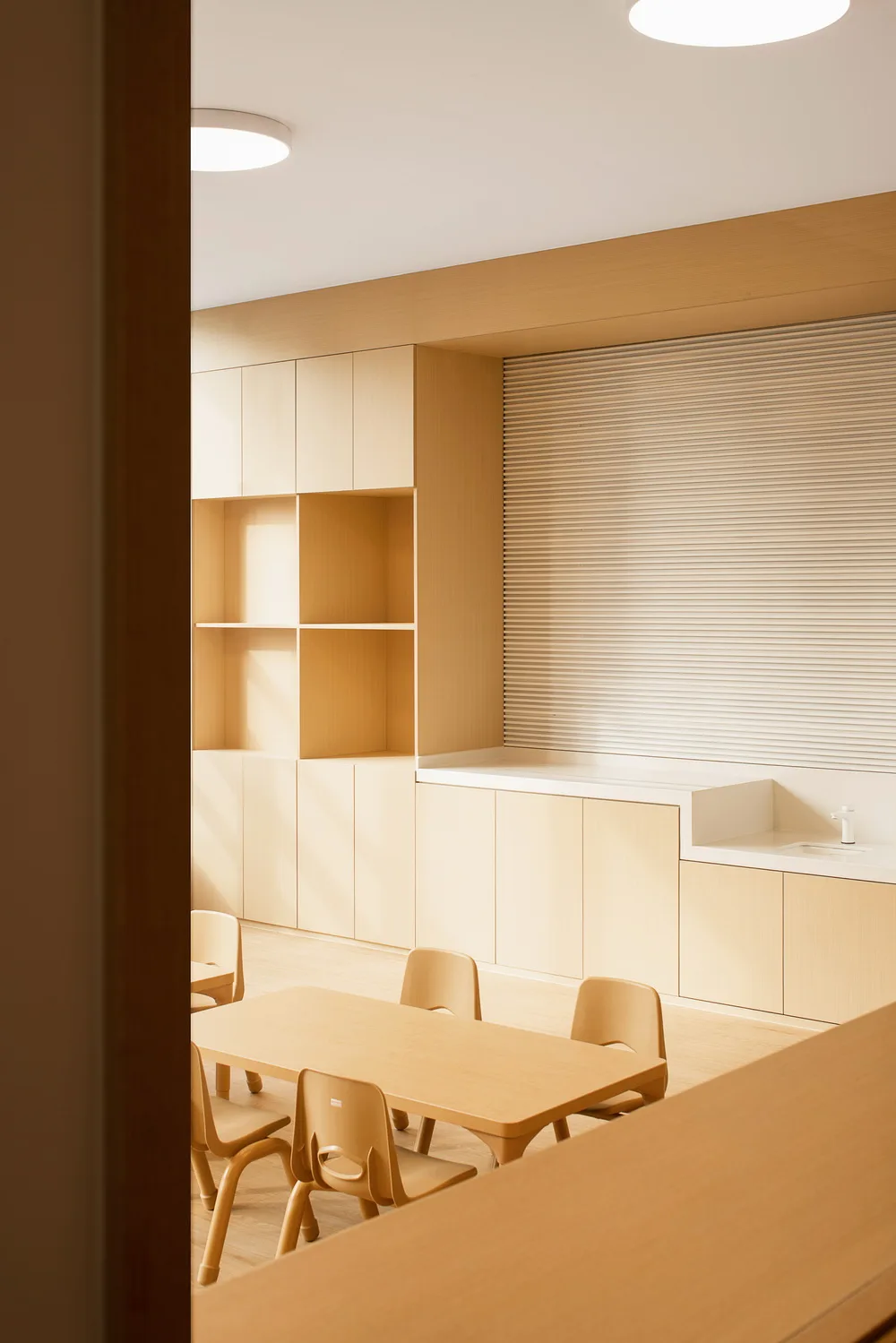
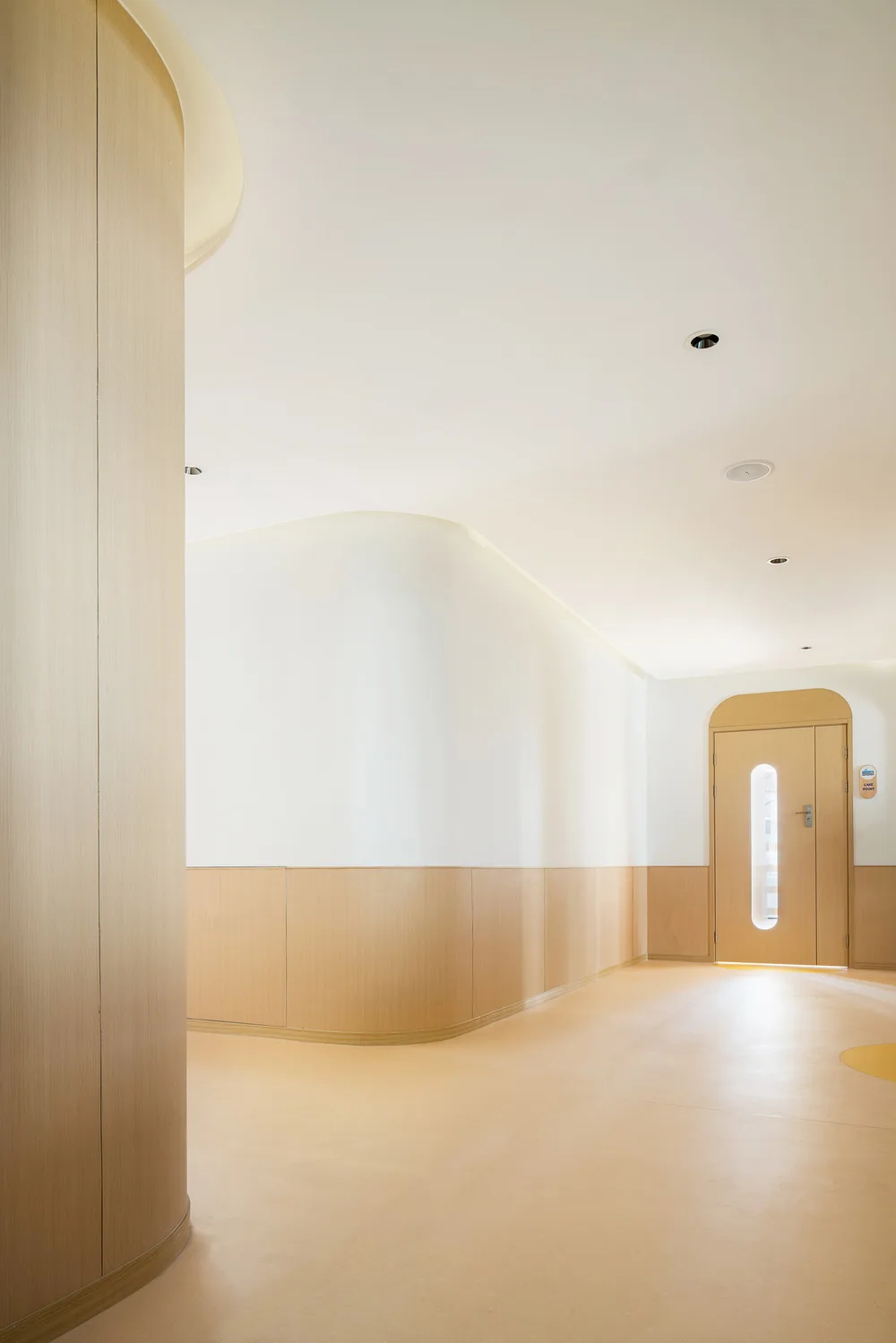
The former approach demands a static posture, like a stage backdrop focused on symbolic objects rather than functionality. The latter embraces dynamic, natural evolution. Clearly, children will continue to use this space, driving its ongoing development and giving rise to the unique spirit of Moi Education Center.
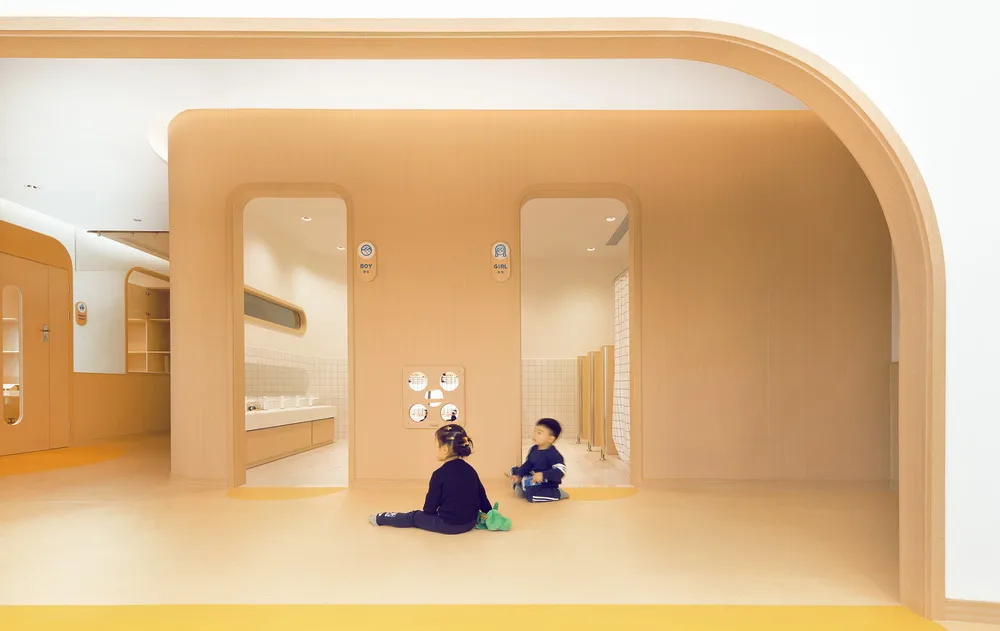
△ Activity Corridor
Technical Drawings
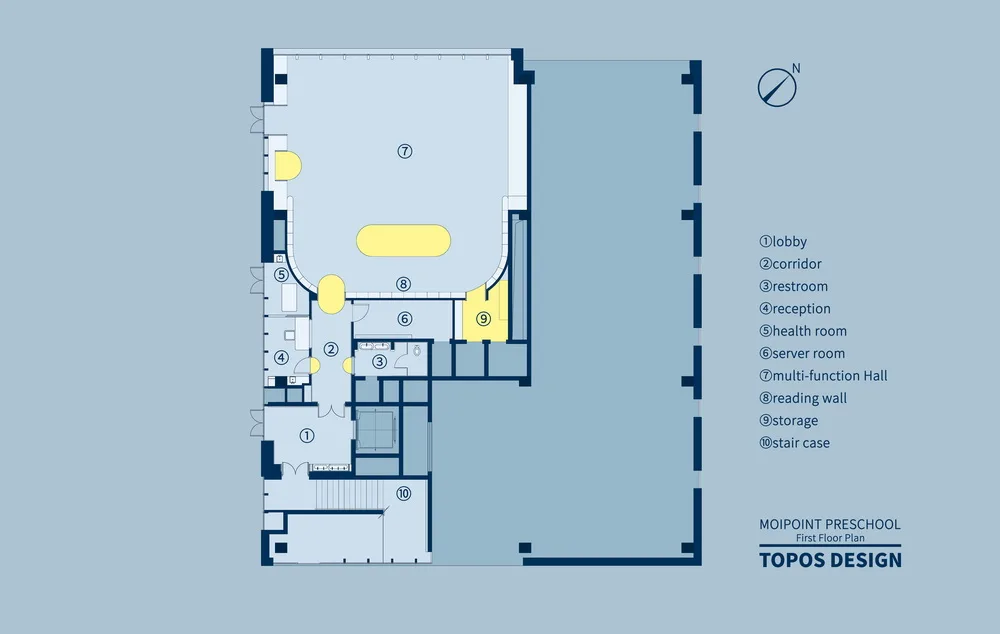
△ 1st Floor Plan
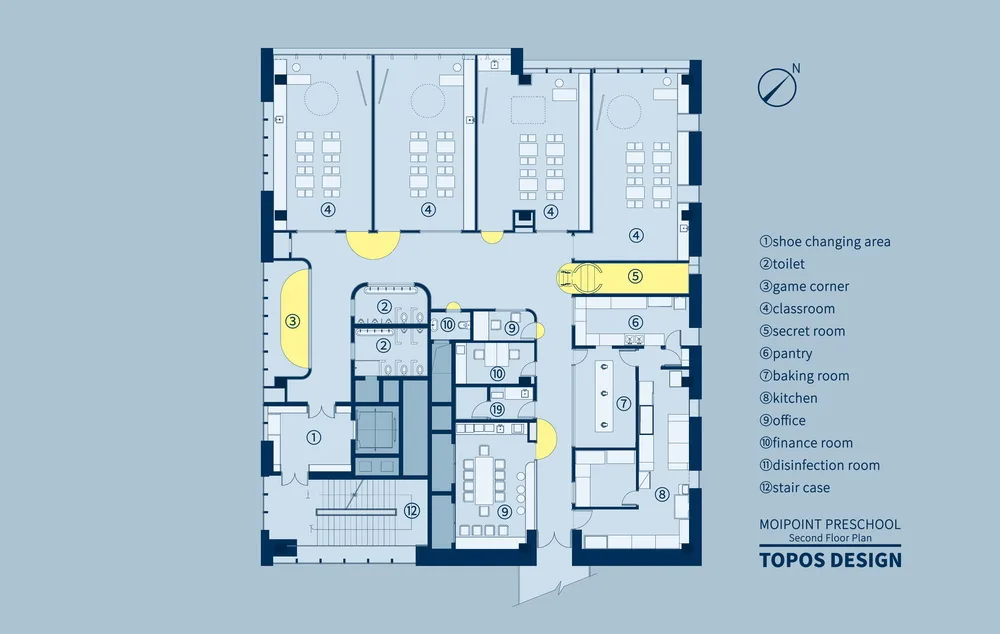
△ 2nd Floor Plan
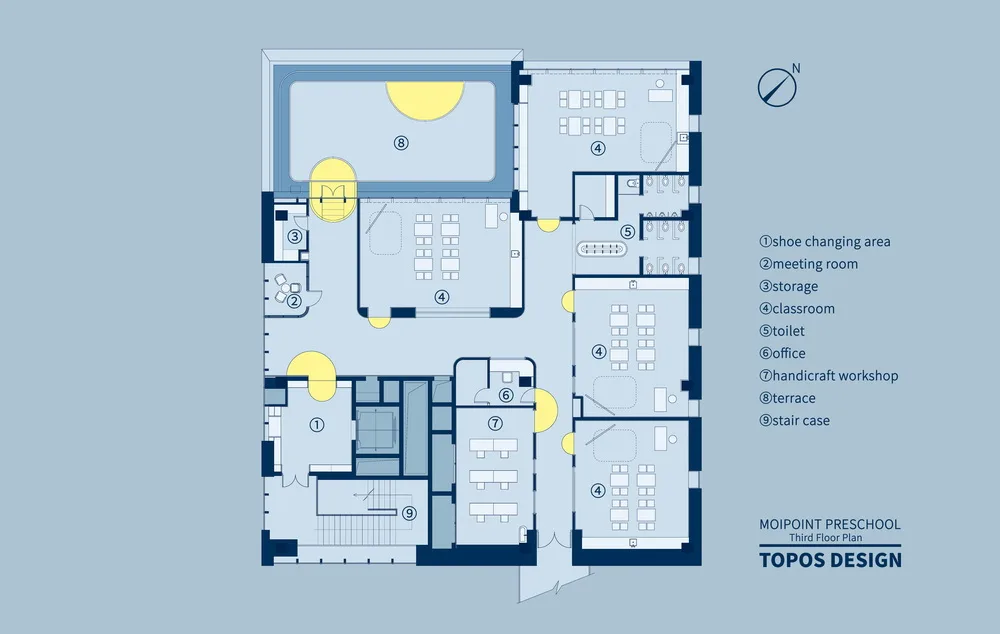
△ 3rd Floor Plan
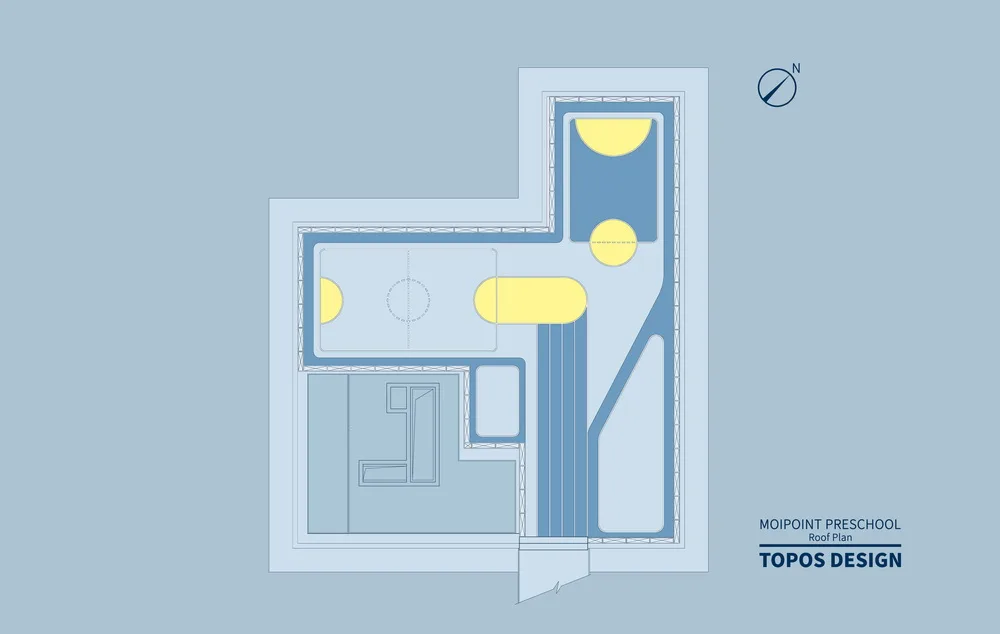
△ Roof Floor Plan
Project Information
Project Name: Moi Education Center
Design Firm: TOPOS Design (www.topos-design.com)
Design Director: Lin Chen
Design Team: Huizhongqi (on-site), Wang Cheng (concept), Lu Liyuan (concept), Zhang Miao (intern)
Design Copy: Zheng Liyue
Visual Design: MEEM Design (www.meemdesign.cn)
Owner: Moyi Education
Construction: Shanghai Yuanheng Construction Engineering Co., Ltd.
ME Consultant: Wang Bihu
Lighting Consultants: Shanghai Beiying Lighting Design Co., Ltd. and Shanghai Xuyi Lighting Technology Co., Ltd.
Architectural Photography: Wu Changle (Space), Li Zaidai (Aerial)
Project Location: Huangpu District, Shanghai, China
Project Size: 1,200 m² indoor area, 420 m² terrace area
Design Period: November 2019 – June 2020
Construction Period: October 2020 – March 2021
Main Materials: Fireproof board, stone, plastic flooring, PVC custom flooring, EPDM plastic flooring, custom fiberglass reinforced plastic flooring, artificial stone












Must log in before commenting!
Sign Up