
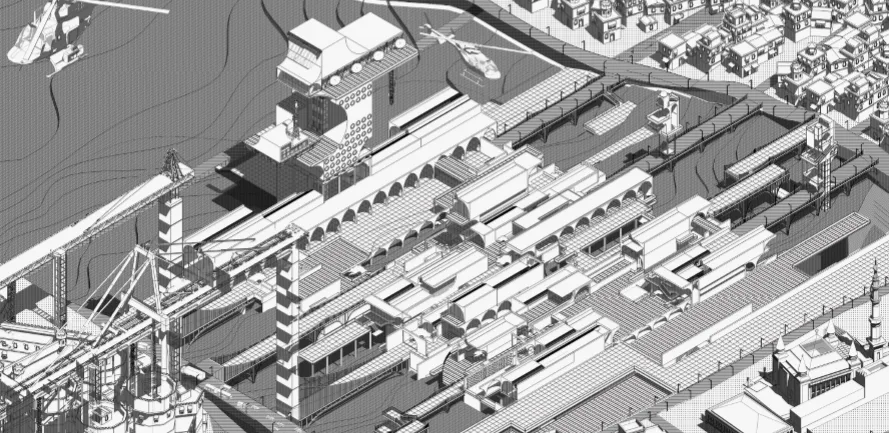
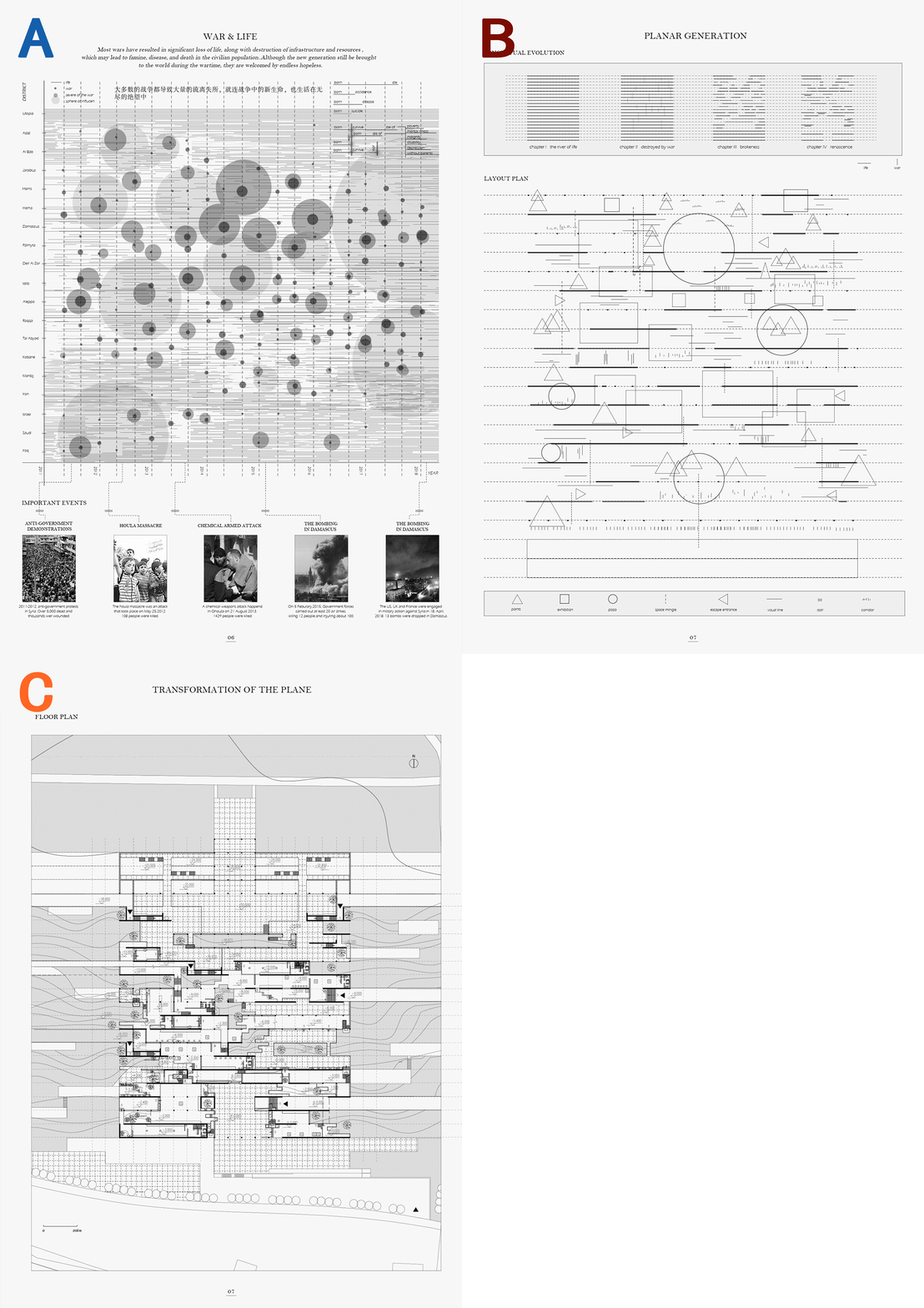
Media News →A + Venue Information →B
B + Space Conversion →C
Can you design like this?
Would you submit your proposal using only SU draft?
Why is this design so special?
Could it be favored by highly competitive master’s programs in the UK?
Let’s analyze it together.
Why do some solutions in excellent portfolios seem difficult to intuitively understand? In these designs, concepts like flat, vertical, sectional, functional, economical, practical are often not the main focus. Instead, the core is always unique ideas. Whether studying abroad or entering competitions, we encourage this mindset: discovering an interesting idea and evolving it step by step into architecture.
In the previous article “Scheme Disassembly” (How was a top-level portfolio analysis diagram created? Quickly with a snap), we briefly mentioned projects like Koolhaas’ graduation work “Escape, or Voluntary Prisoner of Architecture” (a metaphor for the Berlin Wall), Peter Cook’s “Architectural Telegram” (a mobile city), and Rietveld’s “Schröder House” (applying Mondrian elements to architecture). All of these are results of building one idea upon another.
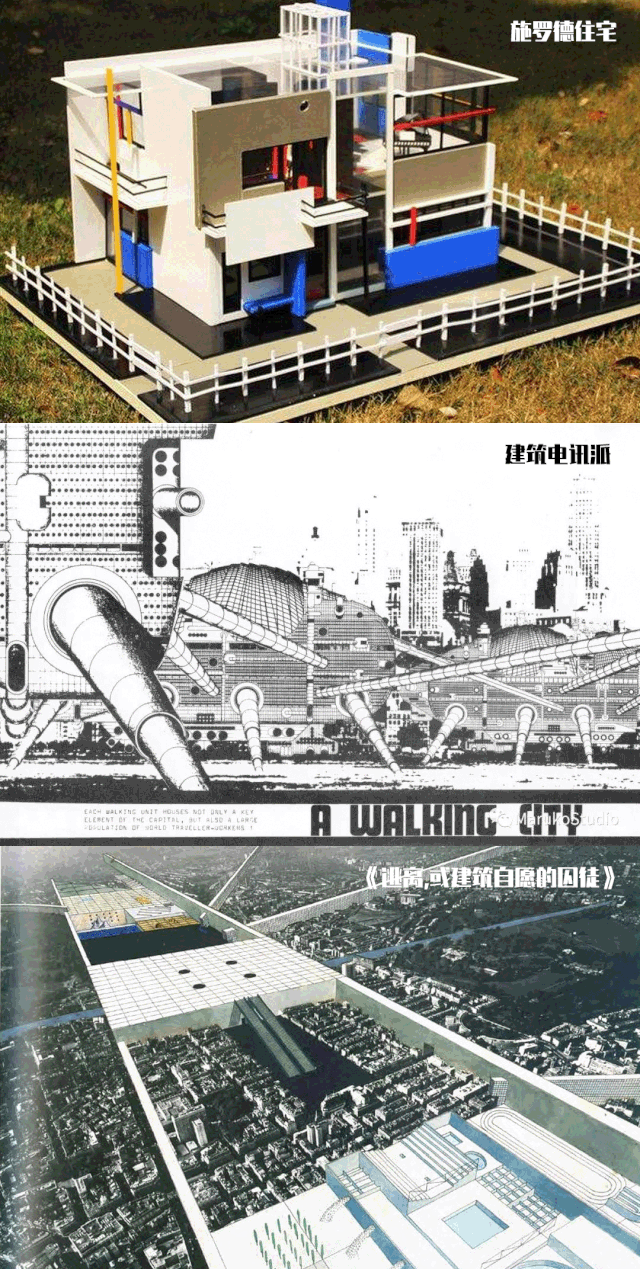
△ Image: Architectural Theory Research and Practice
Learning this way of thinking will help us appreciate more outstanding solutions in the future. Participating in student competitions or pursuing studies abroad can be extremely beneficial. Today, we will attempt to understand this mindset by breaking down an excellent work submitted for UCL Part II (University College London) master’s admission. It’s actually not complicated. The author expressed all her ideas using SU and PS alone, convincing the interviewers. You can learn from this approach.
01. Design Background

The Damascus War Memorial Hall © Du Tongxue
Scheme rendering (SU exposed)
This work was created in 2018, located in Damascus, the capital of Syria. Its architectural function is a “War Memorial Hall.” Searching online reveals that on April 14, 2018, the US, UK, and France jointly bombed Damascus citing a “chemical weapons attack,” causing civilian casualties and stirring global controversy. This likely inspired the author’s intention: to express her stance on war through architecture.
Even today, conflicts persist worldwide: on March 16, 2021, Israel bombed Damascus; in May 2021, the Israeli-Palestinian conflict intensified with rocket exchanges. Through this analysis, we explore the perspective of an undergraduate architecture student on war and how she gradually translates these thoughts into design.
02. Design Specifications
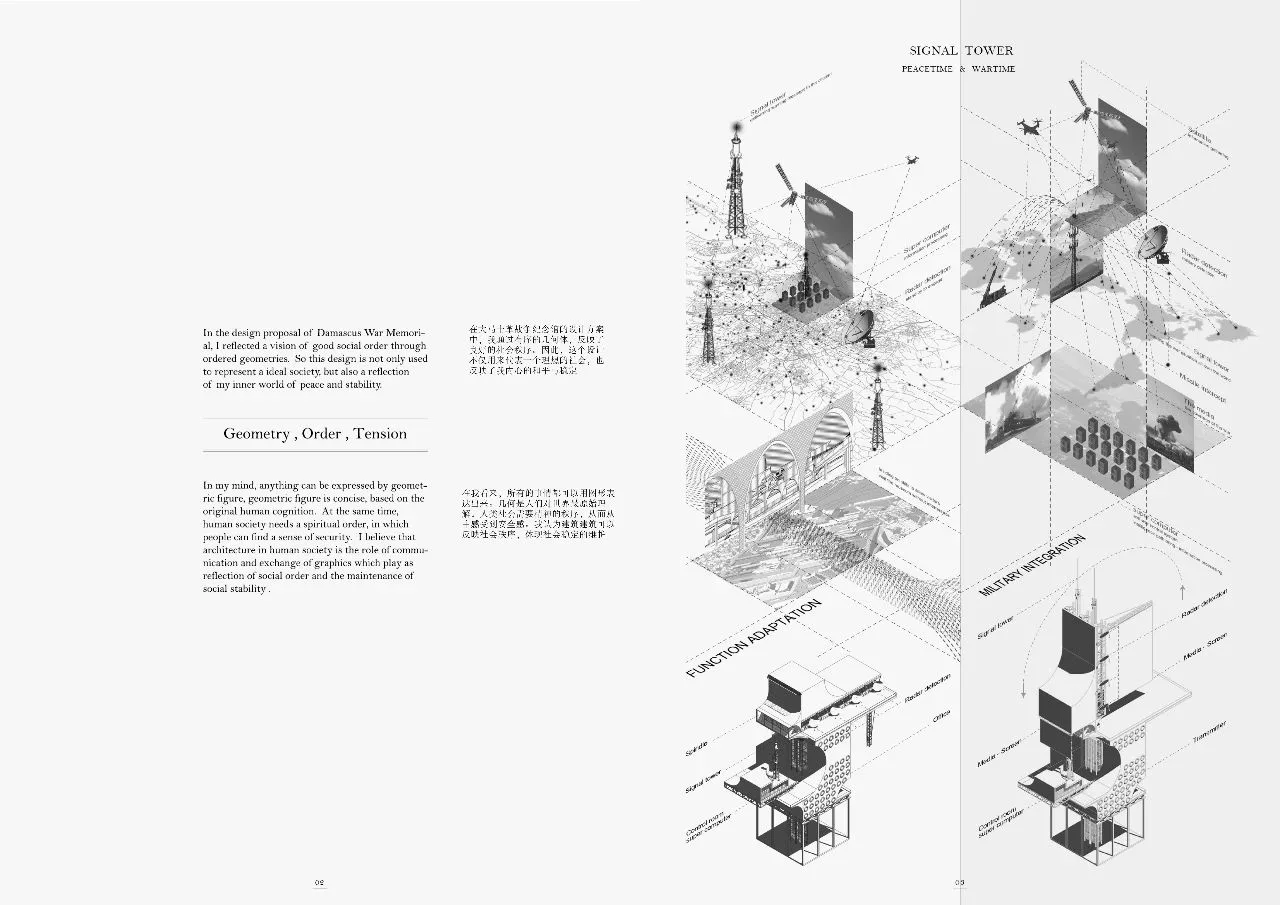
On the portfolio title page, the author wrote: “In designing the Damascus War Memorial, I reflected social order through ordered geometry. This design not only expresses an ideal society but also reflects my inner peace and stability.”
Here, the author shares a key message: “Ordered geometry” symbolizes “good social order.” The design organizes buildings through ordered geometry representing the ideal society the author envisions. This is the core concept behind the plan’s evolution.
This may require careful interpretation, just like reading complex text, to guide the reader’s thought—even if their understanding doesn’t fully match the author’s intent. Thus, comprehending the text in an excellent portfolio is crucial.
Next, consider this paragraph:
“I believe everything can be expressed through graphics. Geometry is humanity’s most primitive way to understand the world. Society needs spiritual order to feel secure. Architecture can reflect social order and demonstrate social stability.”
Breaking this down, the author makes four points:
- Everything, including war, can be expressed graphically.
- Geometry is the most basic form of human cognition—using simple shapes to awaken understanding.
- Humans require spiritual order to feel psychologically secure.
- Architecture reflects social order; building upkeep symbolizes stability, while decay often signals instability.
Rocks piled, dust flying, broken walls, and ruins yet to emerge.
@War photographer Gao Lei – In That Desperate Land
This plan explains how the author translates these concepts into architecture step by step. Let’s analyze the process in detail based on the drawings.
03. Analysis Diagram: “A”
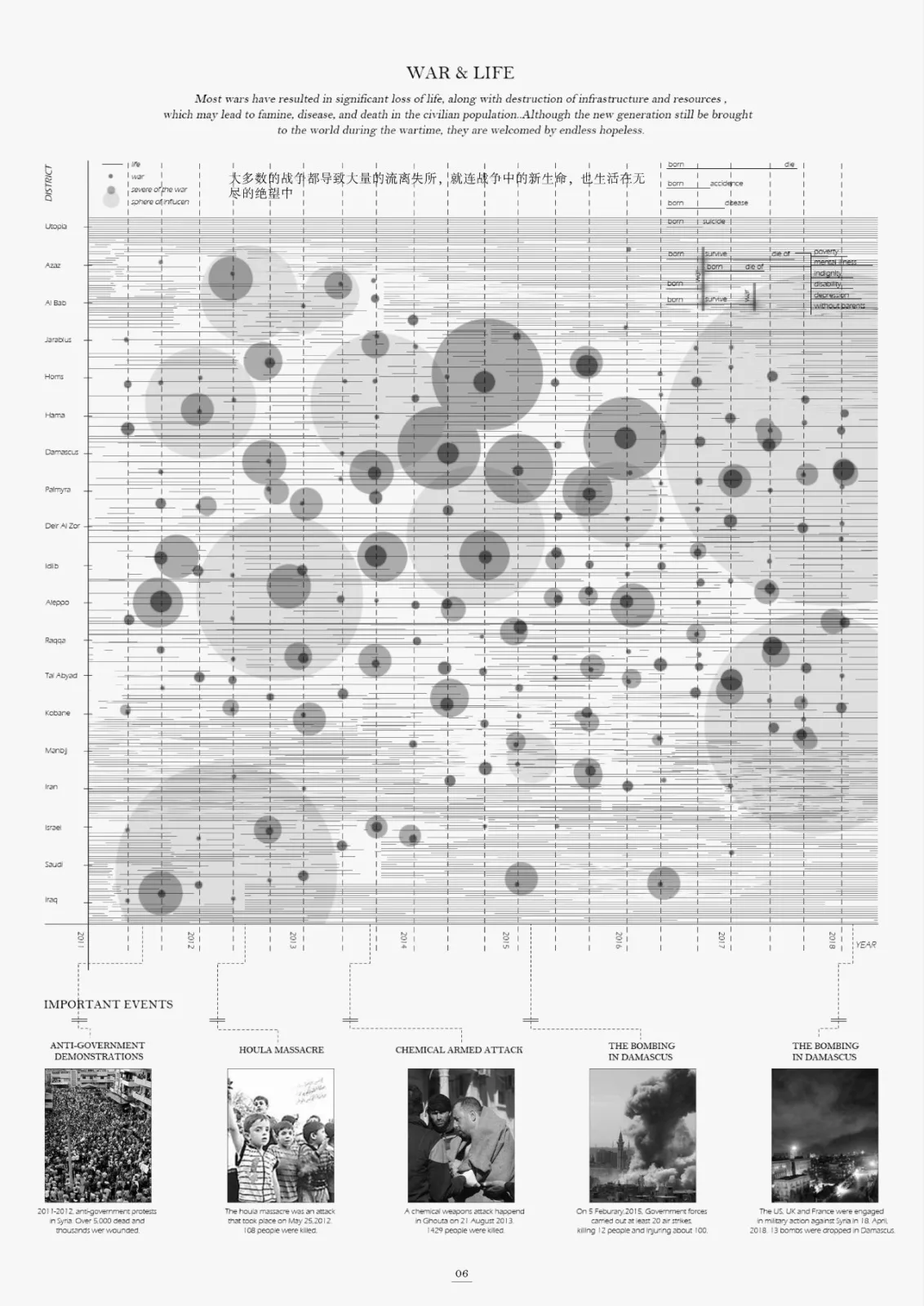
WAR & LIFE – Graphic Media Information:
Everything can be expressed through graphics.
After understanding the design background and description, the drawings become easier to interpret. The above analysis diagram is the most essential illustration of the author’s work—representing the first step of the design.
Let’s explain what this picture means and how it was created. It contains a lot of information, so we’ll break it down into seven parts:
Part 1: Title & Introduction
Title: War and Life
Most wars cause massive displacement, and life during war is lived in endless despair.
This introduction suggests the diagram focuses not only on war but also on life during conflict—the core theme the author wishes to convey.
Part 2: Main Image
This largest section can be divided into four components (borrowed from the author’s PSD for clarity, which will be shared at the article’s end):
- ① A background of many horizontal lines of different lengths and uneven distribution.
- ② 176 small black dots of varying sizes.
- ③ 61 dark gray dots nested with the black dots.
- ④ 12 large light gray dots, some overlapping.

Try to guess what each of these four parts represent before we explain further.
Part 3: Vertical Coordinates
The vertical axis is labeled “DISTRICT: region.” It’s divided into 5 segments covering 19 regions from bottom to top, including Iraq, Saudi Arabia, Israel, Iran, and many cities in Syria such as Damascus, Aleppo, Idlib, and others. “Utopia” is a fictional mixed region.
Most regions are in the Middle East, with Syria being the primary war zone. The dots in the main image are distributed by these regions.
Part 4: Horizontal Coordinates
The horizontal axis is labeled “YEAR: year,” spanning 2011 to 2018, the year of the author’s creation.
Part 5: Legend ①
Recall the main image from Part 2—did your guesses match the legend?
Legend first line: Life
This confirms our initial impression: the image depicts not only war but also life. Some lines are continuous, others broken, which will be analyzed in the next legend.
Legend second line: War
The author represents war as small black dots—176 in total, corresponding to local conflicts. For example, point A marks a local war in Azaz, Syria, at the end of 2011.
Think of these dots as bombs landing one by one. The author’s ‘graphic translation grammar’ uses dots to represent bomb craters of varying sizes, indicating different bomb power and war scale.
This implies a hidden dimension of ‘size’ in addition to time. Though subjective, it adds depth to the interpretation.
Legend third line: Severity of War
The larger black dots often correspond with larger dark gray dots, representing war severity. Again, this is a subjective interpretation.
Legend fourth line: Sphere of Influence
This indicates the impact scope of the war, also subjectively judged.
Why so many subjective judgments? This is just the beginning. The most fascinating part of the work lies in these subjective choices. Initially, it was confusing, but after discussion with the author, it became clear:
Design is not a mathematical formula.
Photo credit: Pexels
@Nothing Ahead
Even starting from a logical idea—mapping all local wars from 2011 to 2018 by region and time, size hidden in the circle dimensions—subjective adjustments are necessary. Dense years, large circles affecting proportions, empty spaces—all require creative modifications.
This emotional, subjective factor distinguishes architects and AI during design. Although the author created a system to translate media information into graphics and then into architecture, the process isn’t formulaic or AI-executable.
Architecture, in this sense, is more like painting.
Photo credit: Pexels
@Jess Bailey Designs
Many UCL Part II applicants create their own “grammar” in design. Interviewers likely seek candidates who fully express their ideas, rather than strictly logical rigor—highlighting the difference between “grammar” and “algorithm.”
Understanding this helps in comprehending the full expression of the work. Let’s proceed to the remaining parts.
Part 6: Legend 2
The author describes several forms of life flow, abstracting life as straight lines, with length representing lifespan.
A complete line represents an individual growing peacefully, joyfully, and healthily.
Legend 2 divides into two parts: top and bottom.
The upper part represents life in peaceful conditions, with four types:
- ① Birth → natural aging and death;
- ② Birth → accidental death;
- ③ Birth → death from illness;
- ④ Birth → murder;
Among these, only “Utopia” may show a complete representation in the selected regions.
The lower part represents life during war, also with four types (most lines are interrupted or affected by war):
- ① Birth → survival despite war, but increased causes of death like poverty, mental illness, despair, disability, loss of parents;
- ② Life born in war faces hardships and premature death risk;
- ③ Birth → death in war, short lifespan;
- ④ Survival in one war, death in another.
This is the message conveyed by legend 2. These life forms become the “reference grammar” for designing lifeline backgrounds in the analysis.
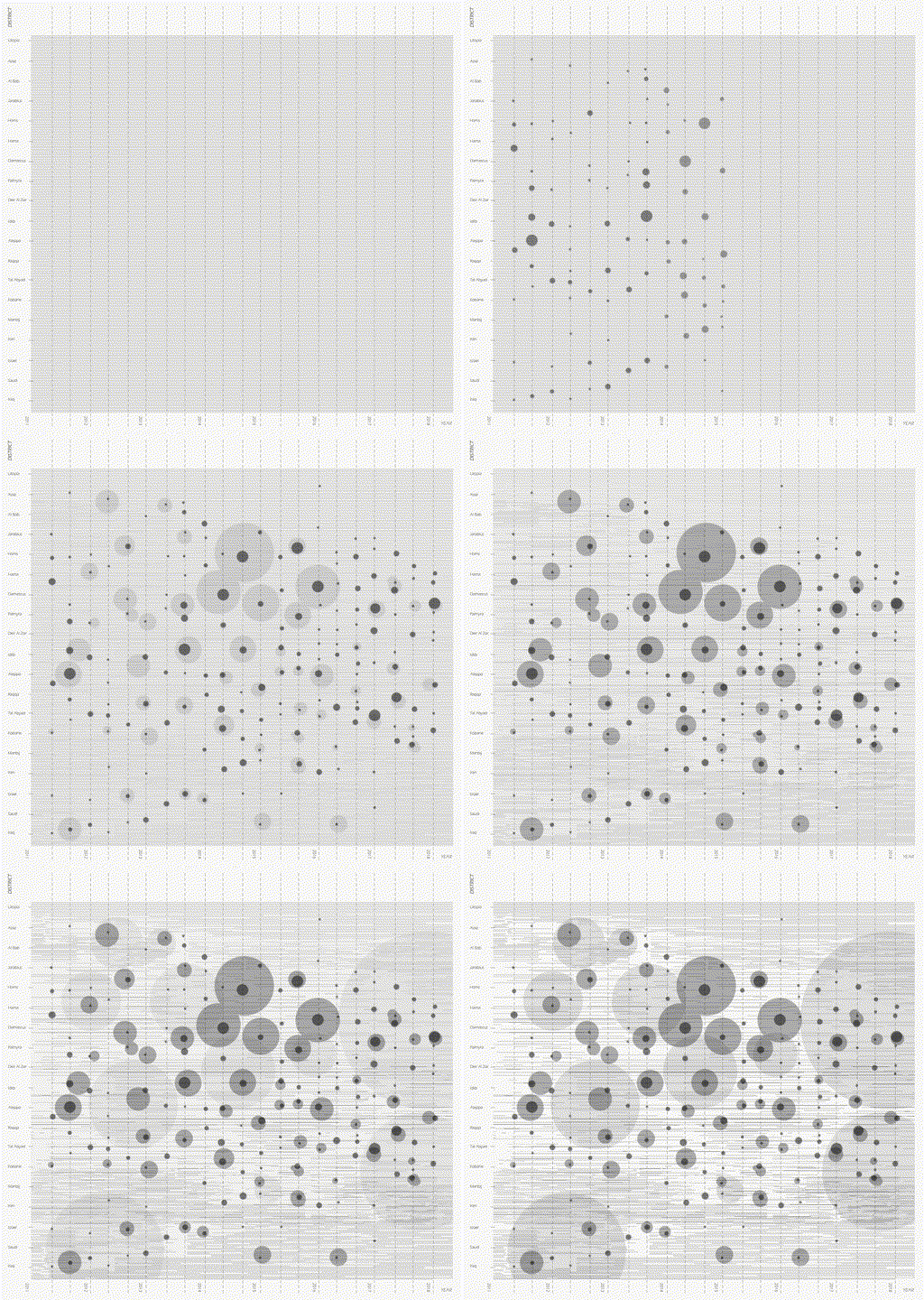
Dynamic simulation of the lifeline painting process.
If the design process resembles “painting,” this background image is the best example. The evolution expresses the author’s emotions.
Part 7: Important Events
Finally, Part 7 covers Important Events. The author selected five key events:
- 2011 Syria anti-government protests (over 5,000 deaths)
- 2012 Hula massacre (108 deaths)
- 2013 Ghouta chemical weapons attack (1,429 deaths)
- 2015 Damascus government airstrikes (12 deaths)
- 2018 Damascus US, UK, and French airstrikes (13 bombs dropped)
This section reiterates the author’s “grammar logic”: collecting media information first, then mapping it visually according to rules to form the graphic. Due to space limits, only key events were shown.
04. Analysis Diagram Summary: “A”
This concludes analysis diagram “A”—the first step of the entire plan: “Grammar ①: From Media Information → Graphics.” We’ve established the core idea and obtained a conceptual “War Information” diagram.
The next step involves translating this diagram into architecture. If you grasp the analysis above, you’re ready to explore the more intriguing “spatial translation grammar.” Let’s first view all plan drawings.
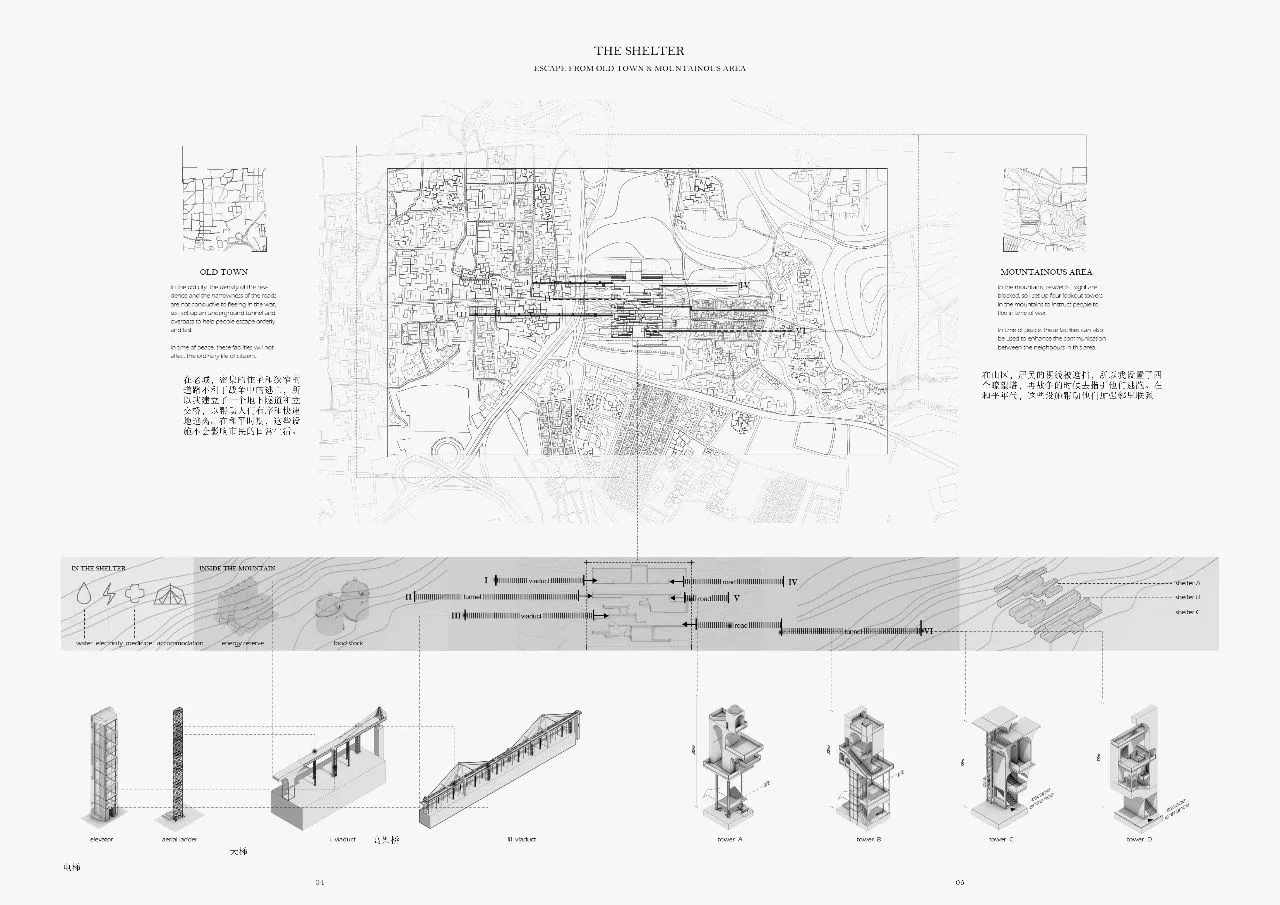
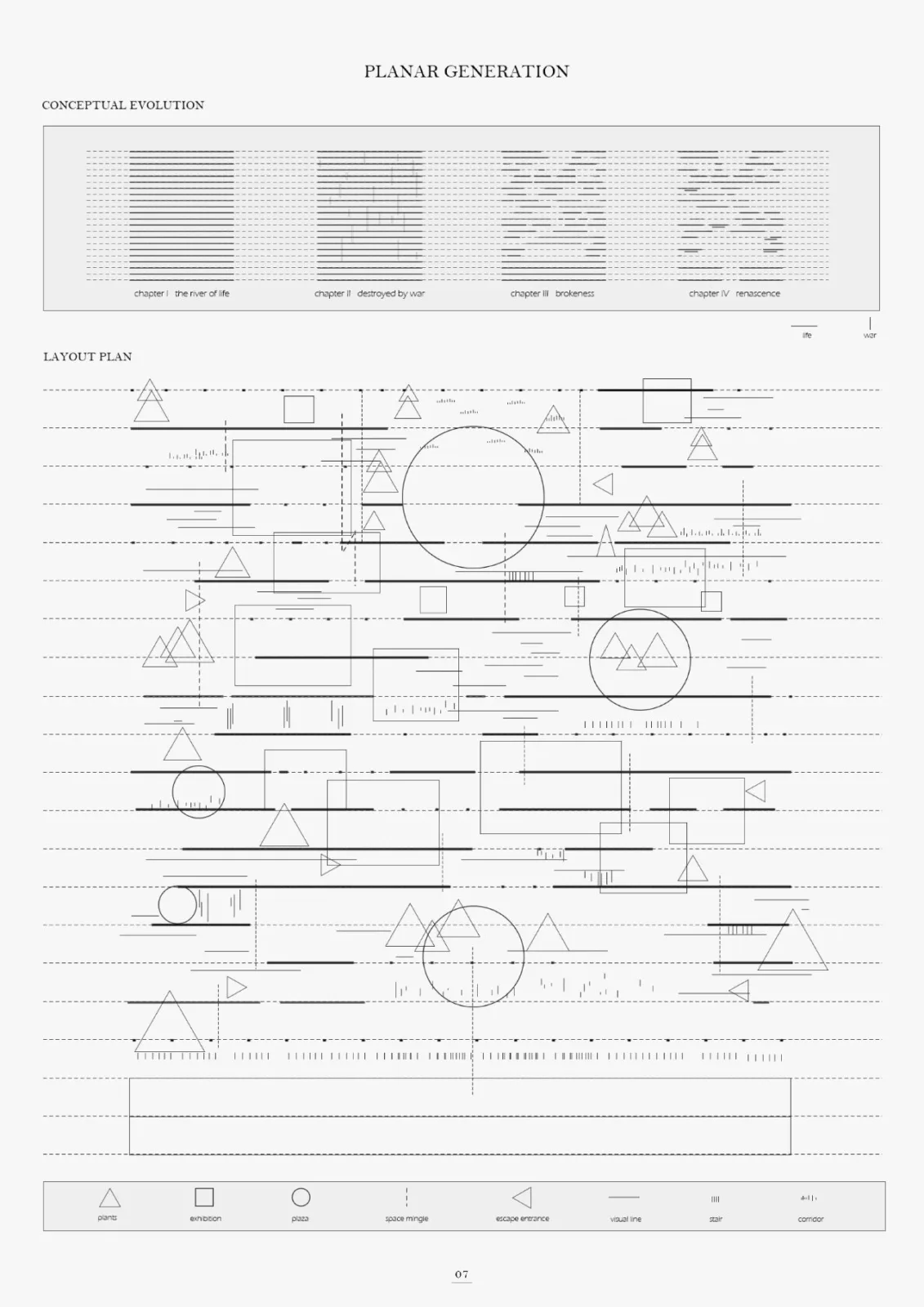
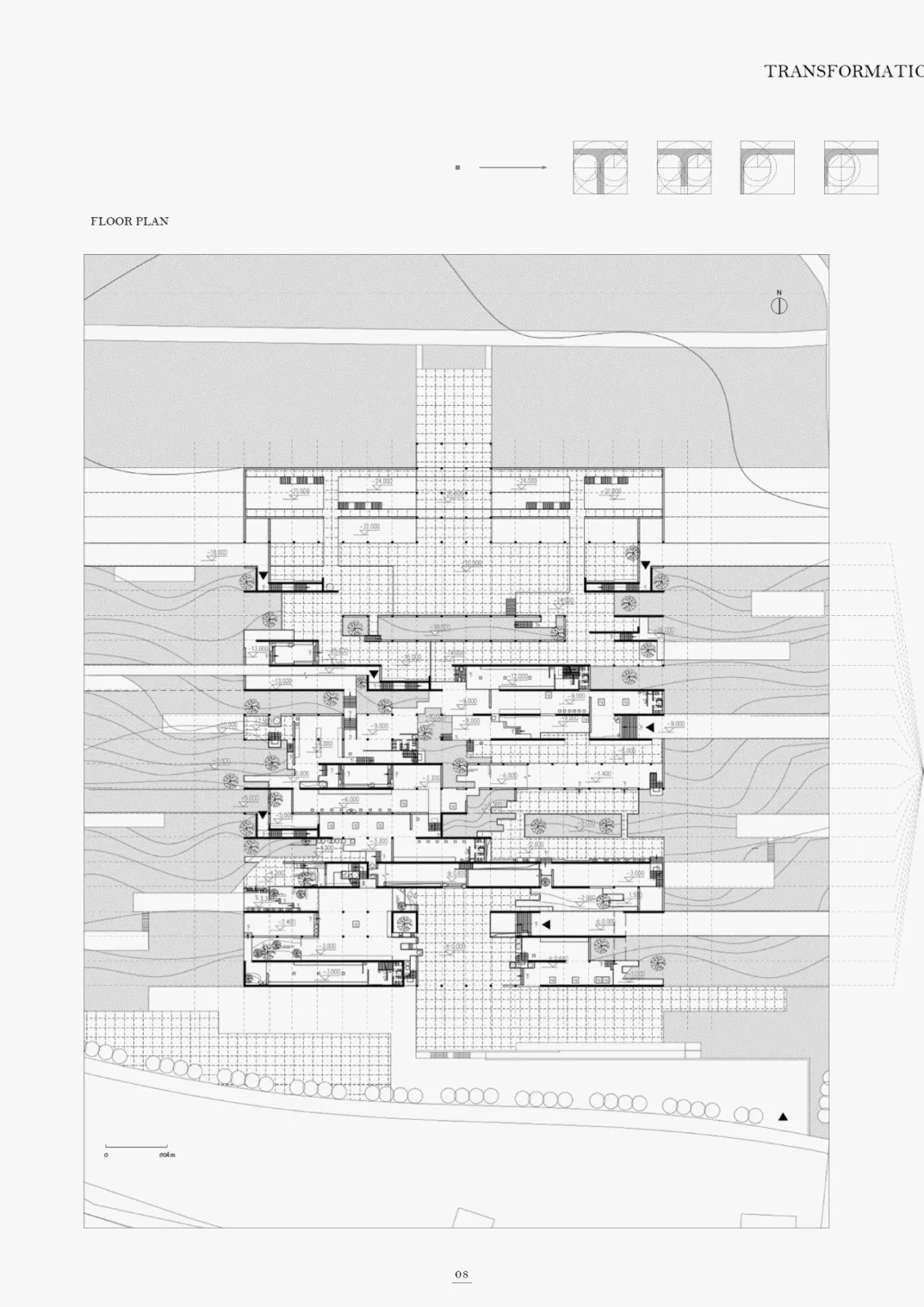
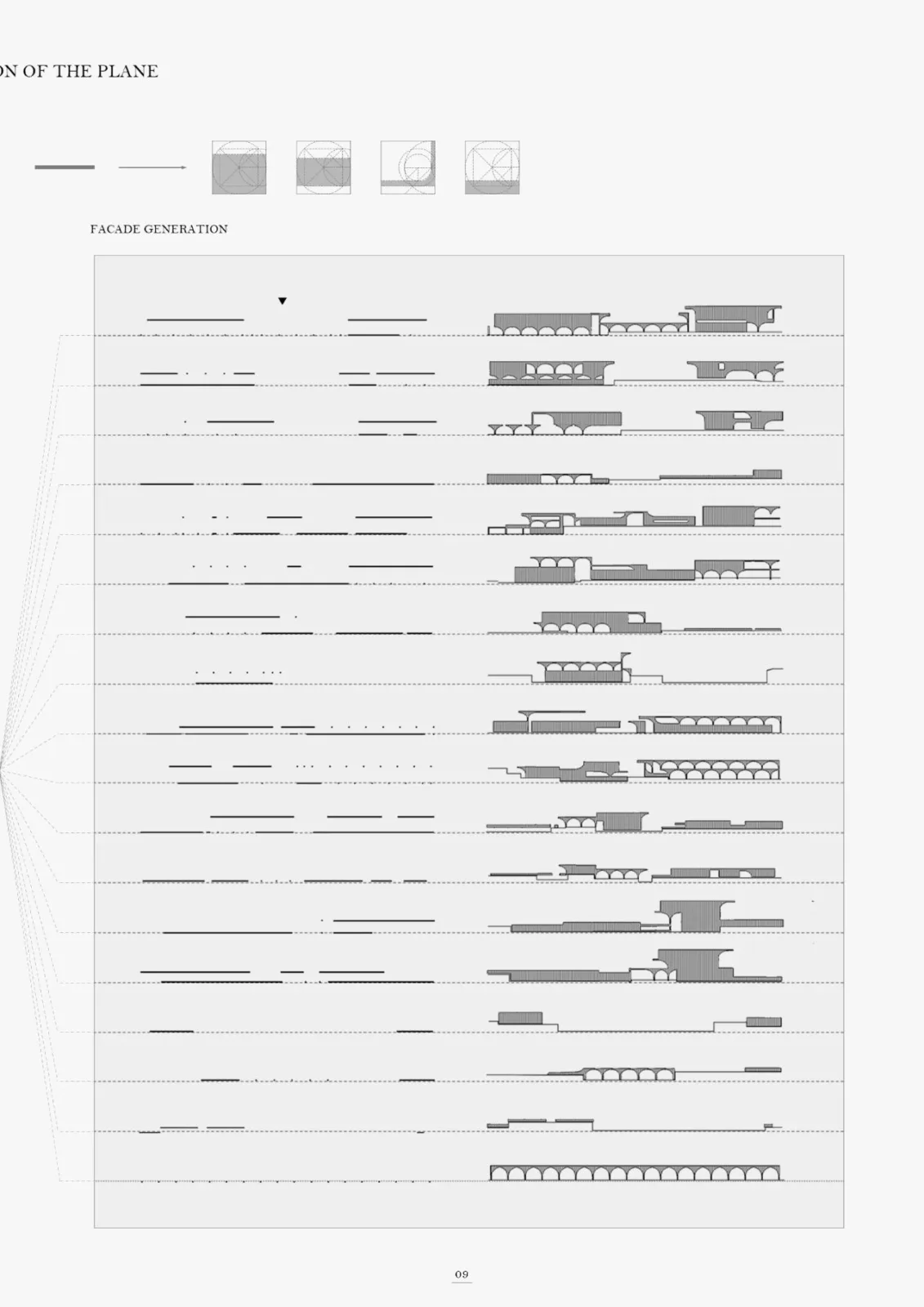
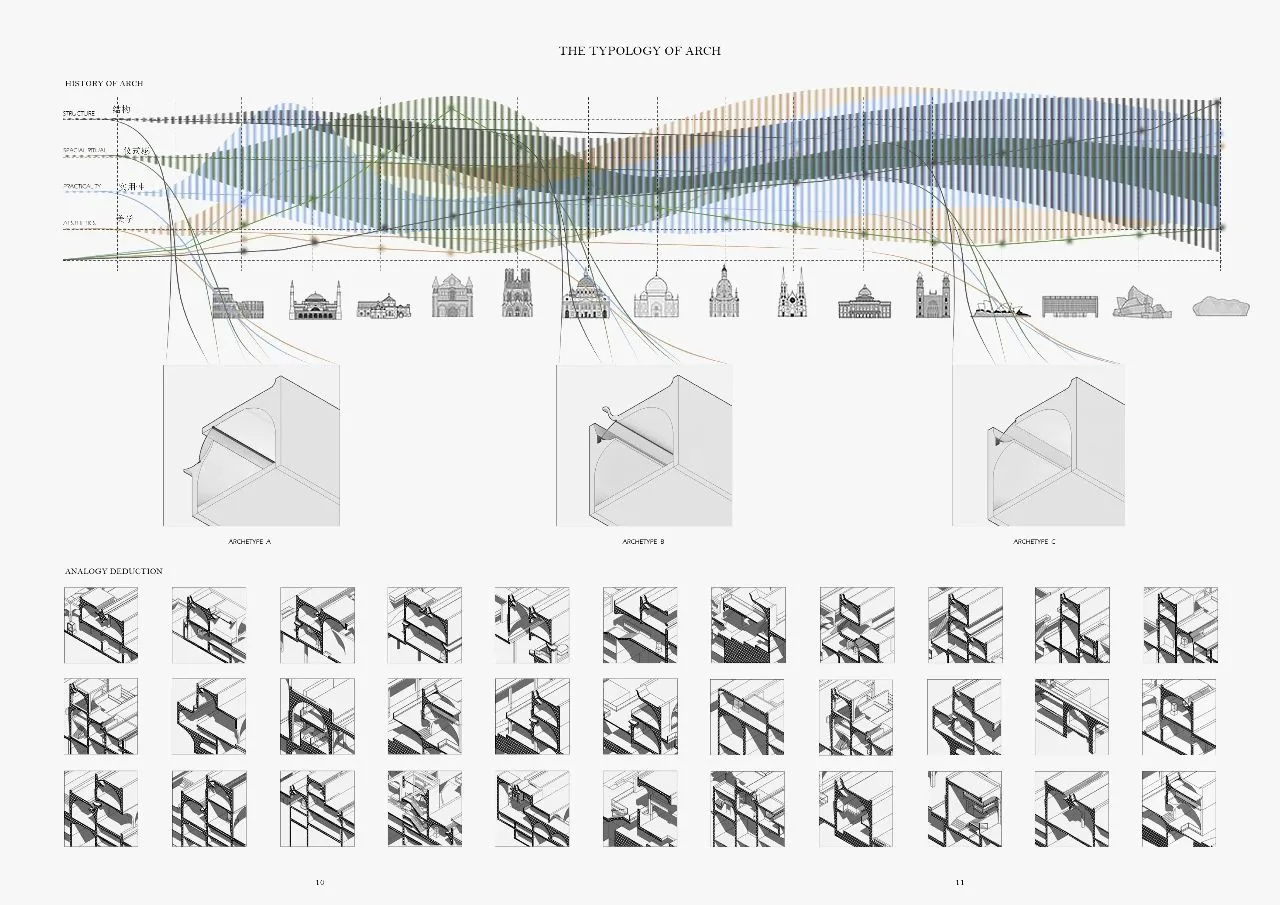
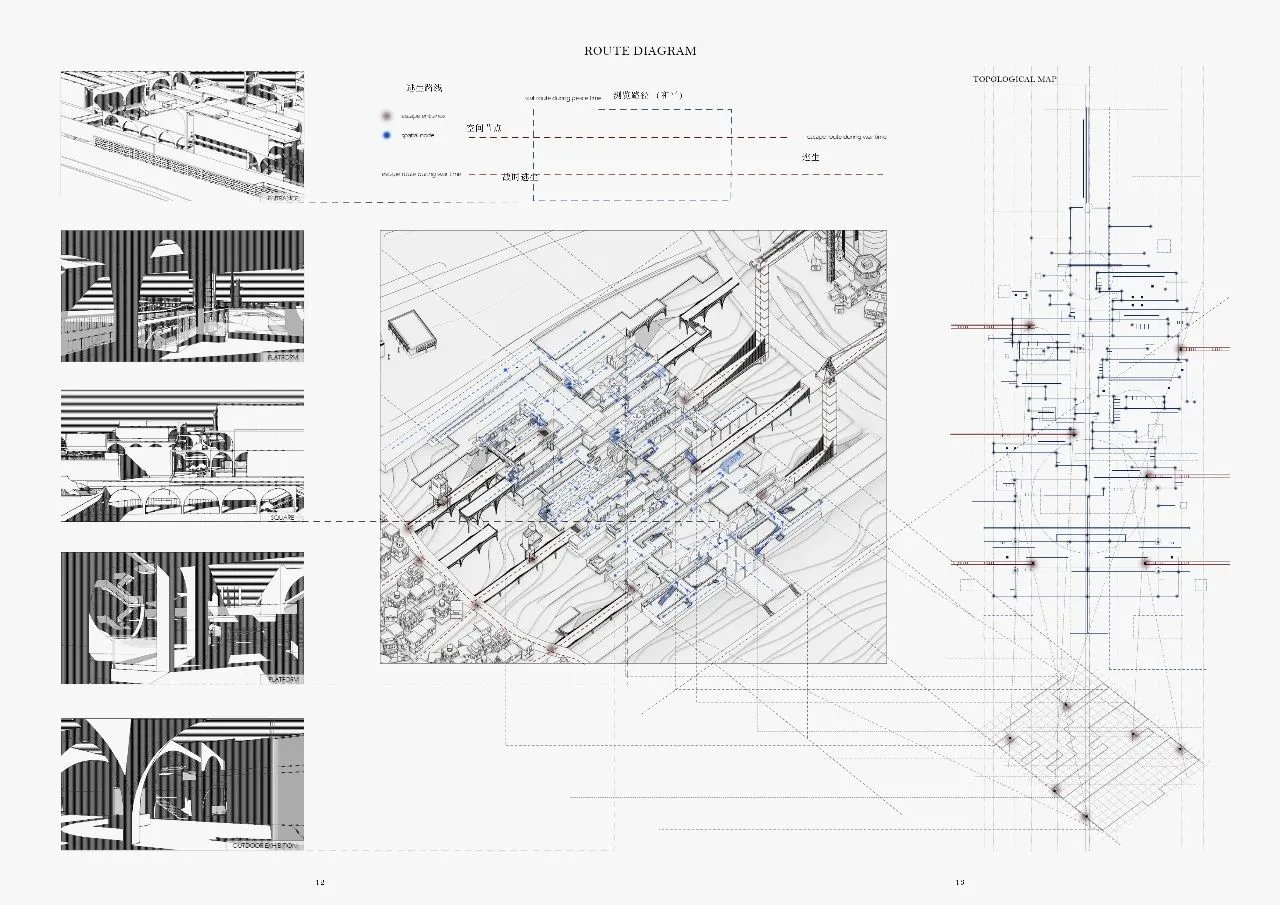
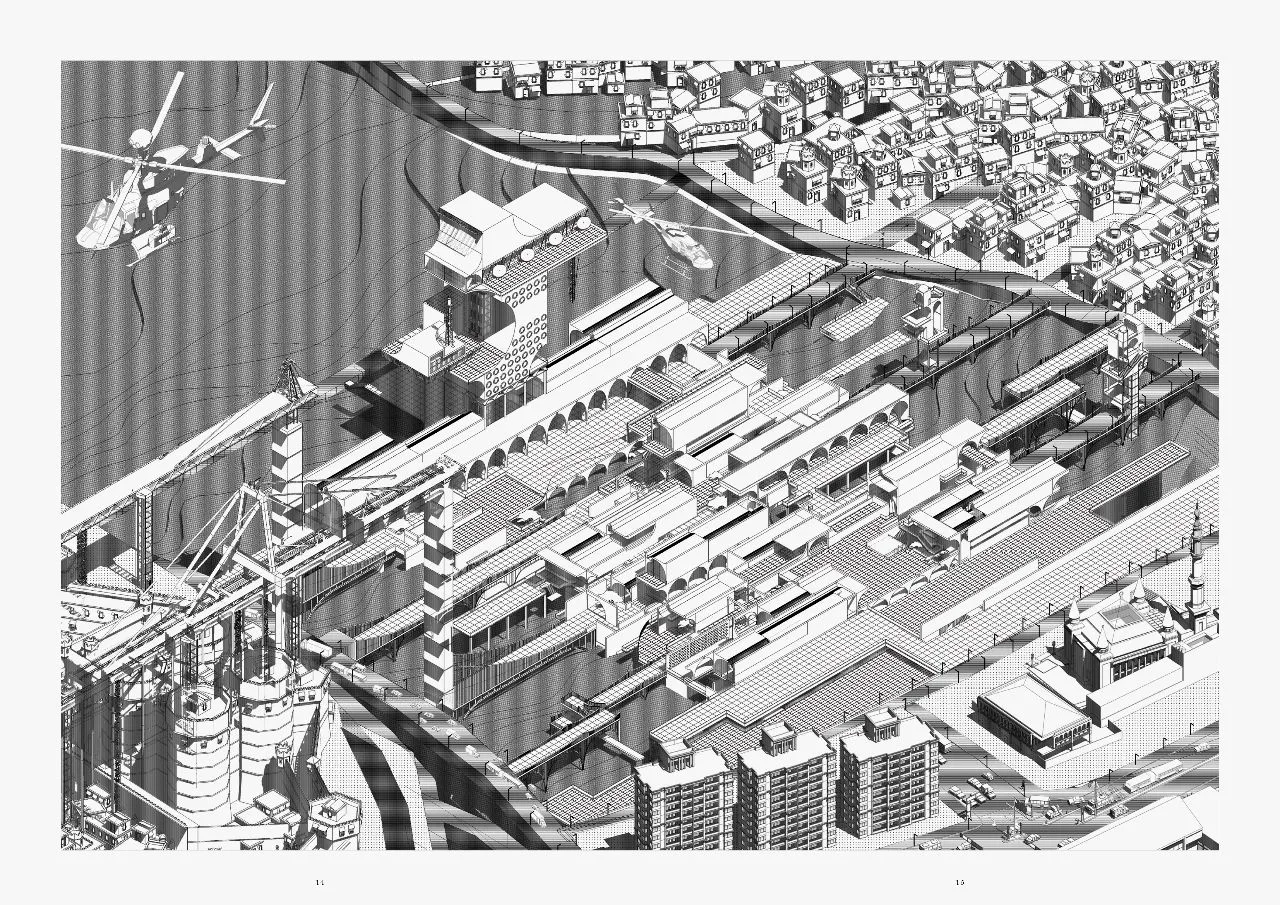
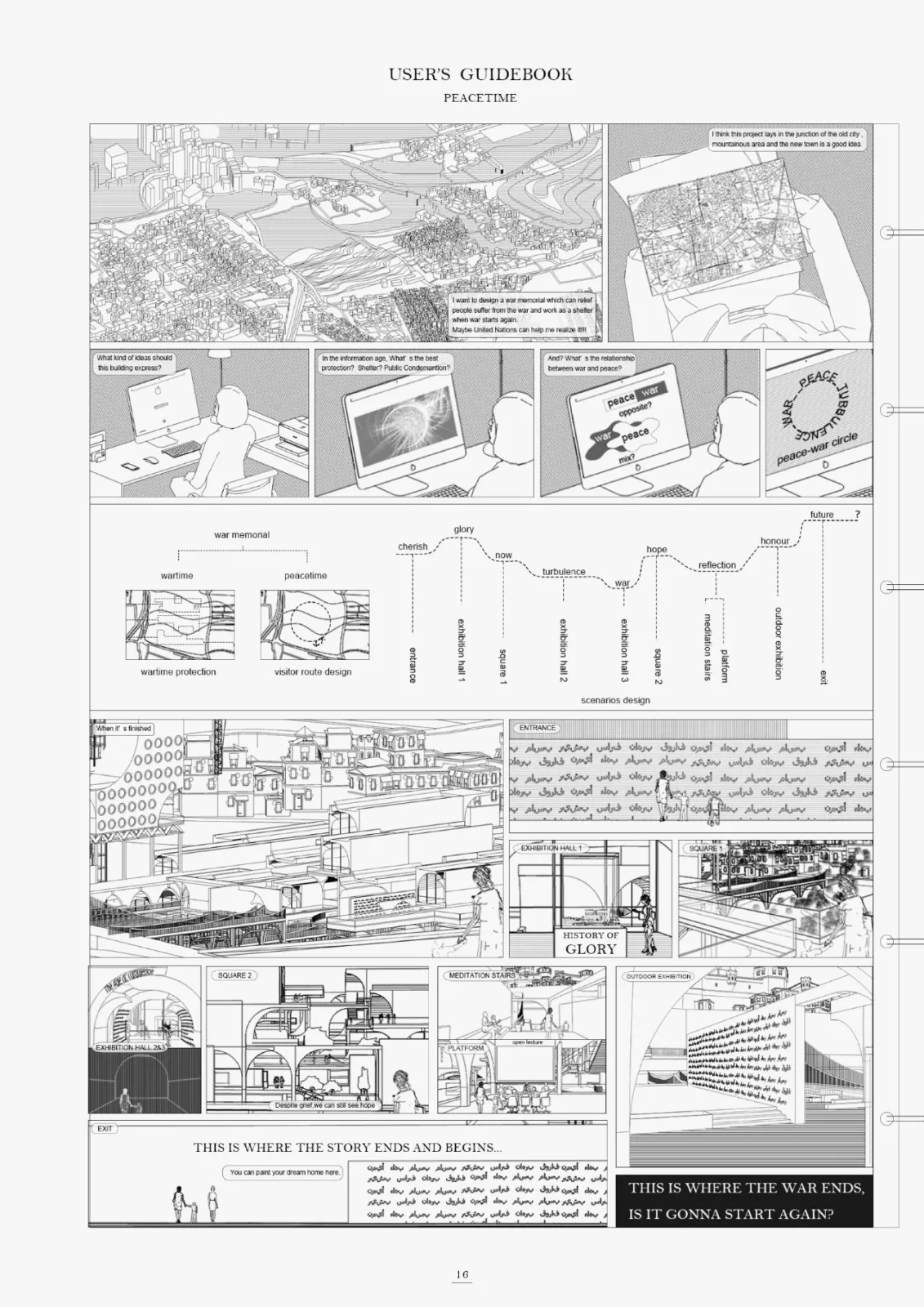
The drawings are authorized by the author.
© Far term | Design Completion Plan
Unauthorized reproduction or use in any form is prohibited.
This extensive set includes 17 drawings, but the one we analyzed in detail accounts for only 2/17. It serves as an introduction where the author expresses her understanding of war’s cruelty and quality of life disparities, leading to her next design: translating “architectural space.”
Before moving on, consider this image:
Bombs fall one by one like raindrops on a water surface, rippling and disturbing the whole pool for a long time.
Photo credit: Matheus Natan on Pexels
When I first saw the analysis chart, this ripple image came to mind. It also reminded me vaguely of the opening scene from season 4 of “Attack on Titan,” released this year, with synchronized sound still echoing in my ears.
“A wonderful coincidence.” Upon reviewing the OP carefully, I extracted and reassembled a small clip:
△
Perhaps the associations evoked by war are similar.
Okay, we have dissected the most important “concept import” analysis chart. You must understand it now, right?
Finally, let’s watch the complete demonstration again:

△ Full demonstration of analysis chart “A”
This concludes today’s plan breakdown. The next exciting step is the “grammar,” which we cannot cover here. If you’re interested, scan the QR code at the article’s end.
We will invite the author and mentor for a live stream to discuss the design process in detail, hoping to inspire you. We also look forward to communicating with more students.
Those who join the group by scanning the code will receive the conceptual analysis PSD source file “A” of the Damascus War Memorial Hall after the live session, along with the demo animation PSD created by the editor.
I hope this “little gift” and the live stream will be helpful, especially to those planning to study abroad.
Bring this disassembly to your “inspiration” or “questions” and join the live stream on Thursday, June 10th at 20:00.
Do you have unique ideas you want to translate into architecture?
Or questions for the author?
Leave a message and share with others.
Thank you all.

Recommended Follow: “Far East Design Completion Plan”

Business Contact: jzxy yz | Reproduction Submission: jzxy gtn













Must log in before commenting!
Sign Up