
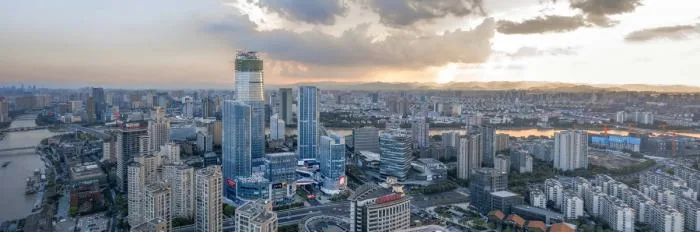
The 30th Greenland Center, part of Greenland Group’s global portfolio, has stood at Sanjiangkou in Ningbo for eight years, reshaping the business district landscape of Sanjiang and Liu’an.
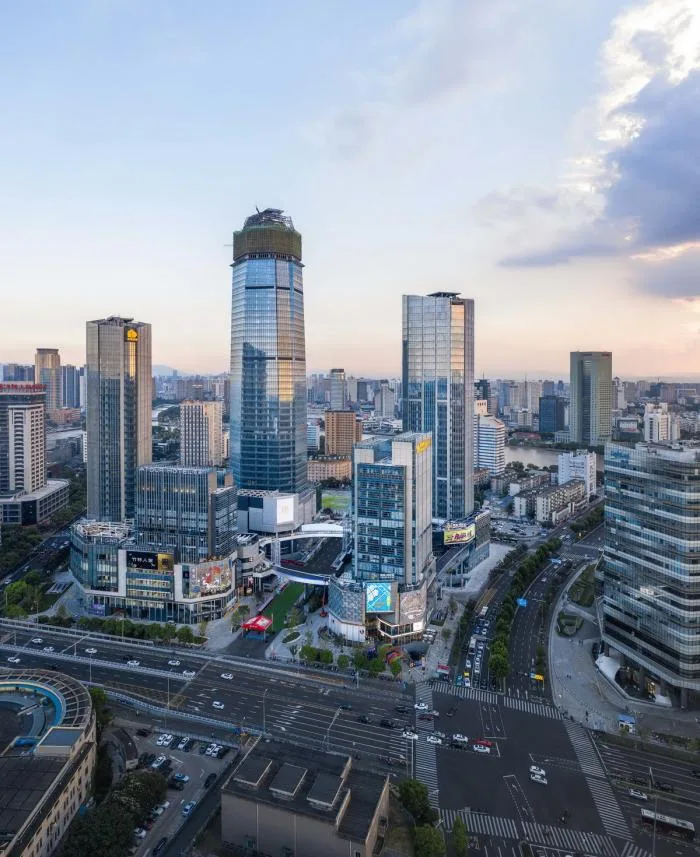
Panoramic view of Ningbo Greenland Center, photograph by Liu Songkai
Since the project’s bidding began in 2012, Greenland Group has collaborated closely with Sanyi China and Japanese designers to tackle various complex challenges. Sanyi China has been fully involved from the project’s inception.
Construction officially started in 2013, but numerous practical issues and repeated revisions extended the originally planned 3-4 year timeline into what became known as the “Eight Year War”.
After eight years of refinement, the once promising area of Sanjiangkou has finally risen into the tall, elegant landmark it is today.
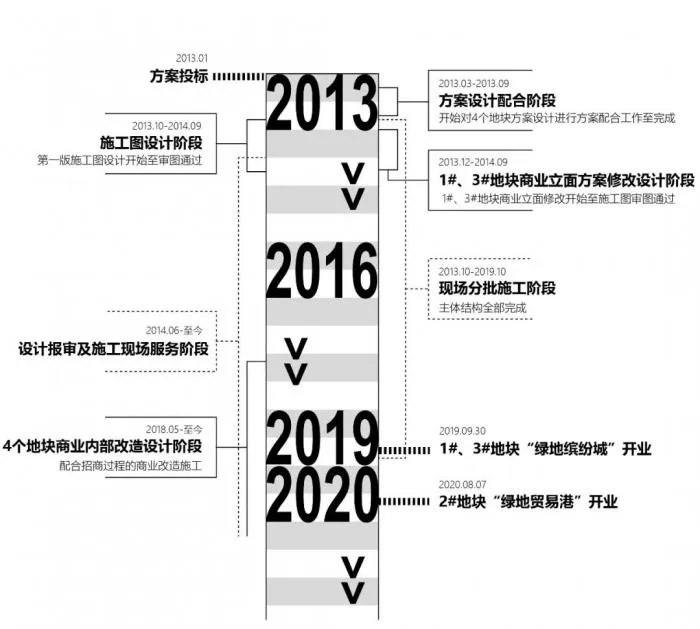
△ Timeline of Greenland Center Project
The Greenland Center’s unique location and scale define its primary identity as a landmark.
In 2011, Harvard economics professor Edward Glaeser’s bestseller Triumph of the City highlighted that:
Urban landmark buildings should integrate residences, dining, retail, and office spaces within a compact area, facilitating transportation and enabling multifunctional coexistence to achieve the city’s optimum state.
Such urban landmarks function as public spaces driven by consumption and utility, requiring timely responses to population needs. They symbolize the city’s spirit, values, social emotions, and future trends, often preceding cultural, governmental, or other urban changes.
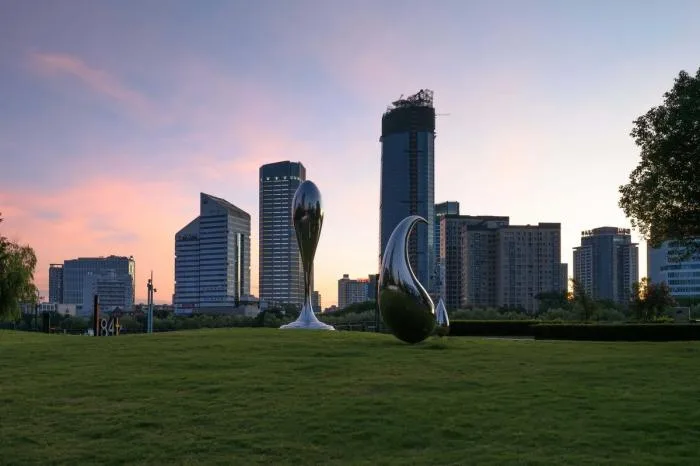
Landmark in the city, photograph by Liu Songkai
How does one design a landmark building in a city? What elements define such structures? How can architectural forms simultaneously serve as landmarks and public spaces in rapidly growing cities, reflecting the urban atmosphere?
What design principles underpin the “Ningbo Greenland Center,” built with these landmark concepts in mind?
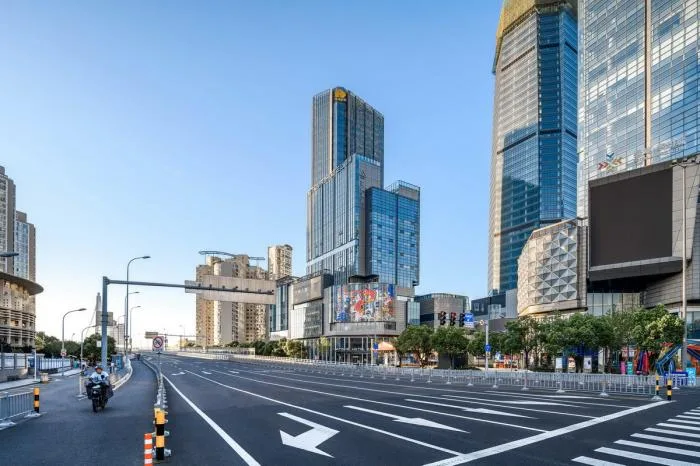
△ Exterior street view of Greenland Center, photograph by Liu Songkai
01. Organizing Urban Network Relationships
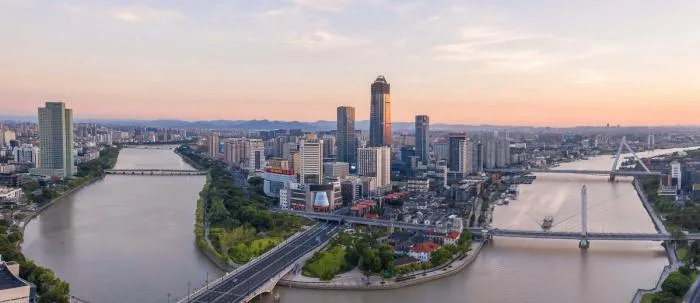
View from the center of Sanjiangkou’s green space, photo by Liu Songkai
The Ningbo Greenland Center is located at Jiangwan, Sanjiangkou, Zhongma Street, within the Old Bund commercial district.
Familiar with Ningbo’s urban layout will recognize two distinct city axes: The Yuyao and Fenghua Rivers converge into the Yong River at Sanjiangkou, flowing into the East China Sea. This convergence marks the origin of the “Ningbo Gang” and forms a historical axis along the Yangtze River. Secondly, Zhongshan East Road connects the eastern new city to Sanjiangkou, creating Ningbo’s busiest commercial district and establishing a commercial axis perpendicular to the Fenghua River.
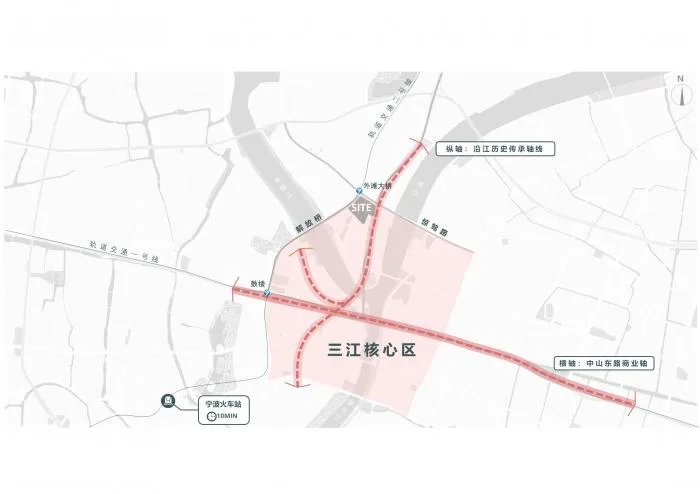
△ Ningbo Urban Axis
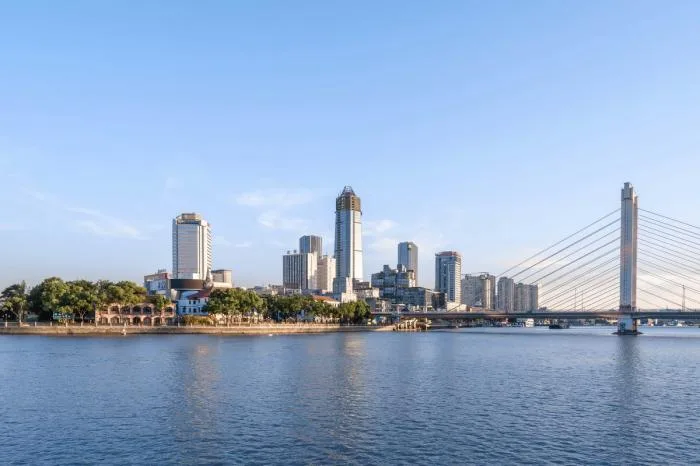
View overlooking the green space center from the river, photograph by Liu Songkai
Today, relying solely on the horizontal axis no longer meets the needs for regional revitalization and urban spatial development. Establishing a vertical commercial axis, while enhancing urban-style commercial landmarks and connecting the Bund historic district with the Sanjiangkou commercial district, is crucial for organically expanding urban functions.
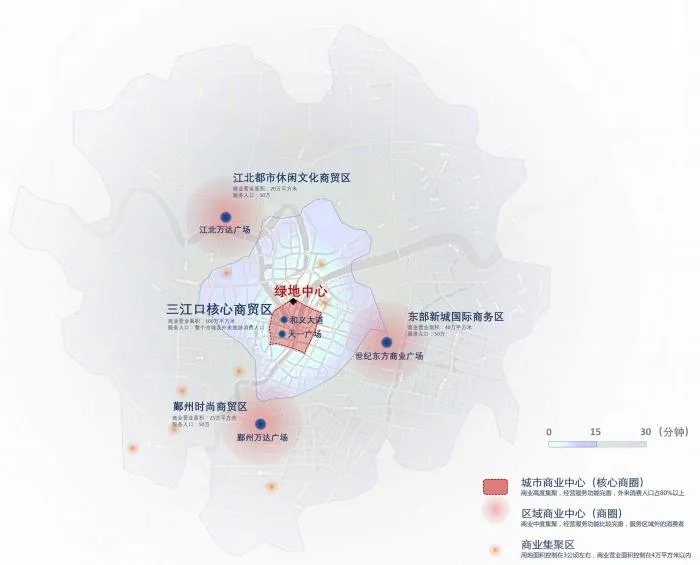
△ Ningbo Commercial Map
The green space center is precisely at the critical intersection of these axes. To the east lie Raffles City and Diamond Plaza; to the south, urban green spaces like Jiangbei Park and Jiangbei People’s Square; and to the southeast, historic docks, Ningbo Art Museum, Planning Museum, Catholic Church, and the old Bund architectural complex, including Banqiao Street. This location integrates history, culture, and landscape, making it a multifunctional hub.
By organizing the site carefully, the Greenland Center will become a lively “urban park,” creating layered urban spaces that offer comfortable, high-quality environments for office work, living, and shopping—allowing residents to thrive and engage naturally.
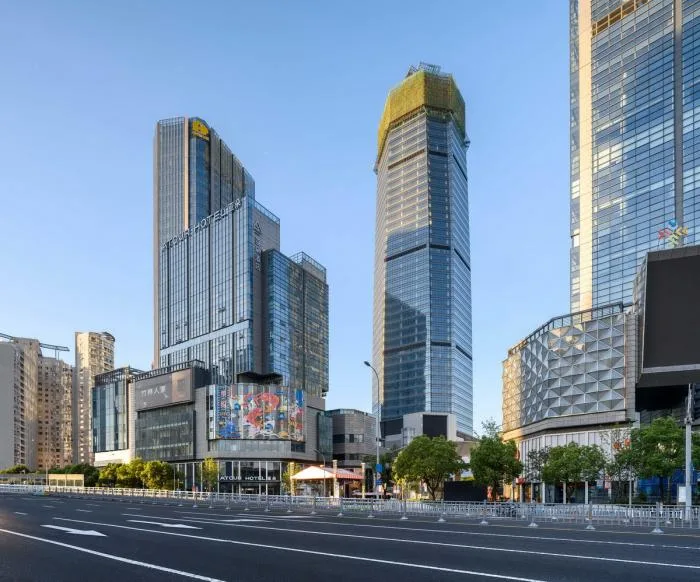
Green Center as an urban park, photography by Liu Songkai
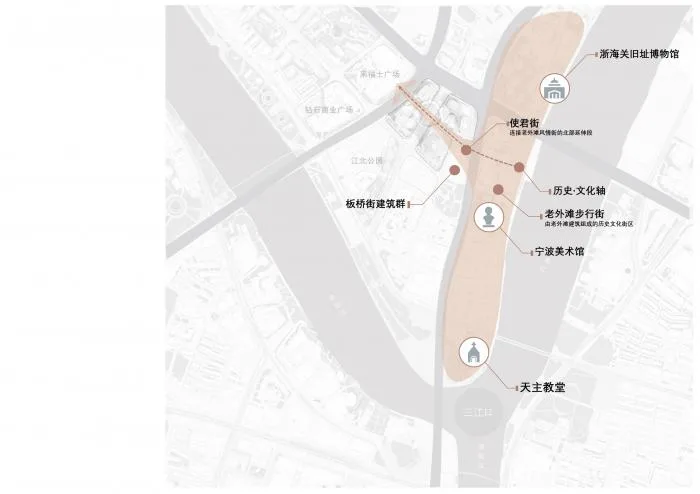
Urban Historical Context Analysis
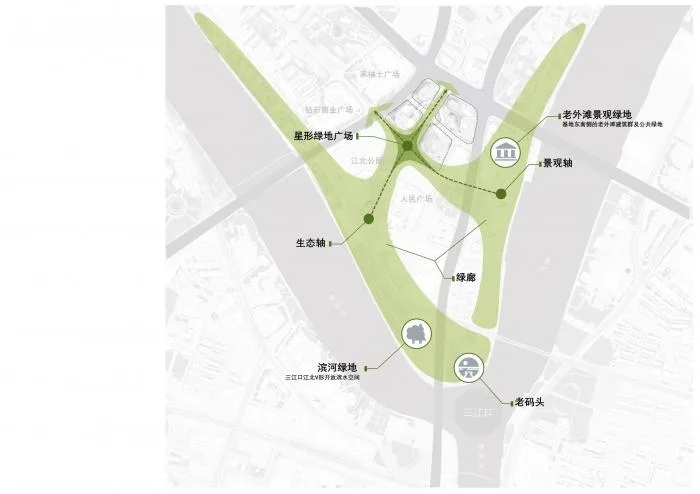
Urban Green Landscape Analysis
The project covers 36,800 square meters, divided into four plots by a cross-shaped municipal road. Daqing South Road and Renmin Road flank the site, with the Bund Bridge approach to the north. The northwest and southeast corners house a subway station and bus stop, respectively, generating substantial foot traffic.
Nearby commercial zones like Raffles City, the Bund Building office, and the affiliated hospital of Ningbo University School of Medicine also direct people flow. Historic buildings and public parks further establish a foundation for local consumer groups.
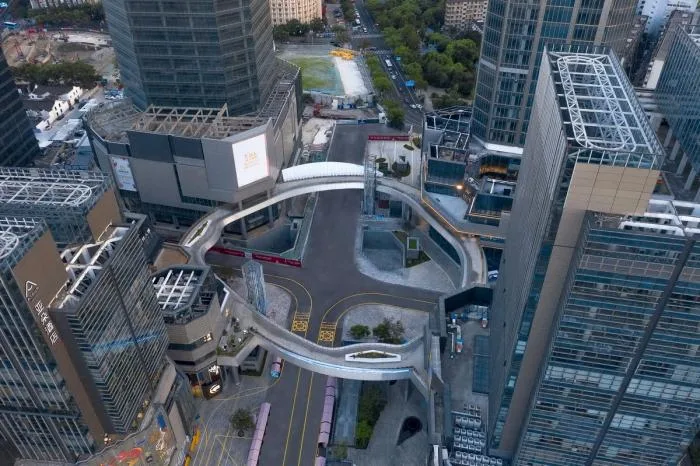
The Greenland Center divided into four plots, photo by Liu Songkai
Integrating these scattered plots and guiding diverse groups of people is the project’s core challenge. Unlike typical commercial real estate with a central hierarchical structure, the Greenland Center disperses multiple flexible spaces—such as plazas and green areas—in a non-hierarchical layout.
This design encourages casual, vibrant interactions along the streets, fostering continuous connection between people and urban public spaces. Numerous small-scale public areas enhance the cohesion between the urban environment and its inhabitants.
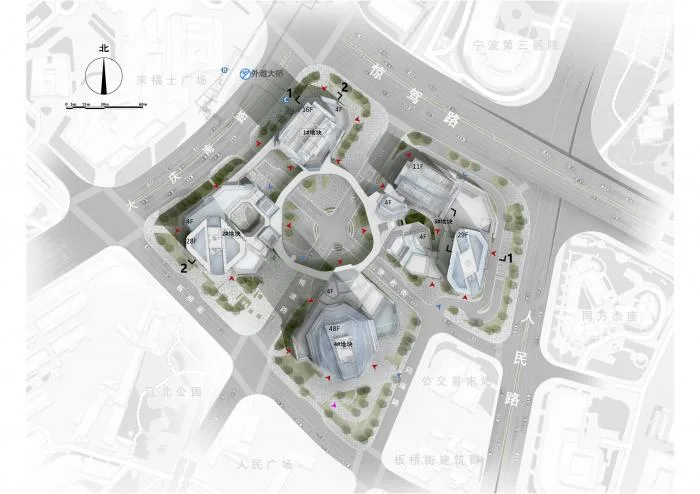
△ General layout plan
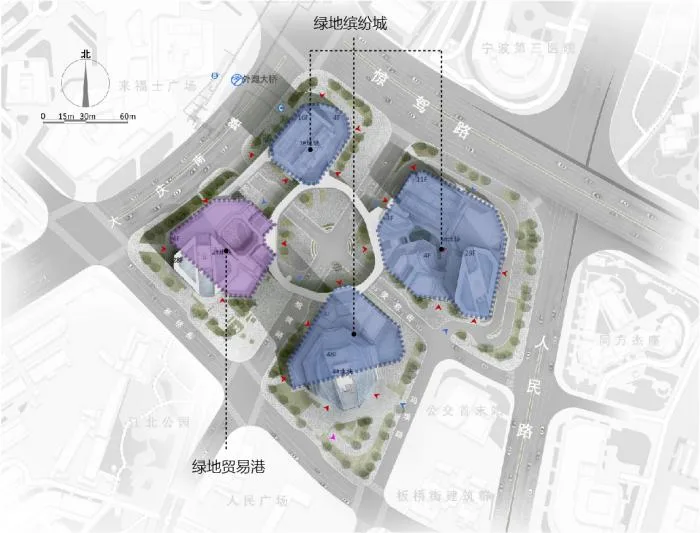
△ Podium commercial format distribution
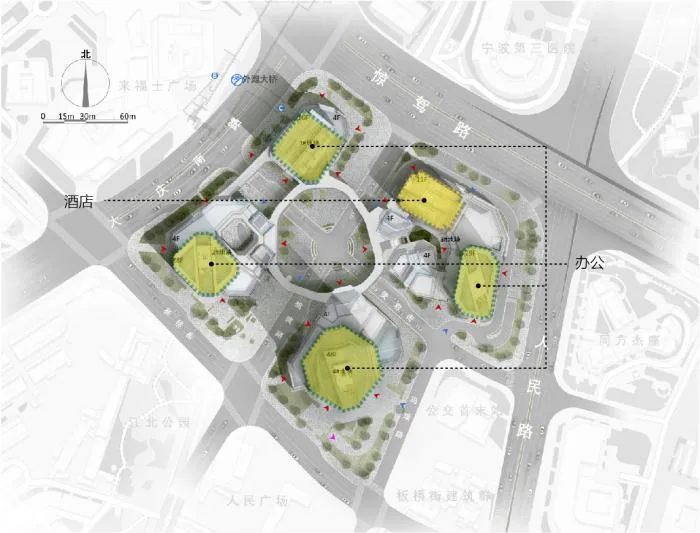
△ High-rise commercial format distribution
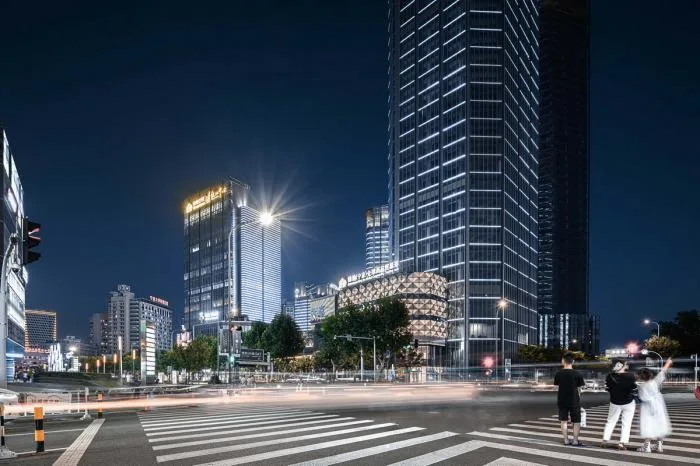
Everyday life interaction, photography by Liu Songkai
02. Creating a Three-Dimensional Urban Space
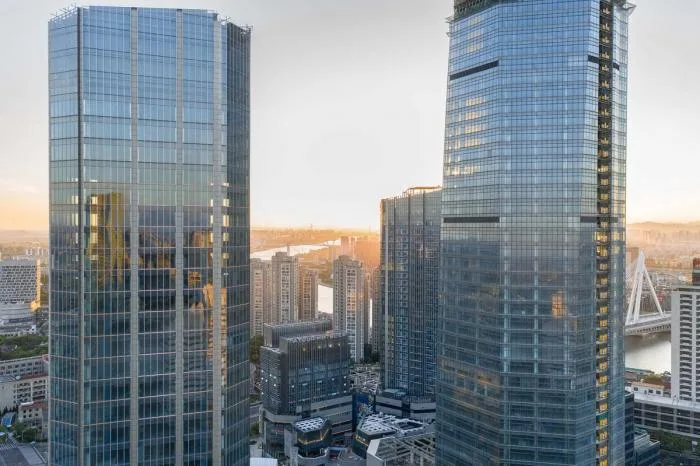
Rising green space center, photo by Liu Songkai
The Greenland Center features five towers scattered across four plots, linked by elevated corridors forming their podiums. From both sides of the waterway, the varying heights of these towers create a “mountain-like” skyline, introducing a new urban silhouette.
The southern super high-rise reaches 240 meters with 48 floors, becoming the tallest building in Sanjiangkou and dominating Ningbo’s skyline. The other four towers are arranged in a “Yong” shape, with descending heights to form a cohesive urban group while minimizing visual impact on nearby historic buildings.
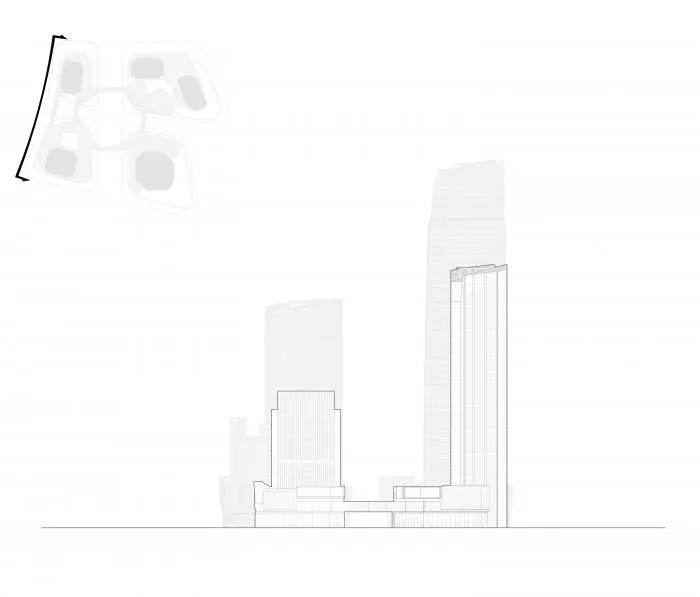
△ West elevation view
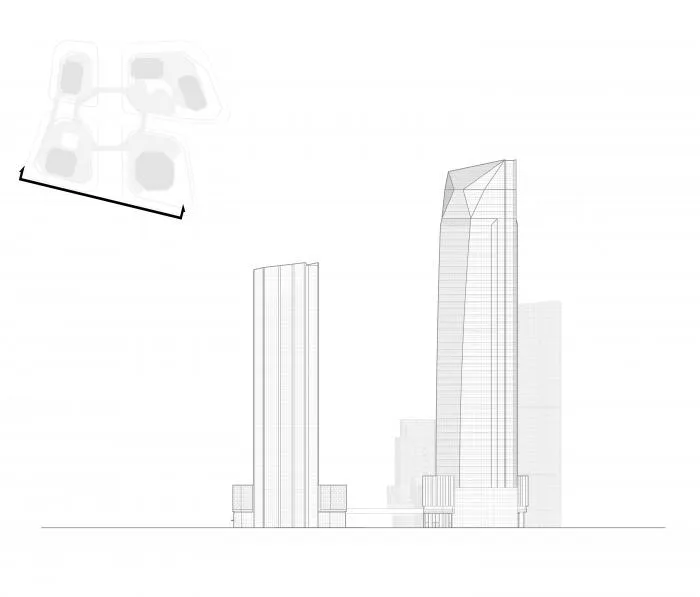
△ South elevation view
All five buildings are situated near major city roads. Plots 1 and 2, with more display space, focus on commercial layouts, while the super high-rise landmark sits on Plot 4 for phased development feasibility.
The four plots form a planning structure of “one core, one belt, and four nodes”—with a central commercial square as the core, commercial atriums at each plot as nodes, and a commercial corridor connecting the subway and bus terminals.
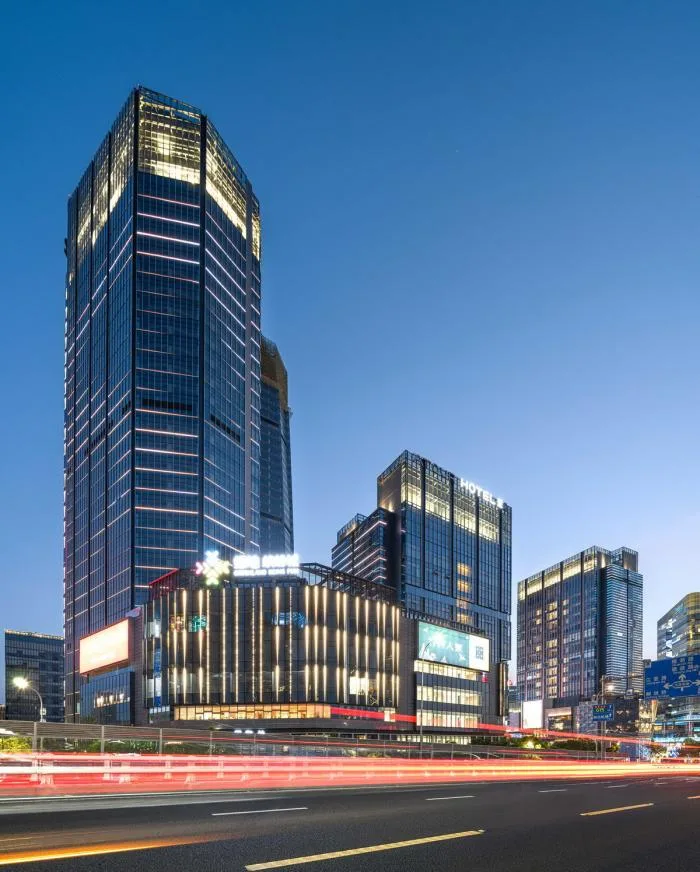
Panoramic view of Ningbo Greenland Center, photo by Liu Songkai
The podium spaces have been segmented to align with the scale of adjacent low-rise buildings, maintaining urban continuity. Four block podiums connect as open blocks, enhancing commercial potential through mutual stimulation. A loose, hierarchical, and fragmented spatial arrangement eliminates organizational barriers.
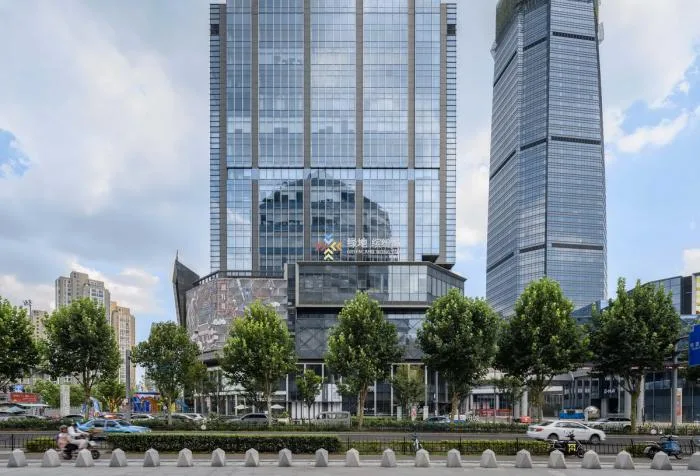
△ Ningbo Greenland Center street view, photo by Liu Songkai
At street level, visitors converge at the central square through four commercial nodes, organically integrating the scattered plots. On the second floor, pedestrian flow is directed through five external escalators, internal vertical escalators, and atrium escalators.
The four plots are connected by sky bridges, enhancing connectivity and creating intersecting pedestrian routes.
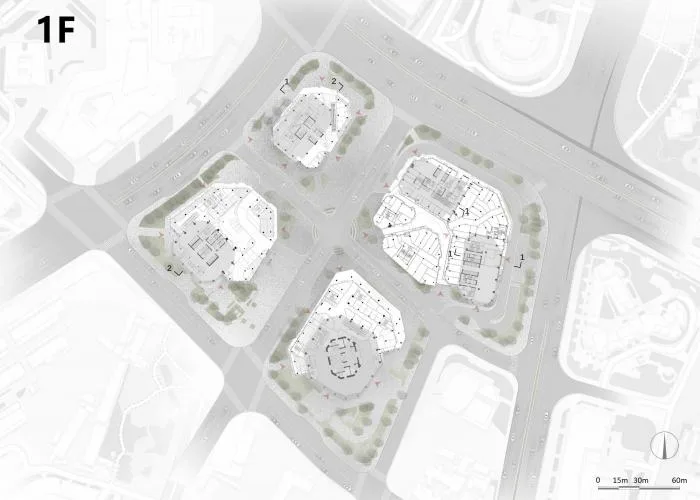
△ First floor plan
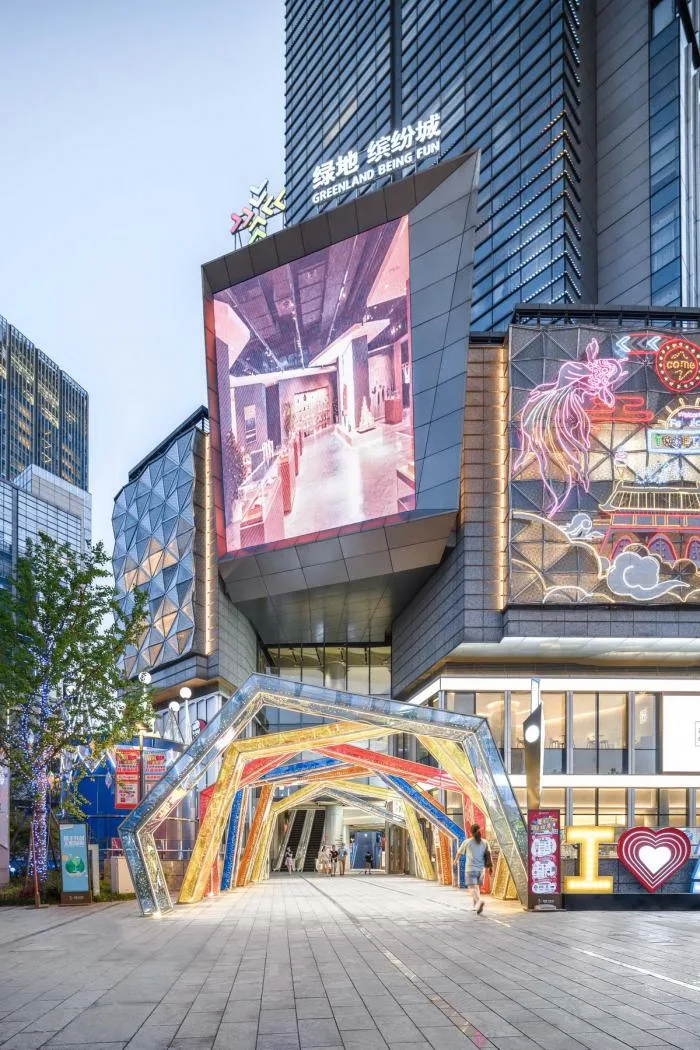
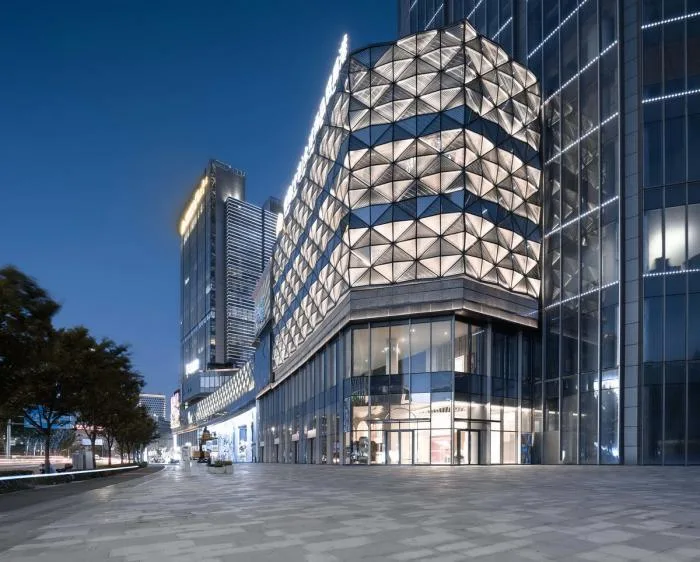
△ First floor commercial nodes, photo by Liu Songkai
Seven sunken commercial plazas connect the four plots, three building groups, and five towers underground. From top to bottom, this network overcomes the constraints of above-ground space.
People flow is guided from subway exits and sunken plazas via escalators in three main courtyards at ground level. Plots 1, 2, and 3 connect through commercial streets, maximizing foot traffic from subway riders heading to the old Bund.
This underground network enhances activity space and convenience, allowing seamless movement between buildings regardless of weather.
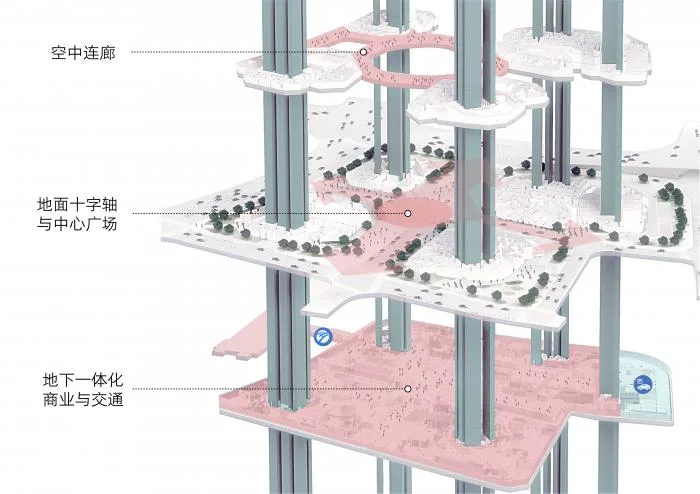
△ Three-dimensional urban space construction
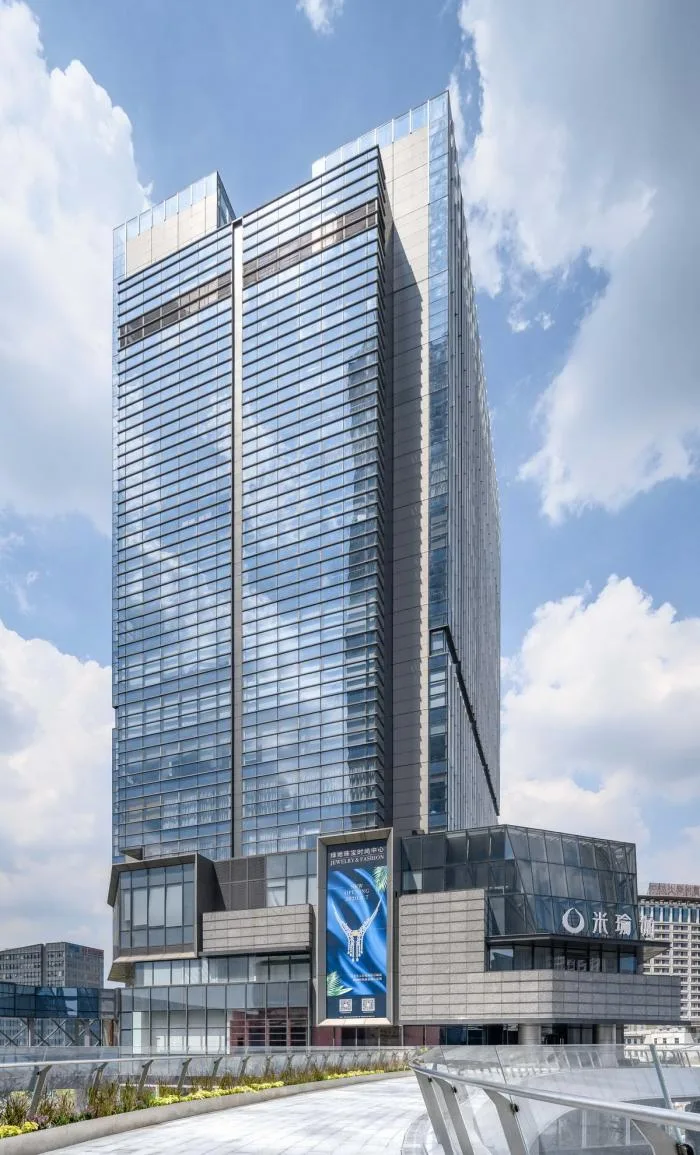
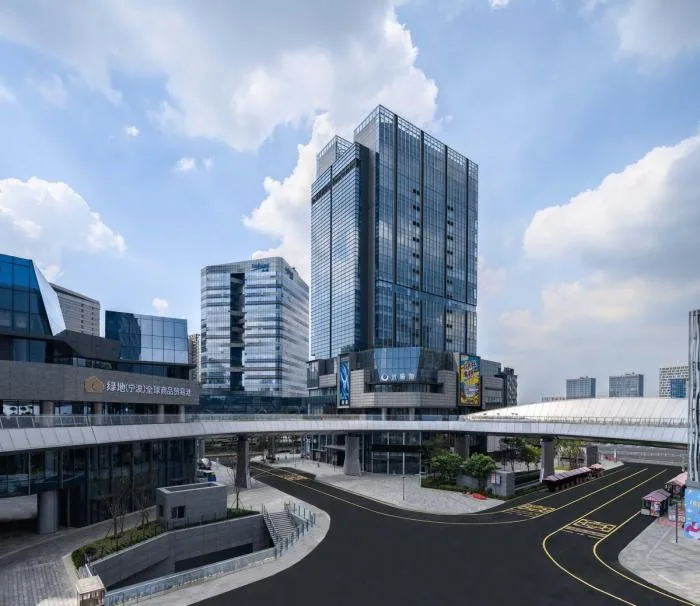
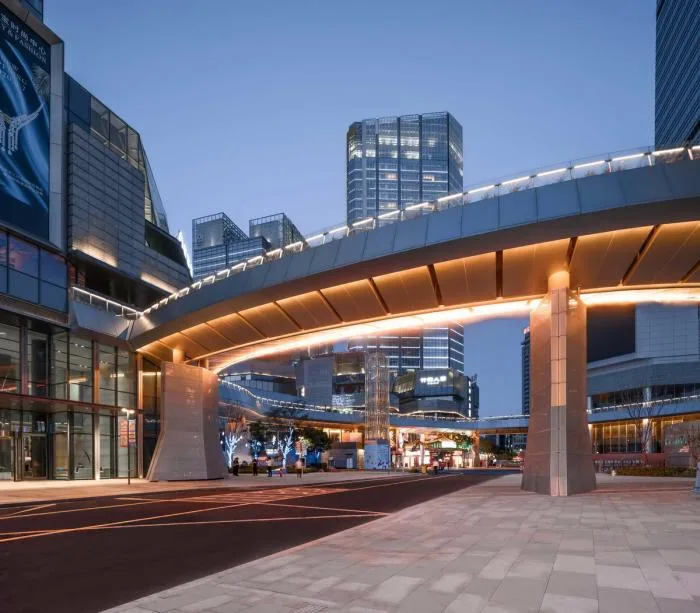
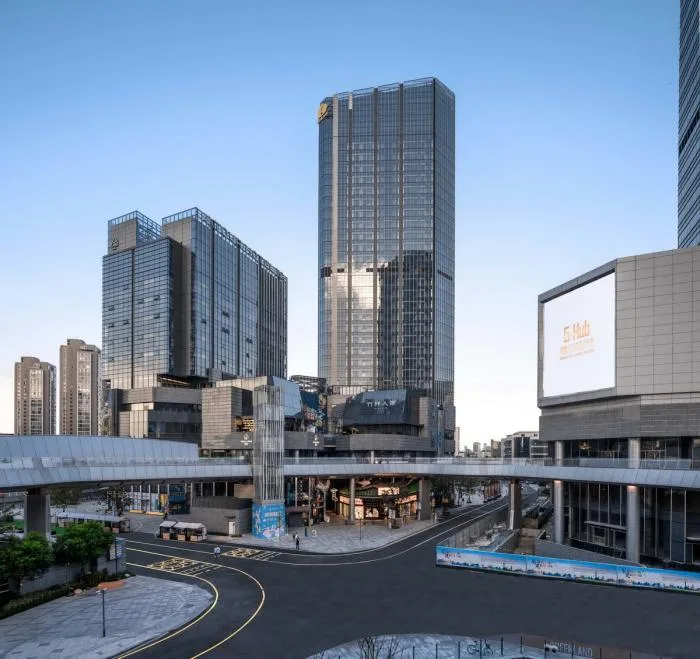
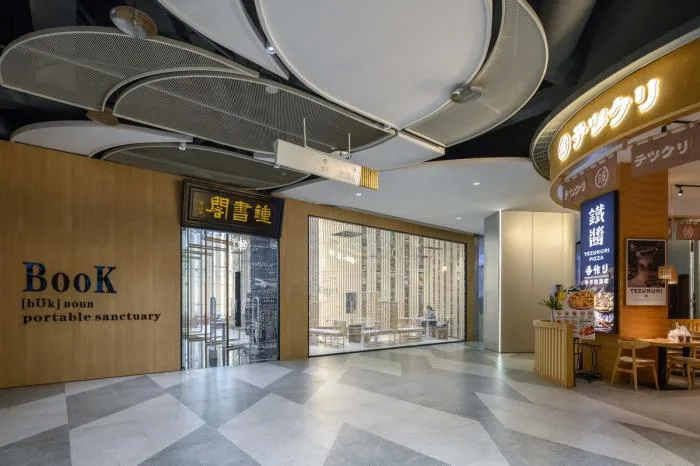
△ Three-dimensional space construction, photography by Liu Songkai
03. Technical Implementation of Urban Landmarks
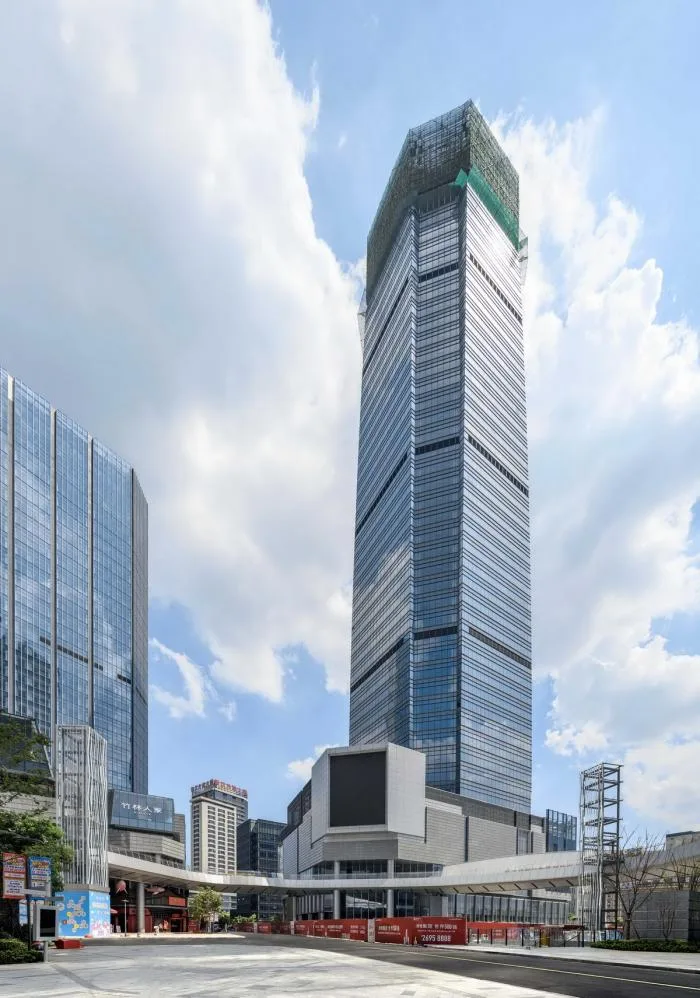
City landmark nearing completion, photo by Liu Songkai
The Greenland Center covers nearly 50,000 square meters of land, with a total construction area exceeding 350,000 square meters. The project faced major challenges ranging from the structural design of super high-rise towers, coordination among numerous subcontractors, unexpected site issues, to managing changes over the extended timeline.
Since construction began in September 2013, Sanyi has cooperated continuously for eight years, addressing design and construction challenges to ensure the project’s smooth progress. Through high-quality design and patient communication, the team has maintained harmony in construction outcomes.
From the outset, San Yi Architecture conducted specialized research on key structural design issues. The super high-rise’s structural design was the top priority, presenting many technical challenges.
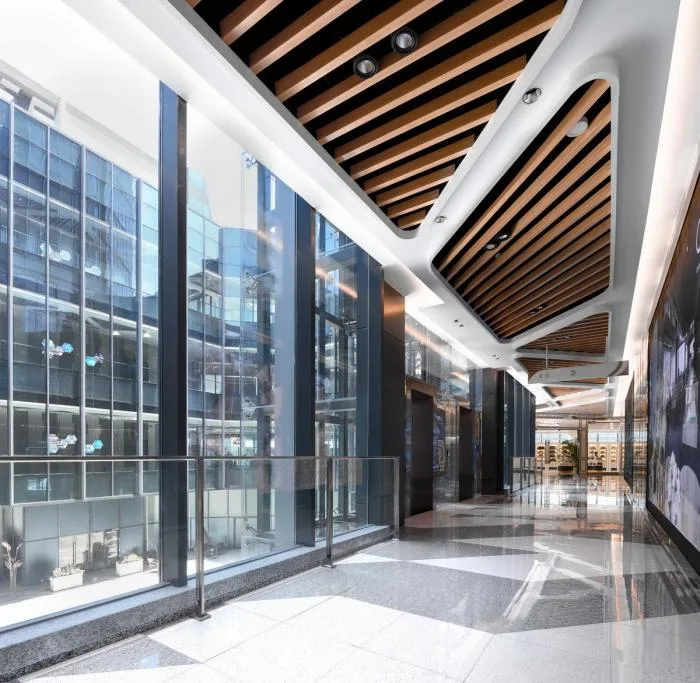
Indoor corridor of Greenland Center, photograph by Liu Songkai
Diagonal Wall Transfer System – “Transplanting Flowers and Trees”
The main tower’s height is significant, and its design vertically segments the building, with the floor plan gradually shrinking at higher levels. This optimizes the tall structure and creates a visual effect that accentuates height. To realize this facade, structural engineers developed a diagonal wall transfer system that overcomes the limitations of traditional structural methods while increasing usable building area.
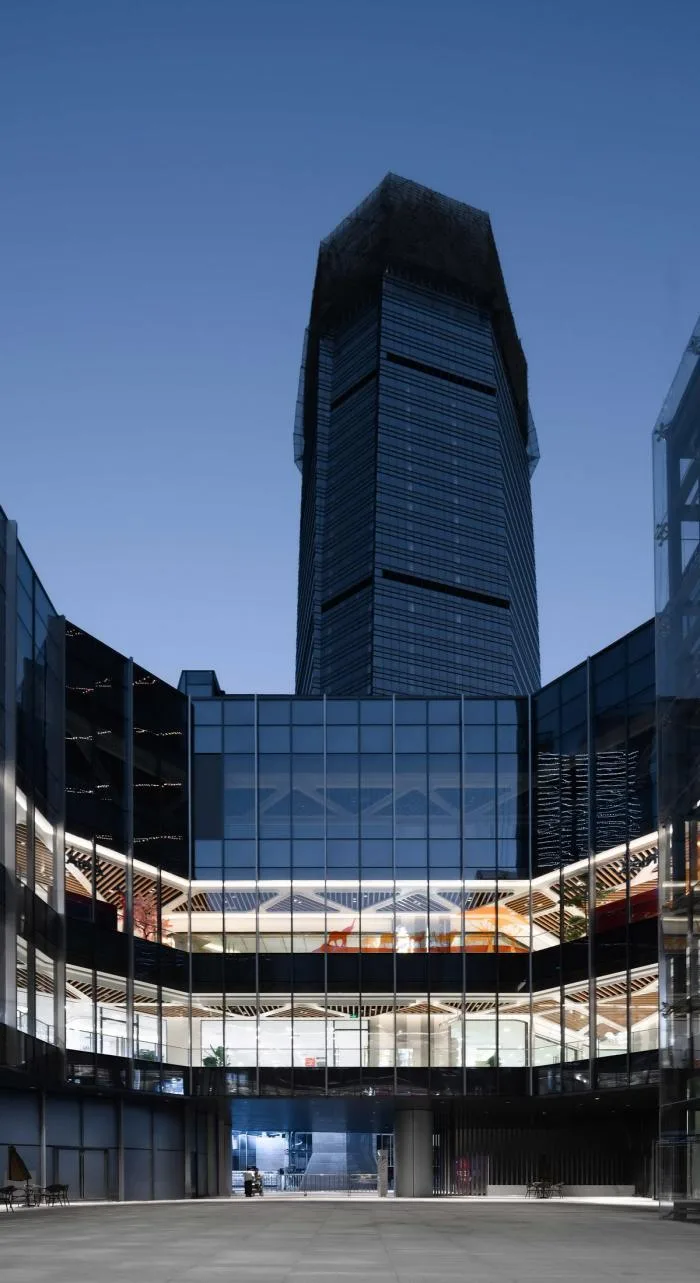
Main tower with vertical segmentation, photo by Liu Songkai
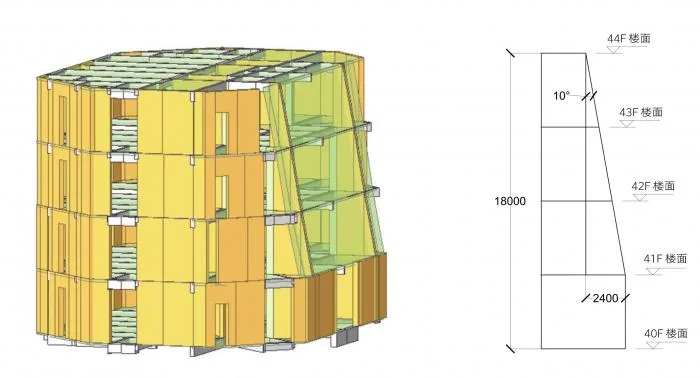
△ Diagonal wall transfer system
Streamlining Complexity – Ring Truss Reinforced Structure
The 240-meter main tower employs a dual lateral-force resistant system: steel reinforced concrete frame, reinforced concrete core tube, and a reinforced layer (ring truss) to counteract wind and seismic forces.
Unlike traditional cantilever and ring truss combinations with reinforced floors, this project features a 4.5-meter-high reinforced floor-ring truss on the 28th floor. The ring truss connects peripheral frame columns circumferentially with steel trusses, enhancing bending resistance, axial compression capacity, and lateral stiffness.
This innovation improves displacement, strength, stability, and ductility, saving approximately 25 days of construction time. The ring truss, initially a coordinating element, became a decisive structural component.
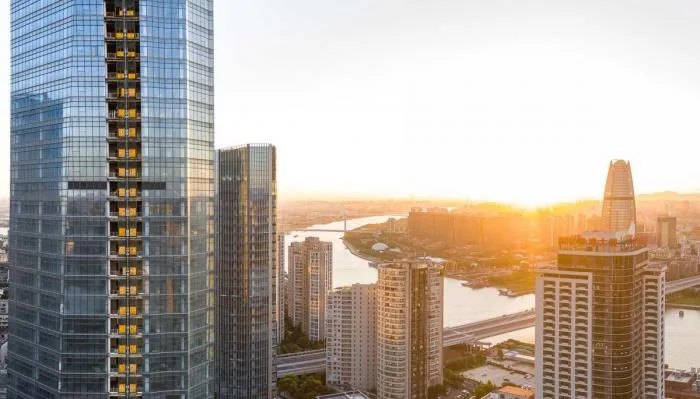
Overlooking Ningbo’s main tower, photo by Liu Songkai
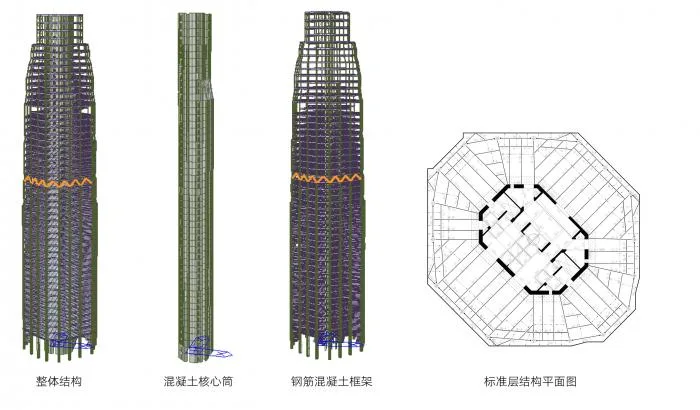
△ Ring truss
Dynamic Damping – Tuned Liquid Dampers
In an innovative approach to wind and earthquake resistance, the fire water tank on the roof of Building 5 was transformed into a tuned liquid damper (TLD). This adaptation saved nearly zero civil engineering costs and millions in overall expenses.
This design has earned a utility model patent and an invention patent application.
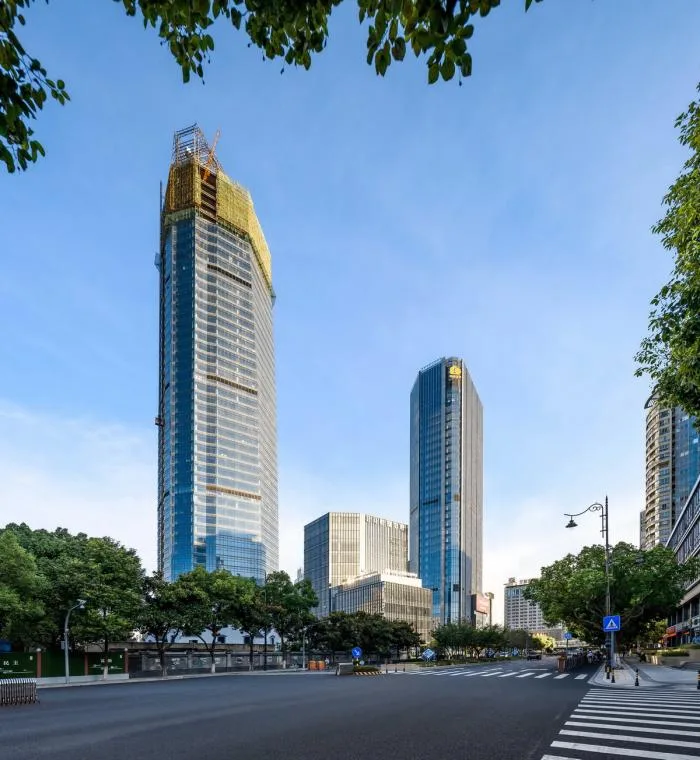
Rising urban skyscrapers, photography by Liu Songkai
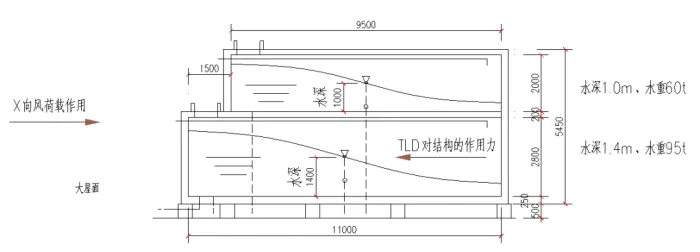
Multi-layer TLD water tank fire protection structure
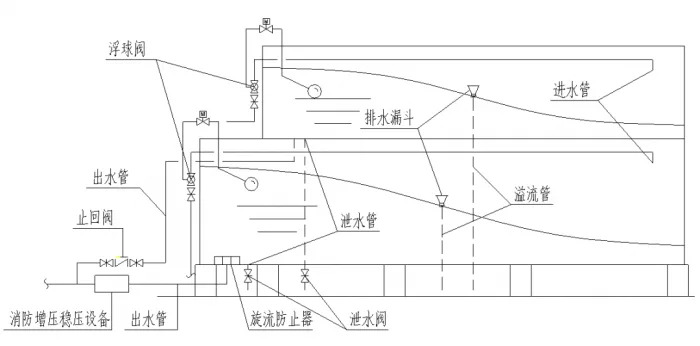
△ Multi-layer TLD water tank fire water supply structure
Integrated BIM Collaboration
The Greenland Center’s complex spatial design posed significant challenges across multiple disciplines. To ensure design intent was realized and controlled, Sanyi employed BIM technology for comprehensive checks on building spatial coordination, structural beam and slab heights, equipment pipelines, and installation clearances.
Each team provided timely feedback based on clash detection, enhancing design and construction quality and efficiency. Collaboration extended to curtain wall facades, lighting, and tower crown steel structure design, with iterative coordination for facade effects, lighting analysis, and technical drawing refinement.
On-site construction guidance was also provided to ensure seamless implementation.
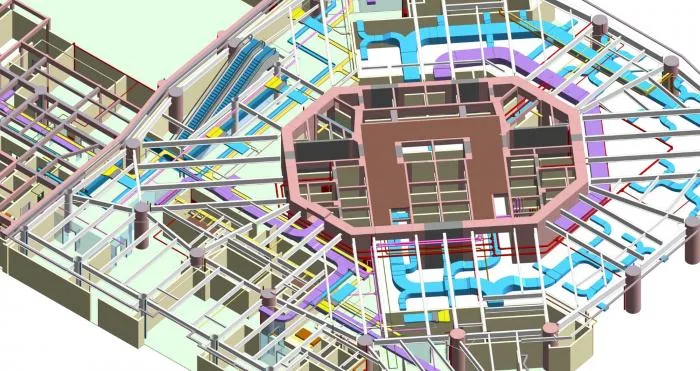
Using BIM to enhance design and construction quality and efficiency
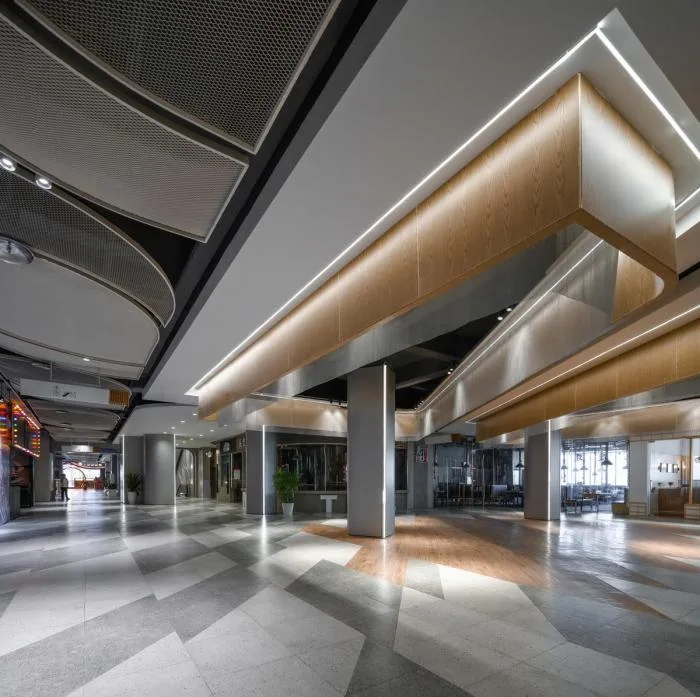
Interior corner of the Greenland Center, photo by Liu Songkai
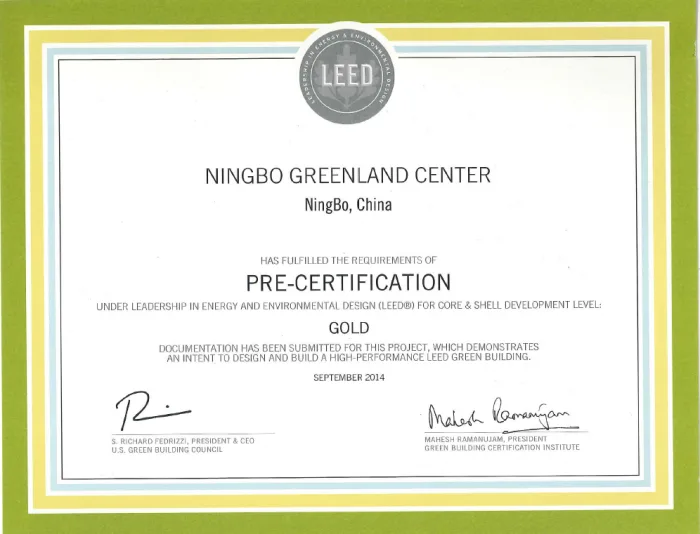
The Ningbo Greenland Center is a key development within Ningbo City’s “Three Rivers and Six Banks” and “Two Rivers and North Banks” initiatives. It represents the 30th Greenland Center globally and has earned LEED Gold certification in the United States.
By organizing contextual networks, creating three-dimensional urban spaces, and implementing advanced technologies, the project strengthens the connection between urban space and human experience, establishing the Greenland Center as a city landmark.
This approach balances building value with construction cost, promoting sustainable urban development and offering innovative ideas for future super high-rise construction.
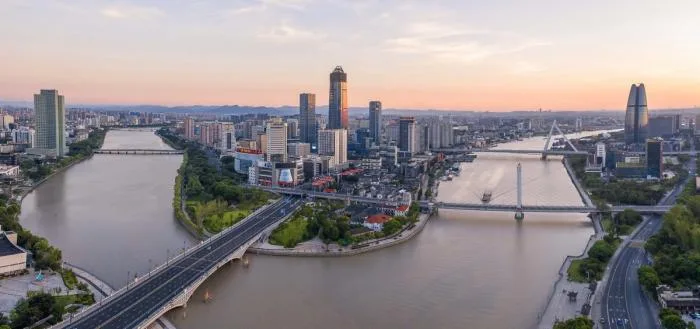
This monumental structure at the mouth of the Three Rivers shapes the evolving skyline of Yongcheng.
Project Information
Project Name: Ningbo Greenland Center Project (Taodu Road Plots 1–4)
Location: Jiangbei District, Ningbo City
Site Area: 36,752 square meters
Building Area: Plots 1 & 3: 152,572.12 square meters; Plots 2 & 4: 231,673.29 square meters
Construction Timeline: Plots 1 & 3: May 2019; Plots 2 & 4: Under construction
Developer: Ningbo Greenland Real Estate Co., Ltd
Conceptual Design: Japan Design Co., Ltd
Architecture / Detailing / Structural / MEP Design: Shanghai Sanyi Architectural Design Co., Ltd
Project Manager: Zheng Yan
Project Team:
- Architecture: Jiao Feng, Ding Beili, Peng Donghua, Li Jihong, Huang Lingrong, Du Yao, Yan Hongying, Hu Runyu
- Structure: Ha Minqiang, Chen Siqiang, Lu Chenying, Li Xuetao, Peng Ning
- MEP: Xu Weidong, Feng Juanjuan, Ding Hongmei, Yang Hui, Lan Wenli, Zhu Huimin, Dai Dan, Jiang Li, Sun Fu
- Technical Support: Wang Xiaohong, Zhao Bin, Chen Ying, Wang Weiqing, Chen Jianxin
- Drawing Coordination: Zuo Yongping, Li Zhong, Zhang Keran
Landscape Design: Shanghai Naqian Landscape Environment Design Co., Ltd
Civil Defense Unit: Ningbo Civil Defense Architectural Design Branch, China Construction Third Engineering Bureau Second Construction Engineering Responsibility Company
Construction Contractor: Beijing Construction Engineering Group Co., Ltd
Curtain Wall Contractors: Shanghai Banpeng Architectural Design Consulting Co., Ltd (Plots 1 & 3); Shanghai Xumilin Curtain Wall Co., Ltd (Plots 2 & 4)
Lighting Design: Shanghai Fusi Lighting Design Co., Ltd
Intelligent Systems: SITLINKUBER (Shanghai) Architectural Engineering Design Consulting Co., Ltd
Architectural Photography: Liu Songkai













Must log in before commenting!
Sign Up