
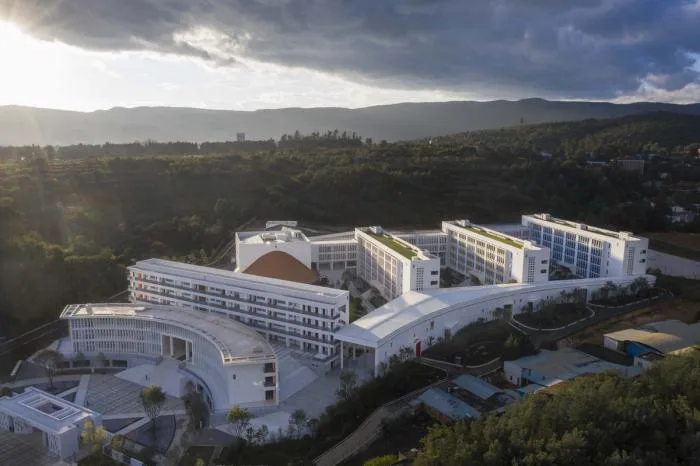
Southeast Aerial View: Existing Buildings
Project Background
This project is situated in the northern part of Panlong District, Kunming City, Yunnan Province, one of the city’s fastest-growing areas. In recent years, Panlong District has prioritized the allocation of high-quality educational resources to attract population migration and foster community development. Within this context, the Yunnan Normal University Experimental Middle School (Kunming Lake Campus) was established.
The local government aims to introduce prestigious school brands, address educational gaps, and promote balanced regional development through this project. The campus planning is being implemented in phases; the first phase has been completed and is operational, currently enrolling over 1,200 students.
The project features complex land use: the first phase is a junior high school campus covering 4.61 hectares, shaped like a “boot.” Adjacent to the west is the second phase, a high school campus covering 9.77 hectares and shaped like a “wrench.” The site has a total vertical height difference of 60 meters, with an average slope of 8%. Specifically, the first phase slopes from north to south and west to east, with a height difference of about 20 meters. These challenging site conditions impacted various design aspects, including building functionality, spatial layout, circulation, transportation, and construction logistics.
As a new benchmark for local campus construction, the project demands strict functional and capacity standards. Besides accommodating 72 junior high school classes, the first phase includes a 300-seat music hall, campus library, and numerous specialized classrooms to support the school orchestra and other activities. Facilities include a robotics lab, makerspace, 3D printing room, film and animation studio, innovative fruit wine room, and recording studio.
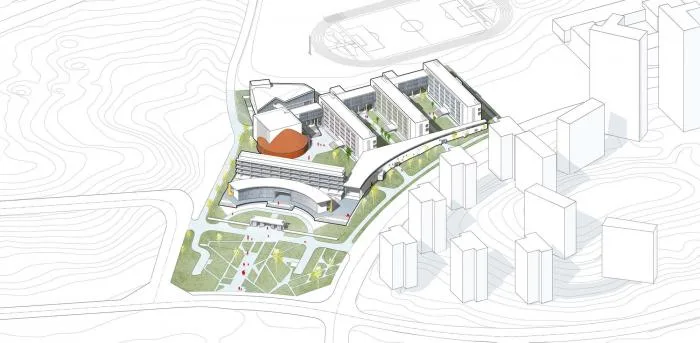
△ Site Axonometric View
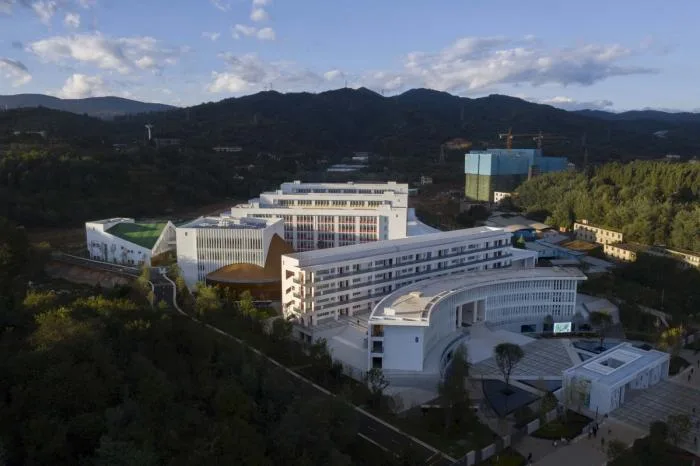
Southwest Campus Aerial View: Existing Buildings
General Layout
The main objective of the overall layout is to leverage the site’s shape and elevation differences to optimize sunlight and ventilation, creating a high-quality campus environment that supports high-capacity functions. The campus employs an intensive courtyard layout, integrating all facilities for the 72 junior high school classes within the first phase.
Additional features include underground parking garages for teachers integrated into urban green spaces, and sports facilities located on the second phase to meet junior high school needs.
Specifically, the south side of Phase I houses the comprehensive building (administrative and laboratory spaces), the east side contains the teaching building and school history exhibition gallery, the west side features the cafeteria, and the central area accommodates the teacher’s offices and art building. These areas are connected through multi-level circulation pathways, creating a campus with clear functional zoning and rich three-dimensional spatial qualities within a compact footprint.
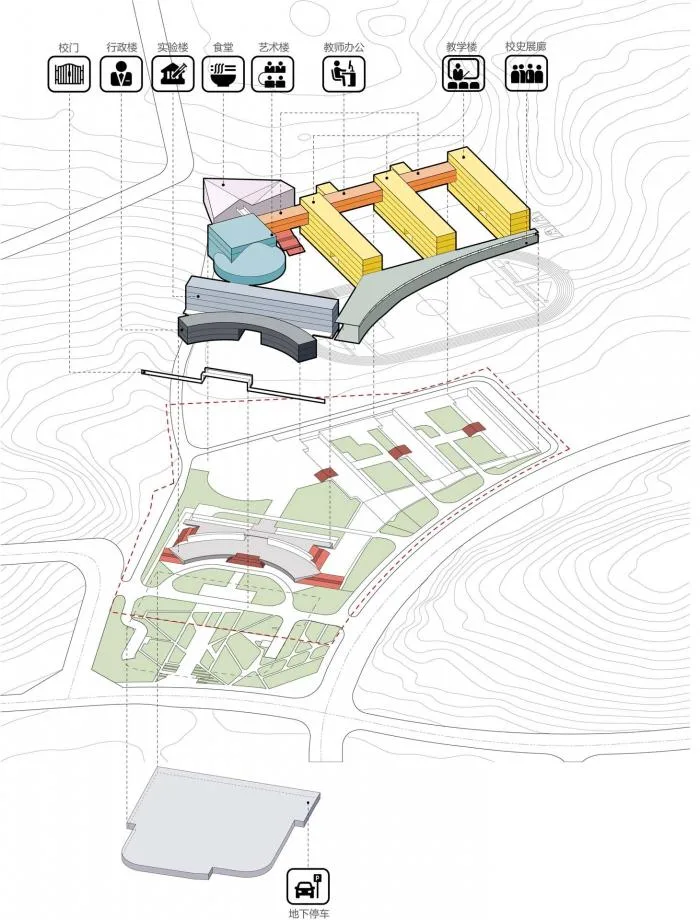
△ Functional Analysis
Design and Philosophy
1. Collaborative Planning and Design
Unlike the conventional “plan first, build later” approach, the design team was involved early in the process, proposing the integration of public green spaces within the development area. This initiative helped consolidate regulatory planning by unifying scattered green spaces on the south side of the project site. These urban green areas were incorporated into the campus design, connecting organically with the main entrance and the motor vehicle garage layout.
This arrangement creates an almost grand front plaza for the school, effectively alleviating urban traffic congestion during peak hours and providing a ceremonial drop-off and pick-up zone for parents.
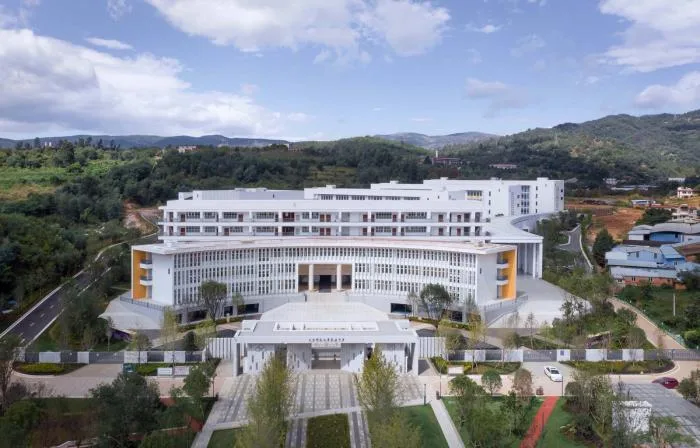
△ Campus Entrance Aerial View: Existing Buildings
2. Site-Adaptive Campus Space Design
The design fully utilizes the site’s unique shape, orientation, and elevation differences. The first phase features a 20-meter height difference east-to-west with an average slope of 10%, and a 10-meter north-to-south height difference with an average slope of 4%. These conditions inspired a distinctive campus layout employing mountain-inspired design techniques such as terracing, elevated corridors, continuous pathways, and semi-underground podiums.
By adapting to the terrain, the design resolves elevation challenges, optimizes sunlight and ventilation, and minimizes urban road noise impact from the east side. The result is a campus that follows the natural mountain contours, transforming difficult site conditions into a dynamic, “three-dimensional” spatial experience unfolding through a sequence of courtyards.
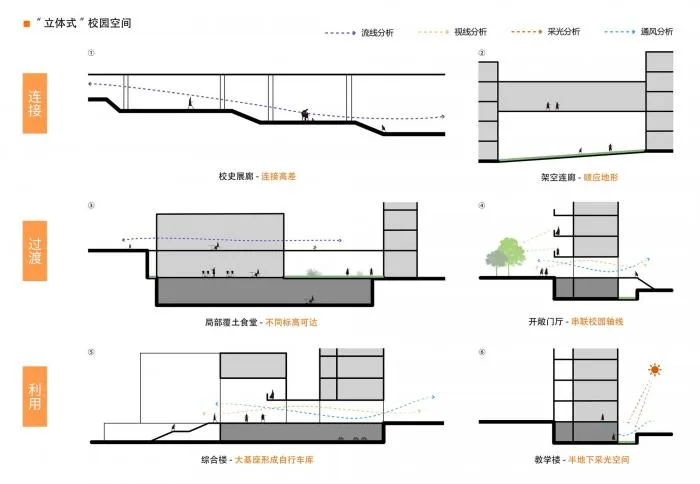
△ “Three-Dimensional” Campus Space
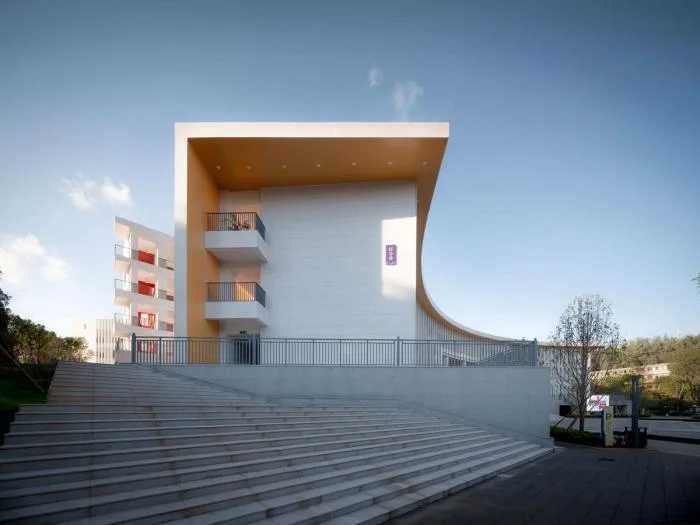
△ Photograph from the West Side of the Comprehensive Building: Existing Structure
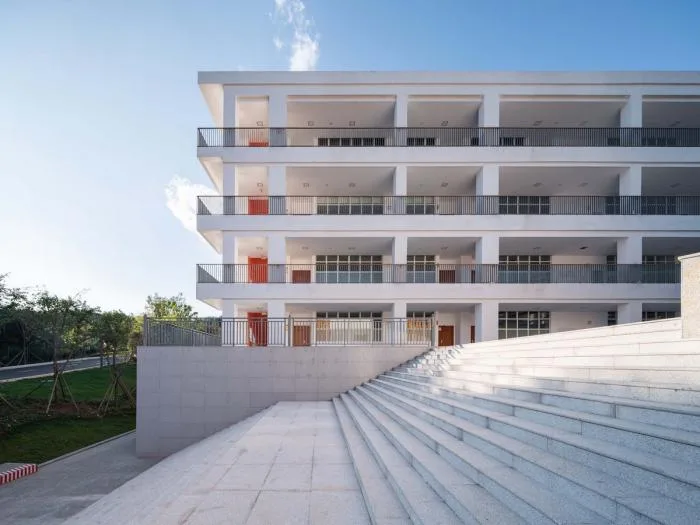
Partial View of the West Side of the Comprehensive Building: Existing Structure
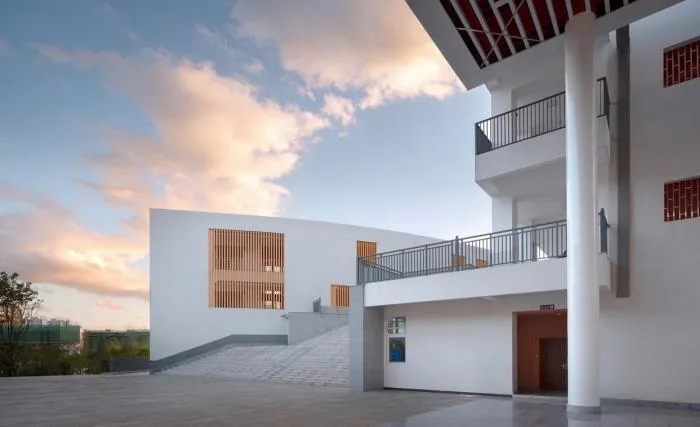
Partial View of the East Side of the Comprehensive Building: Existing Structure
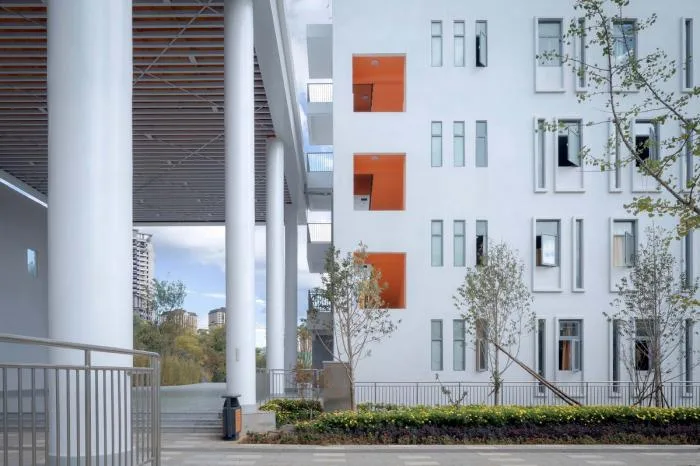
Partial View of the North Side of the Comprehensive Building: Existing Structure
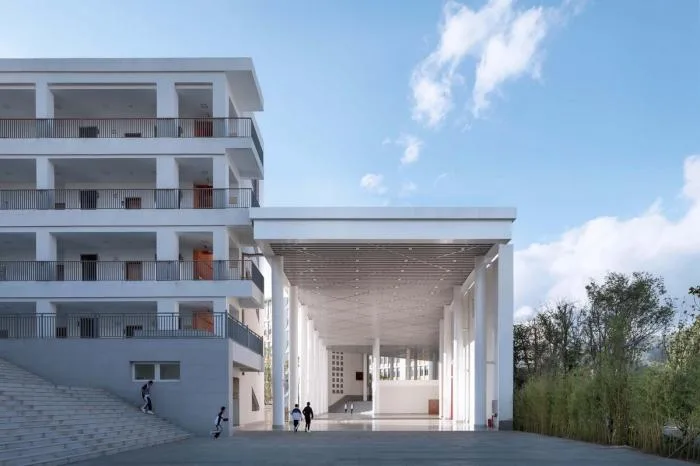
△ Entrance to the School History Gallery: Existing Buildings
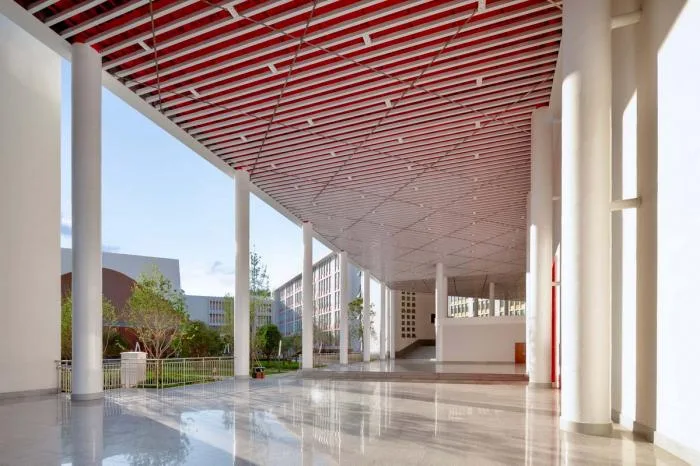
△ School History Gallery: Existing Buildings
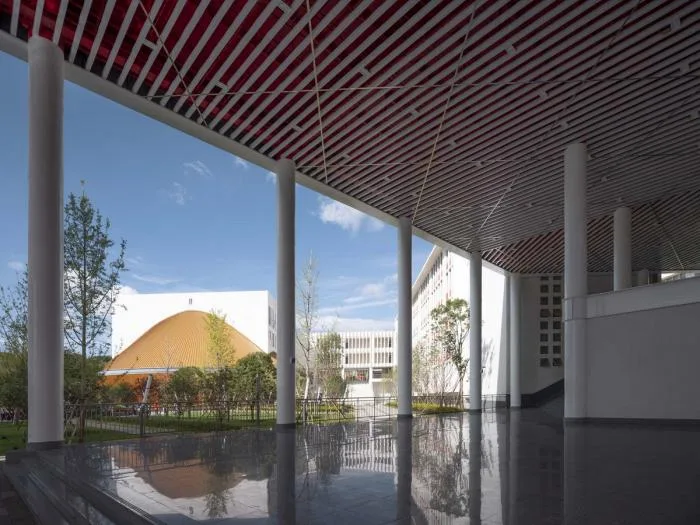
△ View of the Art Building from the School History Gallery: Existing Architecture
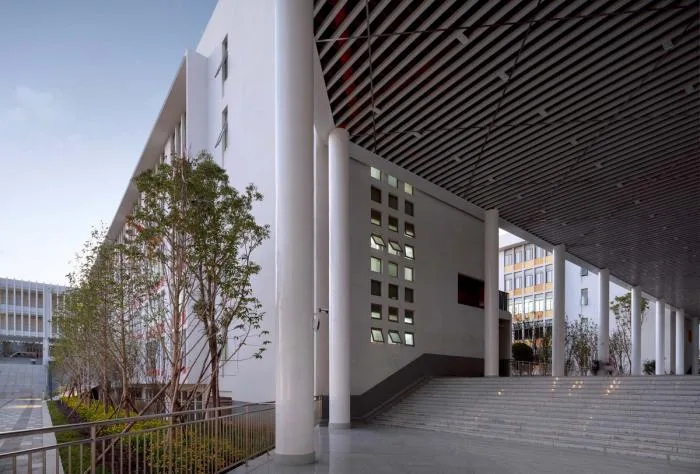
△ School History Gallery and Teaching Building: Existing Architecture
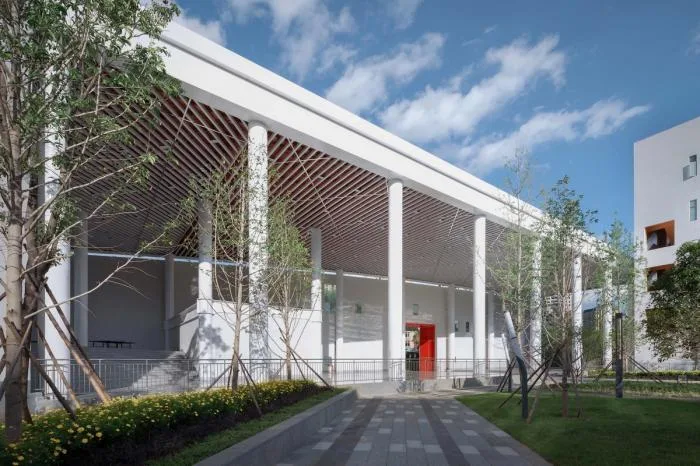
△ View of the School History Gallery from the West: Existing Buildings
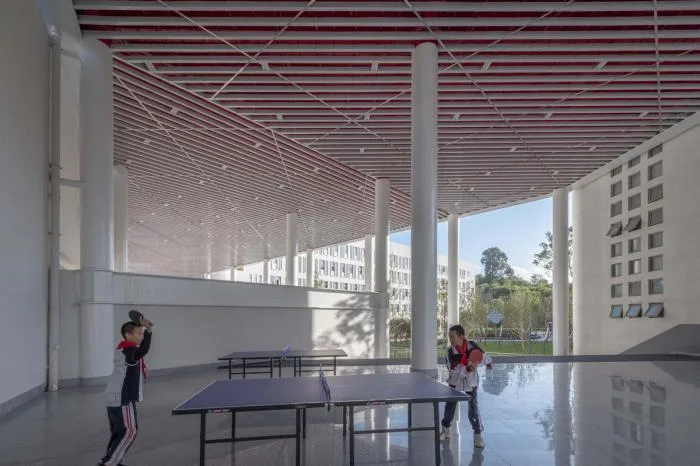
Student Activities in the School History Gallery: Existing Architecture
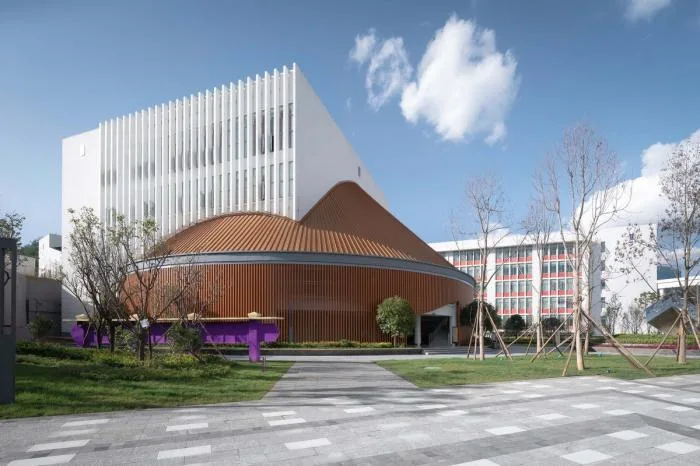
△ Art Building: Existing Architecture
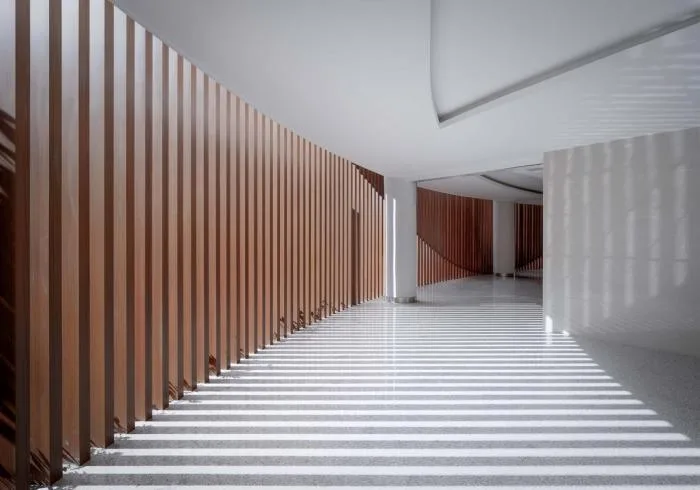
△ Lounge Area in the Art Building: Existing Architecture
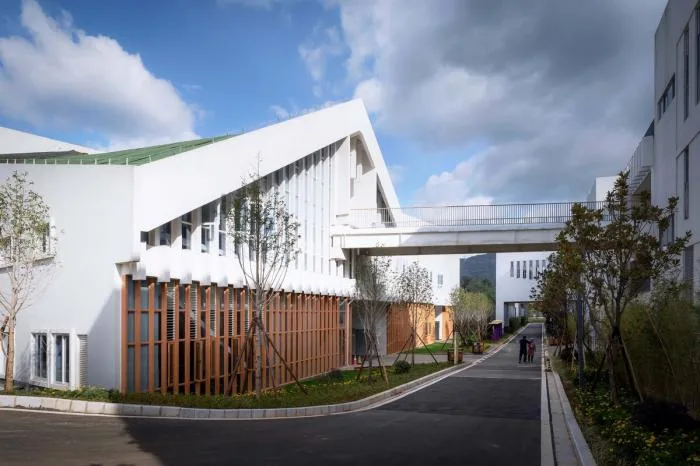
△ Cafeteria: Existing Buildings
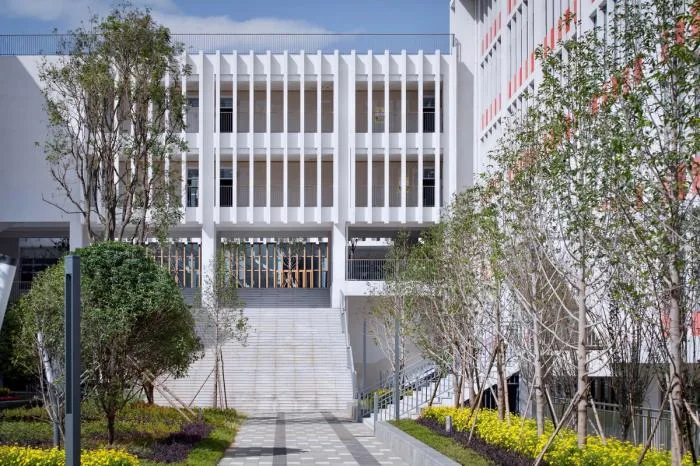
△ Teaching Building Gallery: Existing Architecture
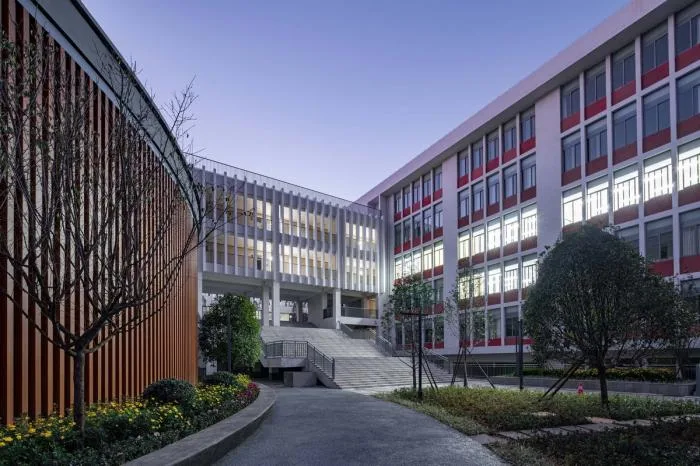
△ Night View of Teaching Building Corridor: Existing Buildings
3. A Grand Yet Harmonious Public Campus Space
Kunming, known as the “Spring City,” inspired a design that respects the local climate and supports diverse campus activities for both teachers and students. The school features ample outdoor and semi-outdoor spaces, including a formal south campus plaza, various courtyards, lively corridors, and numerous inviting bridges, doorways, steps, and platforms, creating a rich public campus environment.
Since opening, the campus has hosted robotics competitions, technology festivals, reading festivals, art festivals, and other events, greatly enriching students’ extracurricular experiences and providing a supportive environment for work, study, and interaction among teachers and students.
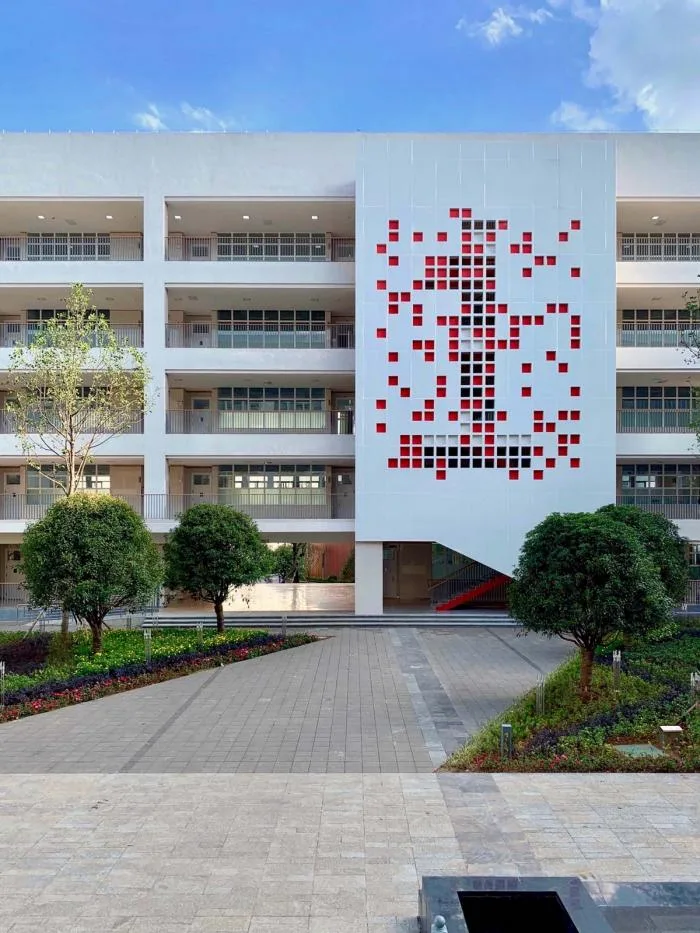
Photography on the north side of the Teaching Building △: Guo Fan
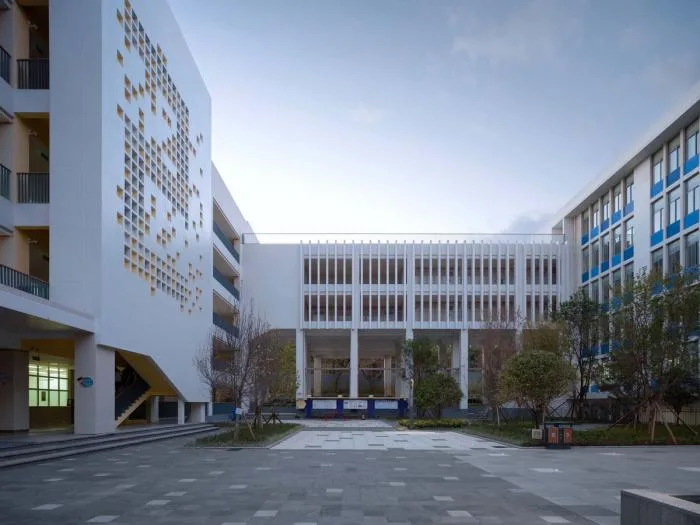
△ Courtyard: Existing Buildings
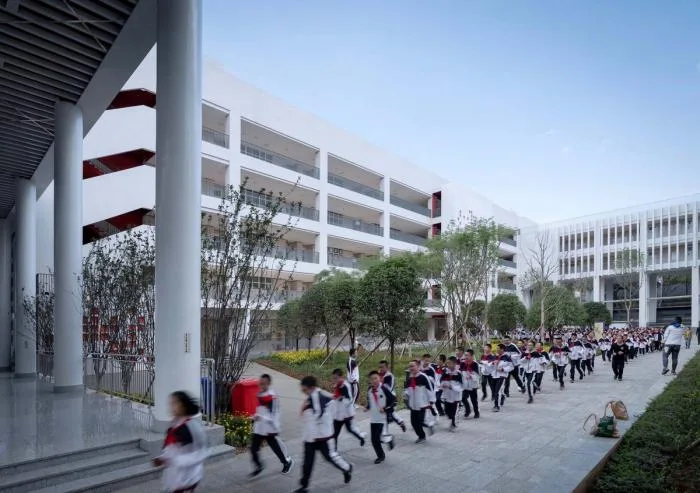
△ Courtyard: Existing Buildings
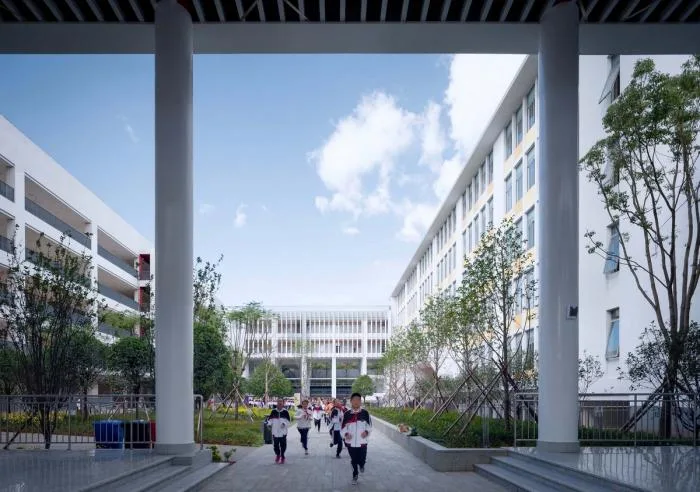
△ View of the Teaching Building Courtyard from the School History Gallery: Existing Architecture
Conclusion
The design of Yunnan Normal University Experimental Middle School (Kunming Lake Campus) addresses the needs of the city and community, overcoming challenging site conditions to create an enriching environment for children’s growth. The high-quality campus spaces and buildings have attracted local residents and the wider urban public, establishing iconic architectural images that have earned positive recognition.
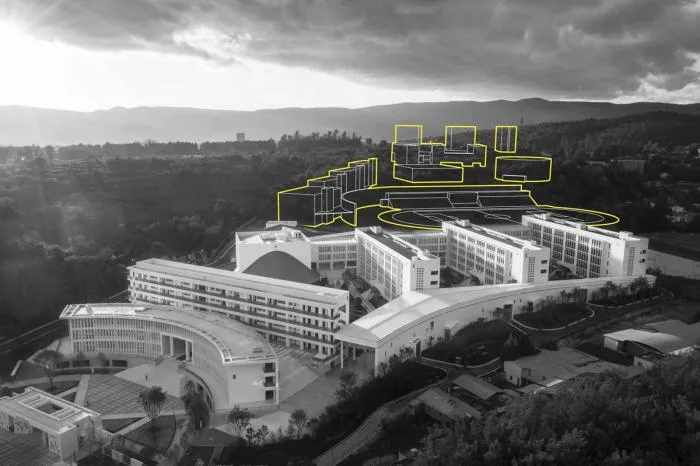
△ Scene Integration (The outlined box indicates the unfinished Phase II building)
Project Information
Project Type: Junior and Senior High School Campus
Location: Kunming, China
Designer: School of Architecture, Tsinghua University & Tsinghua University Institute of Architectural Design and Research
Area: 61,267 m²
Year: 2019
Photographers: There are buildings, Cong Guo
Manufacturers: Toshiba, Quantong, Xingfa, Taizhou Hongfa, Dulux, Hengjie, OPPO, Yonggu Weihua, Jiefu, Hikvision, Moganshan, Siemens, Fushuo, Marco Polo, Longpai
Lead Architects: Lu Xiangdong, Huo Chunlong, Guo Cong
Design Team: Lu Xiangdong, Huo Chunlong, Guo Cong, Wang Lili, Sun Zhongxuan, Zhang Wenjuan, Liu Xiao, Gong Shiyu, Gao Gejin, Hao Xiaoxu, Liu Xiang, Cui Yanhui, Li Bing, Zhang Hongxia, Li Yuming (intern), Yao Rangyuan (intern)
Construction: Yunnan Chengtou Zhonghe Construction Group Co., Ltd
Partner: Kunming Official Building Design Co., Ltd
Principal: Yunnan Chengtou Longrui Real Estate Development Co., Ltd












Must log in before commenting!
Sign Up