
Have you ever witnessed the social dance craze that captured the hearts of trendy uncles and aunts during the 1980s and 1990s?
Ballroom dancing, a cherished memory of a generation’s youth, was once celebrated nationwide before fading away and eventually resurfacing in parks and public squares. Its ebb and flow reflect the leisure lifestyles and living standards of young people three decades ago. The once-thriving social dance halls, now weathered by time, have transformed from vibrant hubs into neglected, shadowy corners.
Located near Beijing’s West Second Ring Road, there was a venue famously known as the “last social dance hall in the Second Ring Road,” which is now the subject of a renovation project.
01
Venue and Strategy
The project site is situated within the Huaxing Building, an office complex on Guangyi Street in Beijing’s Xicheng District. Previously, one floor of this building functioned as a ballroom dance hall, while the basement served as a small hotel. As part of the city’s urban space realignment, grassroots government authorities have leased and renovated these spaces with the goal of transforming them into cultural and leisure hubs for the local community.
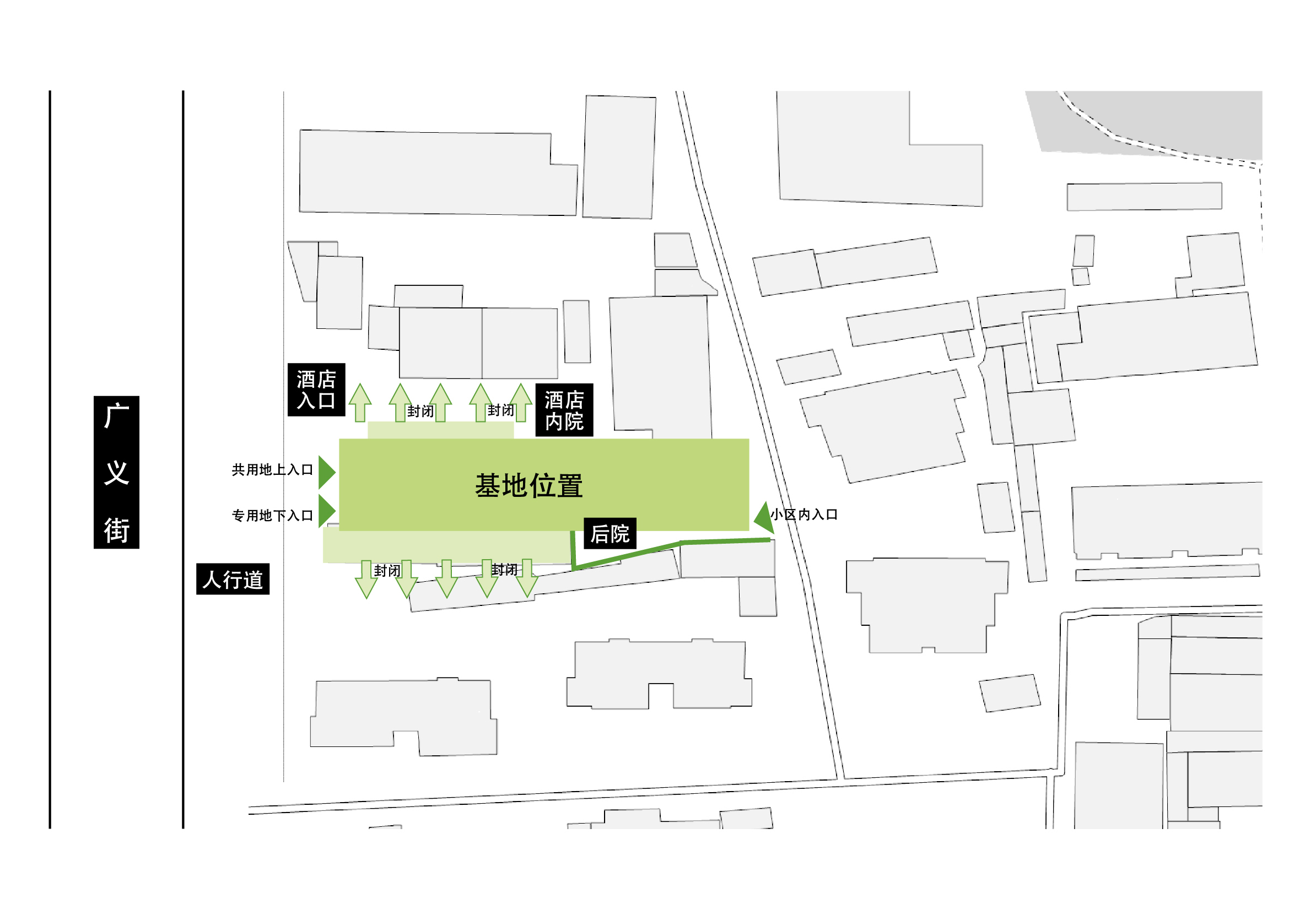
△ Base analysis
Upon removing the original interior finishes, the exposed structural elements revealed challenges for renovation: a weak connection between the upper and lower floors, generous ceiling heights on the ground floor, and low clearance in the basement due to bulky beams. These factors complicated the division and functional use of the space.
The primary design challenge was how to break from traditional layouts and create interconnected, flexible community service areas across both levels within these spatial constraints.
Guided by functional requirements from community operators and resident interviews, the design team identified twelve distinct “spatial business cards” to address diverse community needs and foster a shared cultural service space.
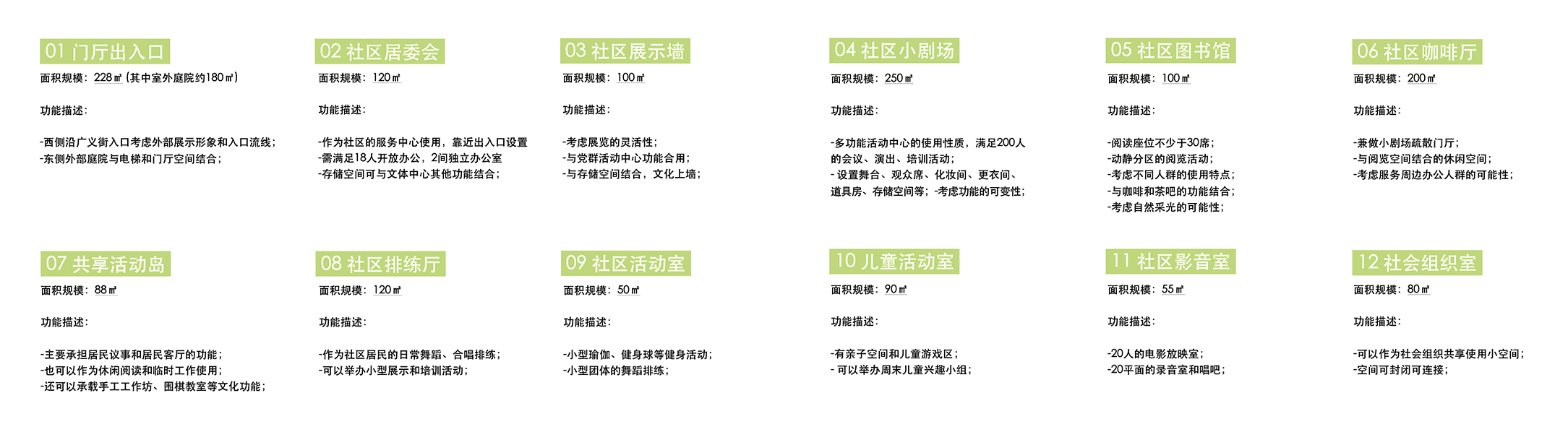
12 types of spatial business cards
The design integrates functional requirements with the building’s architectural features to create a layered spatial layout across the basement and ground floor.
The first floor is dedicated to community cultural and leisure activities, requiring open and spacious areas. Meanwhile, the basement functions as a community service support unit with less spatial demand. To organize these functions, the design employs “embedded geometry” and “continuous roof implantation” strategies.
A specially designed evacuation staircase connects the two levels, enabling visual and chromatic continuity between the seemingly separate floors, while complementing one another in scale and use.
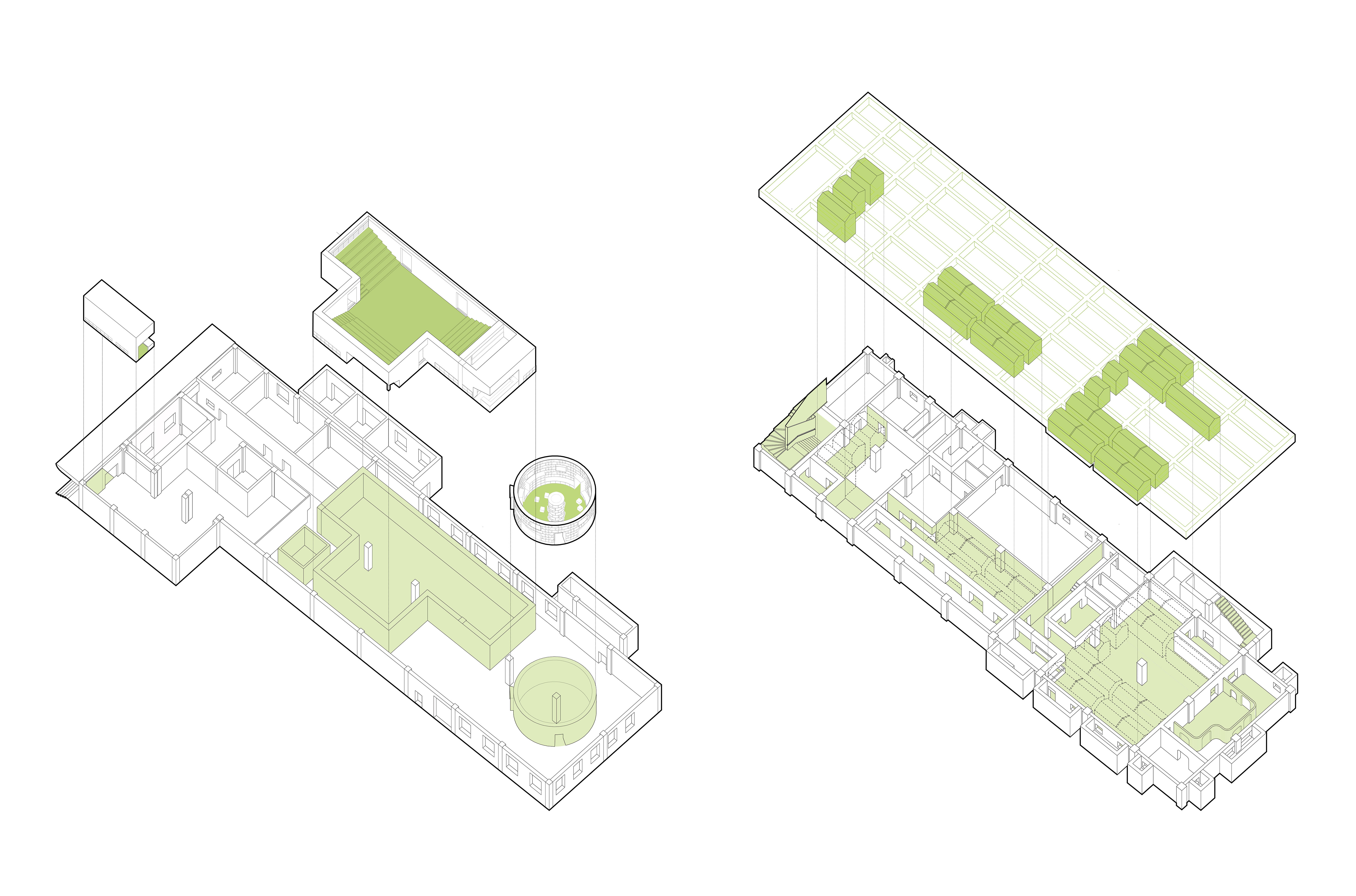
△ Design Concept
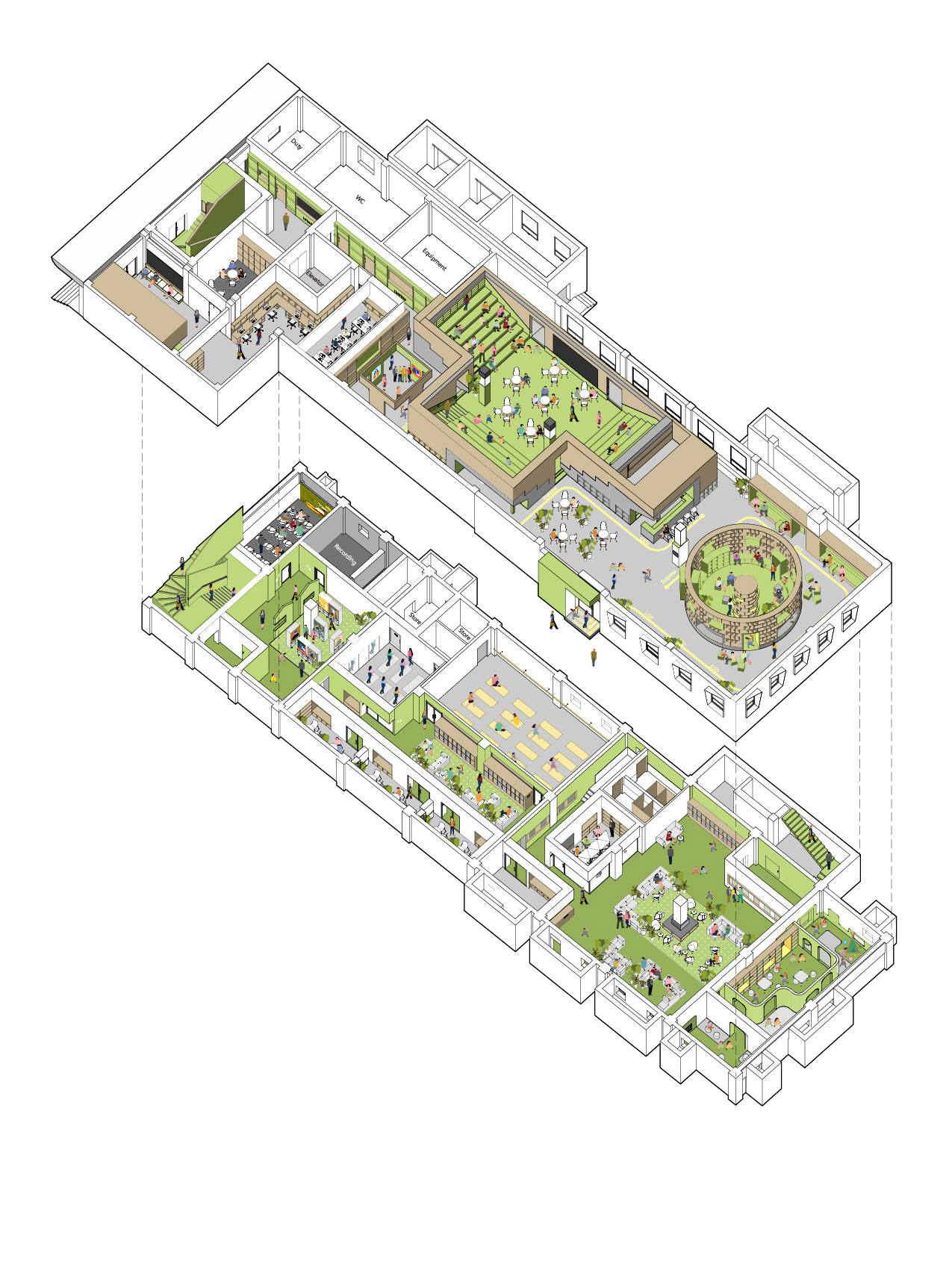
△ Axonometric diagram
02
Community Cultural and Leisure Space
The building’s first floor is designed as a vibrant community cultural and leisure area, emphasizing large, flexible open spaces. The concept of “embedding geometry” was adopted, introducing three distinct geometric volumes—a T-shaped form, a cylinder, and a rectangular prism—integrated into the structure. These house the community theater, book tower, and neighborhood committee reception area respectively.
The remaining open spaces around these volumes can be adapted for reading, relaxation, and exhibitions as needed.
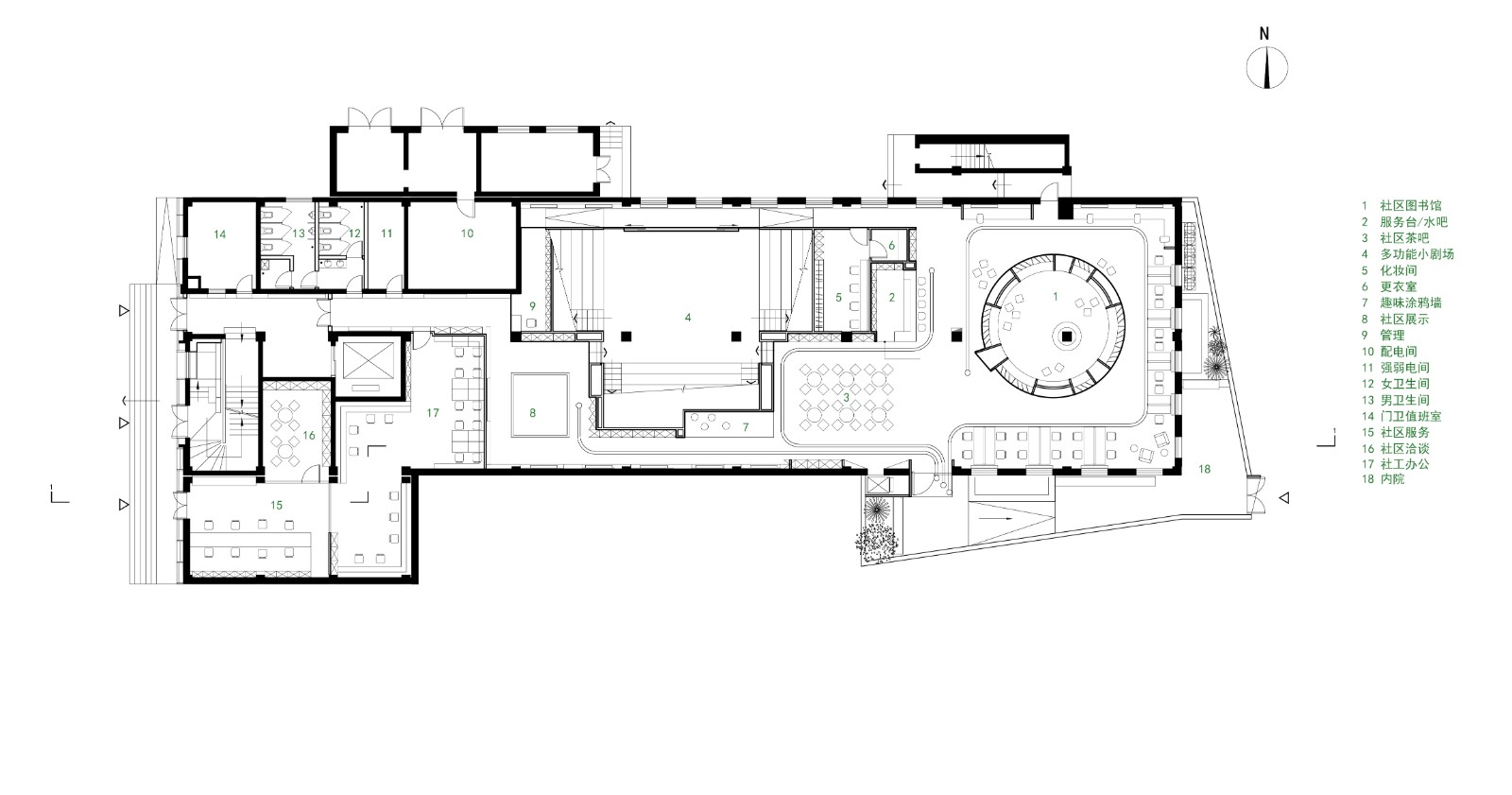
△ First floor plan

△ First floor spatial axonometric view
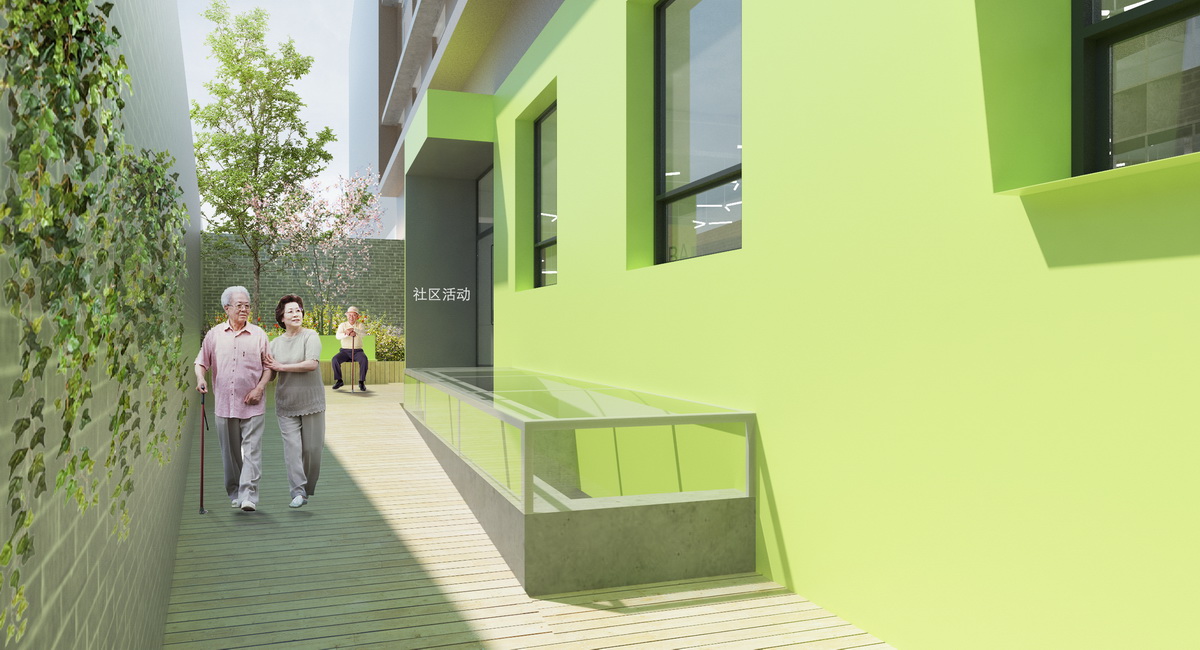
△ Courtyard
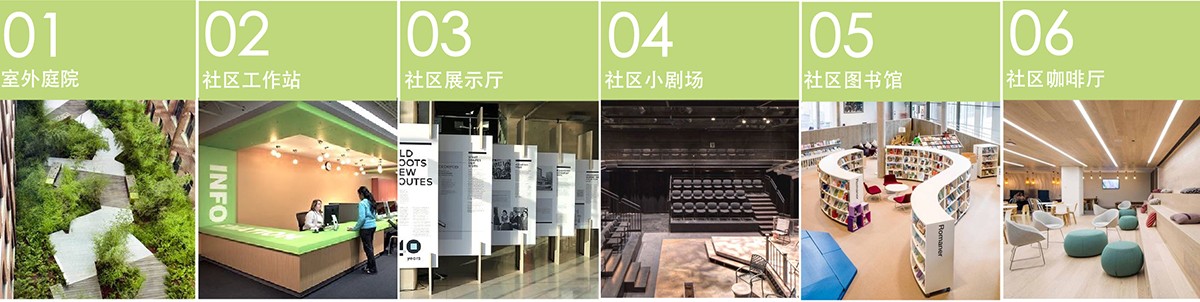
12 types of spatial business cards
1. Community Theater
The community theater requires the largest area in this renovation. Traditional theater spaces demand wide, unobstructed spans that the existing structure cannot provide.
Inspired by drama theaters, a “T-shaped” layout was designed using the column grid, accommodating flexible seating arrangements.
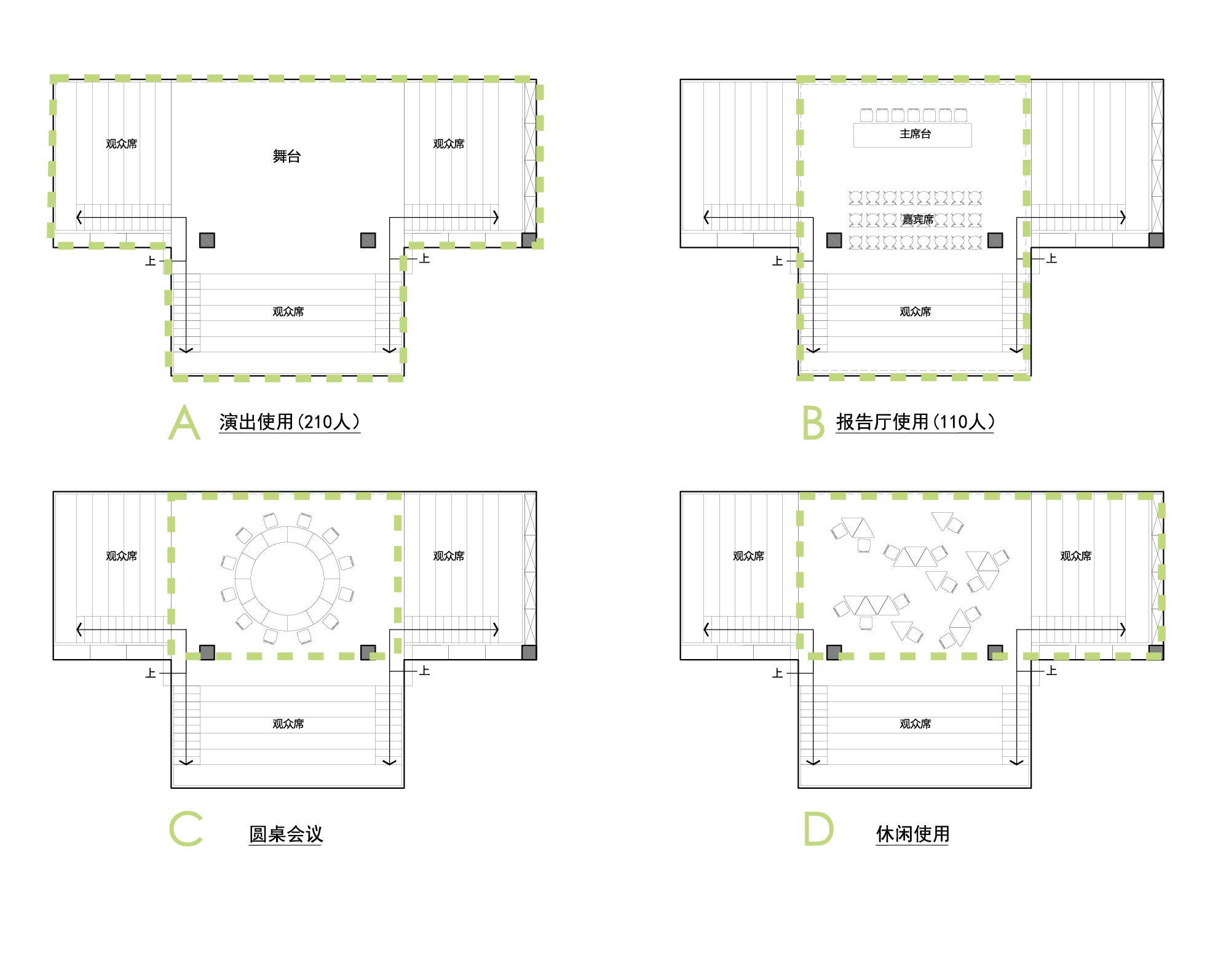
Analysis of Seating Arrangements
The stage is surrounded by three seating areas, breaking away from the traditional front-facing auditorium setup to create diverse configurations tailored to different needs.
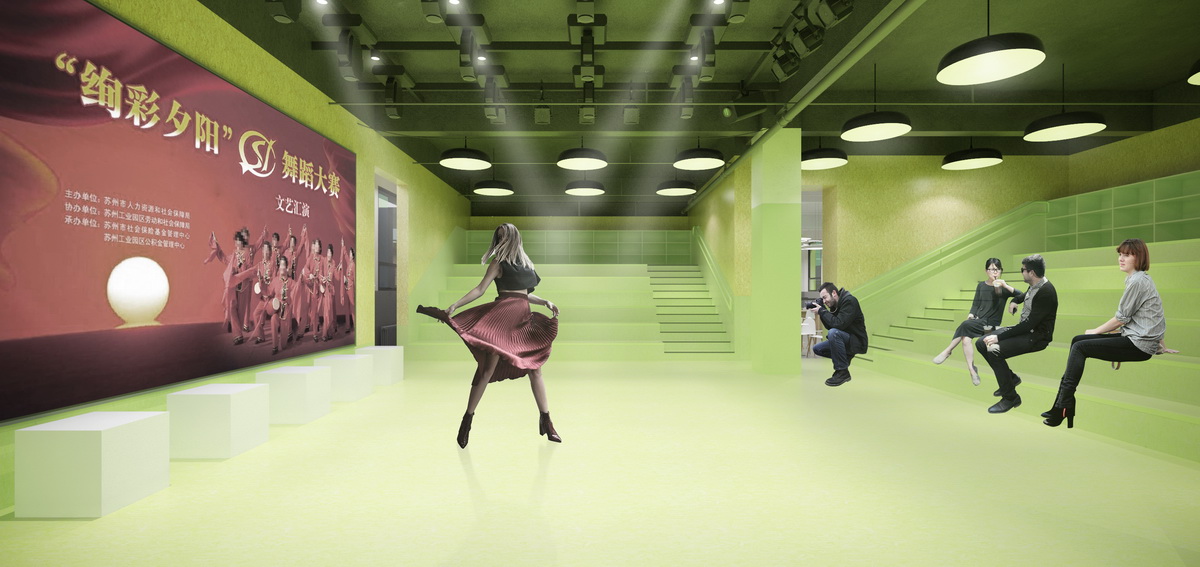
△ Stage
This flexible design supports various uses such as performances, lectures, roundtable discussions, and small theater events, allowing users to customize layouts accordingly.
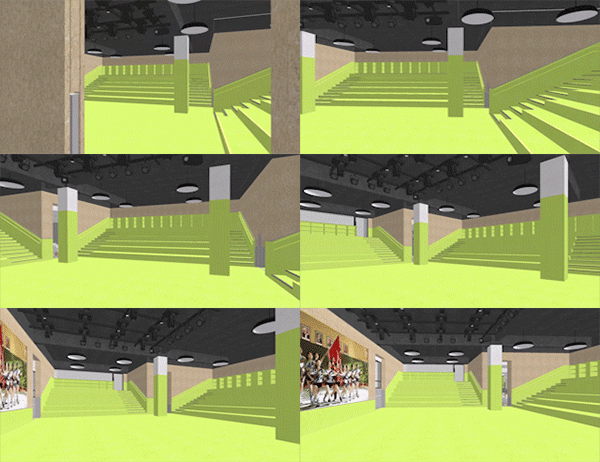
△ Rehearsal Hall
2. Community Book Tower
Community reading is another key function on the first floor. Previously, a window near the east exterior wall had been sealed off during renovation. In our site survey, we explored reopening it to introduce natural light into the space.
The bright reading area is positioned near the building’s secondary entrance by this window, arranged linearly to maximize daylight while maintaining a quiet atmosphere.
In the central, less-lit zone, a cylindrical book tower capitalizes on the high ceiling, creating an inviting reading hub.
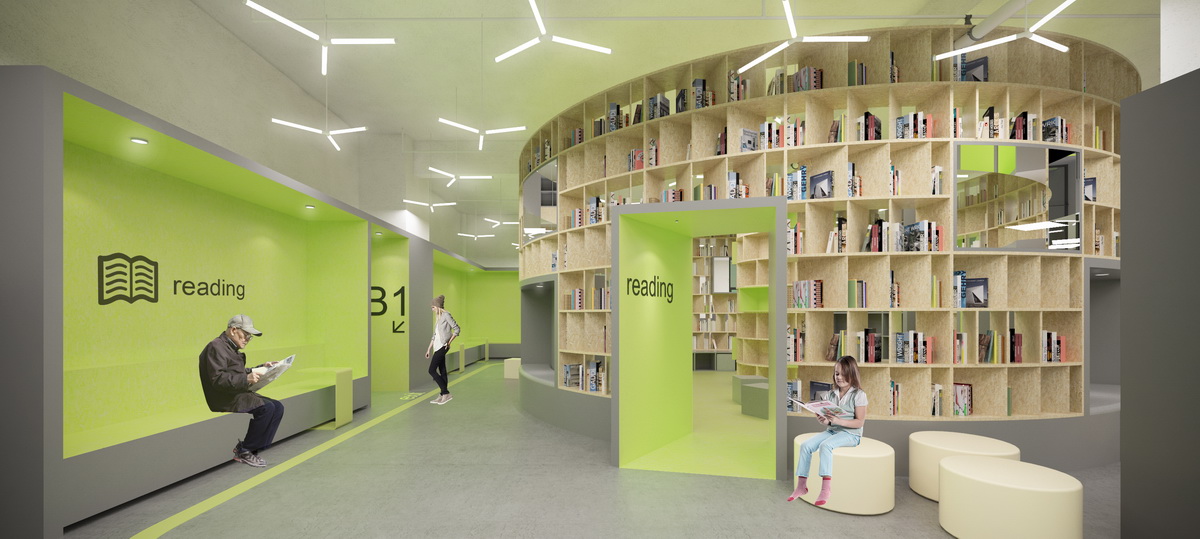
△ Reading Area
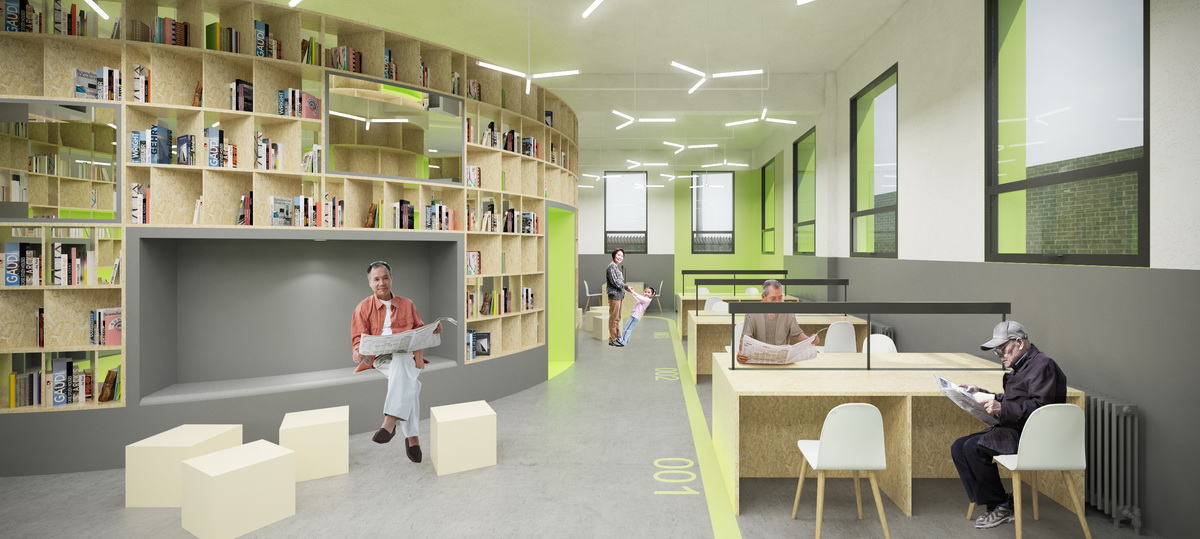
△ Reading Space

Inside the Book Tower
The cylindrical design provides dual spatial interfaces: inside and outside the tower. The façade combines bookshelves and seating, offering multiple reading options for visitors.
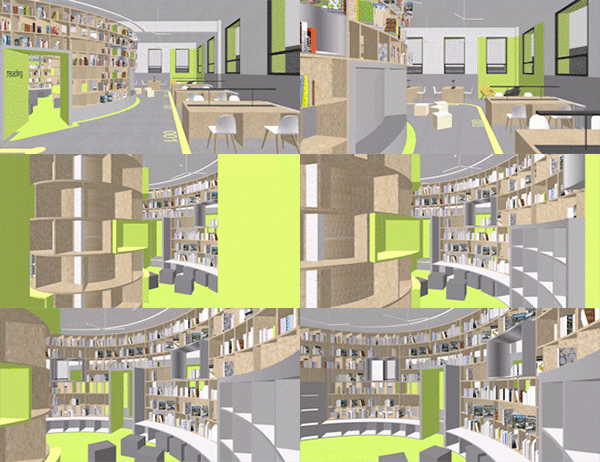
△ Bookshelf
3. Community Coffee Bar
With the theater and reading spaces defined, many architectural voids remained.
To utilize these underused areas, we designed a water bar beneath the stepped theater structure, leveraging ceiling height variations and applying specialized lighting to lighten the theater’s volume and enhance spatial layering.
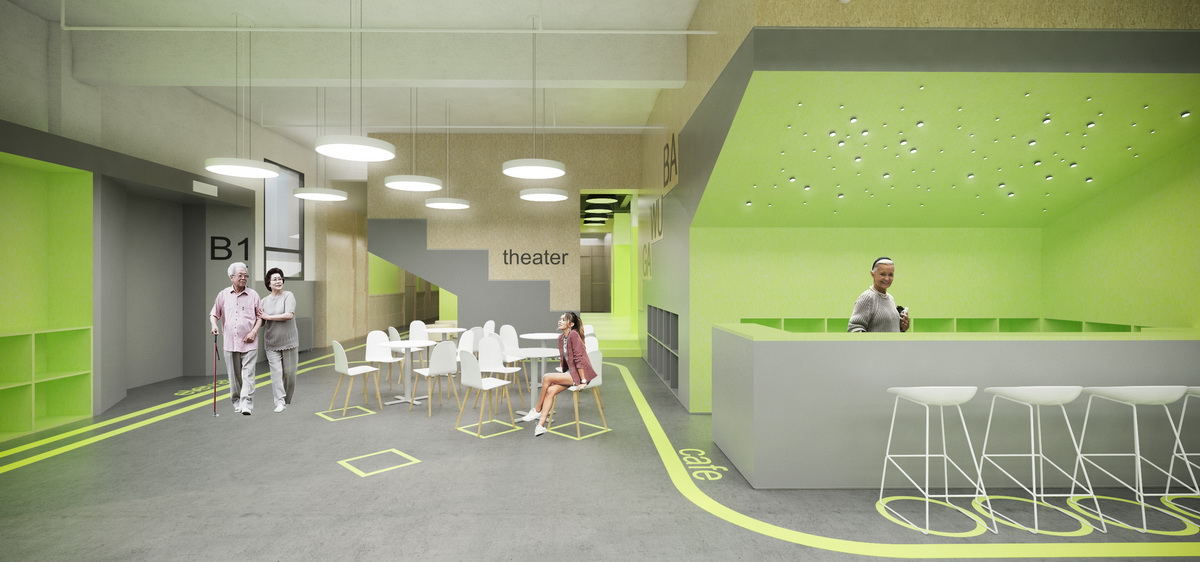
△ Bar Counter
4. Community Office
Near the building’s exterior wall, the street-facing space benefits from independent entrances and exits. This area was repurposed as the reception space for the neighborhood committee, incorporating functions such as visitor reception, information dissemination, and office work within a compact design.
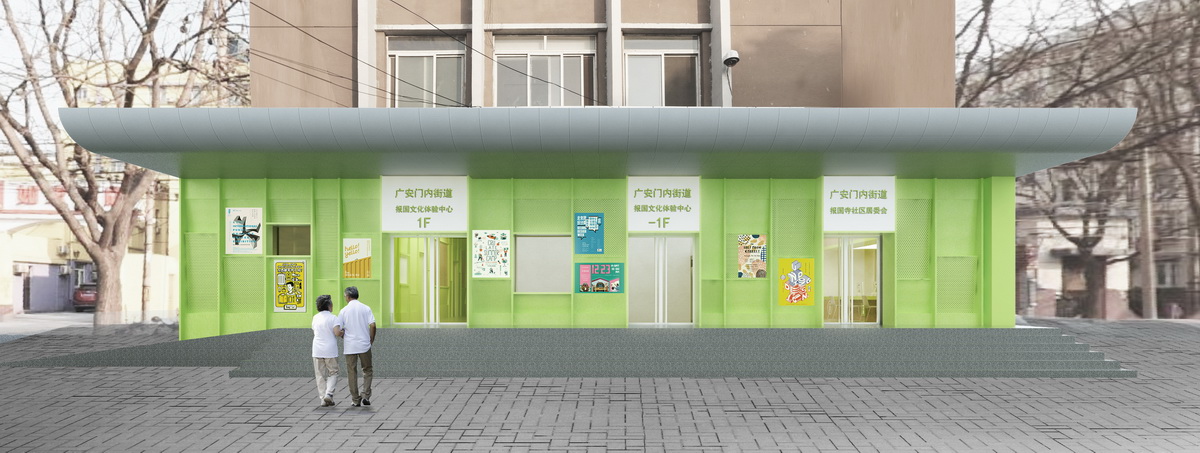
△ Facade

△ Neighborhood Committee
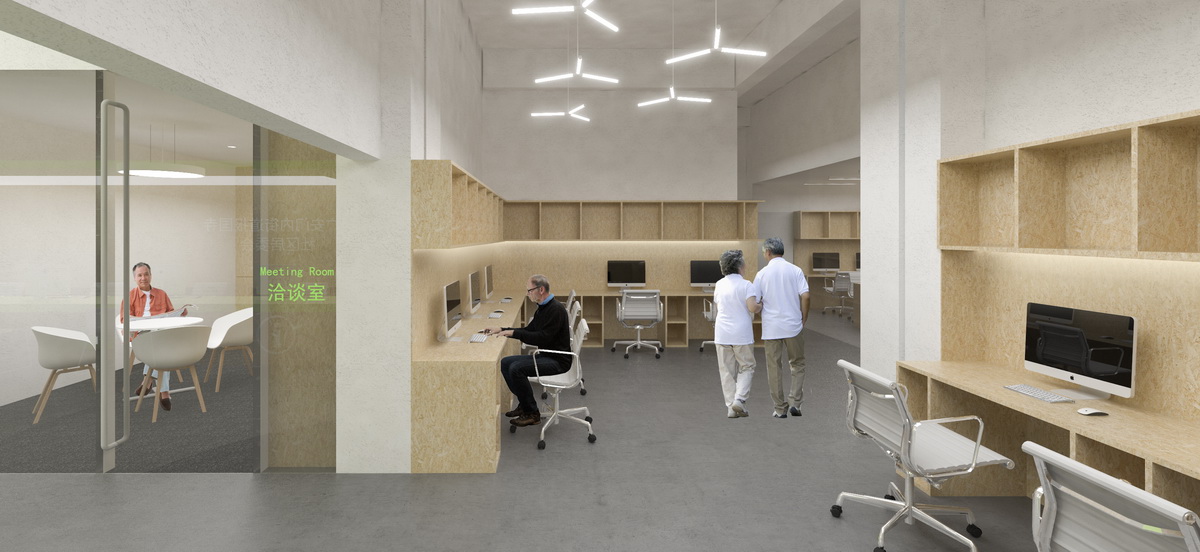
△ Neighborhood Committee
03
Community Support Services
The basement level serves as a supplementary community service area with lower space requirements, also needing connectivity and emergency evacuation access.
To address this, a “continuous roof implantation” concept was introduced, embedding a sloping roof structure in the ceiling that unites previously segmented spaces caused by beam grids and creates a rhythmic flow.
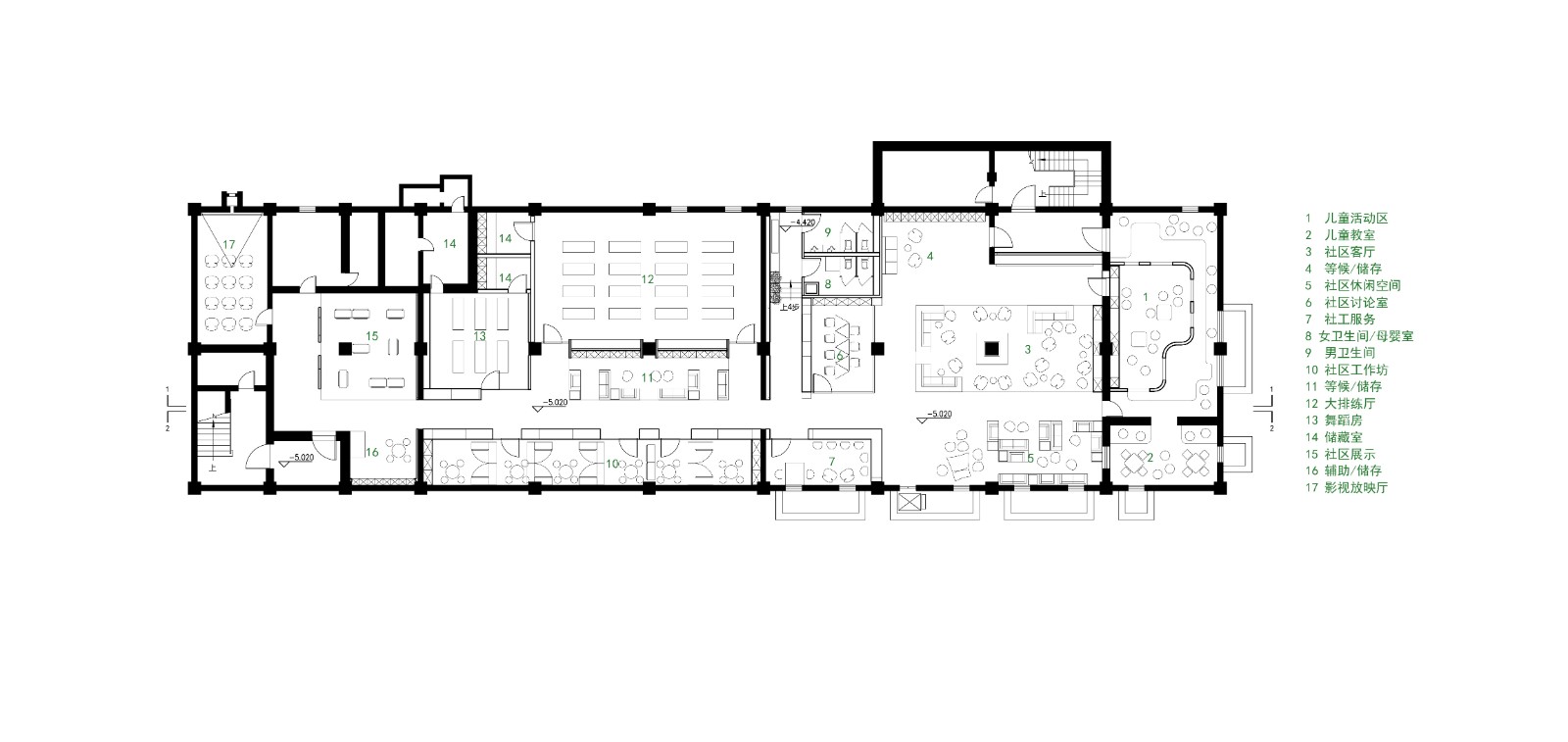
△ Basement Floor Plan
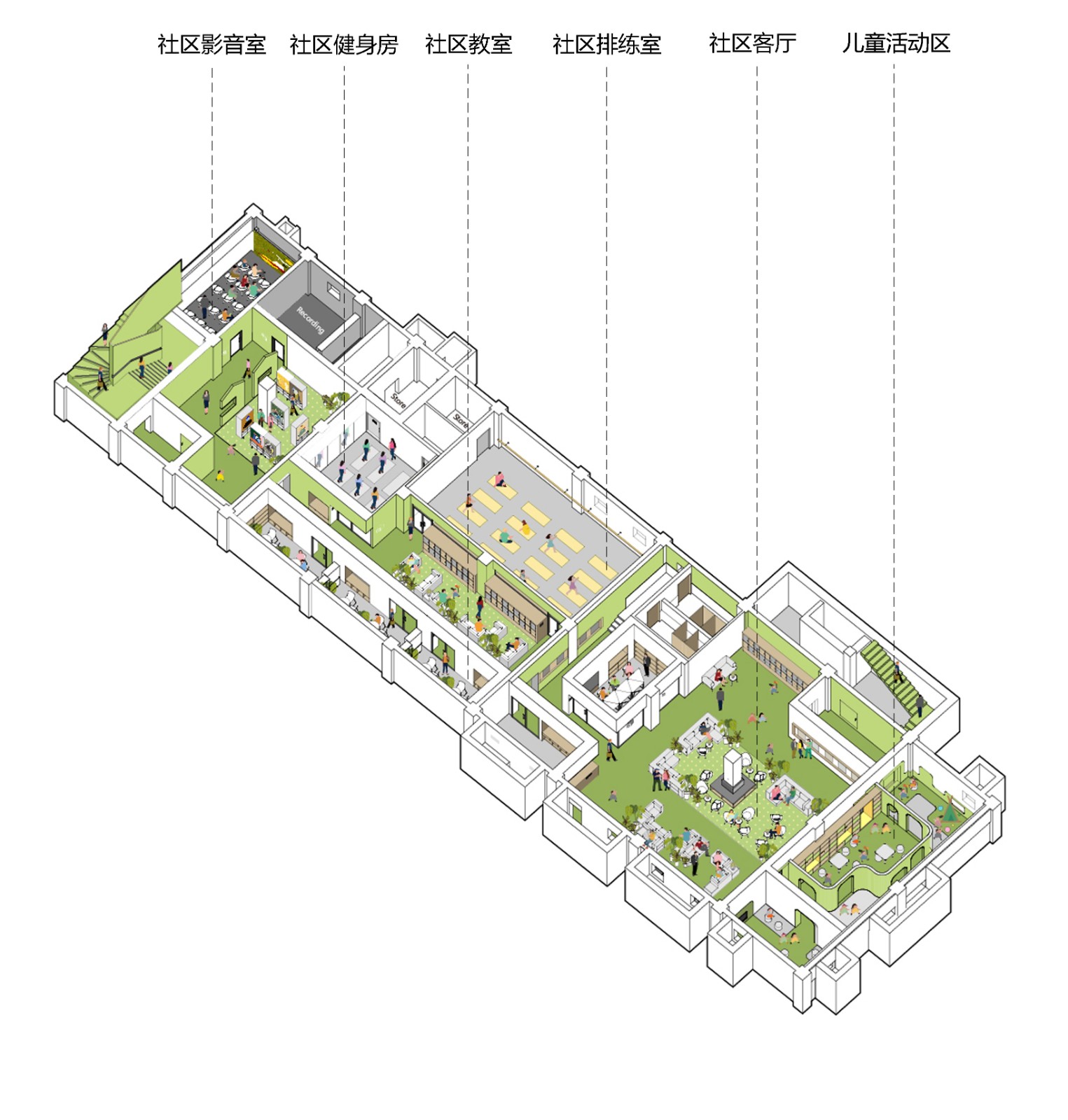
△ Basement spatial axonometric map
Along this continuous path are arranged community displays, audio-visual facilities, rehearsal rooms, workshops, and shared living spaces, fostering a cohesive and engaging environment.
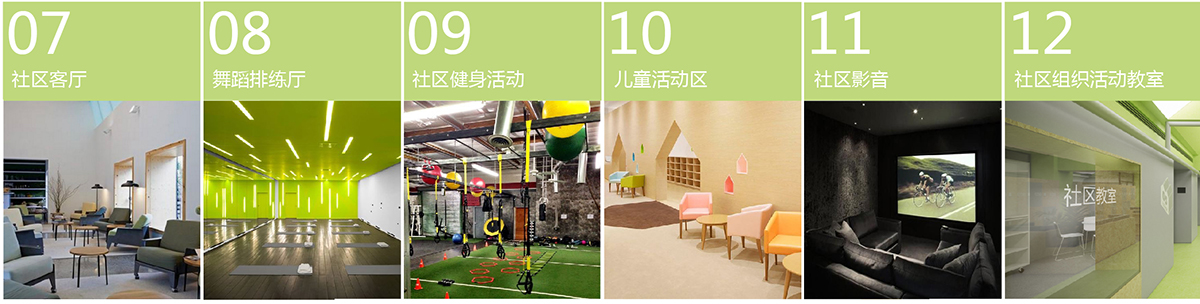
12 types of spatial business cards
1. Community Living Room
The community living room is the most accessible open space on the basement level, serving as a hub for leisure, conversation, resident meetings, and temporary office use.
Flexible semi-fixed furniture modules divide the space, supporting diverse community activities.

△ Community Living Room

△ Community Living Room
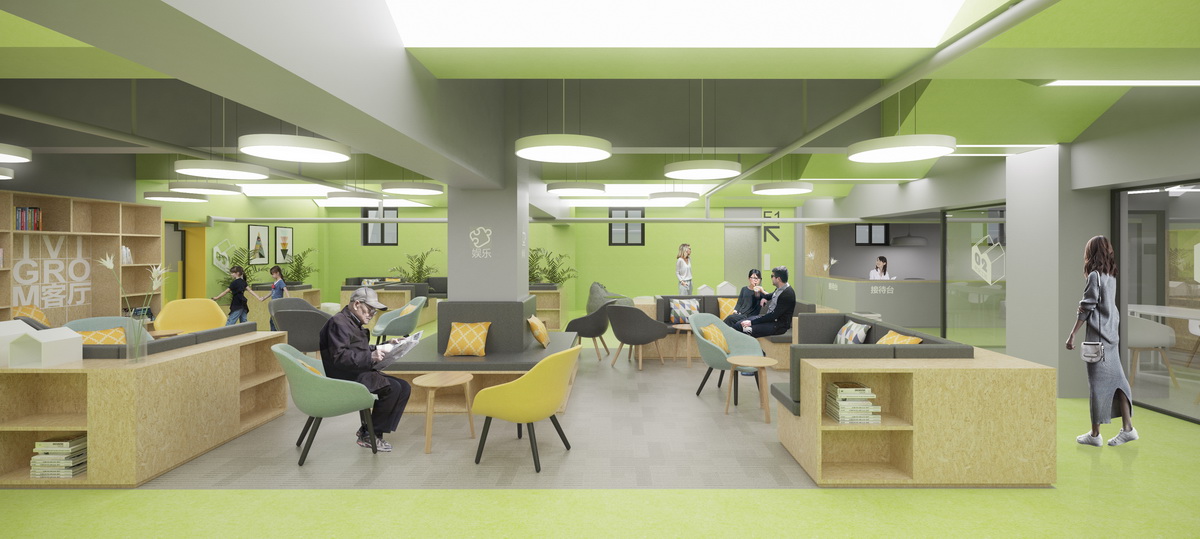
△ Community Living Room
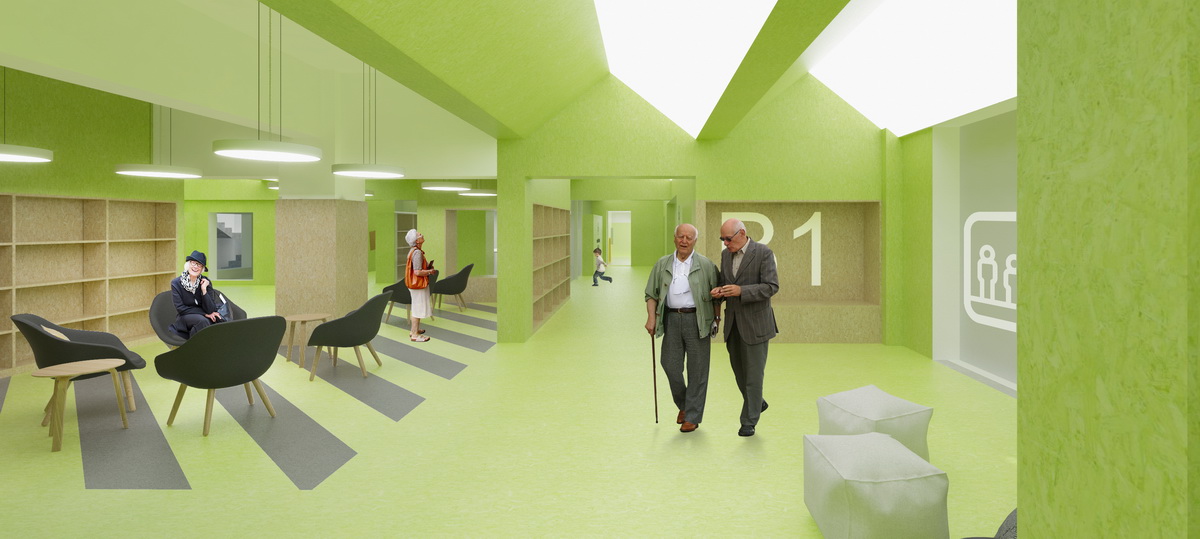
△ Elevator Hall
2. Community Rehearsal Room
Along the main corridor of the basement, the design centers around storage and waiting areas, with progressively larger rehearsal halls and workshop spaces.
Community rehearsal rooms are available to residents by appointment through a time-sharing system, while workshops serve as offices, meeting rooms, and support spaces for volunteers and social groups.

△ Large Rehearsal Room
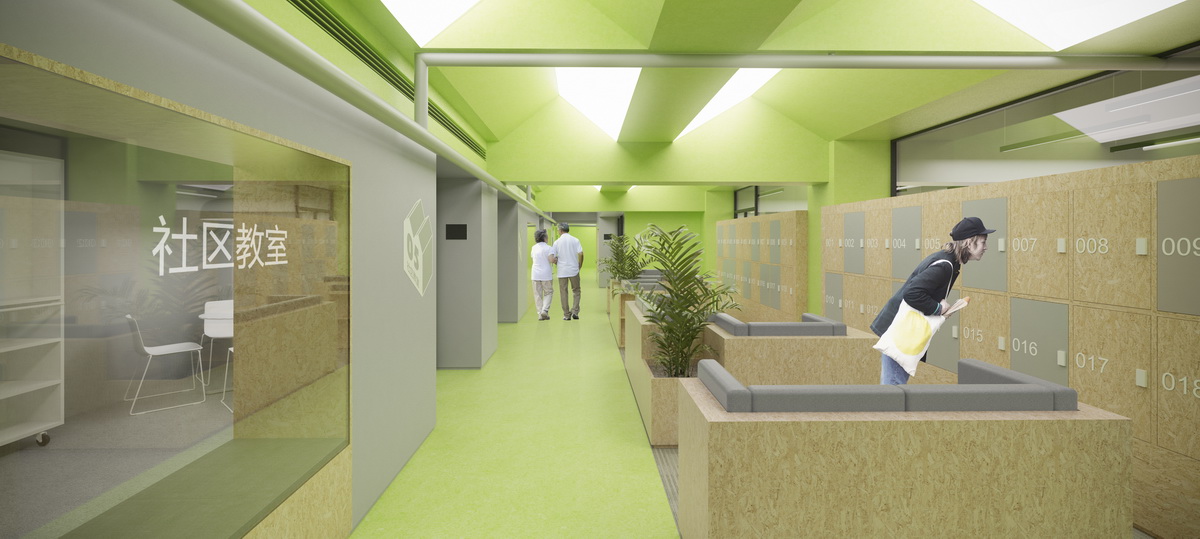
△ Public Space Outside Rehearsal Hall
3. Community Parent-Child Area
Positioned near the basement’s evacuation exit, this independent open space was designed as a parent-child zone.
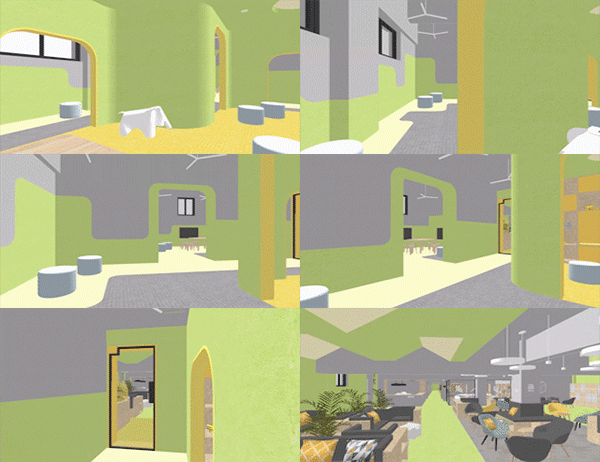
△ Children’s Area
Unlike typical parent-child spaces that require constant adult supervision, this area features a reading cabin where children can play independently. A linear painted wall along the entrance and exit provides clear visibility, enhanced by natural light streaming through high windows.

△ Children’s Area

△ Children’s Area
Parents can choose to engage with their children in this space or relax in the community living room, allowing children to socialize independently and enjoy versatile interactions between dependence and autonomy.
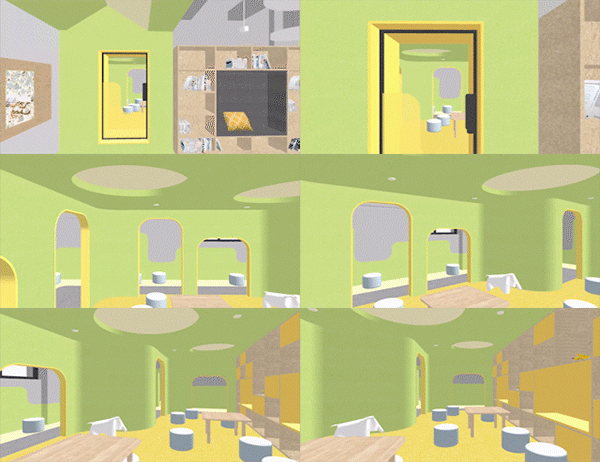
△ Children’s Area
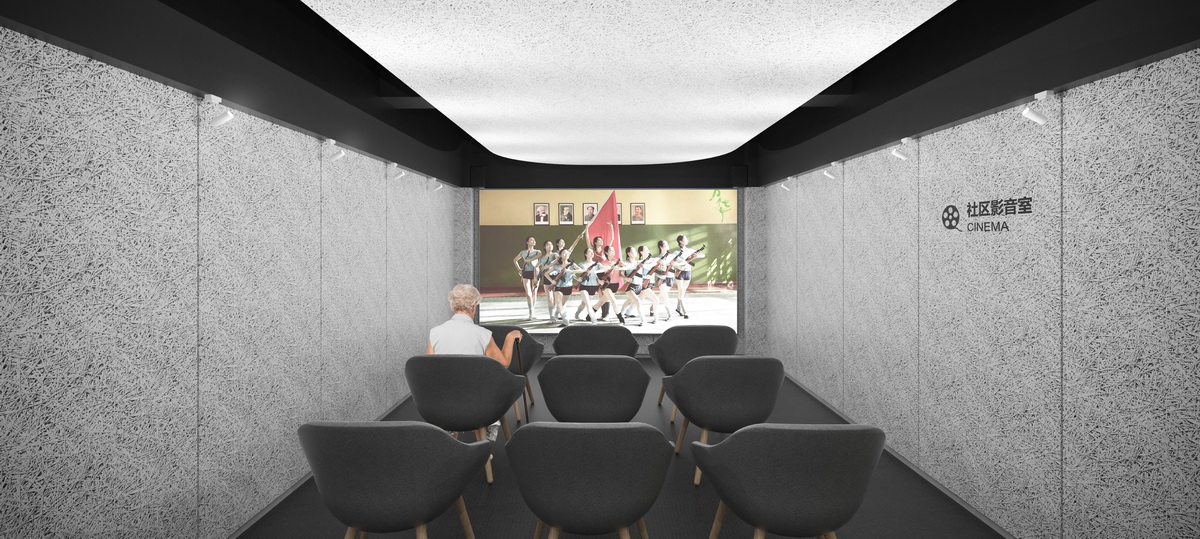
△ Screening Hall

△ Screening Hall
04
Conclusion
Transforming a physical space into a thriving community hub is a clear and achievable goal. However, after completion, ongoing functional adjustments and user adaptations are essential.
Beyond aesthetics, community space design must embrace broader social objectives. Through collaborative efforts, these spaces should be conceived openly and systematically to empower users and foster a true sense of belonging.

△ Sectional perspective

△ Section diagram
After more than a year of design and numerous meetings with residents,
the cultural and sports center project has now begun smoothly.
We look forward to its successful completion,
and to the creation of many exciting community memories here.
Project Information
Project Name: Renovation Design of Guang’anmen Inner Street Cultural and Sports Center
Location: 1F/B1, Huaxing Building, Xicheng District, Beijing
Architectural Design: MAT Super Architecture Firm
Lead Architects: Tang Kangshuo, Zhang Miao
Design Team: Wang Feiyu, Liu Youpeng, Liu Huixian, Zhang Bei (intern)
Design Period: July 2017 – September 2018
Construction Period: April 2019 – present
Project Owner: Guang’anmen Inner Street Office












Must log in before commenting!
Sign Up