
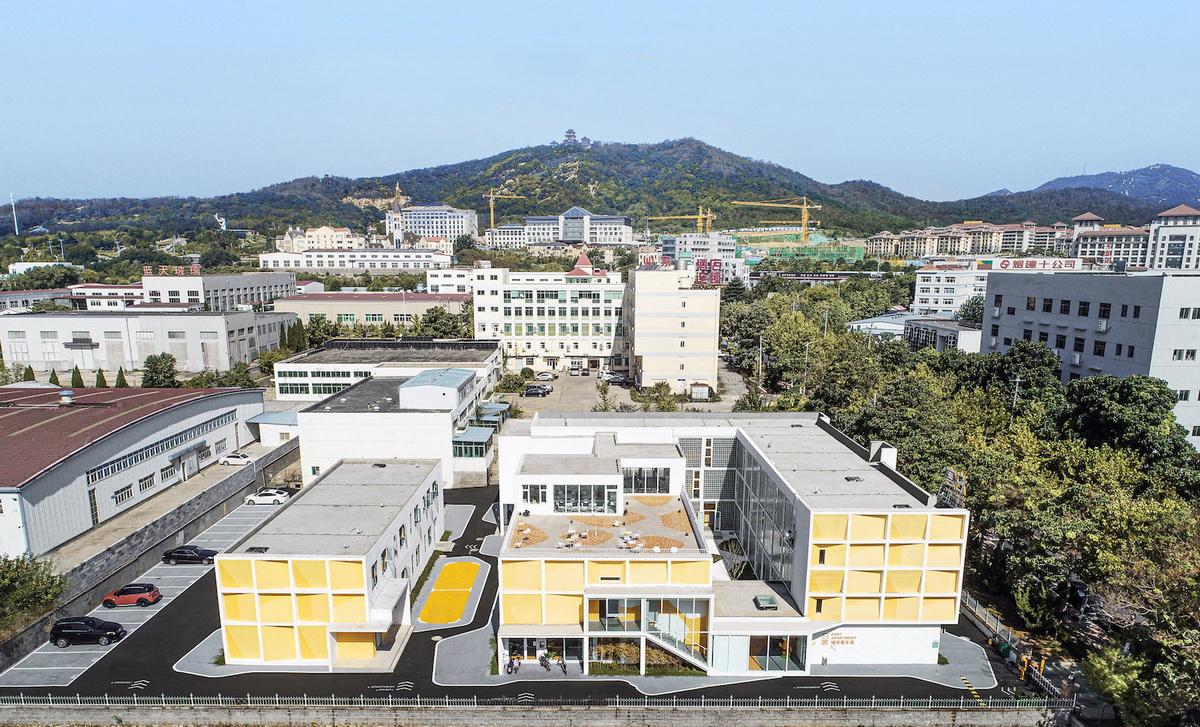
▲ Project Overview © Zhang Peizhi
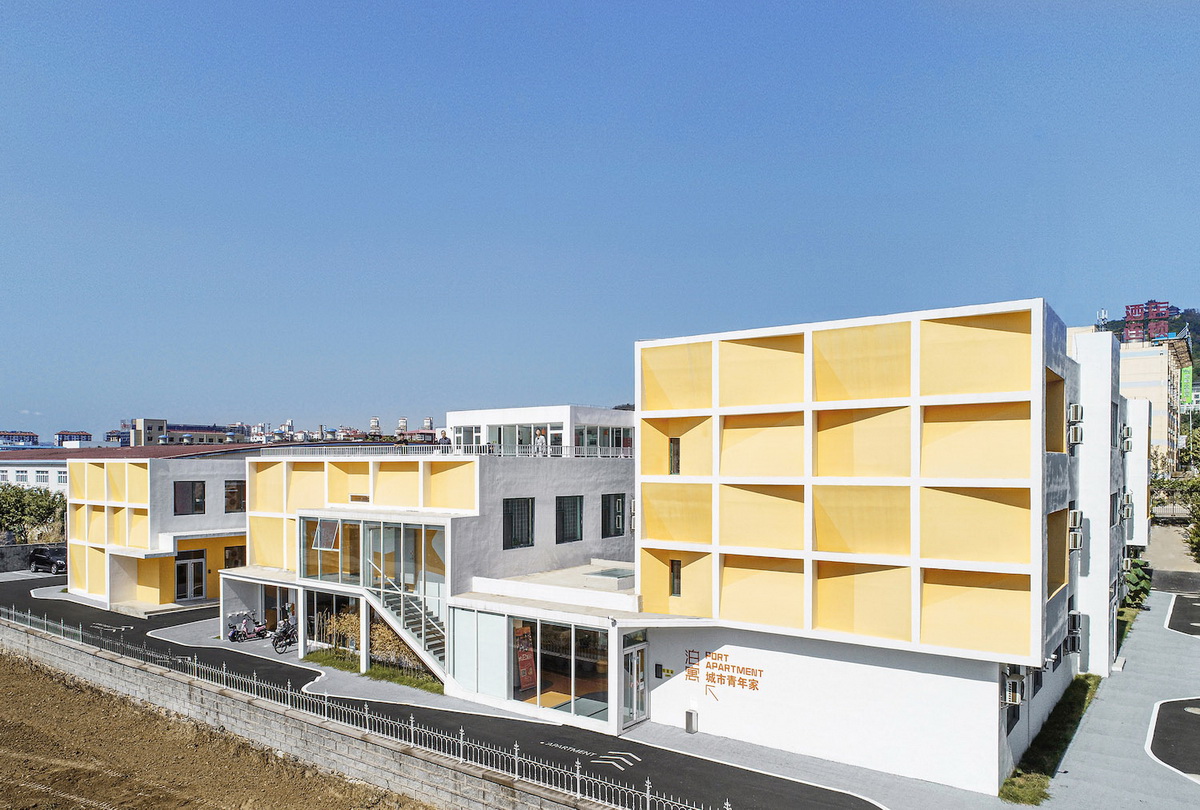
▲ A vibrant, shared youth residential community © Zhang Peizhi
Located in Laishan District, Yantai City, Chunhui Road is surrounded by a rich cultural, educational, and light industrial environment. Nearby institutions include Yantai University, Shandong University of Commerce, and the Institute of Chinese Academy of Sciences. Recent urban development has transformed this area into the heart of Laishan District, with many factories relocating and leaving behind vacant industrial buildings.
The Boyu project site on Chunhui Road sits on a former industrial area currently undergoing revitalization. The site consists of three original factory buildings: an office, a warehouse, and equipment rooms. The design goal is to convert this compact park into a lively, shared youth residential community.
Yantai, a typical northern coastal city, is characterized by abundant mountains, ample sunshine, and a lengthy coastline. This project approaches the design from an urban temperament perspective, aiming to endow the seaside youth apartment with a unique architectural identity, enhancing the quality of life for young residents through a shared community experience.
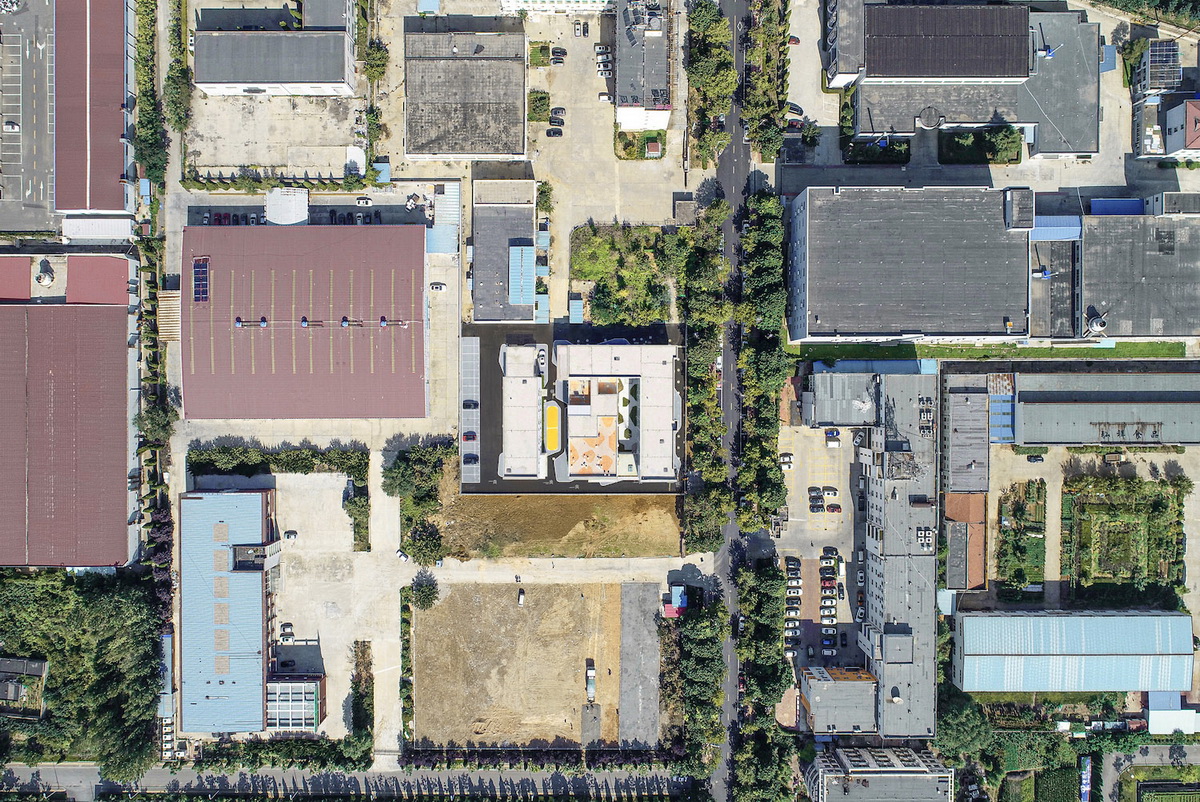
▲ The site in the midst of former industrial buildings undergoing transformation © Zhang Peizhi
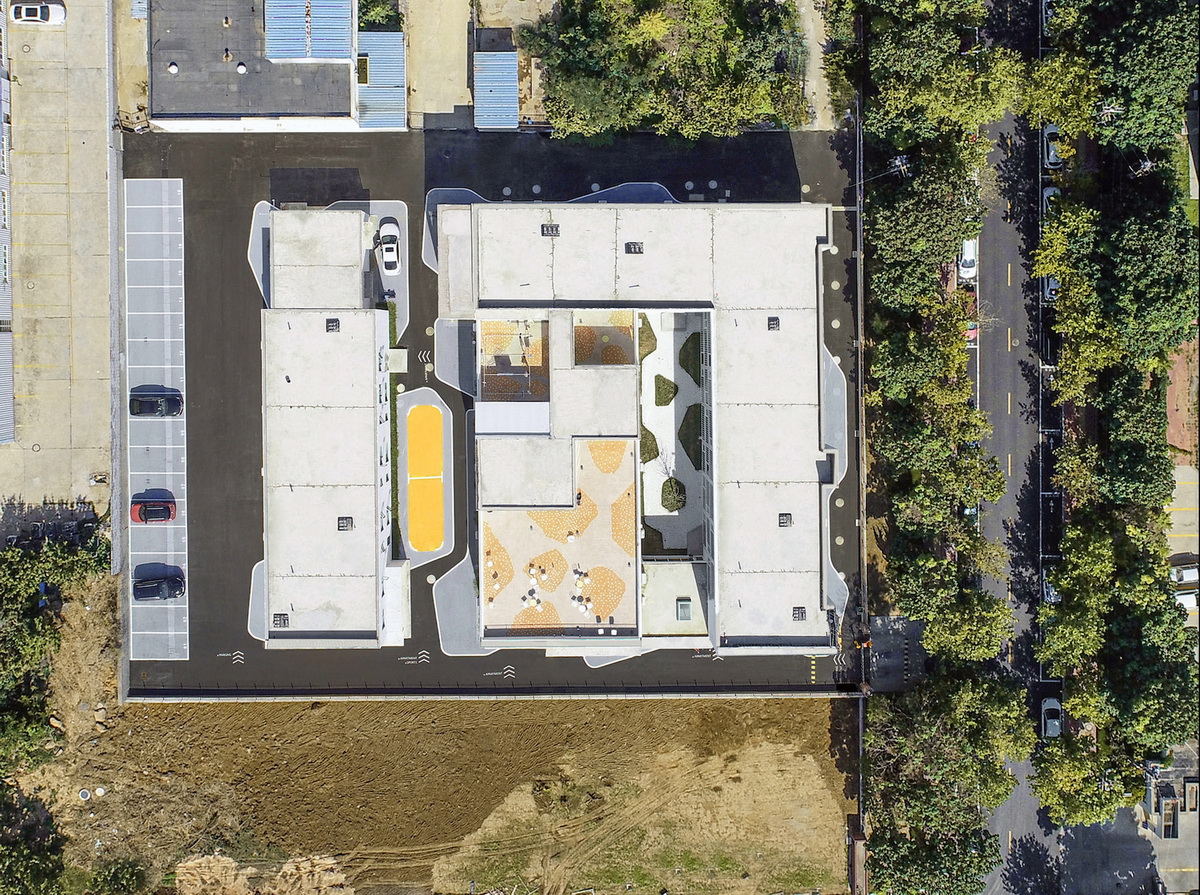
▲ Aerial view of the project site © Zhang Peizhi
To the north along Chunhui Road, two rows of lush trees nearly obscure the building facades, while the east side faces an open green space belonging to a training school. Embracing this, the design redefines the building’s primary facade to face east, overlooking the open green area.
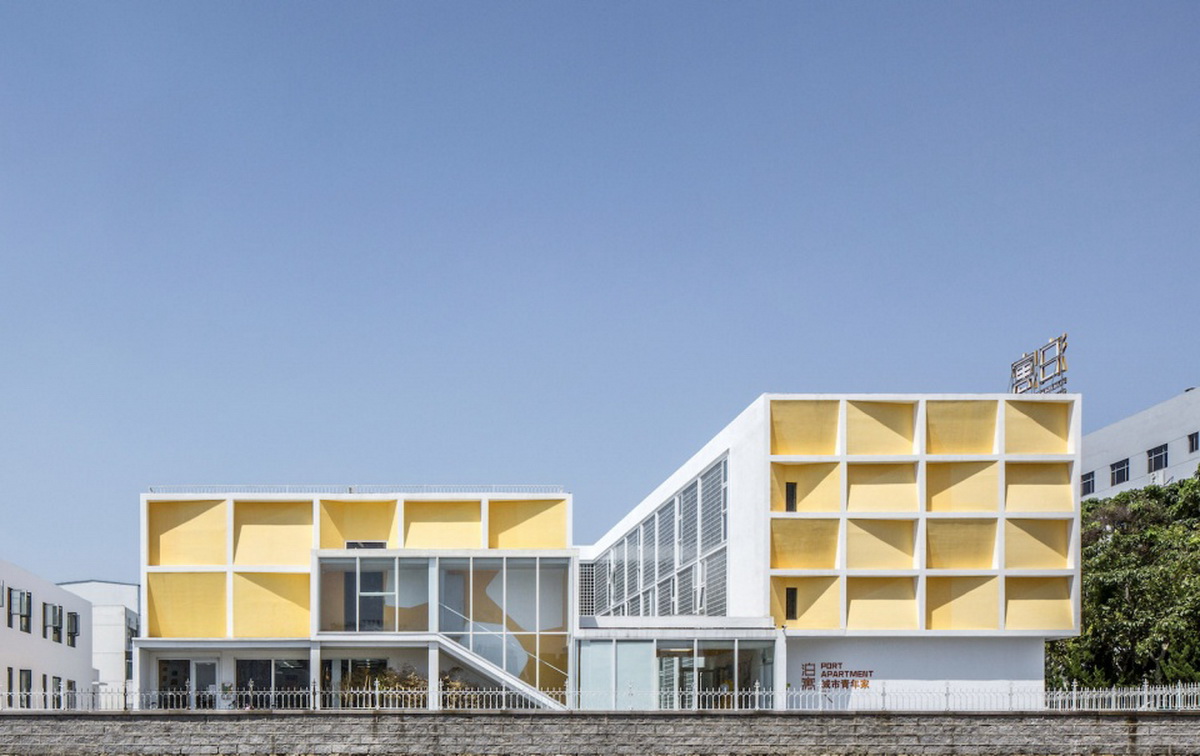
The building’s first floor opens on the east side, serving as a living room and communal activity space for the youth apartment. The eastern façades of the three original buildings feature a cohesive, continuous square grid design, forming the main external characteristic of the complex.
The original three-story building on the north side had a shallow depth. To enhance living comfort, an external corridor was added to connect communal spaces. This corridor’s outer wall is crafted from artistic glass bricks, creating a semi-transparent barrier that, together with a newly added entrance hall, encloses a quiet inner courtyard.
The corridor also links to the original two-story warehouse roof, which now hosts a sunroom that functions as a dining area, shared kitchen, laundry, and fitness center. This rooftop platform faces the open eastern green space and serves as the primary outdoor social and leisure area for residents.
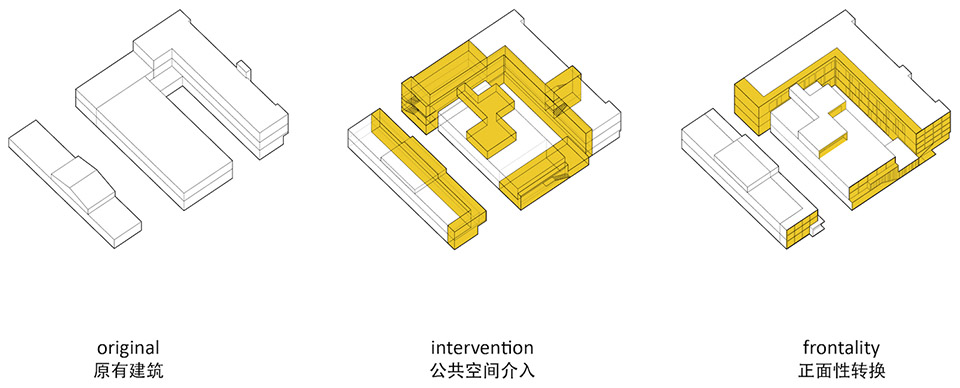
▲ Volume generation analysis diagram
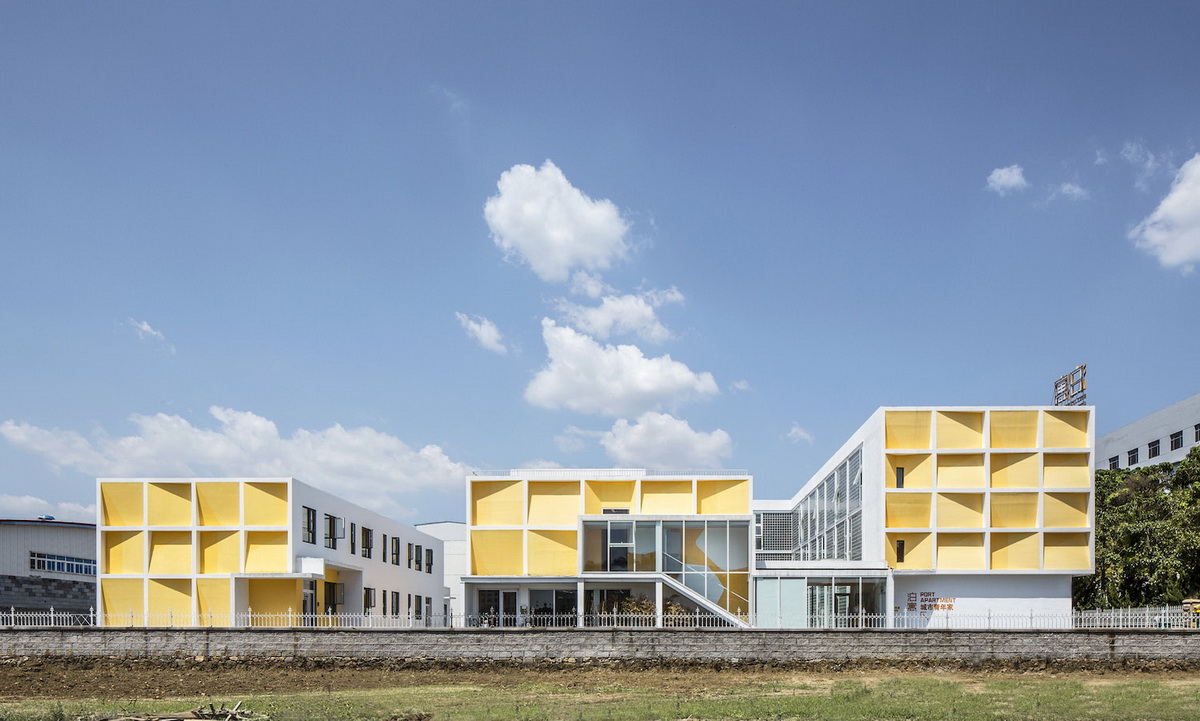
▲ Main building facade © Tang Kangshuo
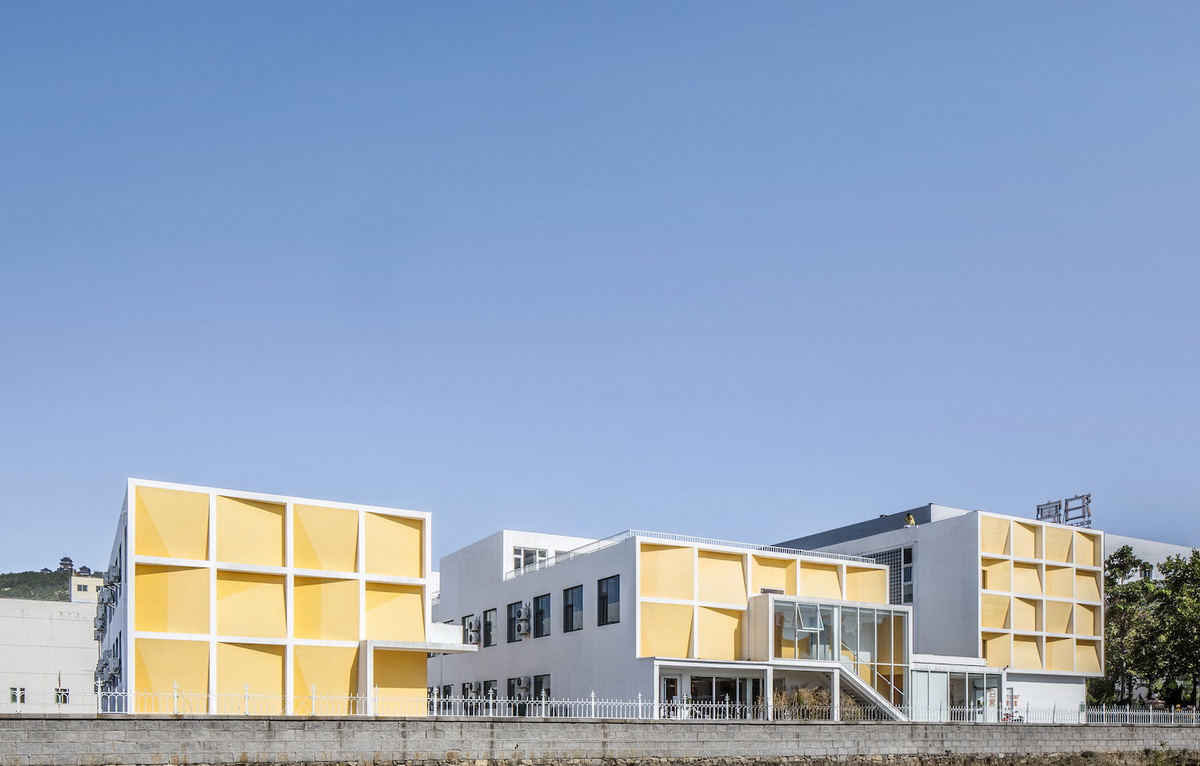
The eastern mountain walls of all three buildings share a unified and continuous square grid design language © Tang Kangshuo
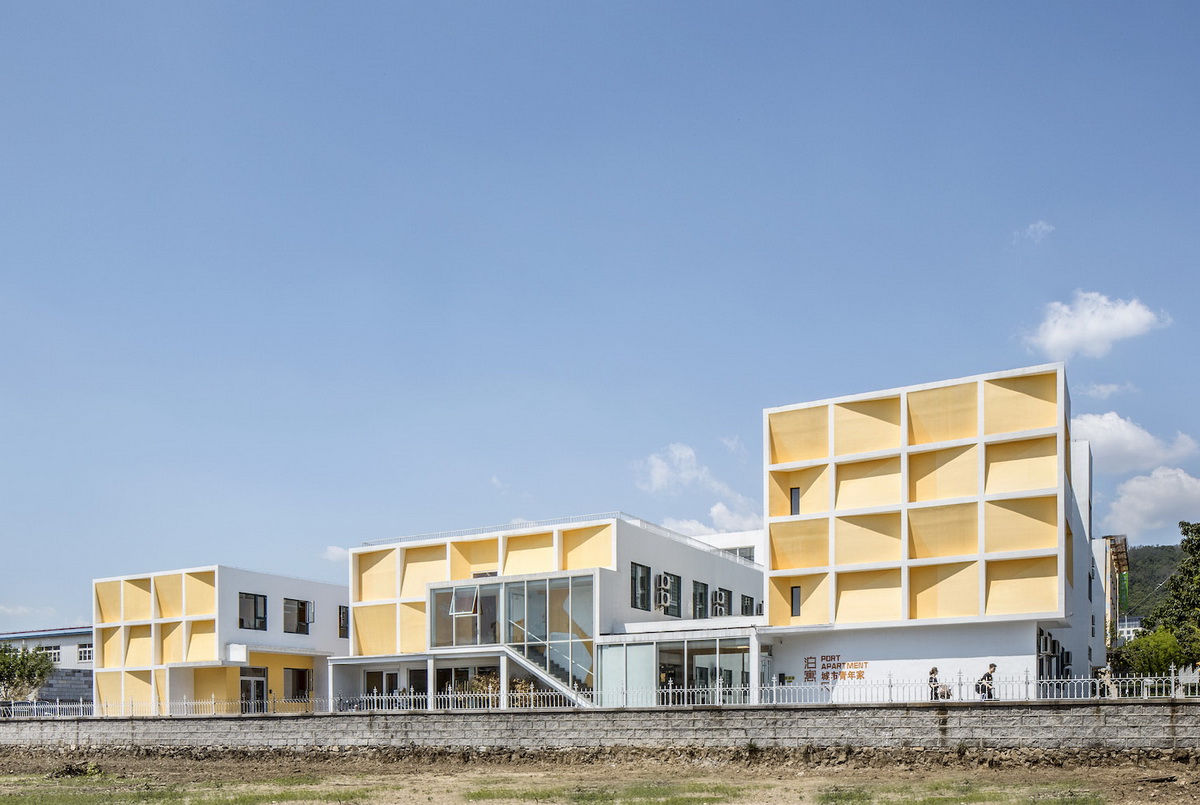
An external corridor connects the three-story northern building’s public spaces © Tang Kangshuo
The corridor’s exterior wall is crafted from artistic glass bricks. Together with the semi-transparent glass brick walls and the new entrance hall, it forms a tranquil inward-facing courtyard © Tang Kangshuo
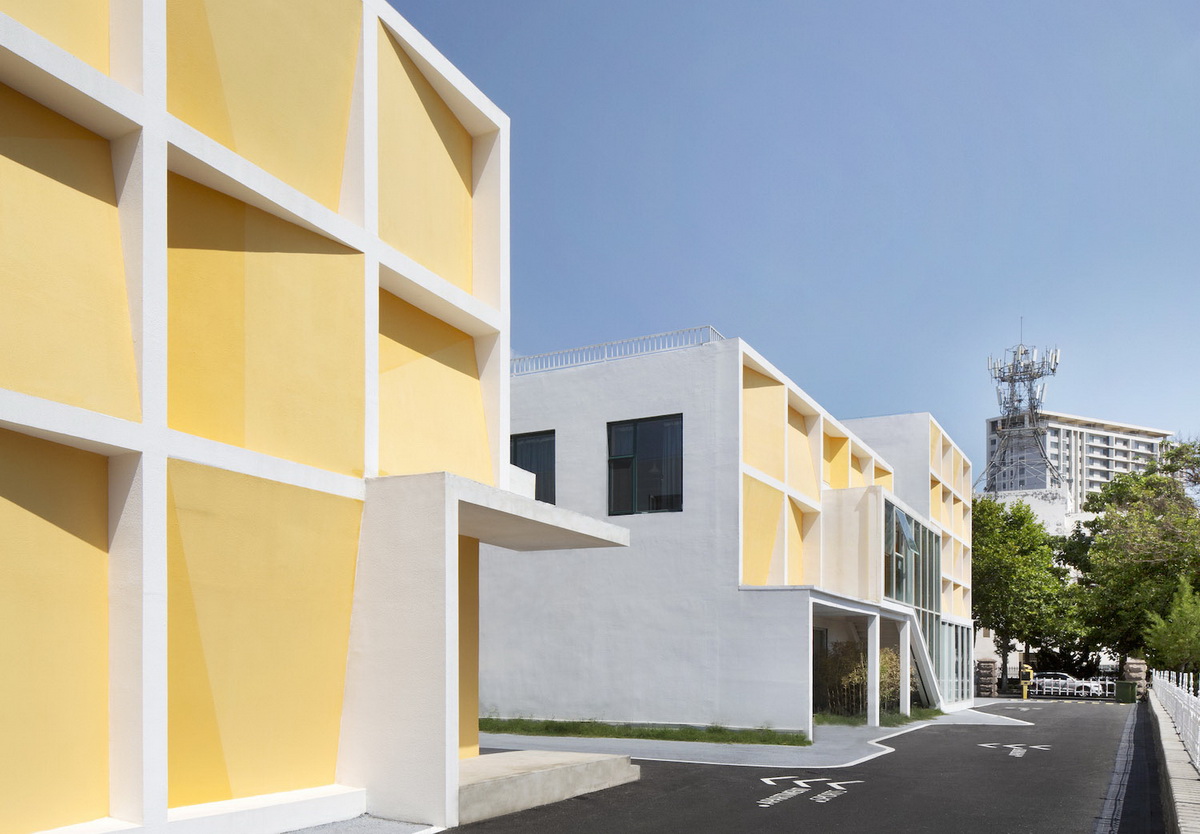
The flooring features varying shades of gray, resembling a skirt wrapping around the building © Tang Kangshuo
The east facade’s gable, given prominence, adopts a simple and clean square grid pattern. Artistic expression is introduced by altering the inclination angles of the grid’s inner walls, with the interior walls painted in a warm orange-yellow. This design simulates shadow projections at different angles, producing dynamic light and shadow effects on sunny mornings.
The contrast between the large white wall and the sloped orange-yellow wall reflects the city’s artistic character, inspired by the blue sea and sky.
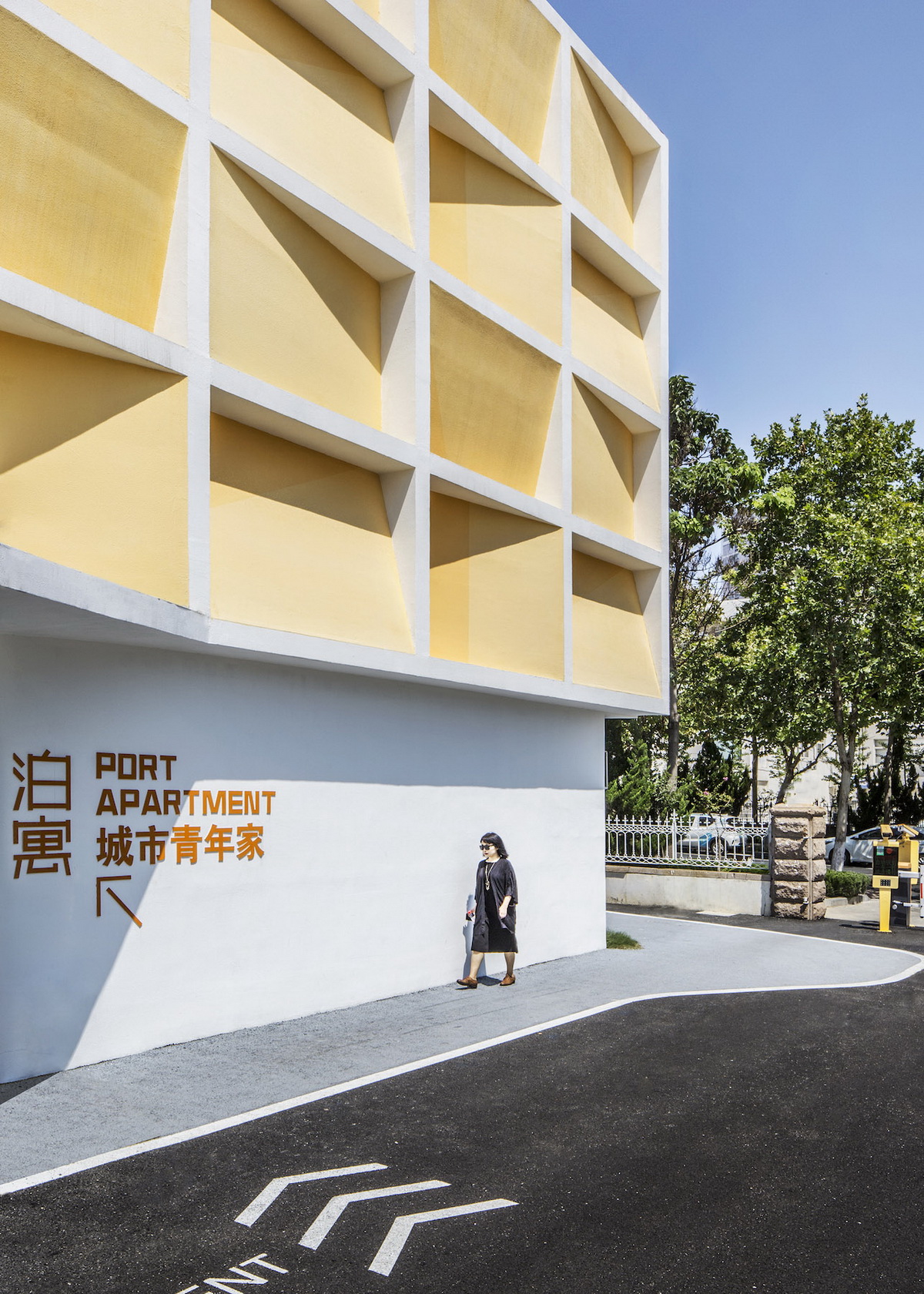
▲ Artistic effect achieved by varying the inner grid wall’s inclination © Tang Kangshuo
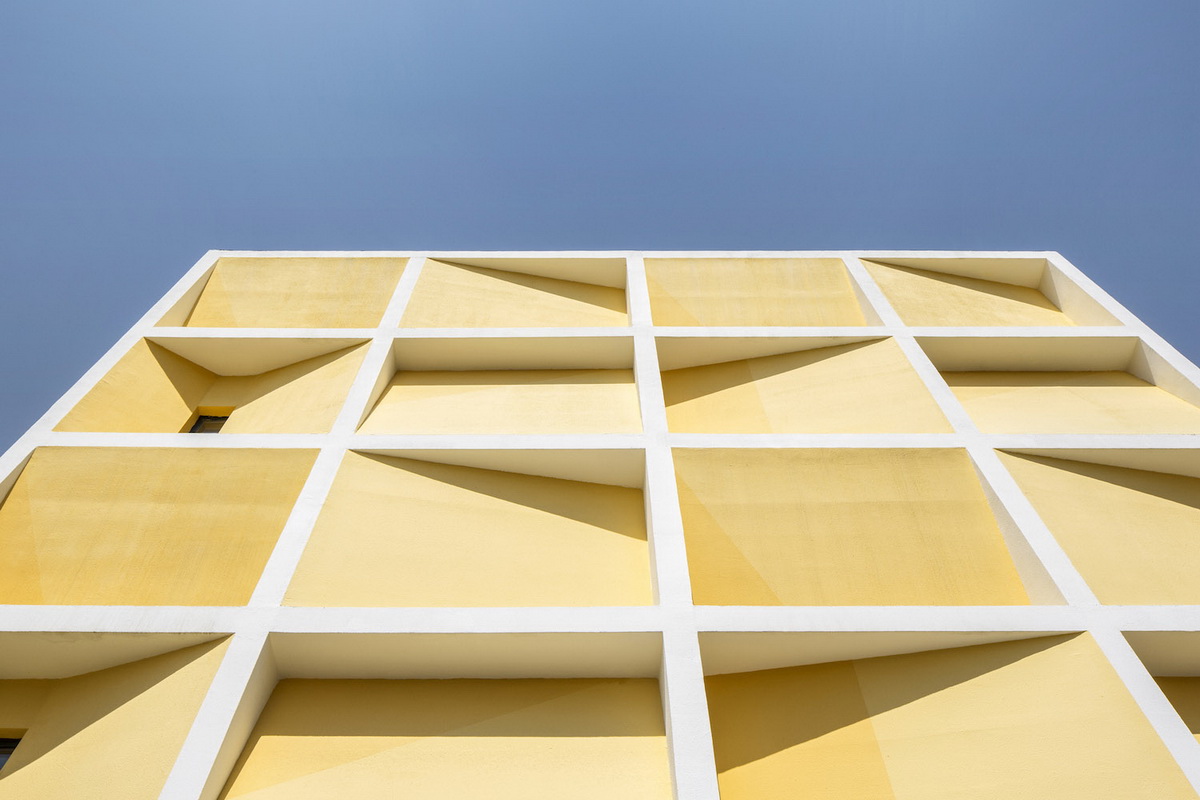
▲ The orange-yellow interior walls simulate shadows cast at different angles © Tang Kangshuo
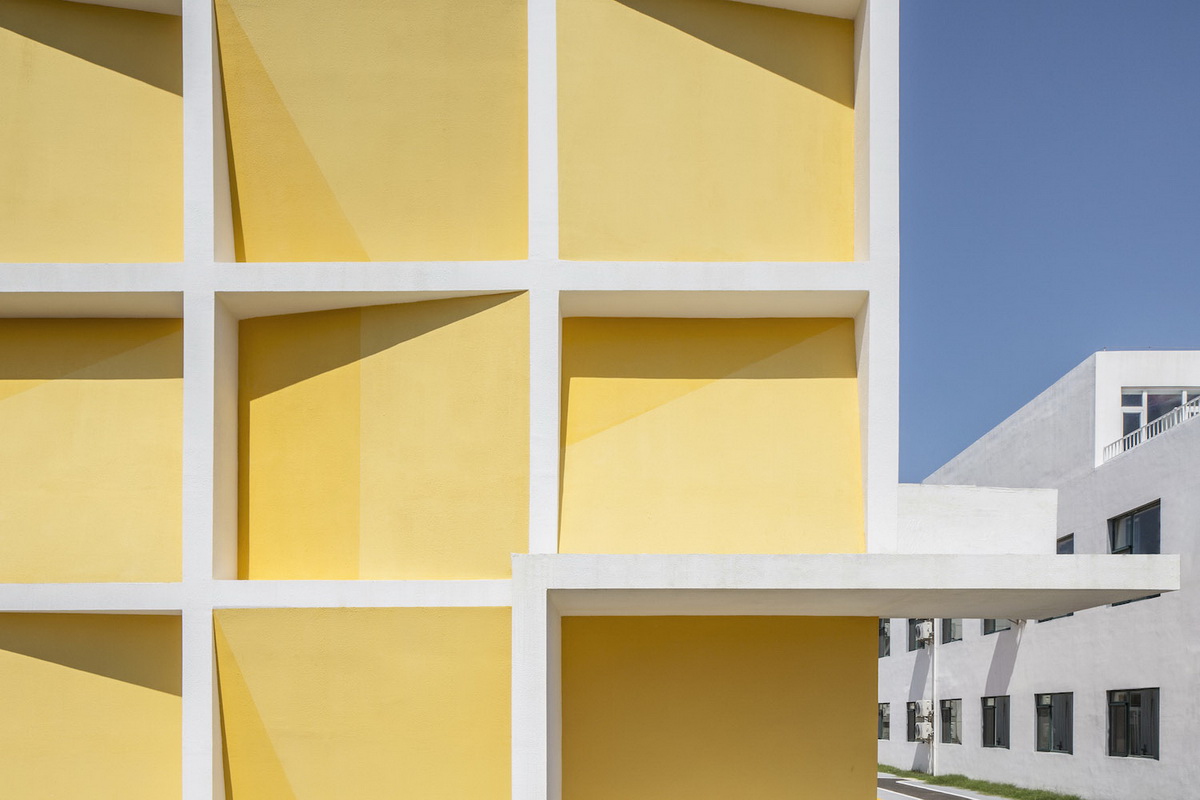
The juxtaposition of large white walls with orange-yellow sloping walls echoes the coastal city’s vibrant artistic atmosphere © Tang Kangshuo
The added corridor faces the peaceful inner courtyard and is primarily constructed with semi-transparent 200mm square glass bricks. During the day, soft natural light filters through the bricks, illuminating corridors and stairwells with a bright, comfortable glow. From the courtyard, one can observe the gentle interplay of light and shadows cast by people moving through the corridors.
At night, interior lighting bathes the corridor and public areas in a warm orange hue. The soft goose-yellow light diffuses through the glass bricks like spilled orange juice, creating a cozy, homely atmosphere for the young residents.
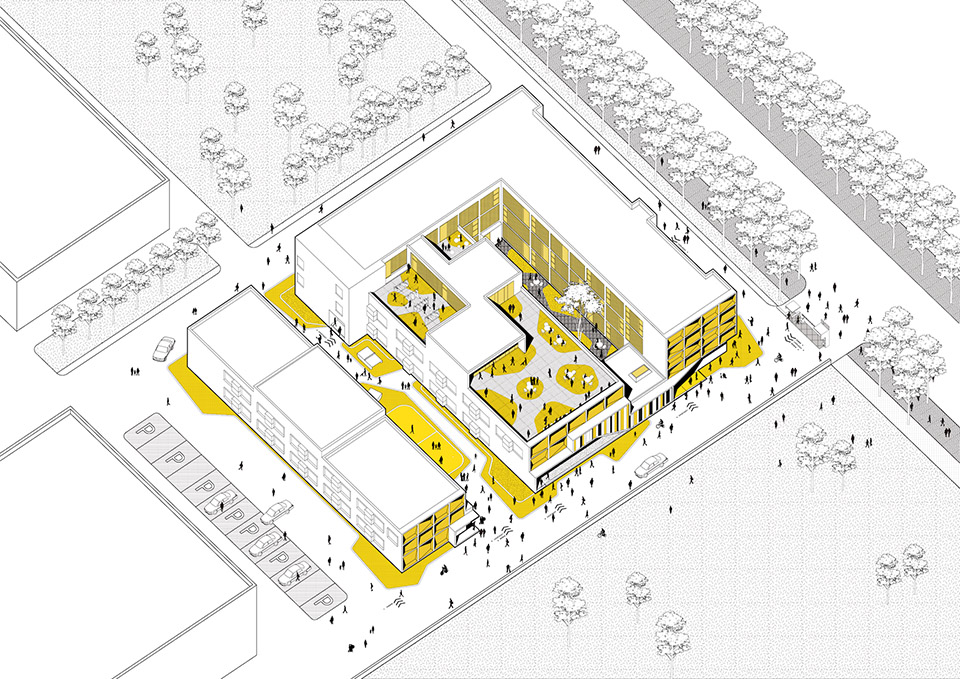
▲ Axonometric diagram
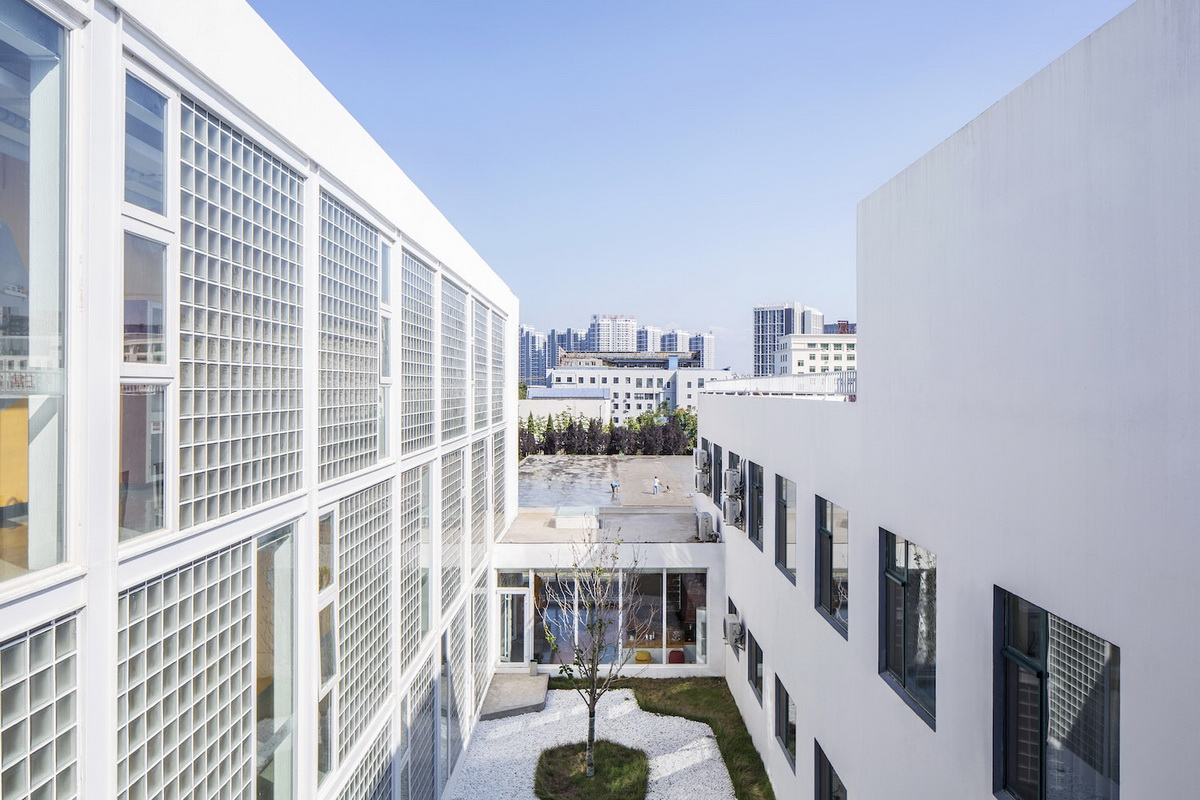
▲ Inner courtyard © Tang Kangshuo
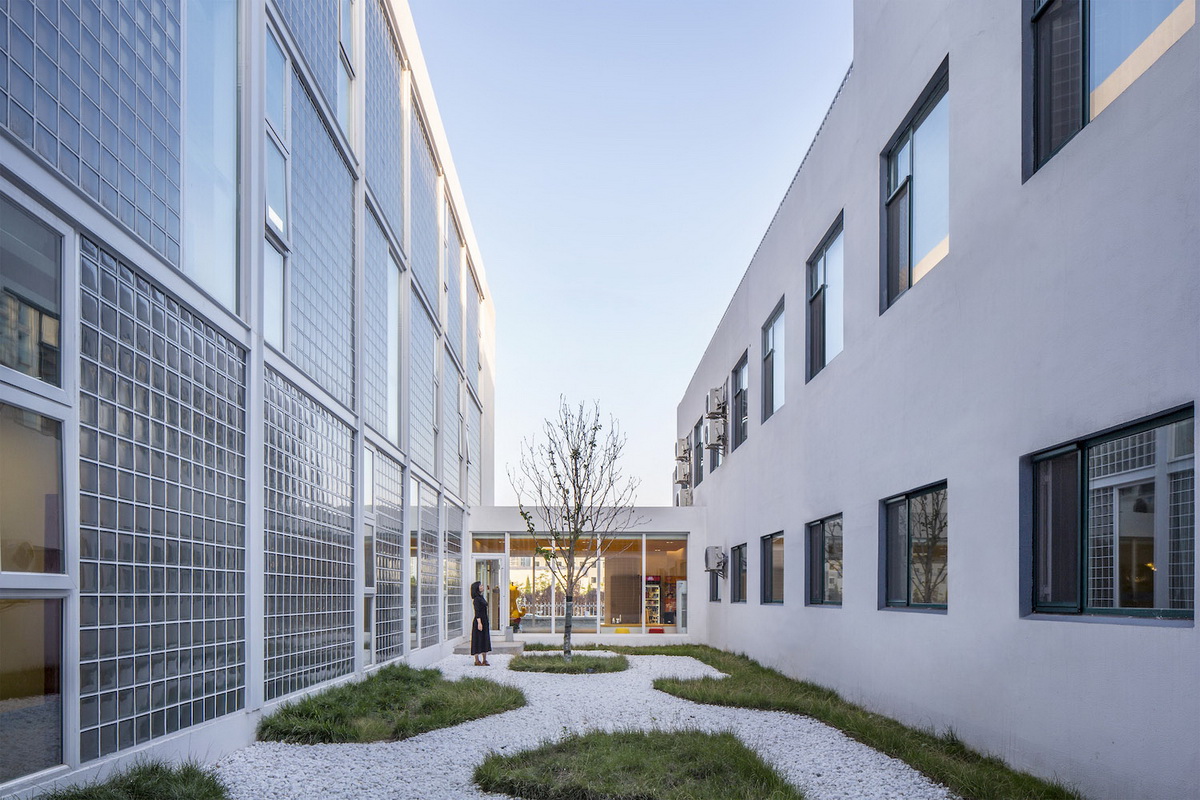
The inner courtyard connects directly to the entrance hall, creating the first impression upon entering the apartment © Tang Kangshuo
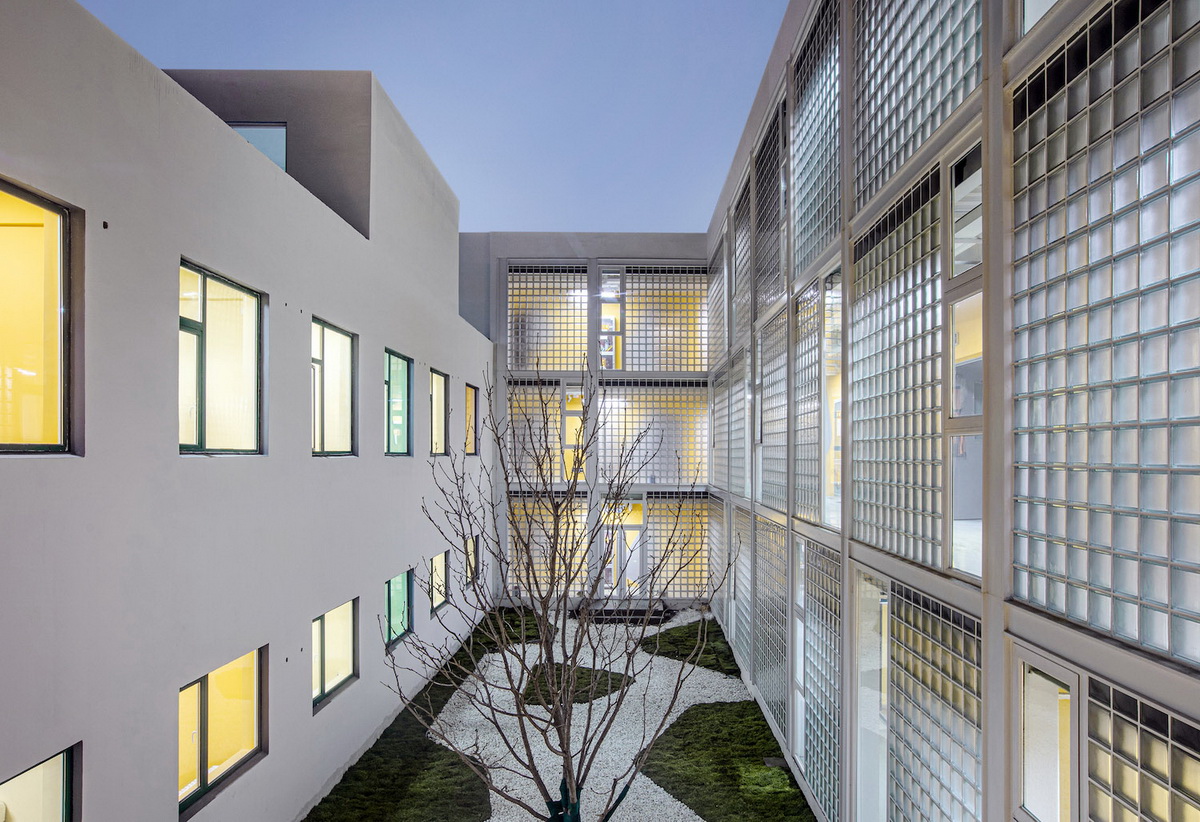
At night, warm goose-yellow light softly filters through the glass bricks © Zhang Peizhi
Landscape design focuses primarily on the inner and outer courtyards and rooftop platforms. The inner courtyard, connected to the entrance hall, provides the initial impression of the apartment. It is designed with a combination of white gravel and plantings to create a serene and stable space.
The exterior landscaping relies on hard paving with varying shades of gray, designed to resemble a skirt wrapping around the building, enhancing its massing. The inner and outer courtyards and rooftop platforms are shaped as islands, introducing a flexible and organic landscape form that contrasts with the building’s angular exterior.
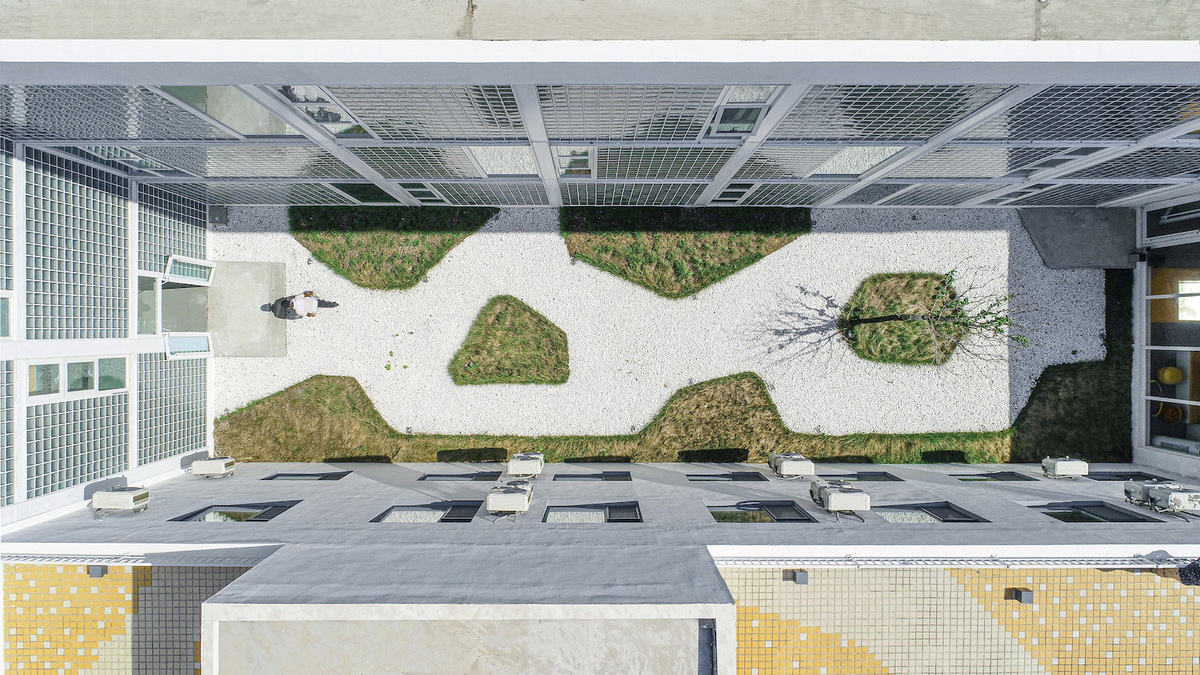
▲ Aerial view of the inner courtyard © Zhang Peizhi

▲ Aerial view of the rooftop platform © Zhang Peizhi
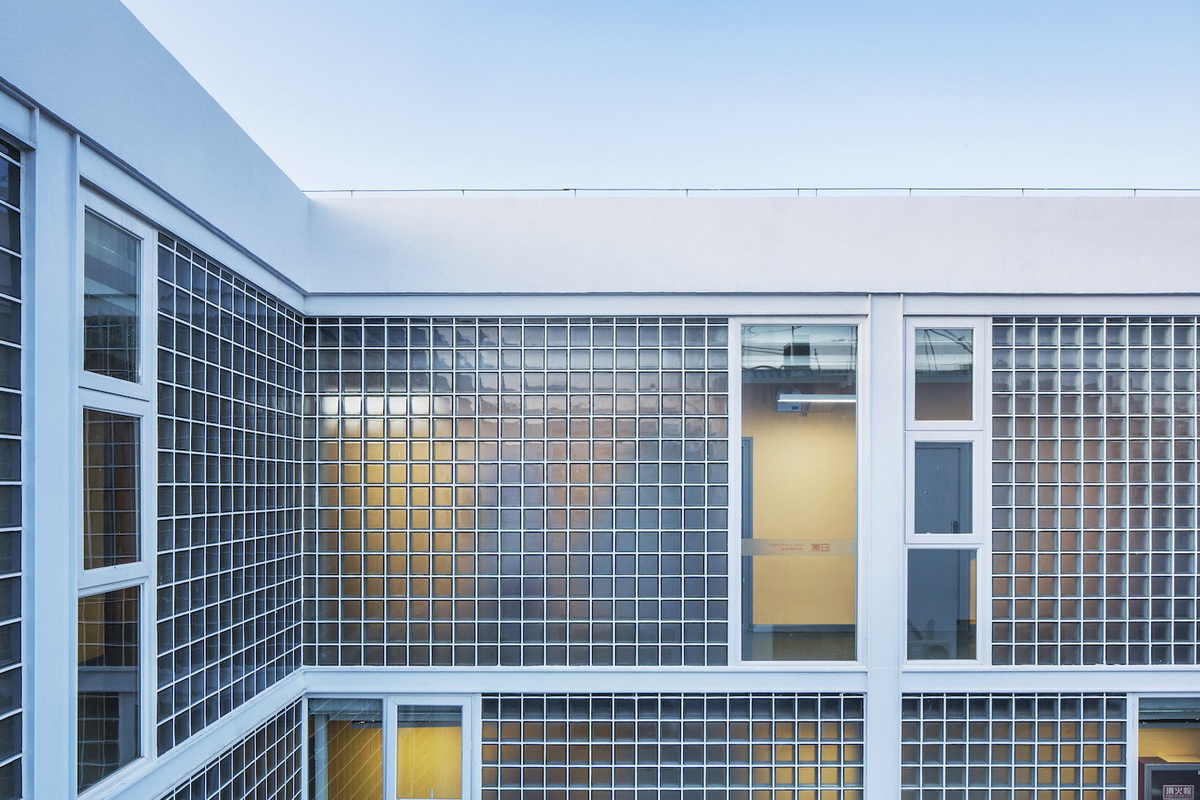
▲ Semi-transparent 200mm square glass bricks © Tang Kangshuo
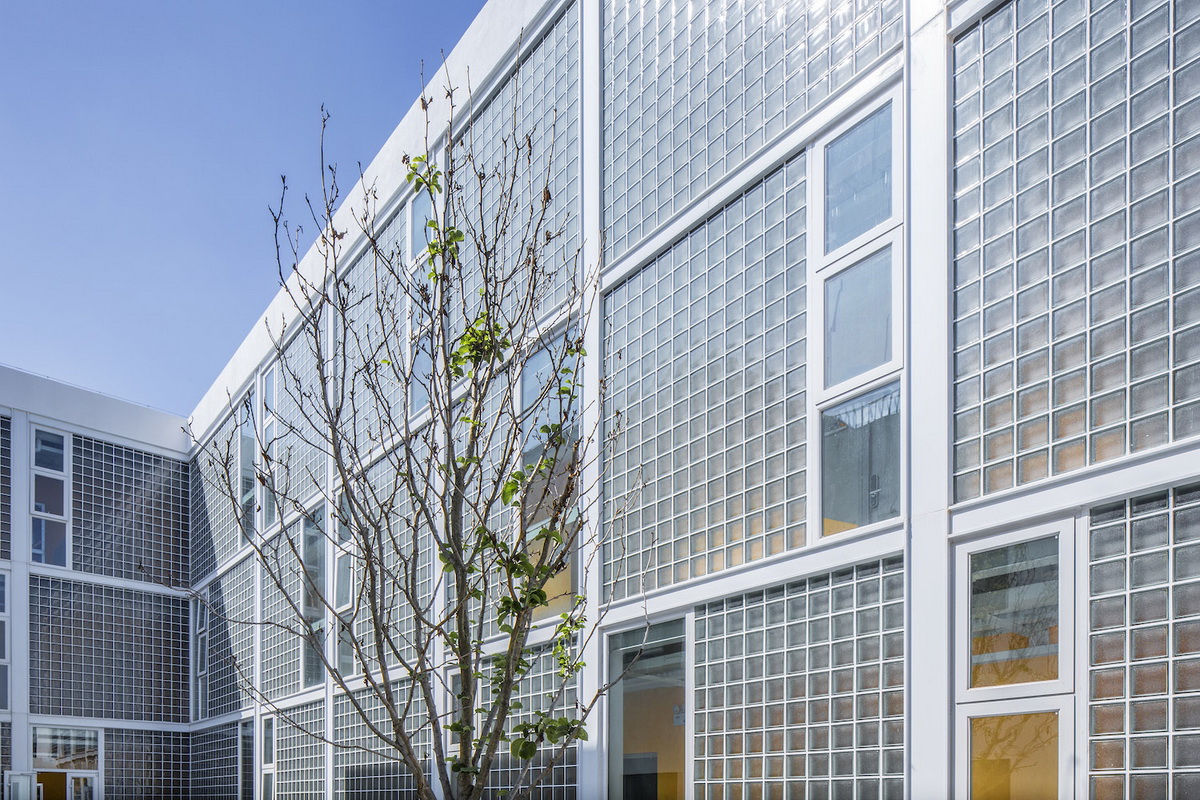
▲ The facade resonates with the blue sky © Tang Kangshuo
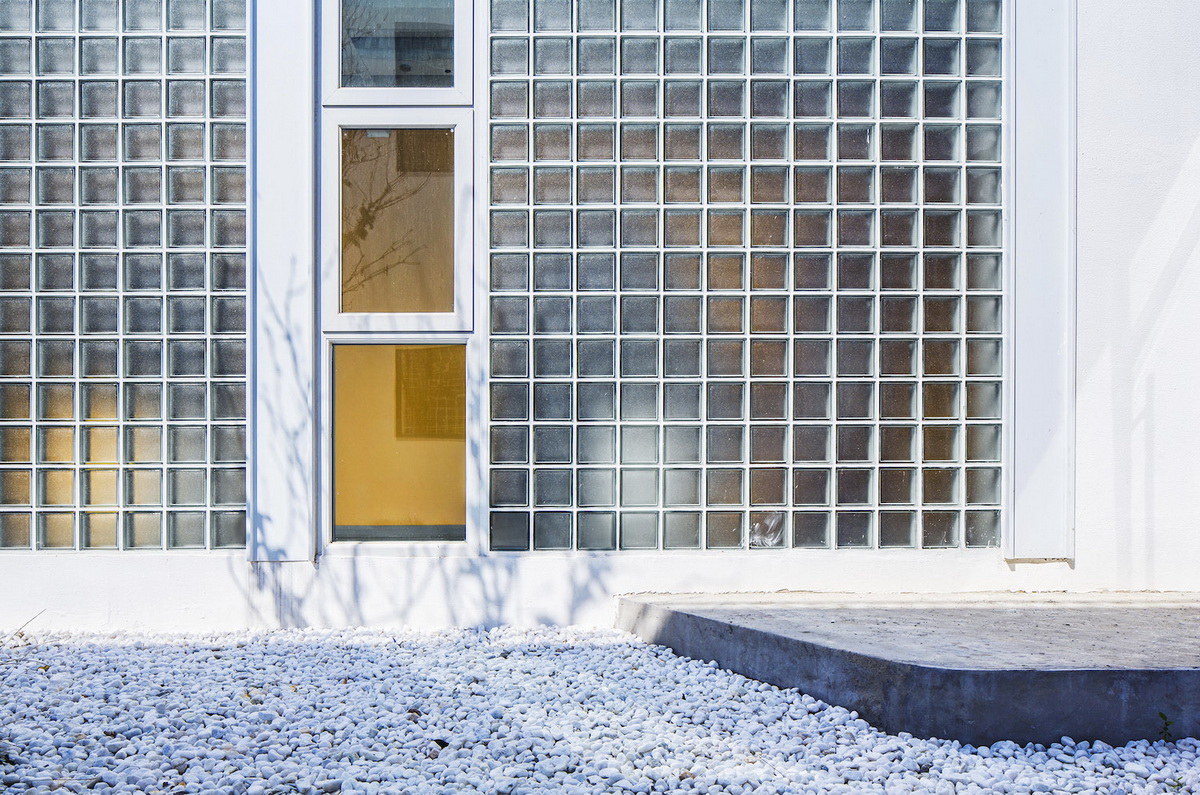
▲ White gravel laid in the inner courtyard © Tang Kangshuo
The project includes a total of 102 apartments. Due to the varying column grid sizes of the original buildings, there are five different layout types with depths ranging from 5.6 to 7.6 meters.
The apartment layouts are divided into three to four functional zones depending on their depth: entrance/bathroom, living area, sleeping area, and extended workspace. Each zone is distinguished by distinct wall colors and furniture arrangements.
The original warehouse building’s second floor had a high ceiling, allowing for the addition of LOFT layouts that separate living and leisure spaces vertically from sleeping areas.
This systematic apartment layout enhances spatial perception and clearly defines functional zones, improving overall living quality.
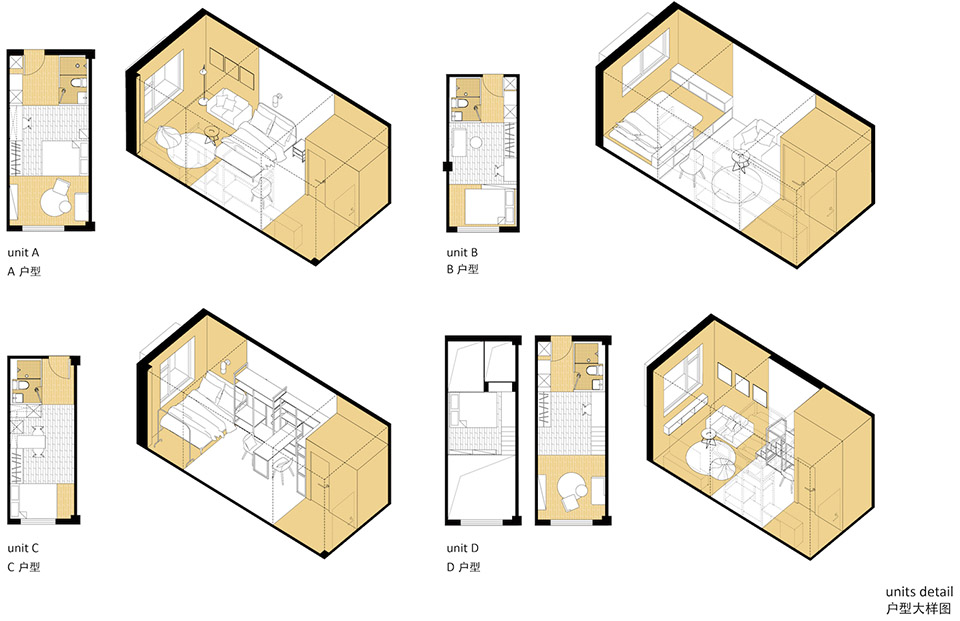
▲ Unit layout plan and axonometric view
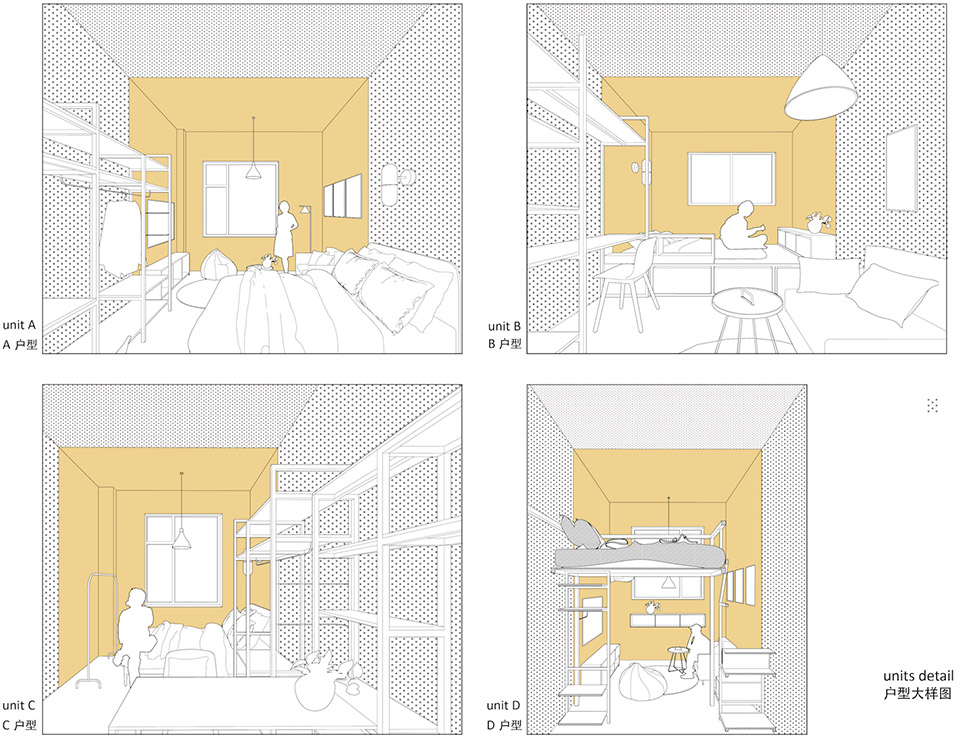
▲ One-point perspective of the unit

▲ Entrance hall © Tang Kangshuo
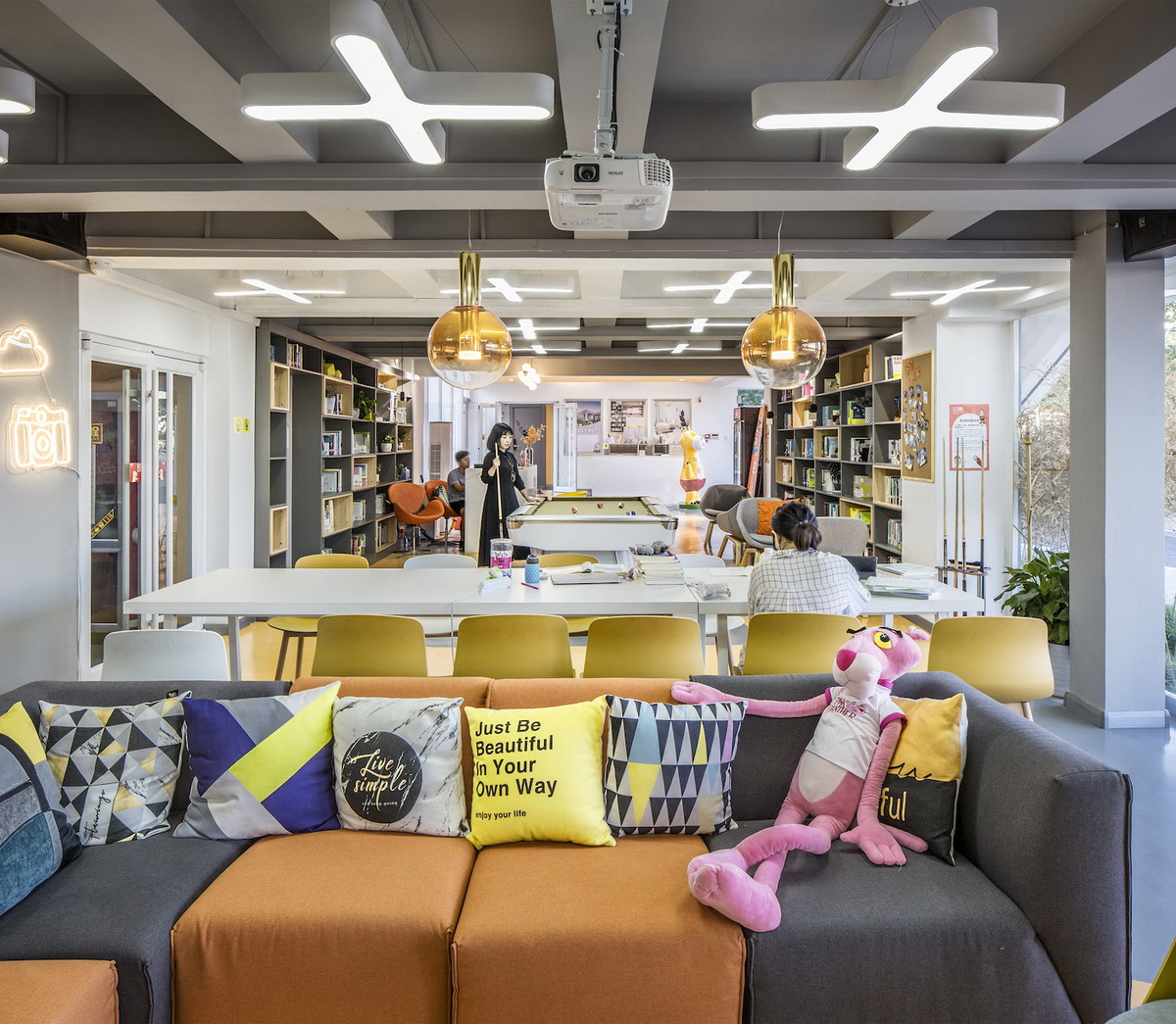
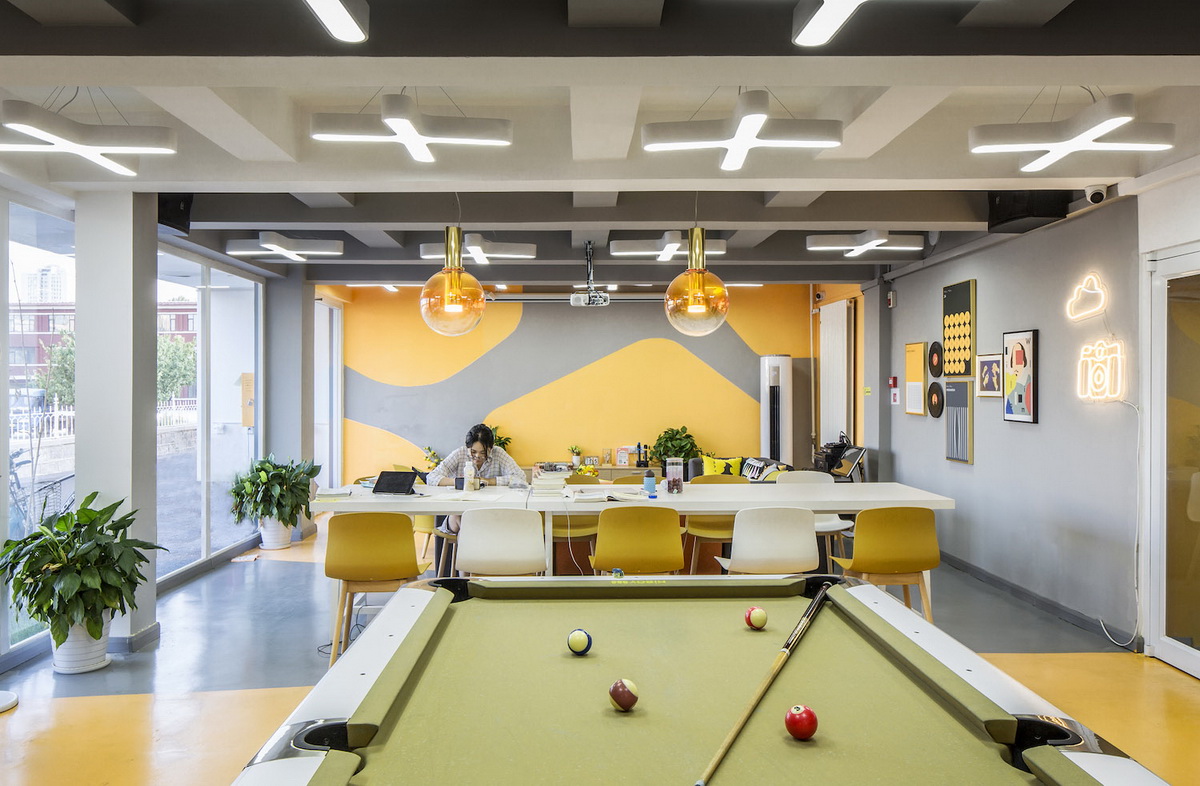
▲ Public rest area © Tang Kangshuo
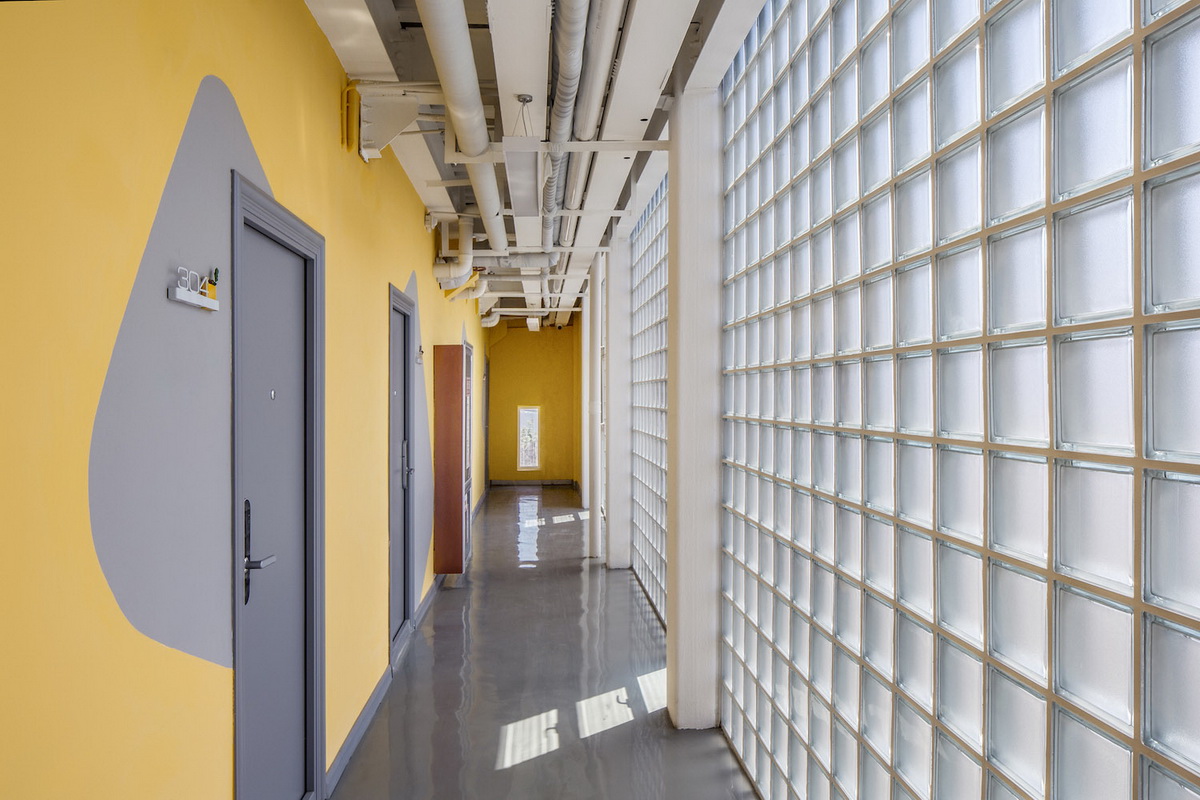
▲ Light filtering through glass bricks illuminates corridors and stairwells © Tang Kangshuo
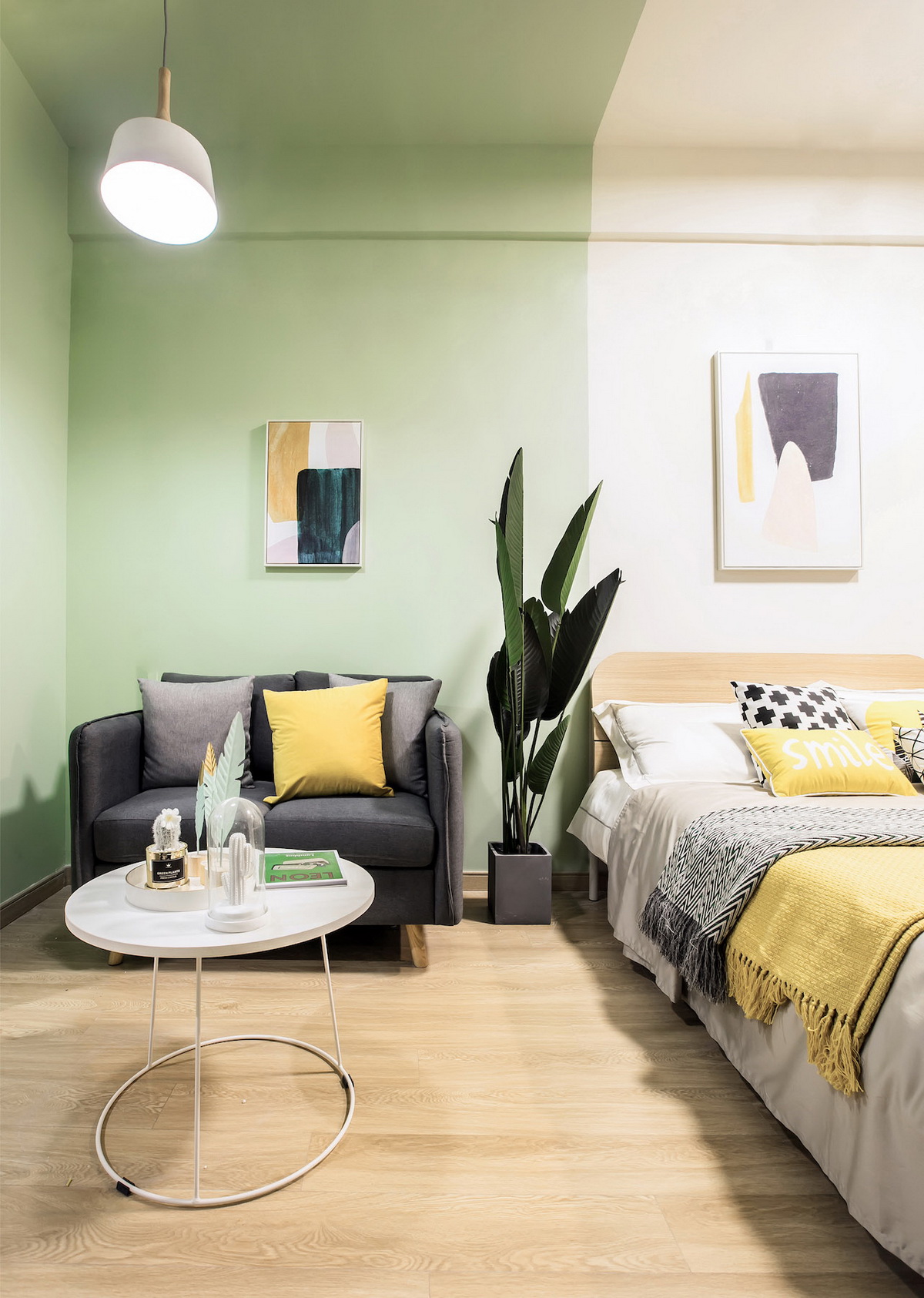
▲ Interior view of an apartment unit © Tang Kangshuo
Philosopher Martin Heidegger once wrote in “The Origin of the Work of Art” that “the work is the work, and it belongs only to the field opened up by the work itself… The existence of the work is to establish a world.” In architectural terms, this means creating a place.
The Chunhui Road Youth Apartment renovation is an experimental approach that goes beyond mere functional reorganization. It seeks to discover a building and spatial character that align with the spiritual identity of this coastal city and its youthful community.
The design redefines the relationship between the building and its urban context by transforming the building’s prominent facade. Artistic elements of color, light, and shadow on the facade create a unique, recognizable spatial identity for the youth apartments.
Additionally, the interior and exterior spaces—including the entrance public area and serene courtyard—are designed to foster a shared lifestyle and communal living experience for young residents.
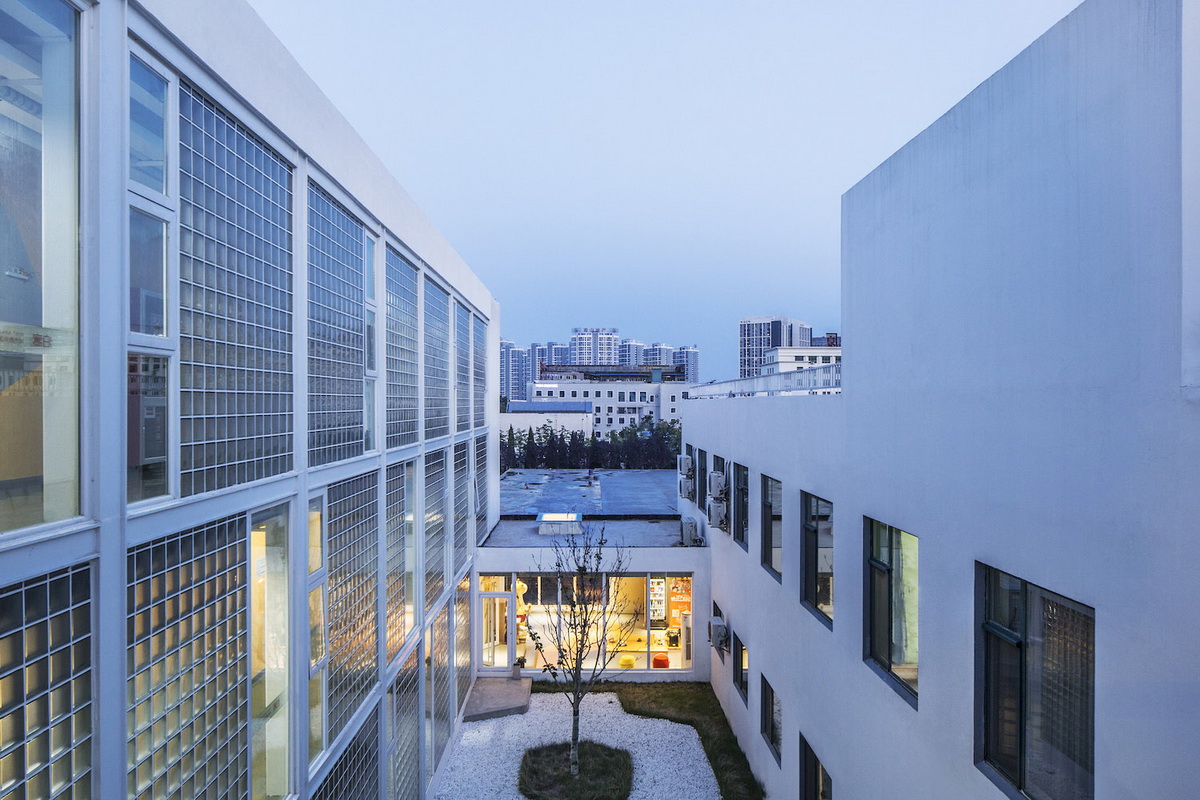
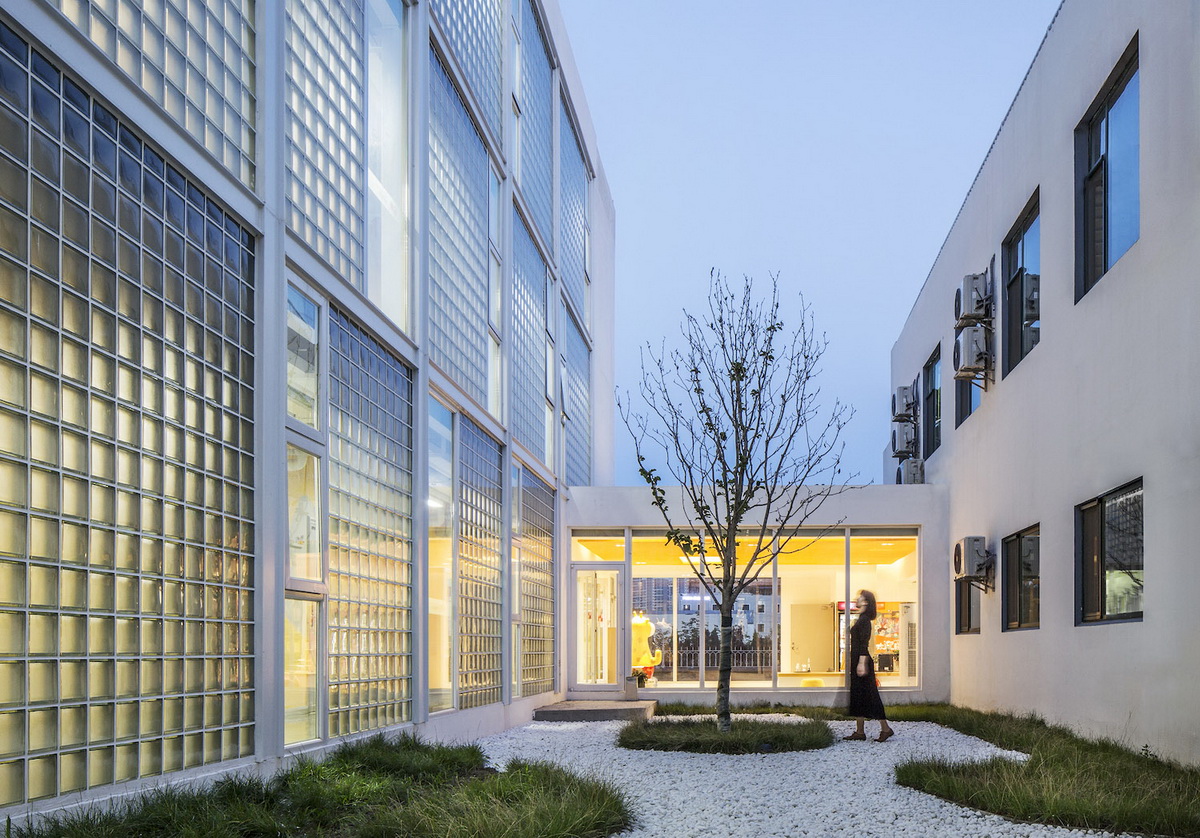
▲ Night view © Tang Kangshuo
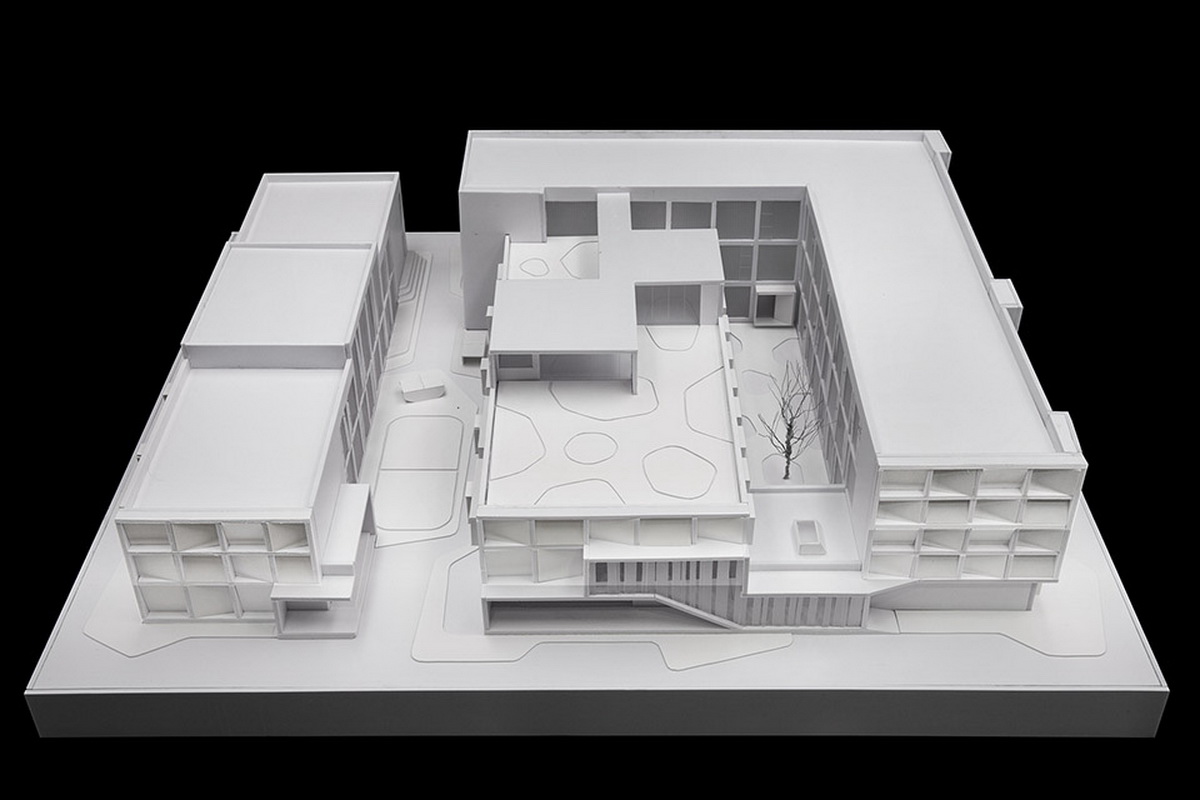
▲ Architectural model
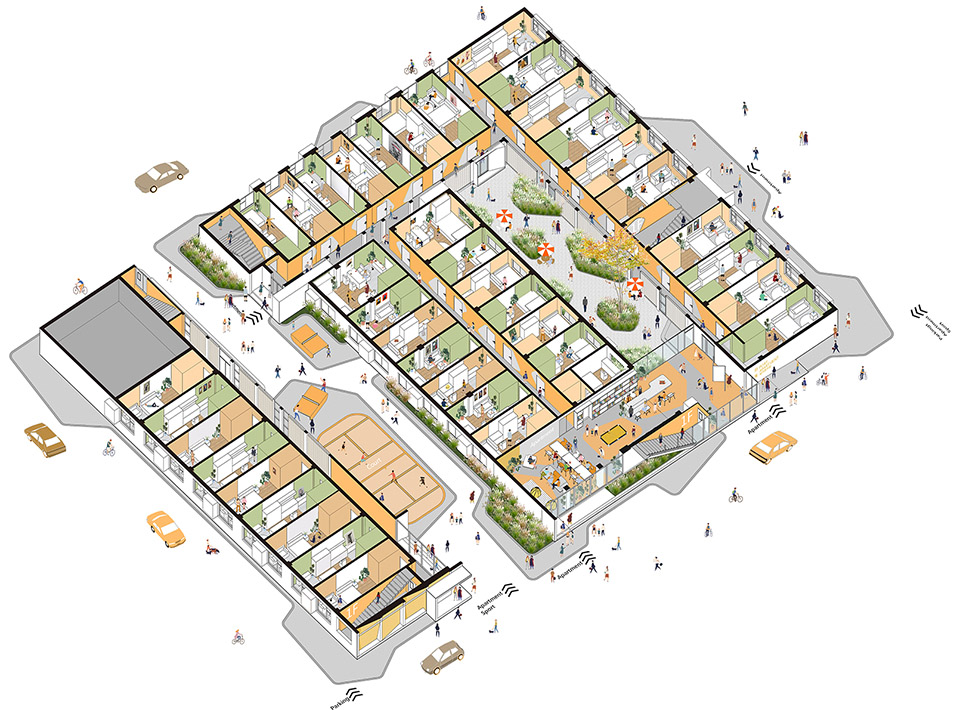
▲ Axonometric diagram of the first floor
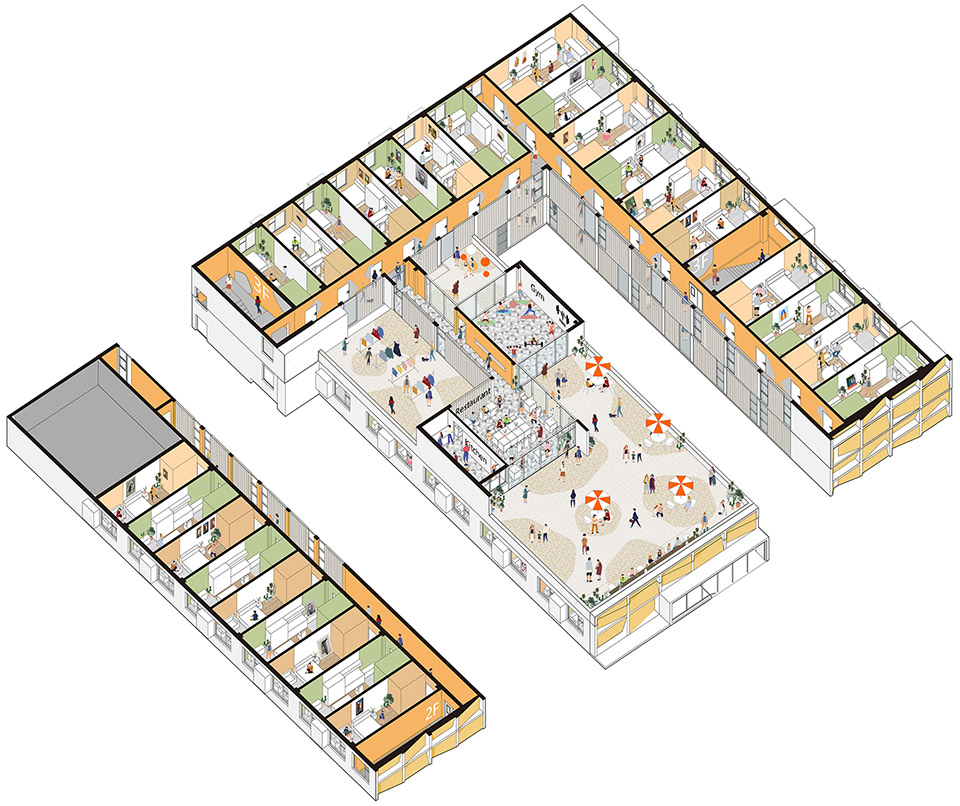
▲ Axonometric diagrams of the second and third floors
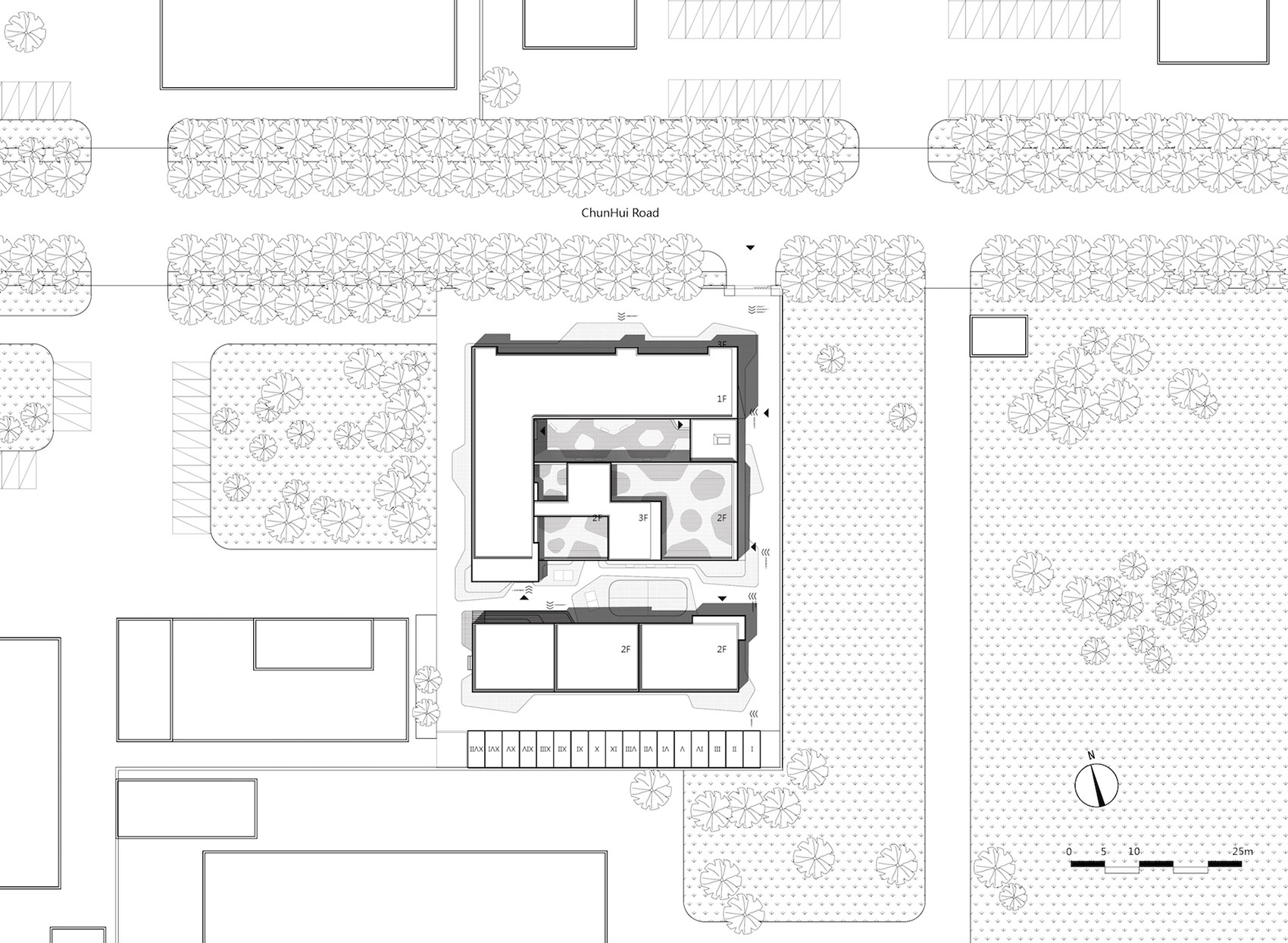
▲ General layout plan
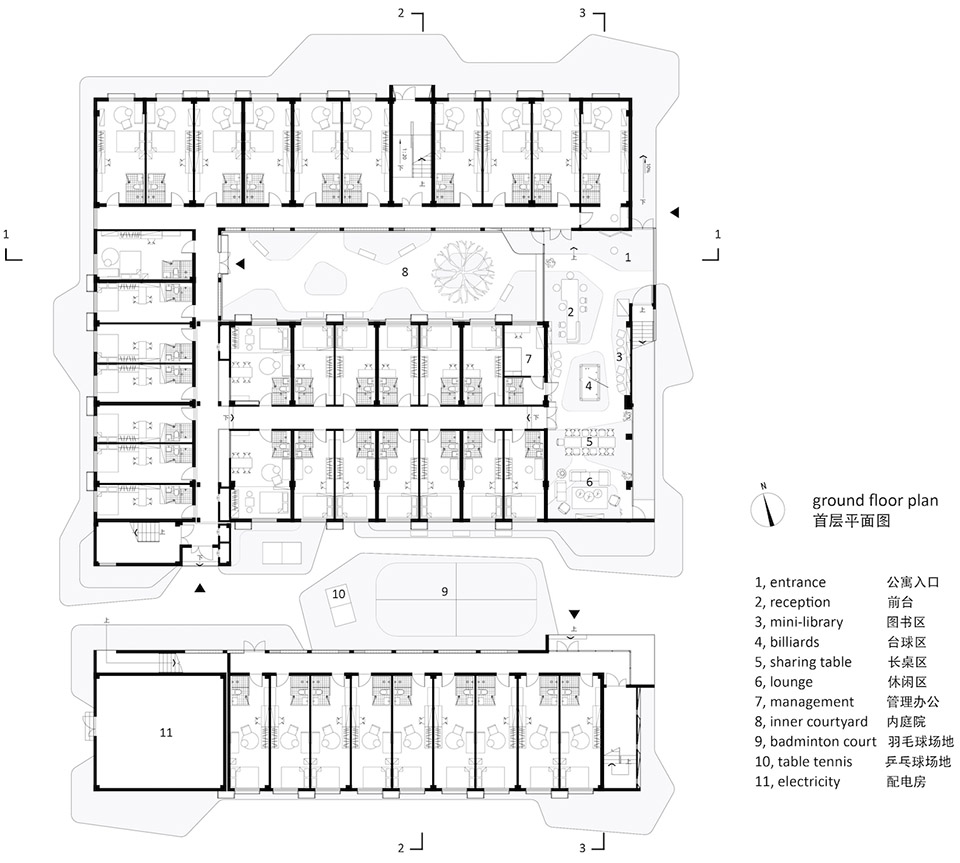
▲ First floor plan
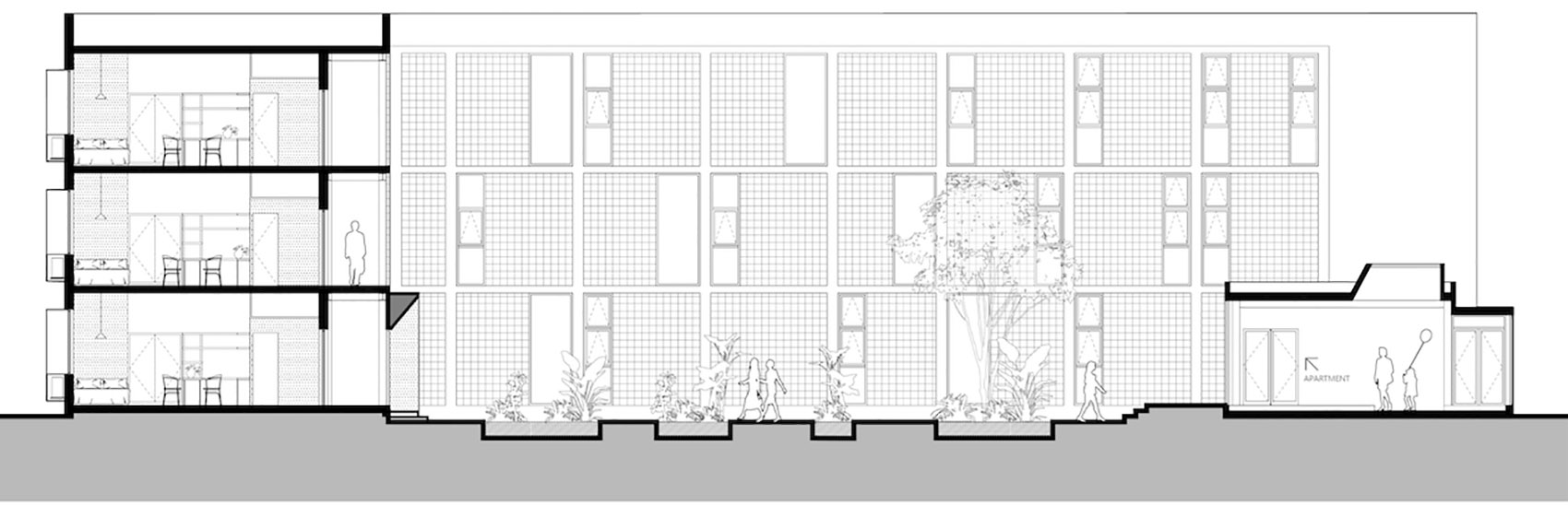
▲ Section 1-1 view
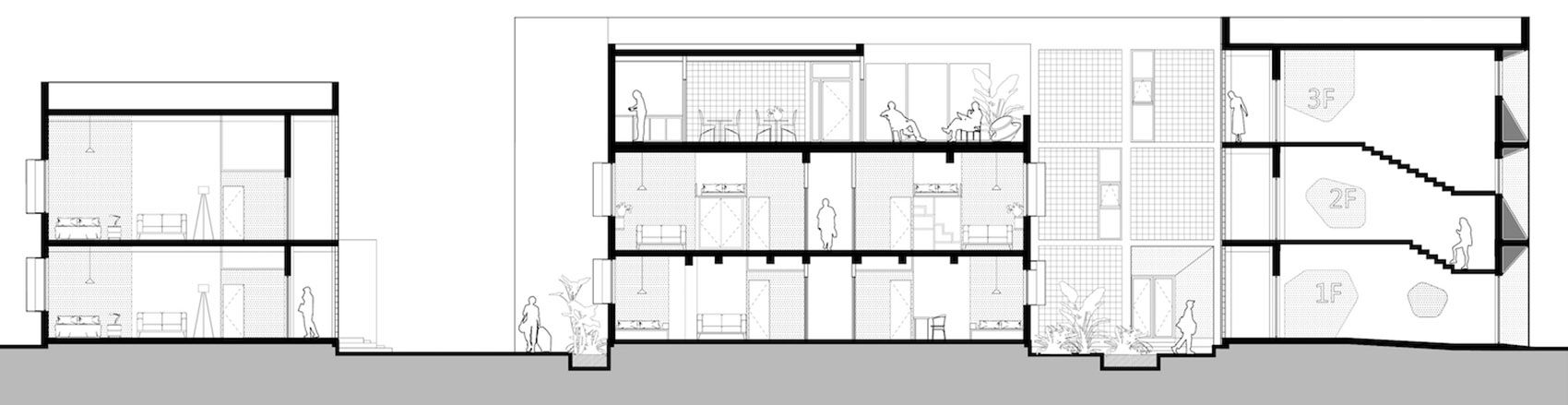
▲ Section 2-2 view
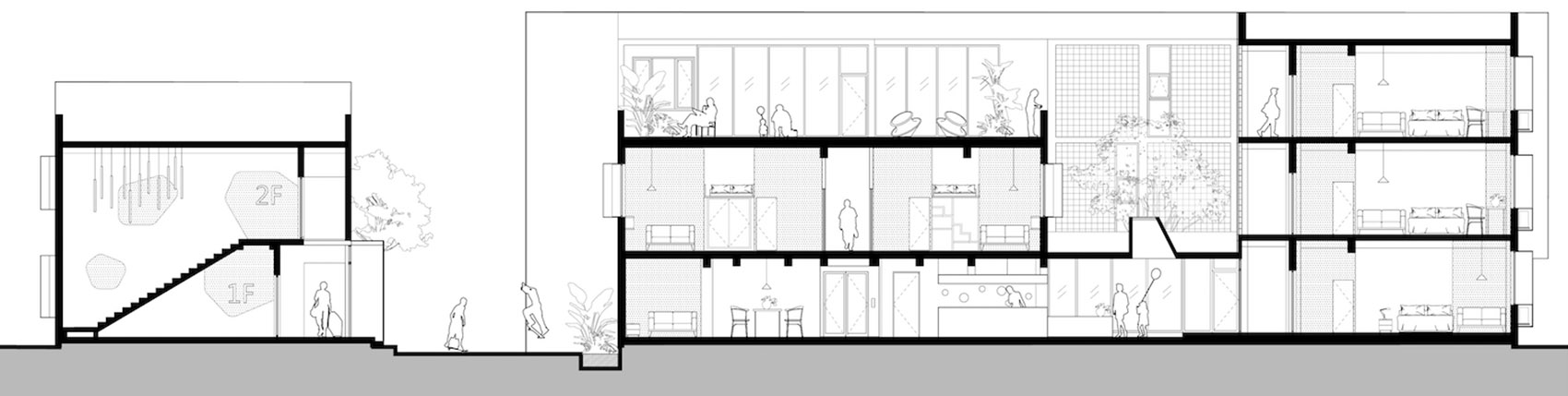
▲ Section 3-3 view
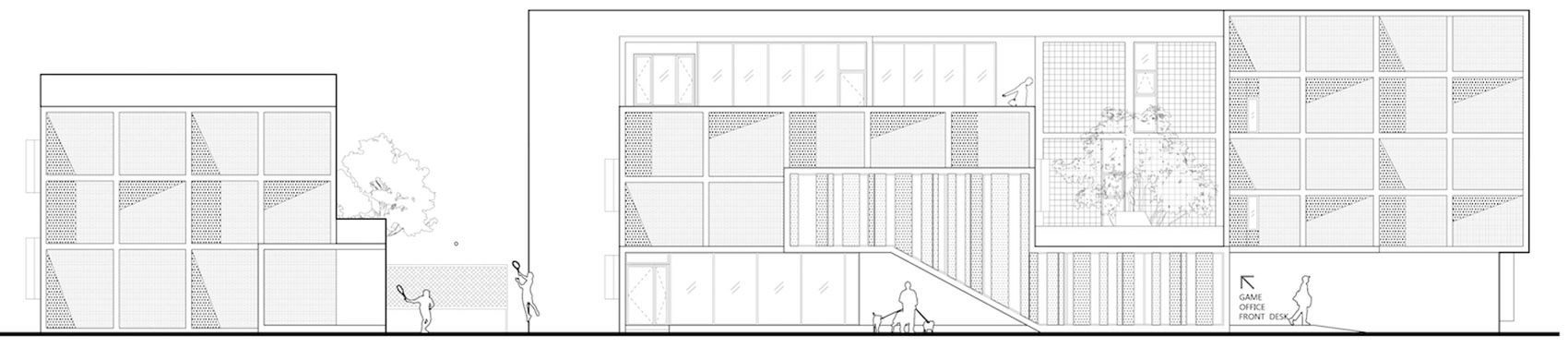
▲ West elevation view
Project Information
Project Name: Boyu, Chunhui Road, Yantai
Architecture/Interior/Landscape Design: MAT Super Architecture Firm
Lead Architects: Tang Kangshuo, Zhang Miao
Design Team: Lou Yunbin, Wu Mingyu, Zhang Shuang, Liu Huixian
Design Period: July 2018 – November 2018
Completion Date: April 2019
Project Owner: Yantai Boyu Apartment Management Co., Ltd.
Building Area: 3,220 square meters
Structural System: Concrete frame with partial steel structure
Main Materials: Square steel, glass bricks, cement pressure board, wood wool sound-absorbing board, epoxy self-leveling flooring
Architectural Photography (excluding annotations): Tang Kangshuo
Aerial Photography: Zhang Peizhi












Must log in before commenting!
Sign Up