
1. How to Choose a Release Agent
The primary purpose of applying a release agent to the inner surface of concrete formwork is to reduce the adhesion between the concrete and the formwork. This facilitates easy removal and prevents damage during demolding, especially since concrete has low initial strength in prefabricated construction. Additionally, the release agent helps maintain a smooth concrete surface, protects the formwork from deformation or corrosion, and makes cleaning easier, ultimately reducing repair costs.
Therefore, an ideal release agent must meet the following criteria:
1) Excellent demolding performance;
2) Easy application, quick molding, and simple cleaning after mold removal;
3) No adverse effects on the concrete surface’s appearance—no staining, impregnation marks, or yellow discoloration;
4) Harmless to steel reinforcement and concrete;
5) Protection of formwork to extend its service life;
6) Good stability;
7) Strong resistance to water and weather conditions.
Release agents are generally classified into two types: water-based and oil-based. Water-based release agents are safer to handle, do not produce oil mist, have minimal environmental impact, and pose less harm to human health. They are user-friendly and have gradually become the preferred alternative to oil-based agents. Importantly, water-based agents do not interfere with secondary processing steps such as bonding or color coating.
On the other hand, oil-based release agents tend to be more expensive and generate oil mist, which contributes to air pollution at integrated decoration and processing sites. This poses health risks to workers and can negatively affect subsequent processing of components. Therefore, prefabricated concrete (PC) factories are encouraged to use water-based release agents to reduce costs and improve the quality of their components.
2. Acceptance, Inspection, and Storage of Release Agents
According to Article 9.2.13 of the “Labeling” standard, the acceptance and inspection procedures for release agents should adhere to the following guidelines:
1) The release agent must be non-toxic, odorless or have no irritating smell, and must not compromise the concrete’s performance or the appearance of prefabricated components;
2) Homogeneity and construction performance tests should be conducted annually—both before selection and during regular use—based on the agent’s application type;
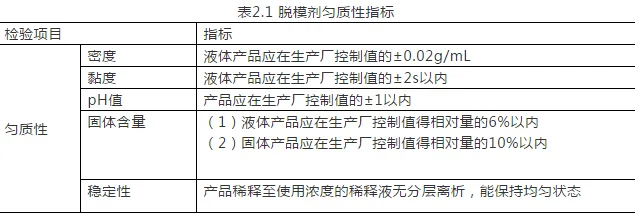
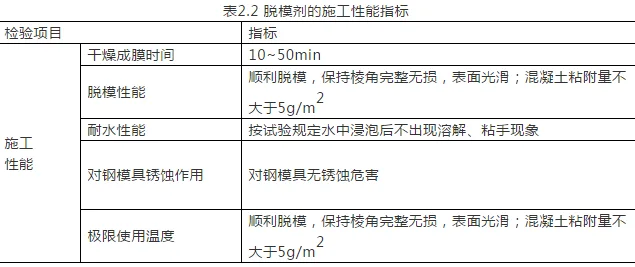
3) Inspection results must comply with the main requirements set forth in the current industry standard for concrete product release agents (JC/T 949):
① The uniformity index should meet the criteria shown in Table 2.1.
② The workability parameters should meet the requirements outlined in Table 2.2.
Additional acceptance and storage protocols include:
1) During acceptance, verify the purchase order against the product name, manufacturer, specifications, model, production date, and instruction manual;
2) Protect the release agent from exposure to direct sunlight, rain, and freezing temperatures during transportation and storage;
3) Store the release agent in a dedicated warehouse or designated area with proper labeling to facilitate easy identification, inspection, and retrieval;
4) Use the release agent within its specified shelf life. If the usage period has expired, conduct testing and inspection before use, and only proceed if the agent passes these checks.















Must log in before commenting!
Sign Up