
Have you ever noticed plastic balls placed between the upper and lower plates of a concrete slab as a substitute for concrete? Is this an attempt to cut corners?
Recommended to watch on WiFi
After thorough research and verification, it turns out this is an advanced technology that has received national technical certification from the German Building Technology Association as well as the Swiss Environmental Award.
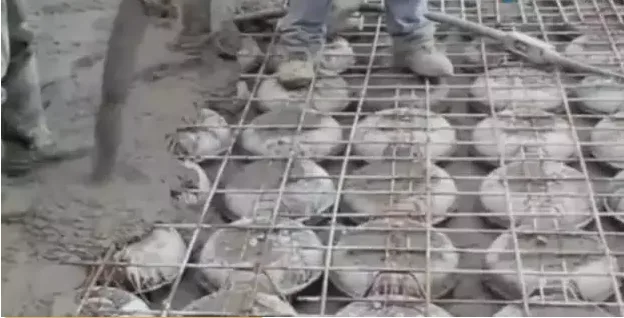
Using plastic balls can reduce the amount of concrete needed in slabs by up to 30%, while also lowering carbon dioxide emissions and reducing the consumption of building materials. This approach supports sustainability in the construction industry. The plastic balls are made from recycled materials, making them both environmentally friendly and durable. Their cost is comparable to traditional concrete, and many countries have already adopted this method.
1. Application of Plastic Balls in Floor Slabs
The use of plastic balls in floor slabs represents a revolutionary innovation in construction. This technology is non-load bearing. By filling slabs with recycled plastic balls, concrete usage is reduced, the structural weight decreases, and the building’s lifespan is extended. Incorporating recycled plastic allows the span between structural columns to increase by 50%. Additionally, this slab system connects concrete structures in two directions, eliminating the need for crossbeams. Key features include:
- No design restrictions; flexible and versatile forms adapt to various building styles;
- Significant reduction in self-weight, greatly lowering foundation costs;
- Column spans increased by 50% compared to traditional structures;
- Crossbeam construction eliminated, speeding up the building process and reducing costs;
- Concrete usage minimized—1 kg of recycled plastic replaces 100 kg of concrete;
- Energy-efficient, environmentally friendly, low-carbon, and helps reduce carbon emissions.

Plastic ball floor slabs have been successfully used in various European construction projects for nearly a decade. In Denmark and the Netherlands alone, over 1 million square meters of multi-story buildings utilize this system.
2. Installation Overview
The installation process is straightforward and includes the following steps:
- Set up temporary supports before installation, placing horizontal beam supports at intervals of 1.8 to 2.4 meters;
- Position the semi-finished components in place within the structure;
- Lay the upper layer and install bottom fixing devices, then bind the upper layer with a mesh structure to connect components;
- Install shear reinforcement devices between columns;
- Install edge reinforcement devices;
- Set up the pouring device, which mixes and pours concrete, securing it to the horizontal mesh structure above;
- Place polymer plate supports between components and columns during pouring device preparation;
- Prepare before pouring by sealing gaps, cleaning, and wetting the existing concrete;
- Pour concrete, vibrate, and allow a maximum settlement allowance of 10 mm;
- After 3 to 5 days, remove the temporary support structure.
3. Technical Specifications
Different building structures require different design approaches. The plastic ball floor system adapts to these needs with several options, as illustrated below:
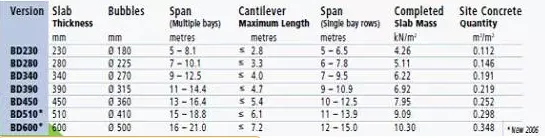
This system supports three different plans:
Plan A: Precision Components
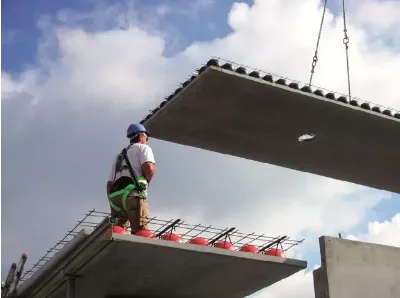
This plan features prefabricated concrete base layers of 70mm thickness as a permanent structure, eliminating the need for prefabricated load-bearing molds. Components are placed on temporary supports with connection joints, including pre-installed shear and edge reinforcements. Edge molds are then installed, followed by pouring the cover plate. This option suits new construction projects but requires crane assistance.
Option B: Prefabricated Component Template
This method places components directly over traditional structures, followed by prestressing and pouring. It is ideal for renovation and refurbishment projects.
Plan C: Wooden Components
Wooden components are manufactured off-site and installed directly into buildings, intended only for non-load bearing applications.
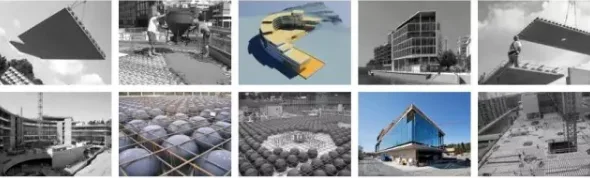
This system has been successfully applied in numerous prefabricated building projects, including the 32,000-square-meter Media City, Millennium Building, and City Hall Office. Using this method significantly shortens construction time and increases design flexibility.
4. Summary of Advantages
This technology sets the benchmark for green energy conservation. Thanks to the sandwich structure used during construction, a significant amount of concrete is saved. For every 5,000 square meters of plastic ball floor slabs installed, 1,000 cubic meters of concrete are conserved. This translates to reducing 166 truck trips, lessening foundation loads by 1,798 tons (equivalent to 19 pile foundations), saving 1,745 GJ of energy used in concrete production, and cutting carbon dioxide emissions by 278 tons!














Must log in before commenting!
Sign Up