
Introduction: Product standardization is a strategic approach commonly adopted by leading real estate companies. For example, Greentown has expanded its villa series, “Rose Garden,” to 13 cities, while Vanke has developed 13 Vanke City Gardens across different locations. Wanda Plaza, a subsidiary of Wanda Group, aimed to reach 80 locations by 2012. The standardization rate for projects within the same product series at these companies has reached a significant level, aligning closely with standardized product design.
Product standardization is a widely embraced strategy among top-tier real estate firms. Greentown’s “Rose Garden” villa series spans 13 cities, and Vanke has built 13 City Gardens in various urban areas. Wanda Plaza planned to expand to 80 locations by 2012. The degree of standardization across projects under the same product series is substantial. Alongside product design standardization, standardizing design management is crucial for rapidly replicating design standards across projects. Key elements in this process include standardized construction timelines, workflows, and change control protocols.
1. Standard Construction Period: Benchmarking, Monitoring, and Maintaining Momentum for Project Development
Ensuring a reasonable and effective design timeline is essential for maintaining design quality. When design plans lack rigor and timelines are compressed, they often fail to align with project development schedules. This misalignment can lead to delays and revisions in landscaping and decoration plans, a shortened construction drawing design phase, and insufficient drawing detail. To address this, headquarters should establish standard timelines for each design phase, create design progress tracking tools, and enforce strict monitoring of project design schedules, with particular attention to key milestone completions.
Step One: Establish Standard Construction Periods, Develop Progress Tracking, and Strengthen Plan Monitoring
The headquarters should oversee construction drawing design management by setting standard durations for each design phase and developing progress tracking tables. These should map project development plans, design schedules, and monthly work plans. Clear accountability for key tasks must be assigned to responsible individuals and collaborating departments, with enhanced plan review and monitoring. Construction drawing design guidelines and design output standards should be organized. For key projects, preliminary conceptual designs (planning) should be prepared; for ordinary projects, mature designs can be directly commissioned, bypassing the design comparison phase. Risk prevention measures should be built into plans to provide early warnings for potential delays. If the schedule cannot be met, early notification and communication are required to adjust the design timeline within deadlines.
For example, Vanke Group reduced the technical decision-making period for its Four Seasons series from 4.2 months to 2.5 months through product standardization, significantly shortening the overall project development cycle. Jiazhaoye rigorously controls drawing timelines to minimize the period from land acquisition to clubhouse construction. They developed a timeline template to confirm land intentions quickly, complete conceptual planning within seven days, submit construction plans in 30 days, and begin piling within 60 days after land acquisition, ensuring project launch within seven months.
Table 1: Design Cycle Analysis
Design Cycle Analysis
Comparison
Project 1
Project 2
Project 3
Benchmark
Phase 1
Phase 2
Standardization
Mature Project 1
Mature Project 2
Pre-project Phase
Conceptual Design (Preliminary)
Formal Planning for Bidding and Tendering
Design Proposal
Detailed Regulations + Individual Units
Preliminary Design
Construction Drawing Design
Construction Drawing Application
Cumulative
Average Design Cycle of the Project
Note: Standardization Project refers to providing mature construction drawings. Mature Project denotes a mature product with intentions to redesign plans or facades. Mature Project 1 excludes formal planning bidding, whereas Mature Project 2 includes it.
Step Two: Set Standard Intermediate Checkpoints to Monitor Secondary Design Progress
Project companies should schedule the secondary design phase according to the group’s standardized construction timelines, enabling early decision-making and communication to minimize design unit downtime caused by internal processes.
Unified intermediate checkpoints should be established throughout the design process. For each design discipline, at least one checkpoint should verify the progress at 50% completion. Construction drawing design requires at least two checkpoints to assess progress at designated milestones.
The design schedule submitted by design units must allow ample time for proofreading, review, and approval. Construction drawing design timelines should be standardized based on design scope. Project companies must review and monitor the design unit’s detailed schedules, ensuring timely execution. Upon receiving drawings, the group design company should coordinate with subordinate design departments to conduct optimization reviews within the standard timeframe.
2. Standard Process: Parallel Operations and Standardized Decomposition to Ensure Timely Delivery and Quality
When establishing effective design management workflows, savvy real estate firms ensure they align with company realities and design standardization needs. They adopt parallel processing, standardized decomposition, and detailed operations to guarantee timely completion and maintain design quality.
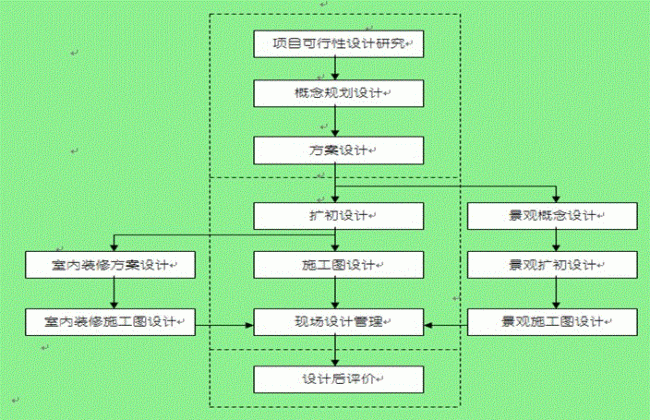
Step One: Implement Parallel Workflow and Strengthen Coupled Design Discipline Management
Moderate parallelism and coupling within the five key design stages can compress timelines, balance value across phases, enhance overall efficiency, and improve construction speed and quality. These stages include conceptual design, preliminary design, expanded preliminary design, and construction drawing design, traditionally viewed as a linear sequence.
Leading companies now initiate architectural, landscape, and interior designs during planning or scheme phases. This approach fosters design improvements in efficiency and quality.
Developers should define integration timelines for various design elements, standardize content, and set operational standards. Interior design should be incorporated during architectural scheme development to optimize building layout and avoid redundant construction drawings later.
Table 2: Parallel Design Process
Step Two: Standardize and Decompose Processes into Forms for Daily Use
Standard processes break down workflows into forms integrated into daily tasks and performance assessments. Design managers clarify key control points, unify design depth and evaluation criteria, standardize input/output documentation, and maintain proper records.
During the feasibility stage, technical evaluation methods address unit type levels and plot ratio relationships to support rapid decision-making.
In the conceptual design stage, efforts focus on data collection, product strategy, design unit selection, evaluation criteria, delivery standards, and cost requirements. Sample layouts and unit combinations are provided to guide preferred options, saving time and preventing detours.
The deepening plan stage includes geological reports, structural scheme selection, equipment choices, and material lists, with unified technical requirements and continuous case study improvements to enhance quality.
Construction drawing design involves detailed survey reports, application processes, internal and external drawing audits, and standardized engineering practices to reduce errors.
Construction coordination covers surveying, measurements, commencement certificates, and pre-sale approval management.
Step Three: Standardize External Collaboration to Accelerate Internal Processes and Boost Efficiency
Internal parallel processing requires proactive external process management, completing preparatory tasks early to support subsequent phases. Construction applications are the most unpredictable aspect of design and critical to rapid progress.
External coordination involves government bodies, monopolistic enterprises, and partners. Where possible, multiple parallel lines should be deployed to shorten timelines.
Project companies can decompose the construction application process into work breakdown structures (WBS), assigning clear deadlines and responsibilities. Network diagrams clarify task overlaps and dependencies, enabling all stakeholders to coordinate effectively. Preparing design input conditions and organizing standard documents, such as “Sensitive Points for Development Project Applications,” for nationwide sharing helps reduce design and application cycles.
3. Design Review Standardization: Define Evaluation Criteria and Establish a Three-Level Review System to Ensure Economic and Quality Outcomes
Design review should be refined and standardized across two dimensions: quality evaluation and decision-making. By defining key scientific and reasonable review points, a systematic and in-depth evaluation system can be established. A hierarchical review and decision-making mechanism improves review efficiency and ensures compliance.
Step One: Divide Design Stages into Sub-Items and Establish Evaluation Criteria
Using apartment products as an example, conceptual planning and design reviews focus on principles, planning structure, overall layout, and resource utilization. Evaluation criteria are developed for each area.
Principles cover drawings, planning conditions, technical specifications, and completeness (e.g., overall plans, analysis diagrams, building intentions). Reviews assess whether design scope meets requirements (e.g., red line boundaries, perimeter connections) and consider land planning, fire safety, sunlight, and traffic assessments.
Planning structure and layout evaluations include clear axis lines, rigorous composition, symmetry, logical group divisions, road hierarchy, and pedestrian-vehicle separation. Public spaces are typically central or at entrances, serving as core landscapes. Building clusters form well-scaled neighborhood spaces, complemented by landscape design for unique residential units combining point and slab arrangements, fostering openness and privacy. Relationships between clubs, commercial areas, and educational and medical facilities are also considered.
Resource analysis and utilization focus on optimizing surrounding landscapes, maximizing planned space potential—including corners like front and back yards and vertical transitions—and integrating perimeter designs with the urban interface.
Step Two: Implement a Hierarchical Review and Decision-Making System
A three-level review framework ensures efficient, scientific, and lawful design evaluations:
- Level 1 Review: Group leaders or the general manager hold final approval authority for major design milestones via review meetings. The design director, alongside marketing, cost, engineering, and property management, participates. The Planning and Design Department schedules meetings three days in advance. Meeting minutes are distributed within three days and archived.
- Level 2 Review: The design director decides on design phase plans and subsequent steps through report meetings involving marketing, cost, engineering, and project management. Meetings are confirmed one day prior, with minutes distributed within three days.
- Level 3 Review: Department managers discuss stage plans in design through discussion meetings with supervisors from related departments as needed. Outcomes are communicated via email within three days and reported to the design director.
4. Change Control: Define Principles, Responsibilities, and Standardized Procedures to Manage Design Changes
Design changes significantly impact progress and quality. Within a standardized management framework, principles, responsibilities, processes, and evaluations for change management must be clearly defined.
Step One: Enforce Strict Review Procedures to Prevent Unauthorized Changes
A rigorous design change review system minimizes unnecessary approvals and reduces risks from arbitrary alterations. Changes to building facades, landscapes, and public doors/windows demand chief designer approval.
Major Design Changes are defined based on their impact on functionality and facade consistency, including planning scheme adjustments, unit layout changes, and significant facade modifications.
Authorization Rules: Strict controls on approval authority apply. Unauthorized signatures are invalid and liable for company losses.
Time Limits: Design change processing and settlement must adhere to strict deadlines, with no retroactive approvals allowed.
Completion Confirmation: Upon material component changes, engineering and supervising engineers must sign off within five days, or prior to concealment for hidden projects.
Step-by-Step Review: Change approvals follow the design rights and responsibilities manual. Approved changes are communicated via change notices and documented with on-site visa forms.
Step Two: Standardize Approval Processes Including Change Proposals, Cost Reviews, and Decision-Making
The project company leads change management, coordinating design modifications to optimize costs and quality during construction. They complete change approval forms and manage internal approvals. The group design company coordinates drawing changes and conducts technical audits, initiating material changes as necessary. They analyze change costs and provide management recommendations.
For expansion and prefabrication projects, the engineering technology department proposes major changes, organizing design companies to develop change plans. The contract department estimates cost impacts. After review, the project company submits major change approval forms with supporting reports detailing reasons, plans, costs, and schedule effects. The Planning and Design Department coordinates approvals. Implementation occurs post-review by responsible parties. Conflicts among departments are resolved via major design change review meetings.
Step Three: Inspection and Assessment Through Compliance Spot Checks
Standardized documentation and numbering facilitate easy tracking of change outcomes. After change approval, feedback is given to the Engineering Procurement Department. The project’s document administrator assigns unified numbers to approval forms, distributing copies to subsidiaries and the cost department. If construction reapplications are needed, approved change drawings are submitted for authorization. Changes impacting sales commitments are filed with the Marketing Planning Department.
The group design company and cost management conduct regular spot checks on subsidiary design change compliance. Results inform the annual standardization assessment. Non-compliance is reported promptly, triggering appropriate corrective actions under the reward and punishment system.













Must log in before commenting!
Sign Up