
What are the origins and key characteristics of BIM technology? The concept of BIM dates back to 1974 with the introduction of the “Building Description System (BDS)”, designed to store architectural design information encompassing all building elements and spaces. By 1987, BIM technology was first applied within information systems under the term “virtual architecture”. The term “BIM” itself officially emerged in 1992, gaining widespread acceptance after Autodesk published a white paper describing it as a strategy to apply information technology within the construction industry. Today, BIM is recognized as a leading technology in architectural design and related fields.
In the early 2000s, BIM modeling technology began supporting architectural and engineering design in pilot projects. Since then, research has primarily focused on leveraging BIM to enhance planning, design, clash detection, visualization, quantification, cost estimation, and data management.
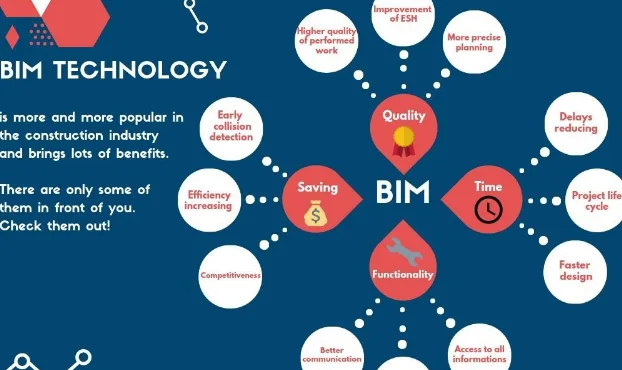
1. Definition of BIM
Despite advances in BIM, professionals across industries often hold varying views on its true nature. A common misunderstanding is to consider BIM merely as software or simply a 3D representation of architectural designs. Scholars have approached BIM from multiple perspectives: as a process, a simulation, a method, an evolution, or a technological tool. Each perspective offers valid insights tailored to roles such as engineering management, facility management, architectural design, and engineering design.
However, none of these alone fully capture BIM’s scope. The most comprehensive and authoritative definition comes from the U.S. National BIM Standard: BIM is the digital representation of the physical and functional characteristics of a facility, serving as a shared knowledge resource for facility information and providing a reliable foundation for decision-making throughout the facility’s entire lifecycle. Furthermore, BIM continues to evolve, expanding into a concept, a model, and even a philosophy and methodology.
2. Core Features of BIM
Based on the authoritative BIM Handbook, the core features of BIM can be summarized as follows:
1. Information sharing across the entire facility lifecycle: From design and bidding to construction, operation, and maintenance, BIM models enable various software applications to share essential data seamlessly.
2. Multidimensional digital models: BIM accommodates and expresses rich semantic information, including 3D structural data alongside 4D and 5D details such as materials and cost information.
3. Object-oriented operations: The model is built from discrete objects like windows, doors, and walls, stacked and organized similarly to building blocks.
4. Parametric design support: Changes to one parameter automatically update related components throughout the model. For example, altering the shape of a roof will dynamically adjust connected walls.
5. Support for open standards: Industry standards such as IFC (Industry Foundation Classes) enable standardized exchange and sharing of building product data, facilitating interoperability across construction software platforms.
These features define the foundation and evolution of BIM technology. We hope this overview helps deepen your understanding of BIM and its transformative role in the construction industry!
















Must log in before commenting!
Sign Up