
BIM technology, with its unique advantages, drives the stable and sustainable growth of the construction industry. Let’s explore its key applications in detail.
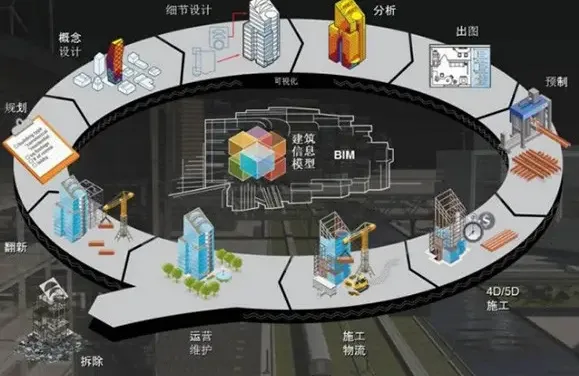
BIM technology offers comprehensive construction management analysis aimed at enabling seamless information exchange throughout the entire building lifecycle. This transforms collaborative workflows among stakeholders and significantly improves efficiency.
1. Steel Reinforcement Detailing
Using actual project data, a steel reinforcement model is created for office buildings. This includes analyzing steel reinforcement drawings, interpreting layout rules, building reinforcement models, and setting components in stages. Potential clashes at reinforcement nodes can be resolved by creating detailed 3D steel reinforcement models.
Models are developed for components such as raft foundations with variable cross-sections, civil defense door frames, irregular walls, columns, beams, stairs, and child walls using Revit. Various techniques are applied to classify and configure detailed lists of reinforcement components, allowing for precise, phase-based quantity statistics.
2. Architectural and Interior Decoration Modeling
Building and decoration models are created based on real office building projects. Parameter settings are established for various component families, including backfill soil, ground, walls, roof decoration layers, staircase finishes, doors and windows, floor-to-ceiling wall windows, railings, drainage steps, steel canopies, and ceilings. These models are developed in stages to enable detailed quantity takeoffs.
3. Site Layout Optimization
Site layout plans for actual projects are modeled, including various facilities and components on the site. Key aspects such as site modeling, design, layout, technical, and safety requirements are mastered. Revit software is used for comprehensive site design and modeling, while Navisworks enables virtual site walkthroughs. These tools support project bidding document preparation and enhance the competitiveness of enterprises.
4. Formwork Modeling
Formwork component families are created based on real projects, covering support systems for walls, frame columns, and floor slabs. Models are built and arranged for formwork and support components.
Revit is used for formwork modeling and segmented material usage statistics. Accurate quantity takeoffs help control turnover materials and reduce overall project costs.
5. Navisworks Software Applications
Navisworks is applied to actual project models, integrating site, foundation pit, architecture, structure, and MEP disciplines for animation viewing, sectioning, and recording. It supports 4D simulation, collision detection, and exporting issue lists.
Using Navisworks for component clearance and dimension measurements provides a comprehensive understanding of BIM implementation in real-world projects and broadens operational capabilities.
6. Coordination Between Revit and Structural Analysis Models
By combining Revit structural and building models, GFC files are exported and imported into civil engineering analysis software. This allows for adjusting concrete strength grades per layer, applying component lists and sub-item quotas, and ultimately exporting engineering data.
This approach resolves bottlenecks between BIM models and computational applications, enabling cost calculation and control based on BIM data.
7. Project Collaboration Management
The BIM project collaboration platform facilitates understanding of team grouping, permission settings, project creation, model uploads, and local model downloads among all parties involved in construction.
These are the main applications of BIM technology. We hope this overview provides valuable insights!
















Must log in before commenting!
Sign Up