
BIM technology serves as a vital tool in construction projects by storing building information within an integrated data model known as the Building Information Model. Through the collaborative use of various BIM multidisciplinary software, seamless integration of building information has been achieved.
The Associated General Contractors of America (AGC) lists 84 widely used BIM software programs, while the Institute for BIM in Canada (IBC) provides detailed information on the functions, applicable professions, and vendors of 79 popular BIM software solutions.
In recent years, China has seen a rising number of independently developed BIM software products. Notably, several BIM tools incorporating advanced computational capabilities, such as Guanglian Da and Luban, have emerged in the market.
Choosing the right BIM software from this vast array is crucial for maximizing investment returns and efficiency in enterprise BIM applications. The selection process should align with the specific needs of the enterprise. After evaluating both technical and business department requirements in construction firms, as well as the current landscape of BIM software solutions, the most common BIM modeling approach used by construction companies is illustrated in the image below.
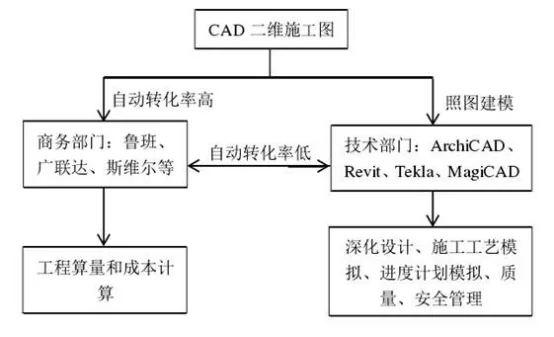
(1) The civil engineering and installation technology departments use software like ArchiCAD, MagiCAD, Tekla, and Revit to create BIM technology models for projects, based on construction drawings provided by design institutes. These BIM models assist in detailed professional design as well as simulations of construction processes, scheduling, and other analyses. The modeling phase also serves as a quality control step, helping to identify and resolve issues within the drawings to ensure their accuracy. Currently, the development of BIM technology models and subsequent tasks such as technical scheme demonstrations and virtual construction primarily rely on foreign software.
(2) On the other hand, business departments employ domestic BIM software such as Guanglian, Luban, and Swell to build BIM cost models used for budgeting and cost estimation. Leveraging BIM quantity modeling, technical teams can perform analyses related to engineering quantities, cost budgeting, and resource allocation. Due to differences in calculation rules and cost models between domestic and international engineering projects, construction companies predominantly use domestic software to handle these financial and resource management tasks.
















Must log in before commenting!
Sign Up