
This project is situated within the campus of a hospital in Kunming, Yunnan Province. To the south lies the original hospital administration building, while a planned 20-meter-wide road borders the north, as illustrated in Figure 1. The building comprises two underground floors covering 5,441 m² and twelve floors above ground totaling 19,834 m². The structure reaches a height of 53.4 meters and serves as a new children’s infectious disease diagnosis and treatment center.
The lower floors house outpatient medical and technical functions, while the upper floors are designated for respiratory infectious disease wards, non-respiratory infectious disease wards, and additional functions. The basement level is dedicated to parking, with strict traffic separation between respiratory and non-respiratory infectious disease areas. Each functional zone is allocated its respective parking floors to minimize cross-infection risks. Furthermore, civil air defense facilities are located on the second basement floor.
The building features a frame shear wall structure, classified under key seismic fortification with a structural safety level of one. The foundation design meets Grade A standards, and the building has a designed service life of 50 years, with seismic fortification intensity rated at level 8.
BIM Completion Status by the Design Institute
The project modeling was carried out using Revit software. Architectural, structural, and electromechanical models have been completed for the standard wards on basement levels 1 and 2, as well as aboveground level 7, as shown in Figure 1.
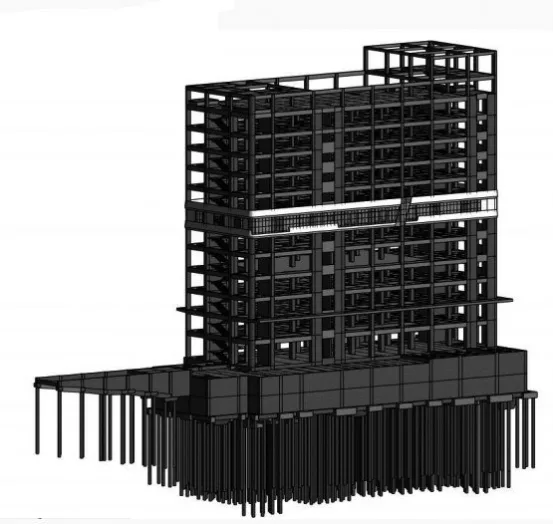
Figure 1: Original design model
Achievements and Benefits of Deepening
Based on the completed BIM models, a thorough review of the original design results was conducted, focusing on the following aspects:
- Verification that the model aligns with the design drawings and that the modeling detail level meets requirements for subsequent applications.
- Assessment of the completeness, continuity, and unobstructed status of the electromechanical system and building structure shafts.
- Evaluation of critical areas including clear height control zones, complex management areas, computer rooms, large beam sections, drop plate regions, and outdoor pipelines to ensure they meet usage standards.
- Validation of elevations for sprinkler mains and branch pipes, water supply and drainage systems, bridge frames, and air ducts.
- Inspection and optimization of pipeline collisions, bends, displacements, and adjustments.
- Review of elevation changes in structural lowering zones and the overlaps among beams, columns, and walls.
- Verification of the net height within the underground ramp system and the integration between electromechanical systems and the ramp.
- Examination of the relationships among pits, structural drainage, and structural components.
- Assessment of the connections between outdoor pipelines and outdoor interfaces, as well as their relationships with indoor beams and slabs.
Through this review process, 16 design issues were identified, leading to the proposal of two improvement and optimization plans. These measures are preliminarily estimated to save approximately 200,000 yuan.
— Excerpt from Reflections on the Current Status of BIM Application in Design Units – Taking BIM Design in a Hospital in Kunming as an Example
















Must log in before commenting!
Sign Up