
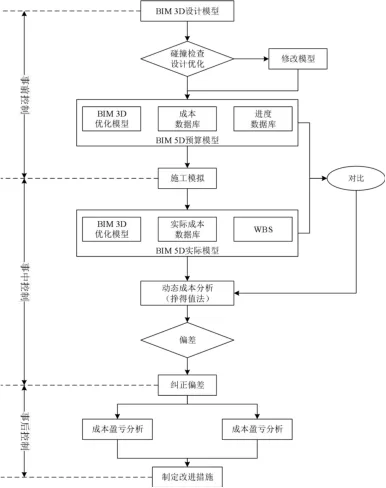
During the construction phase, implementing dynamic cost control is essential. Establishing a dynamic control process based on BIM significantly enhances cost management at this stage, as illustrated in the image below. The main stages of BIM5D construction cost control include pre-control, in-process control, and post-control.
1. Pre-Control
First, the BIM3D model is used to review the design scheme, detecting any conflicts or clashes. If any issues arise, immediate communication with the owner and design team takes place to discuss and refine the model for optimization. Then, the optimized model is used to calculate and clarify the quantities for each sub-project. Finally, a construction plan is developed, selecting the best approach and preparing a detailed construction schedule. The BIM5D budget model represents the key deliverable of this pre-control phase.
2. In-Process Control
Before construction officially begins, simulations of daily, weekly, and monthly plans are conducted to anticipate potential challenges during execution. These simulations enable proactive problem-solving and guide construction activities to strictly adhere to the schedule. Next, the cost data is compiled based on the construction work breakdown structure to build an accurate BIM5D actual model. This actual model is then compared against the planned BIM5D model to ensure the project is progressing as scheduled. If discrepancies arise, schedule analysis methods are employed to identify causes and develop corrective actions. The BIM5D actual model and deviation resolution form the core achievements of this control phase.
3. Post-Control
Upon completion of sub-projects or the entire project, a comprehensive analysis of cost profit/loss and plan-versus-actual deviations is conducted. These insights are summarized to refine and enhance cost and schedule management strategies for future implementation. BIM5D technology facilitates a detailed breakdown of cost control elements—such as sub-items, floors, construction surfaces, and components—enabling an in-depth understanding of cost variances. This granular analysis supports effective overall cost management and enables true dynamic cost control.
















Must log in before commenting!
Sign Up