
BIM, or Building Information Modeling, refers to a broad range of engineering software used throughout the construction process. A single project typically involves multiple BIM software, each serving a distinct purpose. These software can be categorized into BIM scheme design, interface software, sustainability analysis tools, and more. The image below illustrates the various types of software encompassed by BIM.
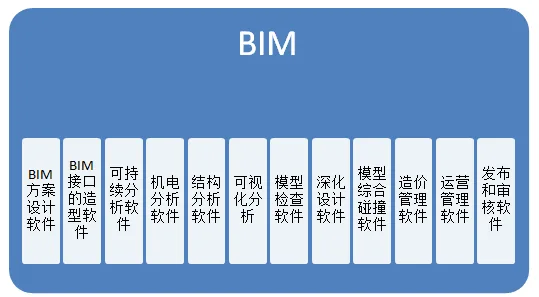
The core BIM modeling software can be classified into the following groups:
a) Revit: Developed by Autodesk, Revit is widely used for building, structural, and electromechanical design. It holds a strong global presence with notable advantages in professional software, capturing a significant share of the worldwide market.
b) Bentley Systems: Bentley’s software focuses on building structures and equipment, serving industries such as petroleum, chemical, power, and pharmaceuticals, as well as infrastructure sectors including roads, bridges, municipal projects, and water conservancy. Its influence in these areas is substantial.
c) ArchiCAD, AlPLAN, and VectorWorks: These three products are integrated into a unified system. ArchiCAD stands out as one of the earliest and most influential BIM core building modeling software worldwide. While it is well-known in China, its adoption there has been limited due to a lack of professional support and design institute frameworks. AlPLAN and VectorWorks are primarily used in Germany and the United States.
d) CATIA: Developed by Dassault, CATIA is recognized as one of the most advanced mechanical design software globally. It dominates markets in aviation, aerospace, automotive, and other mechanical production fields. CATIA excels at simulating complex large-scale models, offering superior visualization and data processing capabilities. Compared to older building software, it provides significant advantages.
















Must log in before commenting!
Sign Up