
BIM stands for Building Information Modeling, a term widely used in the Chinese construction industry. Many experts consider BIM a revolutionary technology that follows CAD in transforming the construction sector. It is both a conceptual framework and a practical approach that guides the industry’s progress. In 2002, Autodesk introduced the concept and significance of BIM in its “Autodesk BIM White Paper,” emphasizing that BIM is not just new design software but a pioneering mindset and workflow.
The advent of BIM has disrupted the traditional methods that primarily relied on text and drawings to convey information. It represents an innovative integration of design and construction management techniques. According to a market research report by McGraw Hill, “BIM is the process of creating and using digital models for project design, construction, and operational management.” The BIM process begins with establishing a 3D digital design plan, followed by building a model based on this design. Relevant digital information is then incorporated to detailedly represent the model’s functions. By combining digital and attribute data, BIM enables visual management of design, construction, and operational processes throughout the project lifecycle.
BIM serves as an information technology tool that provides integrated services for creating and managing engineering project information, as illustrated in Table 1.
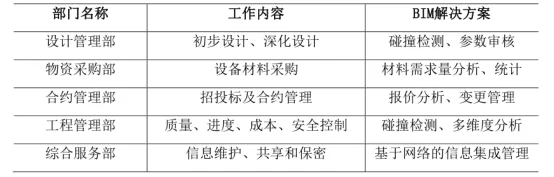
The National Institute of Building Sciences (NIBS) in the United States defines BIM as a digital representation encompassing the physical and functional characteristics of engineering projects. BIM offers unique technological advantages, enabling integrated information management. Acting as a shared knowledge and information repository, BIM consolidates multiple parameterized databases, providing reliable data to support decisions throughout the entire project lifecycle—from conceptual design to demolition.
At various project stages, participants can create, extract, insert, update, and modify information within the BIM database, facilitating collaborative work based on integrated information.
Built on 3D digital technology, BIM reorganizes and integrates the processes of collecting, analyzing, exchanging, updating, and storing project information. Through digital simulation, BIM mirrors real-world building information, offering timely, accurate, and comprehensive data to all stakeholders at different phases of the project. Additionally, this model promotes information exchange and sharing across different software platforms, participants, and project stages, significantly enhancing the efficiency of design, construction, operation, and maintenance activities. Consequently, BIM drives productivity improvements within the construction industry.
















Must log in before commenting!
Sign Up