
There are generally two effective ways to enhance design quality using BIM technology. First, directly utilizing BIM-based design software during the design process helps prevent or minimize design errors. Second, BIM software can be used to review existing design outputs, identifying and correcting errors through the BIM model. Designs processed with BIM technology result in higher-quality drawings, eliminating many errors that typically cause changes during construction. This reduces additional costs and project delays.
(1) Improving Design Efficiency
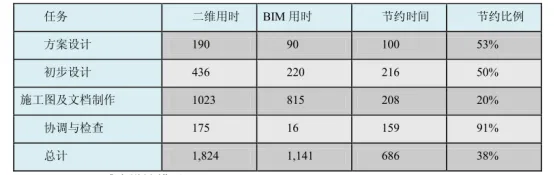
A study on an international project demonstrated that BIM significantly saves design time compared to traditional CAD, especially during the “coordination and inspection” phase where time savings are most noticeable. Table 3-1 compares the hours required for traditional 2D CAD and BIM across various project design stages.
(2) Reducing Design Errors
Traditional 2D drawings do not clearly convey the spatial effect of the building design, leading to three main types of errors: drawing inaccuracies, non-compliance with design standards, and conflicts between different disciplines. Since design tasks often involve collaboration among architects, structural engineers, electrical engineers, equipment specialists, and HVAC professionals, interdisciplinary conflicts are the most common and challenging to resolve.
BIM technology enables 3D design without relying on 2D drawings to visualize space. The “what you see is what you get” approach effectively prevents 2D drawing errors. Built-in design standards in the software reduce specification violations. Additionally, 3D models highlight conflicts between disciplines clearly, allowing them to be detected and resolved early, significantly minimizing such errors. Overall, BIM 3D design greatly improves design quality.
Moreover, designers frequently face extensive rework due to design errors, which imposes costs on design firms and undermines their profitability. BIM-based 3D design produces higher-quality outputs with fewer errors, reducing the need for costly revisions. Design modifications can be made directly within the 3D model, and 2D drawings of plans, elevations, and sections are automatically generated from this model. This streamlines the revision process, boosts design efficiency, and enhances the economic benefits for design firms.
















Must log in before commenting!
Sign Up