
The following flowchart illustrates the application of BIM technology in designing curtain walls for irregular buildings:
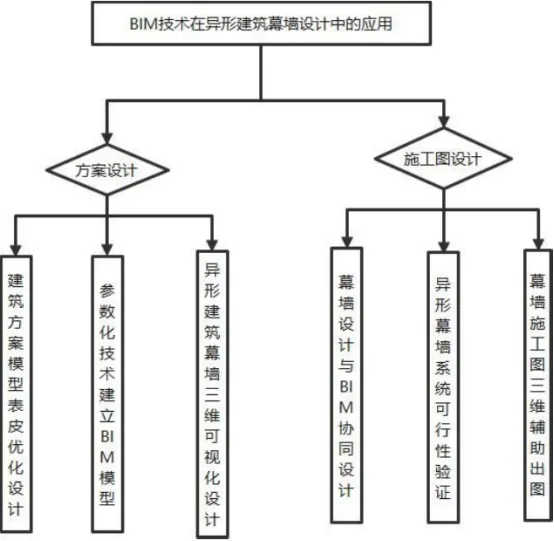
BIM technology plays a crucial role throughout the design phase of irregular building curtain walls, enhancing both the scientific accuracy and feasibility of the design process. Its powerful capabilities make it the most effective approach to improve project quality and work efficiency. Key aspects include creating detailed 3D curtain wall models, enabling collaborative design, facilitating visual design, and supporting 3D drafting. These components cover virtually every step of the design stage. Designers work collaboratively on a shared model platform, ensuring the accuracy and synchronization of building information models, which highlights BIM’s significant advantages and drives the digital transformation of curtain wall design.
When creating 3D models during the design phase, it is essential to balance accuracy. Models must meet design requirements without being excessively detailed, as over-precision can increase costs and consume unnecessary resources. The level of detail should be tailored to the specific project needs. Collaborative design leverages computer-based communication to promote efficient teamwork, clear division of responsibilities, and effective visual data management. This approach establishes a unified resource database and enables network sharing of design outcomes, ensuring each team member completes their tasks on time and maintains consistency across the project.
Visual design tools and auxiliary 3D drafting functions simplify the creation of construction drawings for curtain walls, enhancing design quality and providing a solid foundation for project execution. During the design phase, BIM also offers significant advantages in cost control. By analyzing building surfaces, designers can reduce the number of irregular panels, maximize the use of standardized panels, and minimize reliance on expensive components such as hyperbolic panels. Additionally, optimizing the structural framework with cost control in mind helps lower overall project expenses, making BIM a source of tangible economic benefits.
Once the BIM model is completed, it allows for direct export of the bill of quantities and accurate cost estimation. Miscalculations in the quantities required for irregular curtain walls often lead to unpredictable costs, posing risks to both investors and contractors, and potentially resulting in significant losses. Effective cost control through BIM not only limits these risks but also maximizes profit potential, supporting the long-term success and development of the enterprise.
















Must log in before commenting!
Sign Up