
The greatest value of BIM technology lies in its ability to facilitate the flow and exchange of information throughout the entire project lifecycle, allowing professionals to efficiently collect and manage project data. The application of information technology within BIM is supported by specific standards and limitations, which have led to the development of three key supporting systems: IFC, IDM, and IFD. The relationship between these systems and BIM technology, organized by relevant data, is illustrated in the figure below.
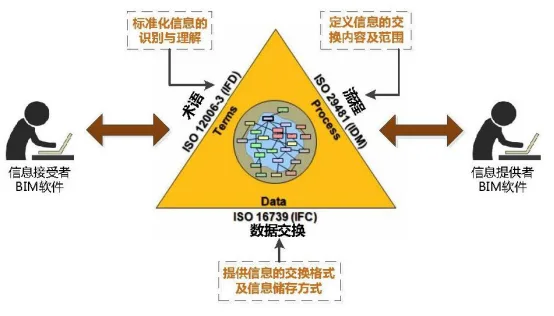
Among these three systems, IFC serves as the fundamental standard. It defines and facilitates the exchange of information across the entire building lifecycle. Following this, IDM delivery standards are used to standardize the information required at each stage and for each discipline, ensuring seamless integration with the IFC model. Lastly, IFD acts as a dictionary that standardizes terminology and translations, ensuring the accuracy and effectiveness of information exchange across different countries, regions, and software platforms. While IFC provides the core foundation, the effective application of IDM and IFD enhances information sharing and exchange throughout the building’s lifecycle, significantly improving the level of informatization.
With the widespread adoption of IFC data standards in BIM technology, several countries have developed their own BIM specification standards tailored to national conditions and current industry needs. Notable examples include the National BIM Standard (NBIMS) from the United States, the AEC (UK) BIM Standard from the United Kingdom, and Australia’s National Digital Modeling Guide. Additionally, countries such as Norway, Singapore, and South Korea have introduced their own BIM application guidelines, some of which include mandatory requirements.
















Must log in before commenting!
Sign Up