
Currently, the lack of standardized BIM protocols and low adoption rates make it challenging to utilize upstream BIM models downstream. This results in issues like redundant modeling and inefficient data sharing, which are key factors preventing BIM models from realizing their full potential. Professor Gu Ming, head of the BIM Research Group at Tsinghua University, has analyzed data indicating that when design or construction companies achieve a BIM adoption rate above 30%, their return on investment becomes significantly positive.
From a value management perspective, the optimal balance between the value of BIM functionalities and their input costs is achieved when BIM requirements are met at the lowest possible cost or when BIM capabilities are maximized within a fixed budget. However, current BIM applications suffer from phased, repetitive modeling processes, leading to high labor, time, and cost expenditures, while the value derived from information transmission and sustainable use remains low. Implementing full-process engineering consulting services, centered around a consulting unit, can span the entire project lifecycle. This approach helps avoid duplicate modeling, reduces BIM application costs, enhances overall value, and maximizes the benefits of BIM models.
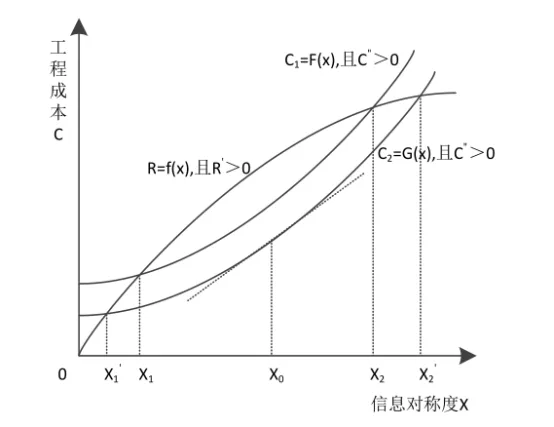
Figure 1: Relationship between Information Symmetry and Engineering Cost
Zhang Dequn developed a construction industry information model to analyze the information asymmetry between project owners and contractors, based on the information exchanges among various project stakeholders. This model describes the relationship between the degree of information symmetry, engineering costs, and project revenue. It reveals that within a certain investment range, the costs of reducing information asymmetry are outweighed by the increased revenue generated. Eliminating information asymmetry within this range yields profits and achieves maximum returns when marginal revenue equals marginal cost, as illustrated in Figure 1.
In the figure, the R curve represents project revenue, which increases with higher information symmetry. The C1 curve indicates the cost of improving information symmetry under traditional methods. Zhang Chunying’s research suggests that with integrated information systems, costs should be lower than without integration. Accordingly, a C2 curve (C2 < C1) is introduced to represent the reduced cost of enhancing information symmetry when applying BIM technology for information integration management.
The graph shows that when information symmetry lies within the interval __AI_S_SC_0_, project benefits (R) exceed engineering costs (C1), meaning benefits arise as information symmetry improves. This interval is defined as the moderate range of information asymmetry. After implementing BIM technology for integrated information management, the cost to improve information symmetry drops significantly, expanding the moderate range to __AI_S_SC_1_. Within this expanded range, achieving the same level of information symmetry is less costly (C2 < C1), demonstrating that applying BIM technology effectively improves information symmetry while reducing engineering expenses.
Utilizing BIM technology for information management throughout the engineering consulting process can substantially reduce “information asymmetry” among the consulting unit, participating parties, internal departments, and multidisciplinary collaborators. This approach offers promising economic benefits by enhancing communication and coordination across all project stages.
















Must log in before commenting!
Sign Up