
Once the project begins and the team arrives on site, the first task is to plan the overall site layout. To ensure smooth and organized construction progress, the layout must be compact and orderly. This approach saves construction land, facilitates workflow, reduces material handling, boosts efficiency, and meets hygiene and safety standards. A well-planned site layout directly impacts both project costs and timelines.
Traditionally, site layouts are designed using CAD software, which produces clear, easy-to-use floor plans that guide on-site organization. This method is widely adopted in the construction industry. However, CAD has some notable limitations that have been addressed effectively with the adoption of Building Information Modeling (BIM) technology.
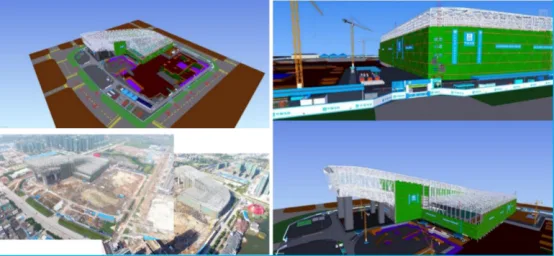
Firstly, BIM’s 3D modeling capabilities effectively resolve the clutter and confusion often seen in 2D floor plans, enhancing spatial visualization with clearer, more layered images. Using Revit, a site layout model is created based on the company’s standardized templates for safe and civilized construction, then explored through Navisworks. This 3D visualization simulates the actual site post-construction, enabling managers and operators to quickly interpret the layout, reduce errors, and significantly increase efficiency.
Secondly, all BIM models are built according to the specifications in the standardization manual, ensuring consistent attribute information. Details such as coordinates, elevations, materials, dimensions, and colors can be extracted as needed. Standardized components are custom-manufactured by suppliers who adhere strictly to the model specifications, ensuring uniformity in materials and avoiding discrepancies in color, size, or font.
Thirdly, construction workers execute their tasks according to the model’s information, while managers use the model to organize inspections and acceptance processes. This approach offers both abstract data and concrete visual models, providing strong technical support for standardized site layout and safe, civilized construction practices.
Finally, BIM enables the creation of standardized CI (Corporate Identity) component models based on company standards. These models form a comprehensive database and are managed via a company-level platform, facilitating efficient information management across projects.
















Must log in before commenting!
Sign Up