
Currently, the most common collaborative work approach is based on CAD, primarily involving the collection and management of drawing standards and various professional documents. This represents a relatively low level of technical integration. While it offers some convenience, it does not significantly enhance the overall outcomes of engineering construction projects. A key limitation is that the two-dimensional workflow fails to provide an efficient collaboration platform. For example, construction drawings remain isolated and unlinked, making it impossible to simultaneously update building plans, elevations, and sections.
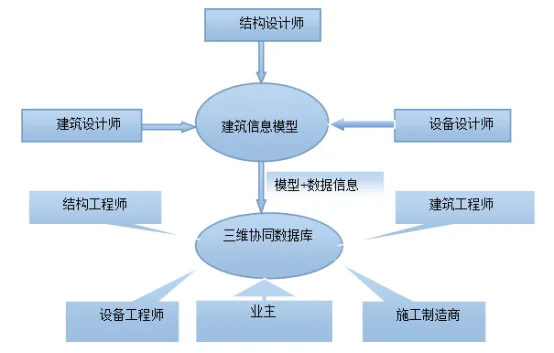
Figure 1: Schematic diagram of a BIM-based collaborative work mode
With the introduction of Building Information Modeling (BIM), the collaborative work paradigm has been fundamentally transformed. BIM models contain interconnected information — a single change updates all related elements instantly. This allows project participants to collaborate effectively on a shared model, realizing true teamwork and completely changing traditional workflows.
The most significant advantage of BIM technology is its ability to share building information resources, serving as a communication platform for all stakeholders involved in engineering projects. It enables participants in deep excavation design, construction, and monitoring to provide timely feedback throughout the project lifecycle, improving efficiency and supporting quality and safety management on site.
A BIM-based collaborative work mode is a vital method to enhance both quality and efficiency across all stages of engineering construction projects. Given the large number of trades involved in deep foundation pit construction, collaboration is especially critical during this phase. BIM-driven construction creates a central information database that encompasses all entities and functional attributes of the foundation pit and its surrounding environment. Storing all components and functional data in a unified database facilitates seamless information exchange among project members, significantly boosting integration and cooperation.
Applying BIM collaboration during deep foundation pit construction helps prevent errors, omissions, and clashes caused by communication gaps. Since the entire construction process progresses interactively and concurrently, updates from each unit automatically reflect in the final deliverables. This ensures that construction data is shared and dynamically updated in real time, greatly enhancing work efficiency. Additionally, BIM supports standardized project management tasks, including tracking construction progress, unifying document management, managing personnel workloads, and overseeing approval workflows.
As BIM technology continues to advance, its role will expand from a technical tool to a comprehensive project management system. Eventually, it can integrate with construction enterprises’ Enterprise Resource Planning (ERP) systems, enabling coordinated management of the entire deep foundation pit construction process.
















Must log in before commenting!
Sign Up