
In recent years, the gradual adoption of BIM technology across various stages of domestic projects has demonstrated its immense value by integrating attribute information with 3D data. Widely regarded as a transformative advancement in engineering design and construction, BIM has garnered significant attention within the industry. This article explores the technical concepts of BIM from three key perspectives:
1. Model Perspective: Unlike traditional 2D CAD models, which rely on independent floor plans and text to convey information, BIM employs 3D technology to build parametric models. These models attach relevant parameters to components, offering a comprehensive representation of all engineering data related to the construction project—such as component names, materials, geometric dimensions, procurement details, management plans, actual progress, and maintenance information. The model’s level of detail varies according to the accuracy of the information provided. Each component in a BIM model is uniquely identified and interrelated, allowing the software to analyze data statistically and generate corresponding graphics and documentation. Importantly, any modification to the model, drawings, or documents automatically updates all related information, achieving a “change once, update everywhere” effect.
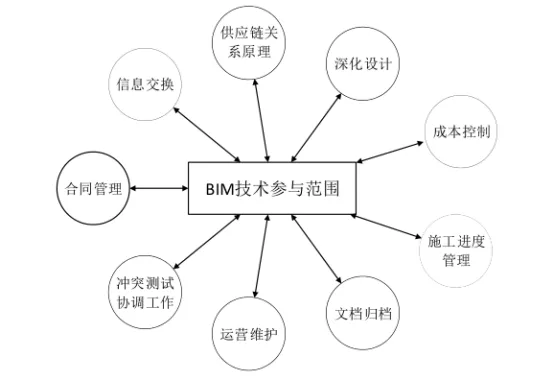
2. Process Perspective: Based on a unified data standard, BIM enables all participants throughout the entire lifecycle of a construction project to extract, modify, and update engineering information in real time at every stage. This fosters seamless collaboration on a single platform, helping project stakeholders make informed and efficient decisions. BIM eliminates issues related to information gaps commonly found in traditional models and resolves inconsistencies caused by heterogeneous engineering data standards. By ensuring smooth information exchange across various disciplines, BIM transcends being merely a model—it becomes an effective information-sharing and management system for the entire project lifecycle.
3. Functional Perspective: BIM plays a vital role in managing the entire project lifecycle, offering diverse application functions. As illustrated in the image, BIM is not only an information model focused on components but also a behavioral model encompassing management processes. BIM technology participates in multiple areas such as construction management, contract administration, energy efficiency analysis, human resource management, cost control, document archiving, operation, and maintenance. By leveraging BIM’s rich, intuitive data to analyze and simulate different project phases, technical challenges that traditional methods cannot address are effectively overcome.
















Must log in before commenting!
Sign Up