
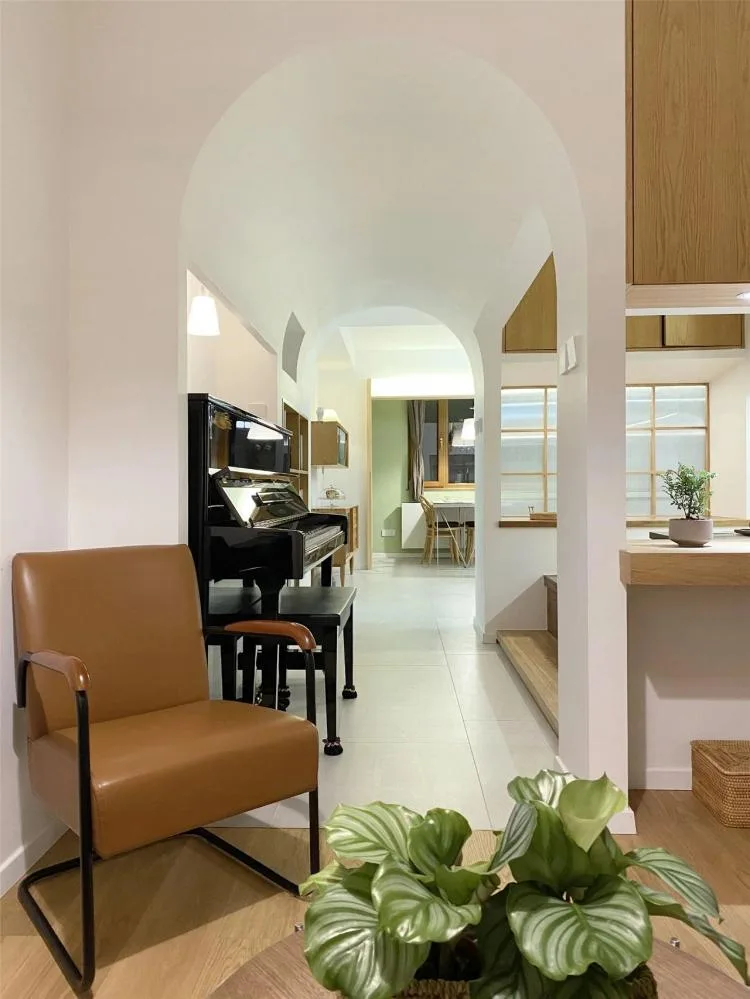
Within One Day
Two years ago, Teacher Gao and I were both in the United States—she was in Pittsburgh and I was in Boston. Teacher Gao and her boyfriend, Mr. Zhu, visited New York, where I dropped by their short-term apartment, bringing red wine. Mr. Zhu magically prepared a table full of Christmas dinner. Later in May, Teacher Gao brought her children to Boston. The snow and wind season had just ended, and they took a walk along the Charles River under thick rolling clouds.
Teacher Gao is knowledgeable and straightforward, sharing values that closely align with mine. When values match, there’s no feeling of “How could they think that way?” She entrusted me with designing her home, probably for this reason. Housing in the U.S. tends to prioritize practicality. In New England, for example, single-family homes are mostly covered with wooden shingles, which, up close, have often been replaced with cheaper composite materials. Styles like Georgian and Queen Anne only differ superficially; interiors are generally similar. Rental apartments typically include a full kitchen, bathroom, electrical appliances, and carpeting for sound insulation. When tenants move out, they must clear all belongings, and landlords disinfect and remove lead paint.
Teacher Gao appreciates her Pittsburgh apartment, which features beautiful wardrobes and automatic dryers without excessive decoration. We both lean toward pragmatism, avoiding clutter that might become a nuisance over time. Meanwhile, minimalist styles like plain concrete walls often feel cold and artificial, which doesn’t suit a home.
Many people learn about American lifestyles through movies and TV, where the home industry has coined terms like “American country style.” Alongside Nordic minimalism and Japanese freshness, these styles solidify exotic lifestyles into fixed images. When people are ready to own a home, the first step is choosing the right place, then molding their imagination like a cookie cutter into a few fixed shapes. I once visited a famous entrepreneur’s mansion with a Chinese-style basement, a European-style first floor, and a Japanese-style second floor—I felt like I had wandered into a building materials showroom. Chinese families are increasingly spaces for imagining foreign cultures.
Kengo Kuma humorously categorizes Japanese home environments in his book The Ten Mansions and then seriously asks: what exactly defines a “place” for Japanese families? When transplanted to China, the question becomes: what is the “place” for Chinese families? Transforming the lifestyle and imagination of a time and community into walls and furniture to express a unique atmosphere is akin to creating a “culture,” which may feel awkward to admit.
The designer’s task is actually quite simple: every home should satisfy its inhabitants. Since people differ, homes should be diverse. The problem is many haven’t seriously examined themselves—otherwise, how could they easily fit life into a mold? Before starting the design, I asked Teacher Gao to condense her daily life—from waking up to falling asleep—into detailed notes. A few days later, she gave me a “Daily Life at Home” document with over 4,000 words—the most detailed and comprehensive brief I’ve ever received. From her words, I see someone who lives with dedication, whose thoughts and feelings come through clearly. Residential design cannot be smaller than this—it reveals real people and becomes tangible.
In my view, if you can’t manage your daily diet and lifestyle clearly, you have no right to speak about life.
Room Separation
One of the most sensitive design challenges is balancing the feelings of all involved. The main consideration was Mr. Zhu’s two children, who stay temporarily during winter and summer vacations. Along with Teacher Gao’s daughter, this “two-person” family can sometimes become three or even five. Teacher Gao wanted the children to have relatively independent spaces but didn’t want to lose expected functions. This was the first contradiction.
Teacher Gao desired a spacious, bright open kitchen immediately upon entry, centered around the Nakajima operation desk. This space would serve as a place for family activities and entertaining guests. The Nakajima island includes range hoods, induction cookers, cookware hangers, and red wine glasses for casual chats and hot pot. She prefers simple cooking: plain boiling and pan-frying. Mr. Zhu, however, cooks with high heat and smoke using traditional Chinese methods, necessitating a fully enclosed kitchen. This was the second contradiction.
When I received the keys, the house was a bare shell with a conventional three-bedroom, one-living-room layout and north-south transparency. The concept favored an open kitchen and a free-flowing layout. Yet Teacher Gao’s brief stated, “There must be constraints in the days of two people. If we can balance freedom and constraints, that’s best.” As the family’s “politician,” her proposal related to human nature and interpersonal harmony. I agreed wholeheartedly. The third contradiction was how to balance free and private spaces.
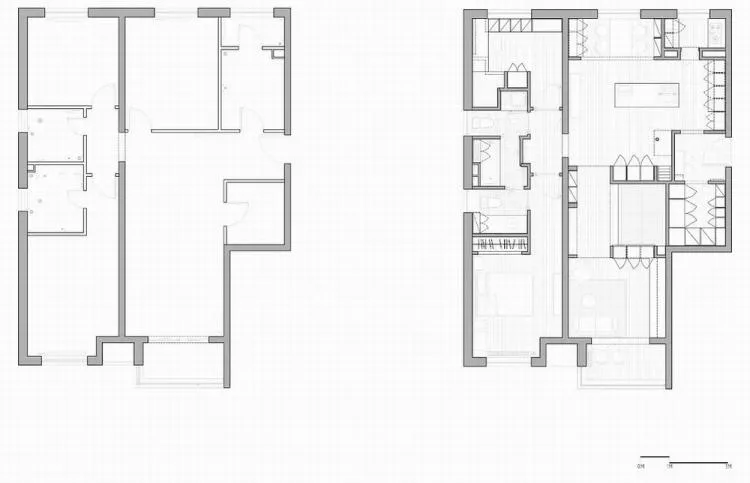
Plan drawings before and after construction: Wang Yao
These three contradictions were solved through flexible spatial organization and adaptable solutions. Skeptical about “multifunctional rooms,” I still categorized main functions separately, allocating areas for those that couldn’t be combined. Then, I stacked flexible and elastic parts together to create many small zones within a continuous large space, each with distinct directions, functions, and atmospheres. Teacher Gao approved, but on the day of site clearing, she joked, “The cleaning lady said my house has four bedrooms, three living rooms, and two bathrooms.” This approach breaks down the large space into smaller functional areas.
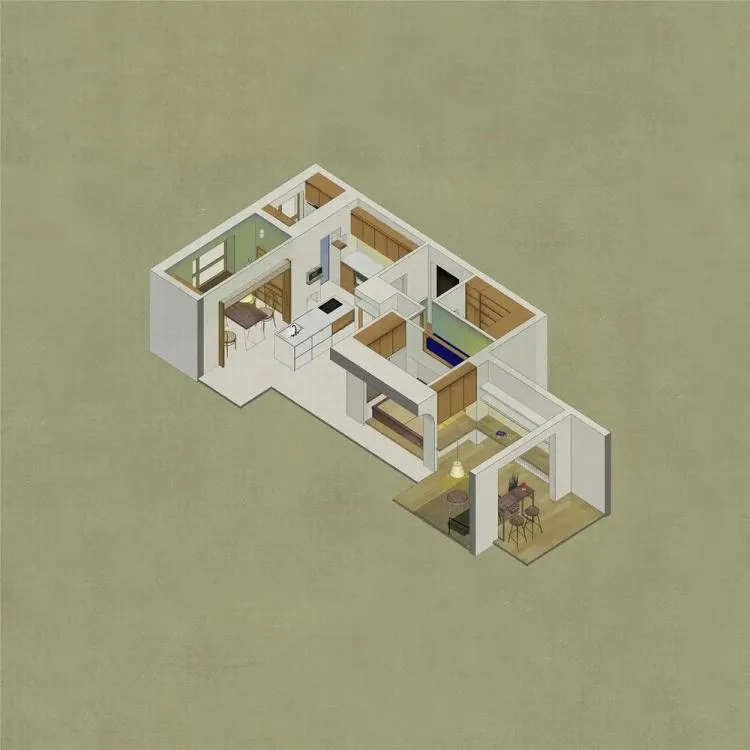
△ Colored axonometric section drawing: Wang Yao
Despite their distinct functions, these areas remain connected through open doorways and window openings, allowing visual interaction and fluid spatial transitions. For example, sitting on a high stool at the balcony bar offers views of the square study, the kitchen island beyond a deep arched doorway, and the small dining room with green walls behind. Further ahead, one can glimpse the outdoors through the restaurant window. Beside the arch, an opening in the desk reveals the tea room and loft bed above, adding visual depth to the compact space.
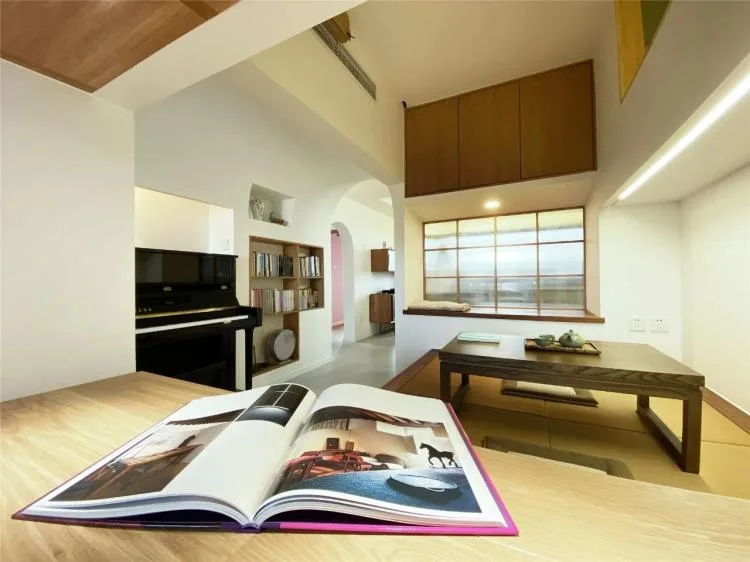
View of the family room from the study: Kim Akino
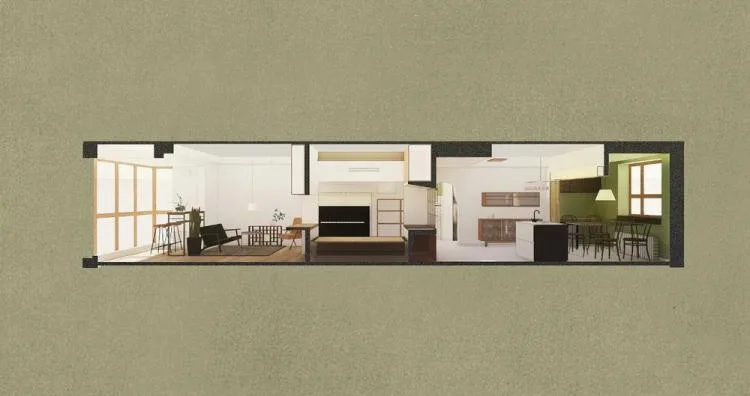
North-South perspective drawing: Wang Yao
The initial plan positioned a spacious kitchen on the north side, centered around the island. However, this exposed the kitchen area, and even the best exhaust systems couldn’t fully eliminate cooking fumes. Insisting on a large kitchen was unrealistic. Instead, we designed a smaller central kitchen operation area. This dividing line separated the dining room and allowed insertion of gas water heaters, kitchen sinks, coffee stations, and microwaves behind vertical and horizontal partition walls. On weekdays, the Chinese kitchen is highly efficient, while the Nakajima island functions as the family activity center, turning the kitchen into a genuine family room.
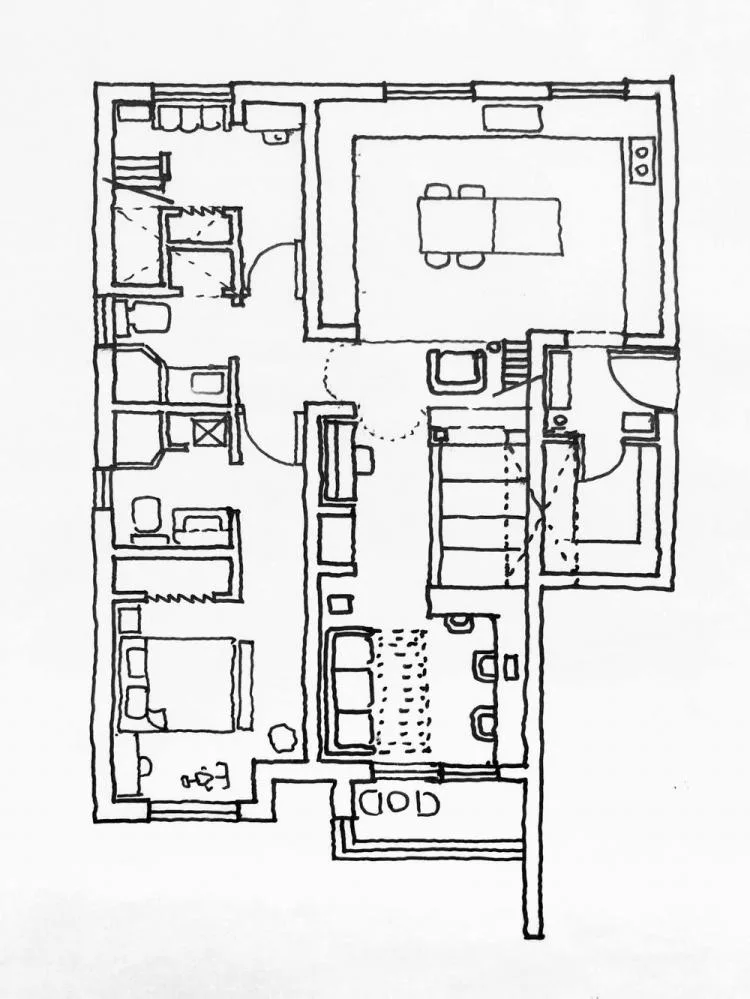
△ Initial sketch draft: Jin Qiuye
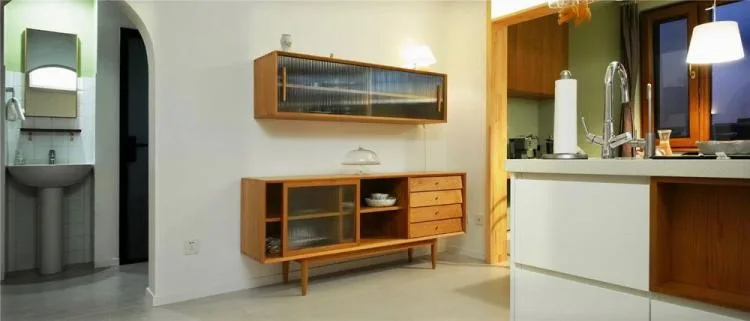
△ Family room photo by Kim Akino
The dining area, located by the window, features a curved opening toward the kitchen island to emphasize its territorial feel. Mid-construction, it was modified to a square opening covered with solid wood for greater comfort. Above the doorway, the studio’s children handcrafted a two-meter-long steel-framed lantern covered with Japanese paper to soften strong outdoor light. The custom dining table has a stainless steel frame and walnut top, flanked by tea display racks, coffee stations, temperature-controlled wine cabinets, and cutlery storage. This space serves as both family dining and a casual tea and coffee reception area. It has become Teacher Gao’s favorite workspace.
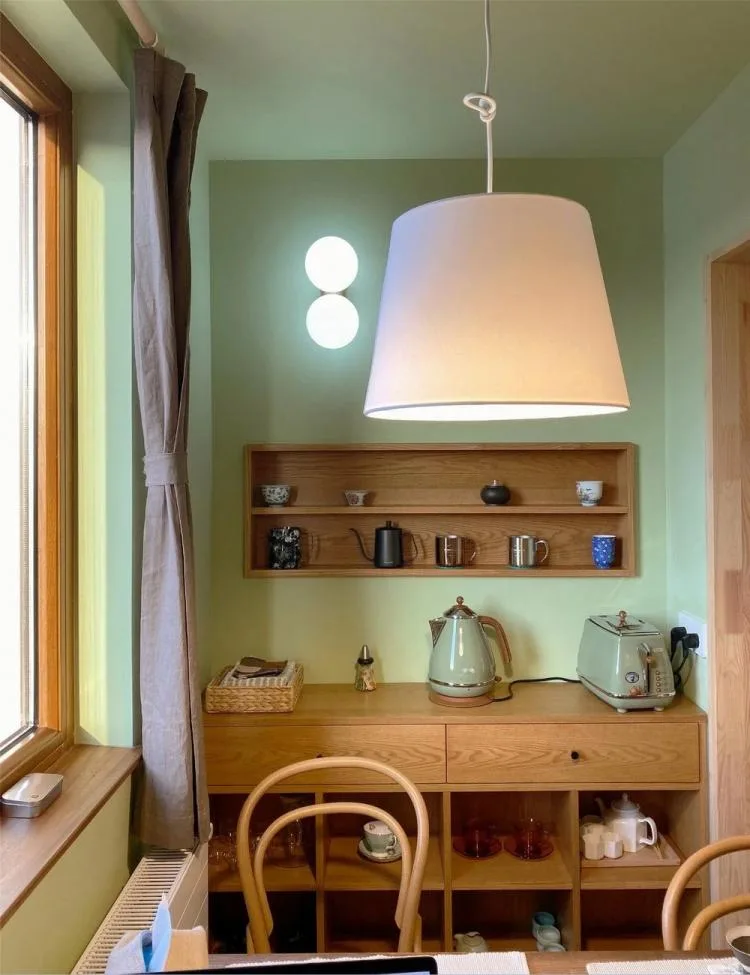
△ Dining area photo by Kim Akino
The original two adjacent bathrooms were large but lacked proper shower areas. Responding to the owner’s request, we designed a separate bathroom with a spacious bathtub. The second bathroom’s sink was moved into the corridor, achieving a full separation of wet and dry areas. Given the low number of users, this bathroom also serves as a laundry room. The master bathroom is spacious with a long sink, where Teacher Gao’s bottles and jars are neatly lined up like soldiers on inspection.
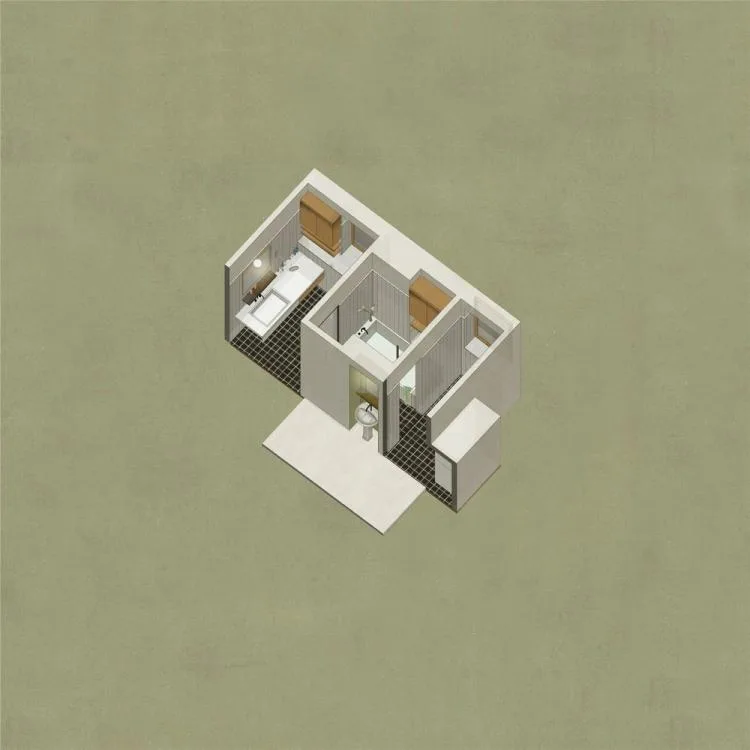
Axonometric bathroom drawing: Qin Hongxin
The study and family room connect via an arcade, yet remain relatively independent. When two people share the home, they can work simultaneously: writing in the study, using computers separately in the dining and study rooms, reading and drinking tea on the couch in the tea room, or occupying the girl’s room table—avoiding disturbances. Partitioning creates numerous “destinations” within the home, giving this small space a sense of “roaming,” flexible and free—not fully open—thus preserving privacy.
Between Top and Bottom
Beyond the master bedroom, three separate small beds provide independent sleeping spaces for the children. Allocating a room for each person is inefficient and costly. Instead, combining the two infrequently used small beds into one larger “big furniture” piece aligns with my design philosophy: large furniture serving multiple spatial functions as a hub.
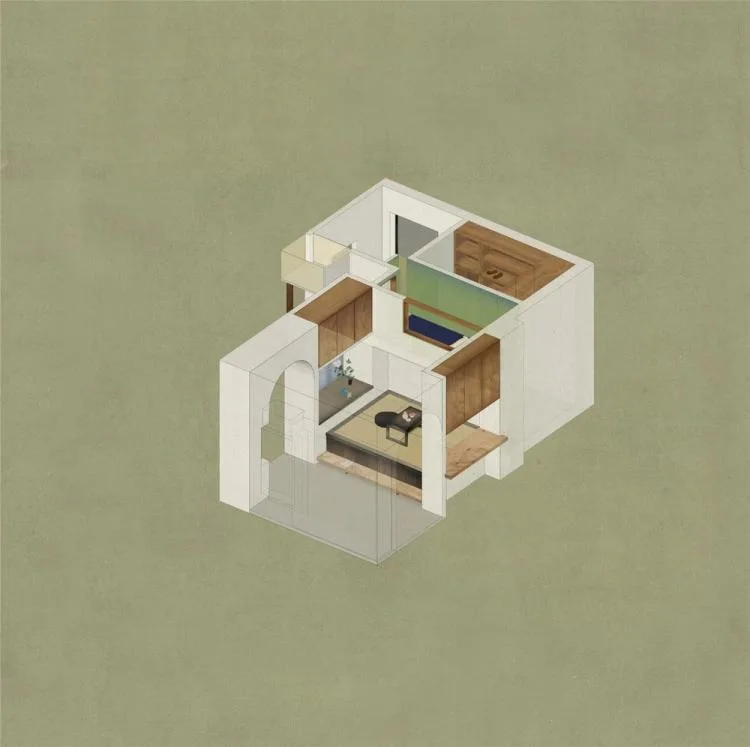
Large furniture axonometric drawing: Wang Yao
Teacher Gao’s home hub is complex, connecting four living areas across three levels: upper, middle, and lower. The original layout lacked an entrance hall; to the left was a dressing room. We preserved the cloakroom and added a partition wall, creating a foyer accessible from the family room’s right side. The small bed sits above this partition, aligned with the dressing room, accessible from the family room and opening a corner toward the entrance.
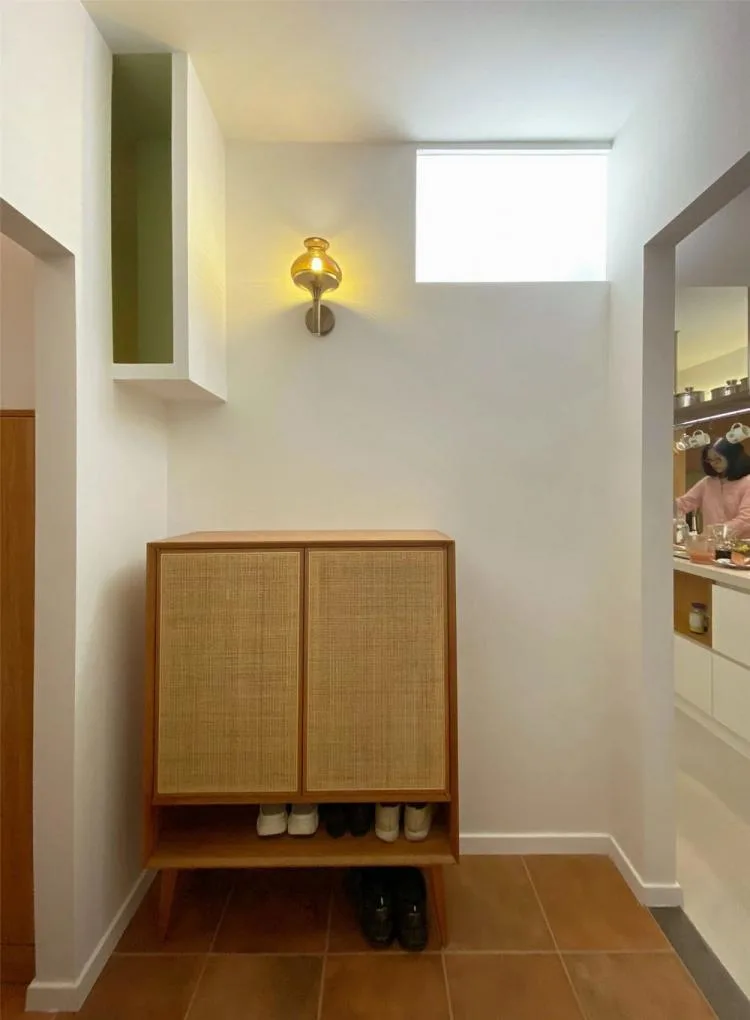
△ Entrance front photo: Kim Akino
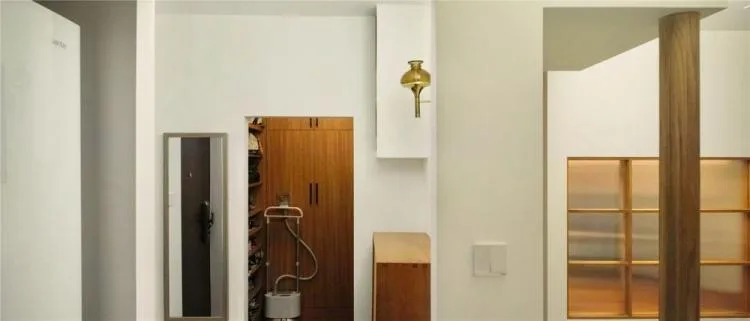
△ View of the foyer and tea room windows from the family room. Photo by Jin Qiuye
The overhanging section toward the dressing room incorporates built-in wardrobes below, while the overhang toward the living room becomes the tea room’s “attic.”
The tea room, centrally located, acts like a stone disrupting water flow, with many openings redirecting the spatial energy. I find this controlled flow more engaging than an unobstructed one.
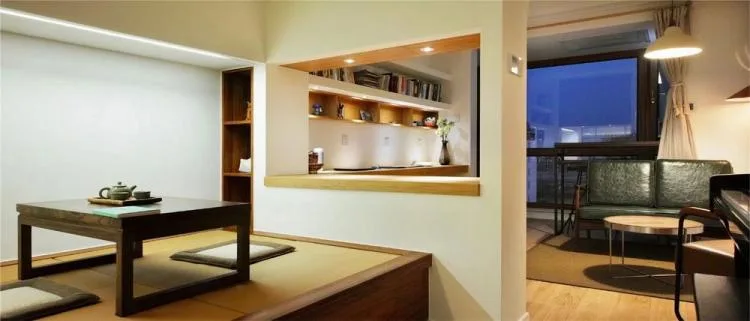
△ View of the study from the tea room. Photo by Kim Akino
The tea room is a kang room (traditional heated platform), and like me, Teacher Gao is from Northeast China. The small bed hangs above the kang, adding a touch of greenery to this cozy space.
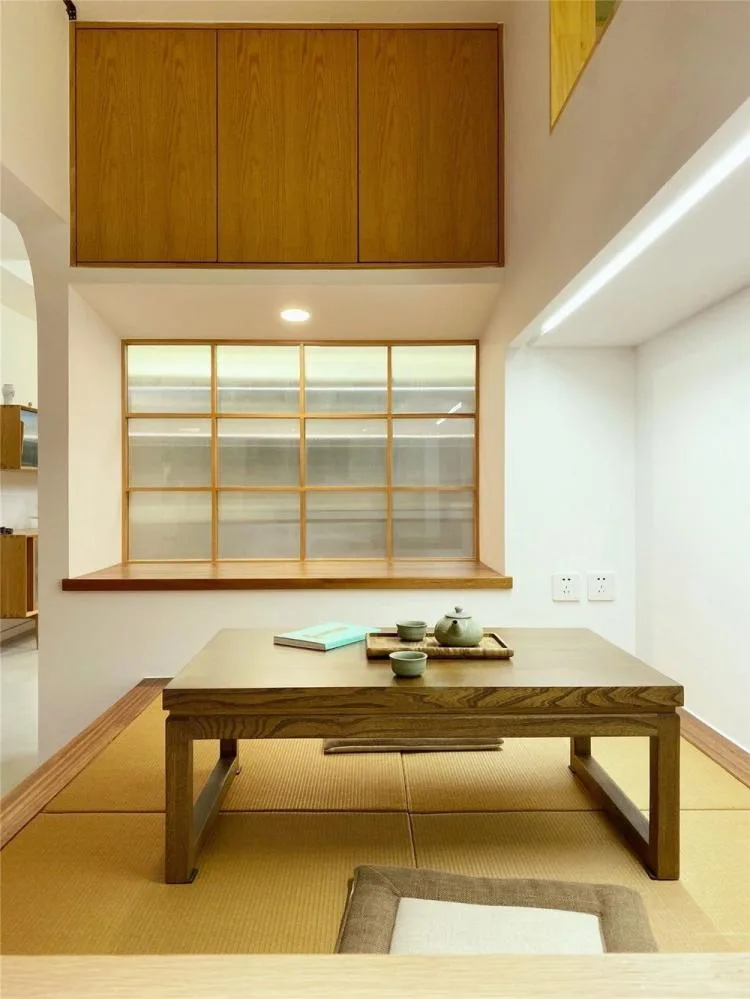
△ Side view of the tea room. Photo by Kim Akino
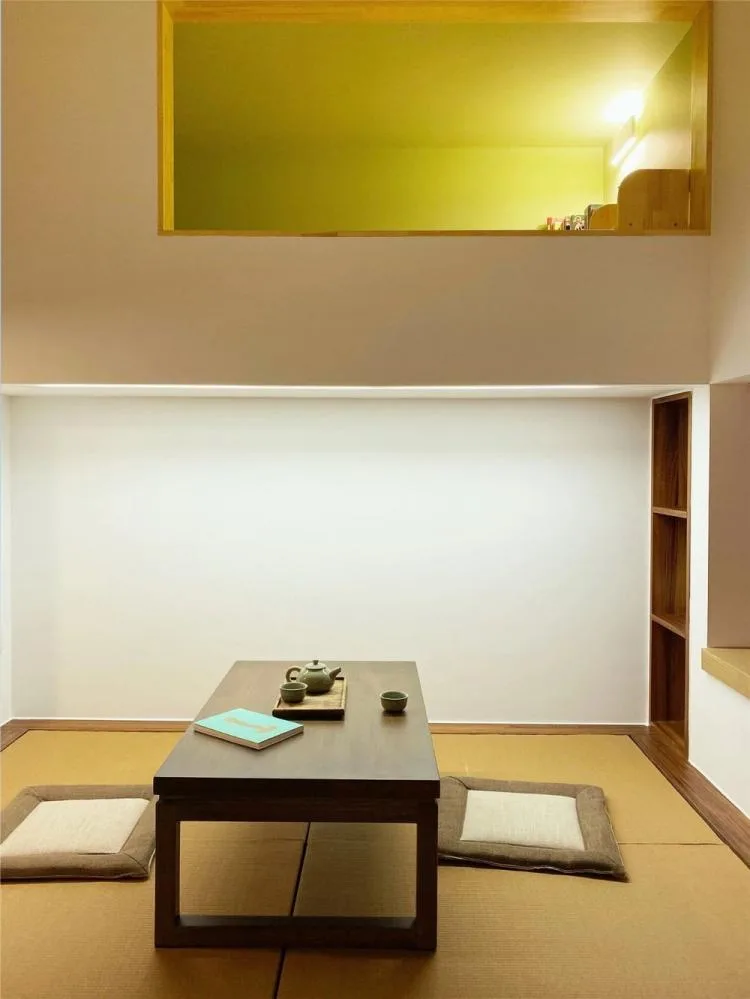
△ Front view of the tea room with small bed above. Photo by Kim Akino
The concave section below evokes “between beds” in college dorms, ideal for elegant decoration. To the right, it connects to the study via a desk under a hanging cabinet. To the left, there’s a recessed seating area. Between this and the family room is a semi-transparent glass window with wooden frames, combined with the family room’s independent wooden columns and the ladder of the bunk beds, creating an outdoor ambiance. The closed window on the north side brings the tea room and study closer, forming the family’s more private zone. The kang is made of walnut, with an elm footrest. Below the kang, a corridor covered by a cylindrical arch links the study and family room. A bamboo curtain hangs above the footrest and lowers to create a temporary bedroom when children visit—one sleeps in the mezzanine small bed, the other on the kang.
The tea room sits at the home’s center, breaking the traditional living room layout. This project explores “living space centered around the kang” and integrates upright and sitting/lying activity modes. Teacher Gao wrote in her brief, “We don’t need a traditional living room or a large sofa. A few simple leather sofas, leather and wooden chairs suffice, along with a small tabletop that can hold casual items. We don’t drink tea or entertain guests here.”
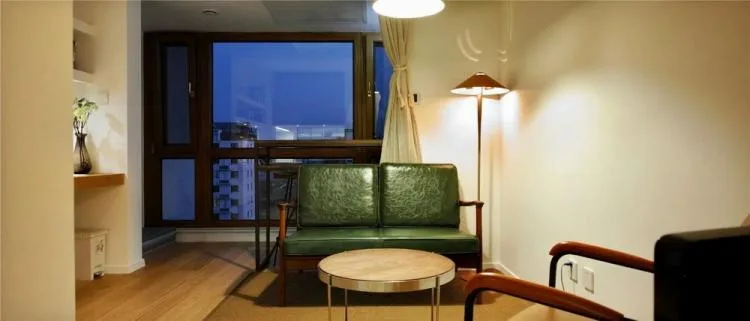
△ Study sofa area photo by Jin Qiuye
The concave part below resembles “between beds” in college dorms, suited for elegant decoration. To the right, it connects to the study through a desk under a hanging cabinet. To the left, there is a recessed seating area. Between this and the family room is a semi-transparent glass window with wooden frames, complemented by the family room’s wooden columns and bunk bed ladder, creating an outdoor feeling. The closed window on the north side brings the tea room and study closer, forming a more private family zone. The kang is made of walnut wood, with an elm footrest. Below the kang, a corridor with a cylindrical arch connects study and family room. A bamboo curtain hangs above the footrest, lowered during children’s visits to create a temporary bedroom—one sleeps in the mezzanine bed, the other on the kang.
The tea room, at the home’s center, dismantles the traditional living room concept. This project explores “living space centered on the kang,” combining upright and reclining activities. Teacher Gao stated: “We don’t need a traditional living room or large sofa. A few simple leather sofas, leather and wooden chairs are enough, with a small tabletop to hold casual items. We don’t drink tea or entertain guests here.”
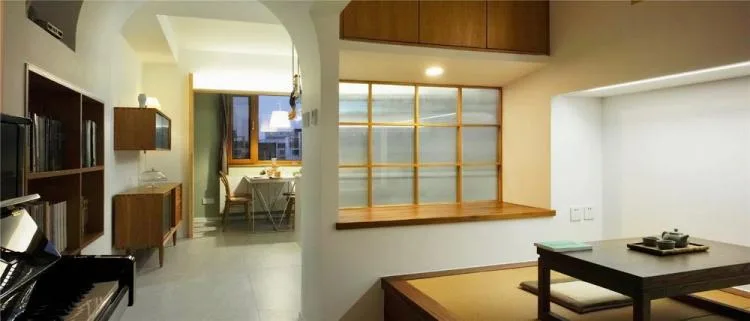
△ Family room view through the tea room by Kim Akino
Teacher Gao’s daughter has a separate elevated bedroom. The space below is divided: the west side is a “secret room” for curling up and reading per the child’s wishes; the east side divides into a laundry area to the south and a children’s storage cabinet to the north. On the wall facing the doorway at the bed’s head is a capsule-like “bubble” window. The child climbs and peers down from this playful feature.
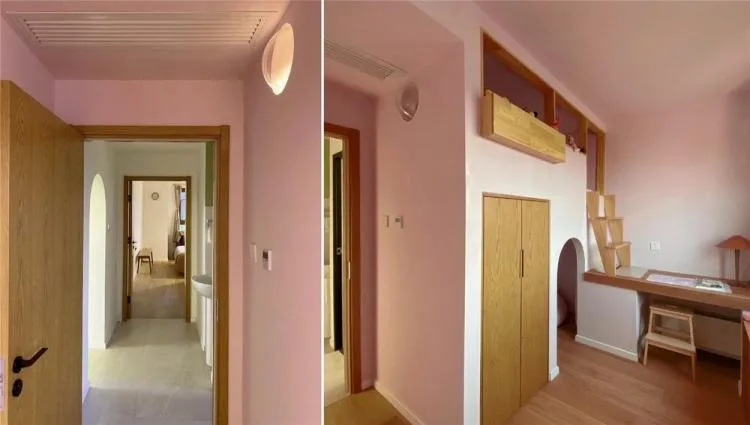
△ Bed and bubble window photo by Kim Akino
A series of horizontal and vertical “partitions” introduce multiple “folds” into the space, distributing family functions into physical layers. The remaining layered space creates visual distance and height, extending the room’s physical dimensions. It’s like folding clothes into a small suitcase before traveling—no matter the distance, you bring only a small suitcase with seemingly endless storage. Similarly, family functions and details are clearly organized and stacked, leaving intentional empty space within the home.
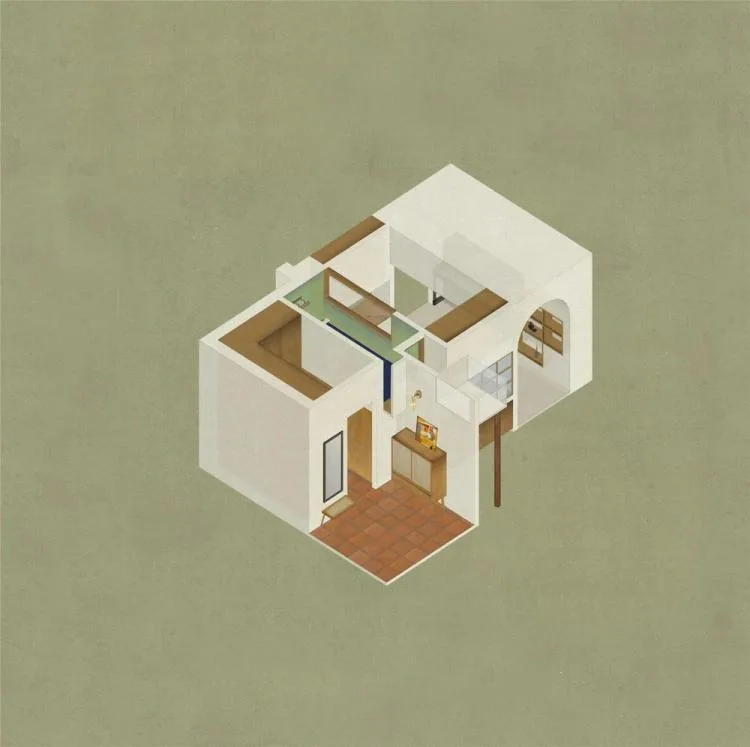
Axis measurement of large furniture from entrance view: Zhang Jingwen
Managing External Belongings
Like many female hosts, Teacher Gao has accumulated numerous personal items: “I have many clothes, including long skirts and coats that must hang; Mr. Zhu has several suits and windbreakers that also require hanging. We have plenty of sportswear and casual clothes to stack. I usually keep about ten bags and countless shoes—mostly women’s shoes needing little space, plus hiking boots, short boots, tall boots (four or five pairs), and short UGG-style cotton boots (three or four pairs). Mr. Zhu’s shoes are fewer but still numerous. How can all these be stored conveniently? I’ve always dreamed of not having to rummage all year. I want to mix and match easily, seeing and grabbing what I want quickly. I also have many scarves; Mr. Zhu has many ties and belts. Paradoxically, I dislike crowdedness—there must be gaps and separation between each pair.”
It’s impolite to advise the owner to discard items, though I wish I could. So, we found ways to assign everything a place. Recently, Japanese home storage tips gained popularity. After reading them, I feel excessive storage is an obsession. How much is enough? It must suit the family’s storage space. Quantity doesn’t equate to life satisfaction; too much storage causes mental clutter. So I avoided overbuilding storage in Teacher Gao’s dressing room to prevent overwhelm when opening doors. Cabinets and coat closets are placed where necessary, such as backpack storage under small beds, stationery shelves on desks, and bedding cabinets by the kang.
At the entrance foyer, red tiles with a slightly rough texture, close to outdoor materials, create a psychological transition from outside to inside. Behind the white frosted glass above is an embedded reflector light emitting soft neutral light, illuminating the entrance. The other three sides of this lamp face the family room and, combined with the paper lantern above the dining doorway, form the main artificial lighting for public areas. From the entrance, one can glimpse a corner of the small bed, where stacked spaces connect through openings and light contrasts.
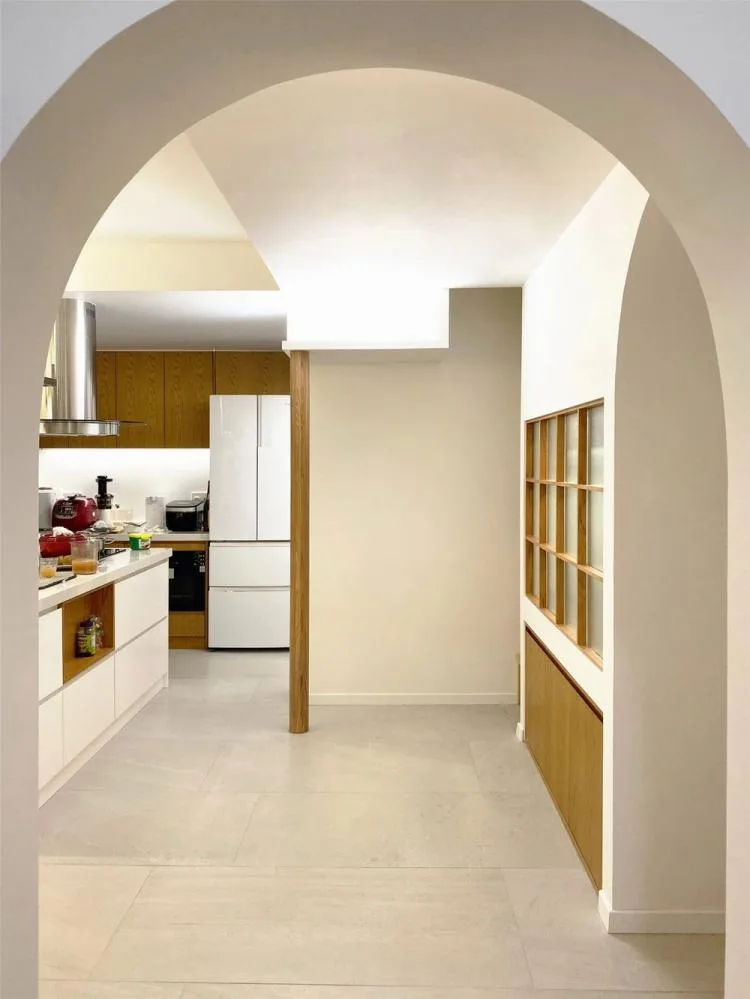
△ View of the family area from the entrance. Photo by Kim Akino
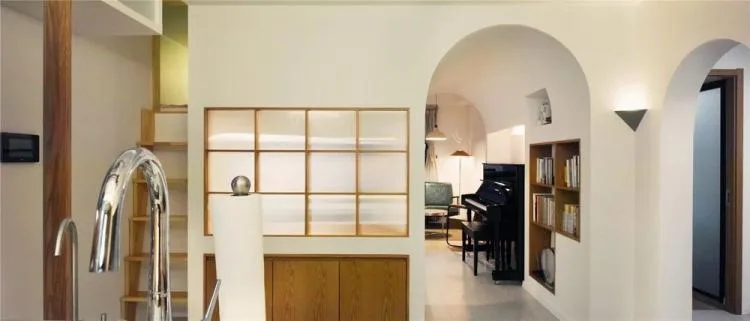
△ Horizontal shot from foyer to arched entrance. Photo by Kim Akino
Independent small spaces such as the dining area, small beds, and hallway sinks can be customized with color. Teacher Gao chose green. While in the U.S., she visited Wright’s Oak Park mansion on my recommendation and loved its wall colors. I gathered photos, book images, and online samples—all in various green shades. Although we confirmed a color code, matching paint wasn’t available. I selected a softer green based on my understanding of Teacher Gao. Her color palette is white, green, and natural wood.
This was our first collaboration with foreman Lei Jinjie, who is clear-headed and meticulous. When given design requirements, he first identifies risks and challenges. The plan featured many unconventional methods requiring the architect’s advocacy. Lei successfully solved key issues, and the construction quality is excellent.
Half a year after moving in, Teacher Gao sent me a photo of a cup of coffee on the dining table with a message: “When I wake early, my home is quiet and refreshing. I think this is a subtle encouragement for designers.” Can Teacher Gao represent most homeowners? Many don’t take their living spaces seriously until they achieve this kind of harmony. Teacher Gao is efficient and composed in her work, never procrastinating; she remains calm and leisurely, able to hear nature’s sounds. In truth, everyone longs to live with such a “leisurely mind,” but few dare or want to face it.
Jin Qiuye
February 20, 2020
Project Information
Design team: Jin Qiuye Architecture Studio
Construction period: December 2018 – August 2019
Building area: 121.25 square meters
Lead Architect: Kim Akino
Project Architect: Wang Yao
Participants: Zhang Di, Chang Tao
Owner: Teacher Gao
Status: Completed
Design start: November 2018
Construction: Lei Jinjie team
Video: Liangwu Craftsmanship / Ning Zekun













Must log in before commenting!
Sign Up