
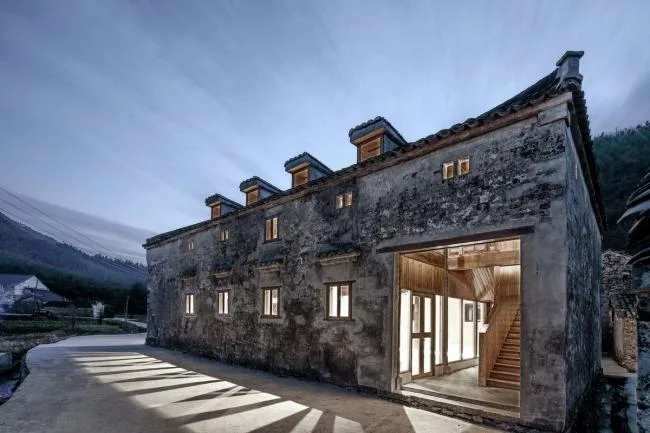
Night view of the inner street in the northeast corner.
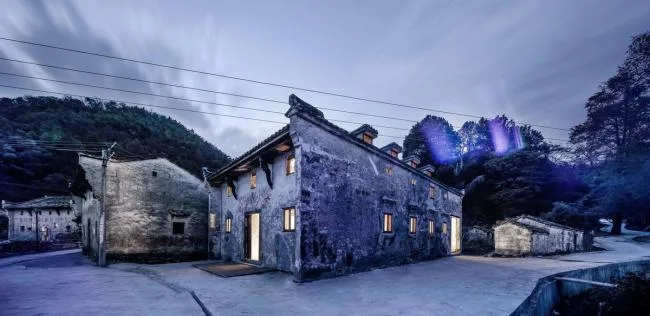
Panoramic night view of the southeast corner.
Qifeng Village is situated in Shitai County, Chizhou City, Anhui Province, nestled on the mountainside of the Guniujiang Scenic Area. My first visit involved an over one-hour journey by car along a steep, winding mountain road to reach the village. At the village entrance stand two towering ginkgo trees, each so wide that it takes two to three people to embrace their trunks. They are said to be thousands of years old.
In front of the village lies flat farmland, where crops grow taller than a person. Traditional farmhouses, characterized by white walls and black tiles, line the mountainside, gradually retreating towards the bamboo forest.
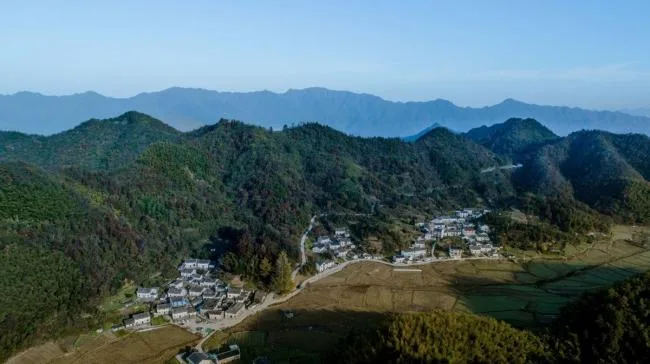
Overview of Qifeng Village.
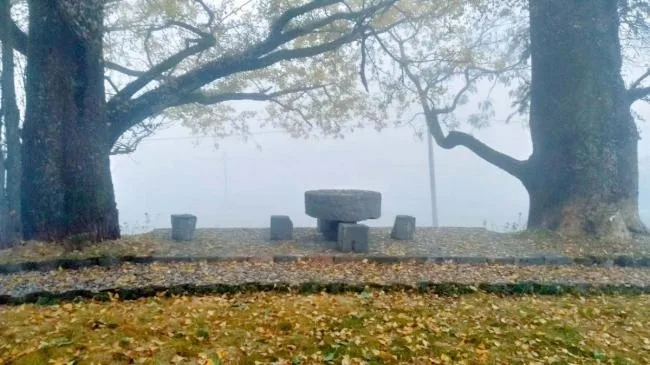
Landscape beneath the trees on a misty late autumn morning.
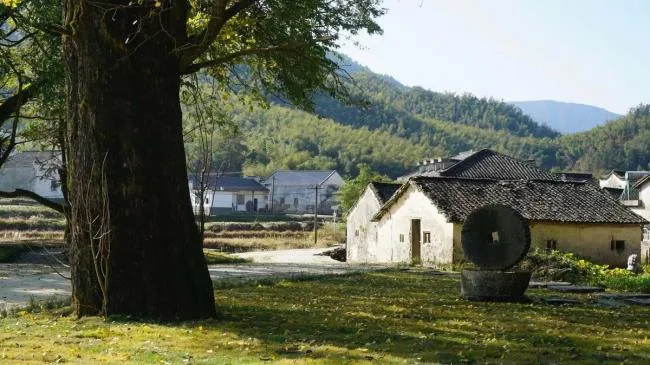
Restored landscape under the ginkgo trees at the village entrance.
Upon entering Qifeng Village, the houses reflect a straightforward and practical simplicity. Unlike the intricate layouts of Huizhou ancient town courtyards or the ornate wooden roof carvings of prominent families, these buildings feature small green tiled sloping roofs with a timeless feel, square hole windows, and modestly adorned eaves and mountain walls.
The buildings close to the village entrance mainly serve public functions such as mills, agricultural tool storage, and community spaces, while villagers’ homes are nestled deeper within the mountainous area.
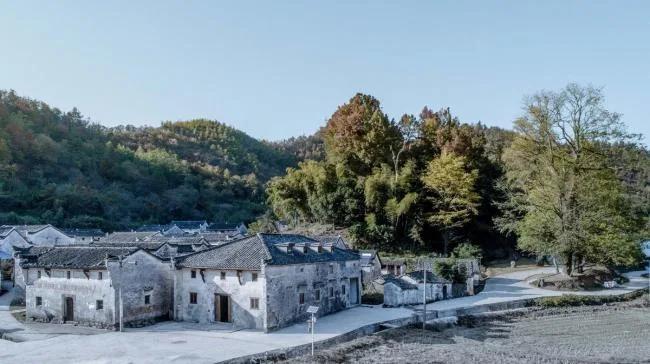
Panoramic view of the southeast corner.
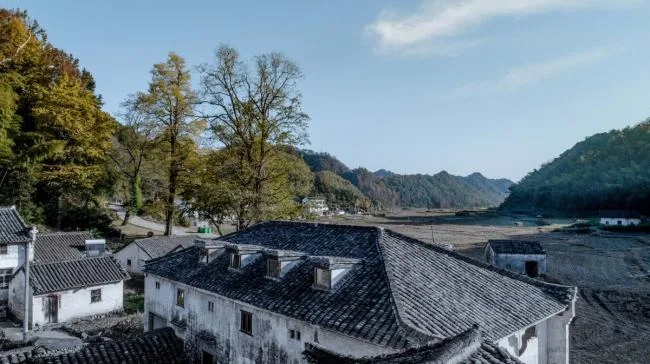
Rooftop view of the southwest corner.
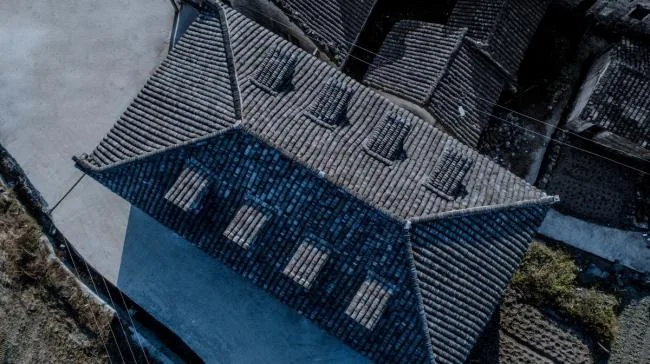
Aerial view of the roofs.
The team house once served as a public facility for Qifeng Village’s production brigade. It has two floors: the ground floor was used for storing agricultural tools, grain processing, and material storage, while the upper floor served as a meeting and rest area during work.
With the decline of rural activities, the ground floor now houses unused agricultural tools and parked motorcycles, functioning as temporary garages. The upper floor remains vacant due to years of neglect and roof leakage.
Despite the clutter, one can still observe the exquisite stone pillar foundations supporting wooden posts, and through the light leaking from the damaged roof tiles, the clear mortise and tenon joinery of the wooden framework becomes visible. These joinery techniques represent the craftsmanship of local artisans: straightforward, simple, yet structurally sound. The wooden beams and rafters retain the natural curved shapes of the tree trunks from which they were hewn.
Although the mortise and tenon joints appear roughly carved and unadorned, they adhere to fundamental woodworking principles. Most remain intact and functional. The beams, pillars, and walls display sketches made with brushes or chalk, alongside political slogans, forming a record of the village’s history within the building.
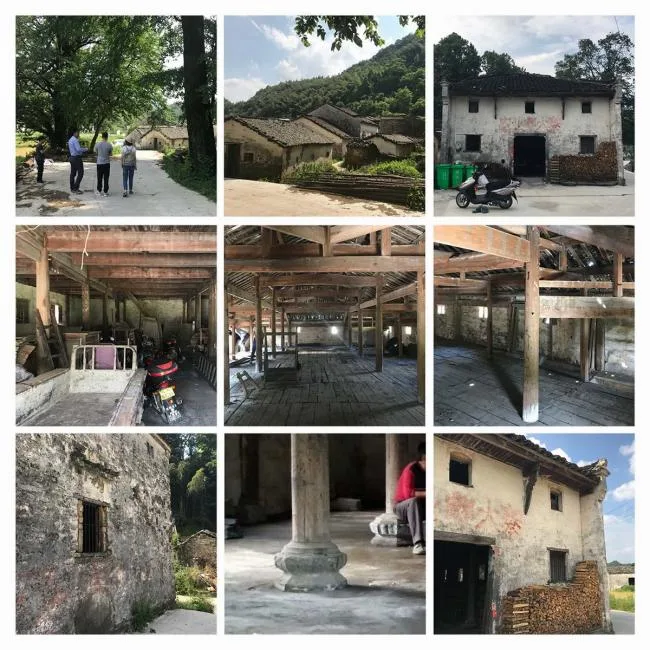
Original interior and exterior appearance before renovation.
While this type of house may seem ordinary to villagers, it is a hidden gem for designers. The harmonious relationship between ancient Anhui villages and nature reflects a natural understanding. The layout suits the terrain, with roads and drainage adapted to local conditions. The construction scale is compact, preserving farmland and green spaces.
Aligned with Huizhou’s philosophy of respecting nature and practicing restraint, the optimal approach to updating ancient villages is not demolition and new construction, nor uncontrolled expansion. Instead, the remaining team houses are gently renovated and adapted to serve modern village life, avoiding becoming sealed historical relics that can only be viewed from a distance (BIM). This reflects the concept of ‘Jian Si Jian’ (build less, build better).
In this context, the renovation of the team house aims to serve both villagers and visitors. For residents, it provides a communal living room for leisure, tea drinking, and conversation. For tourists, it functions as a village history museum showcasing the local heritage.
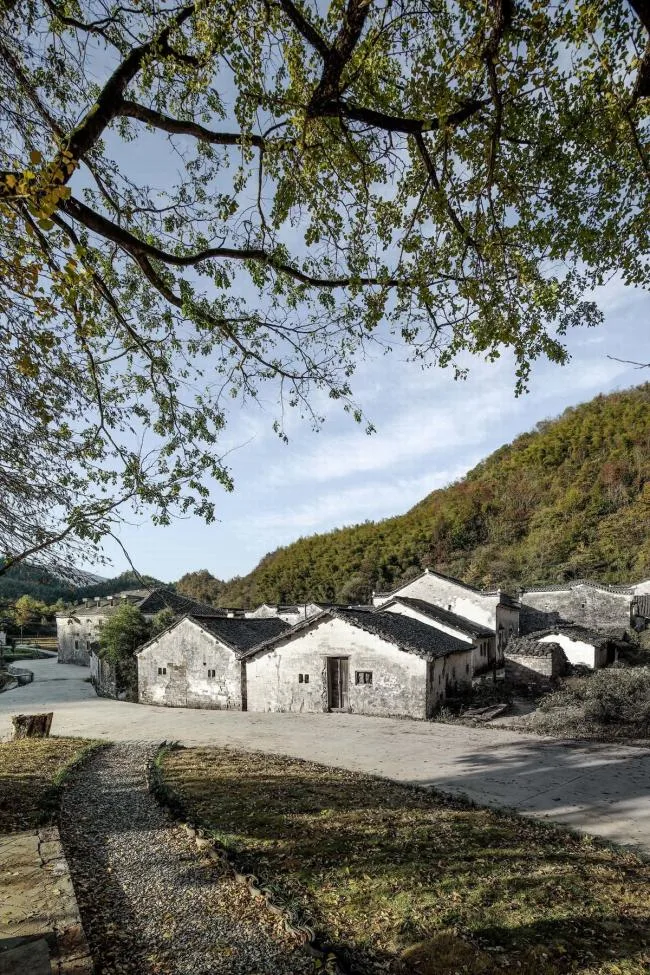
Restoration of green landscaping at the village entrance.
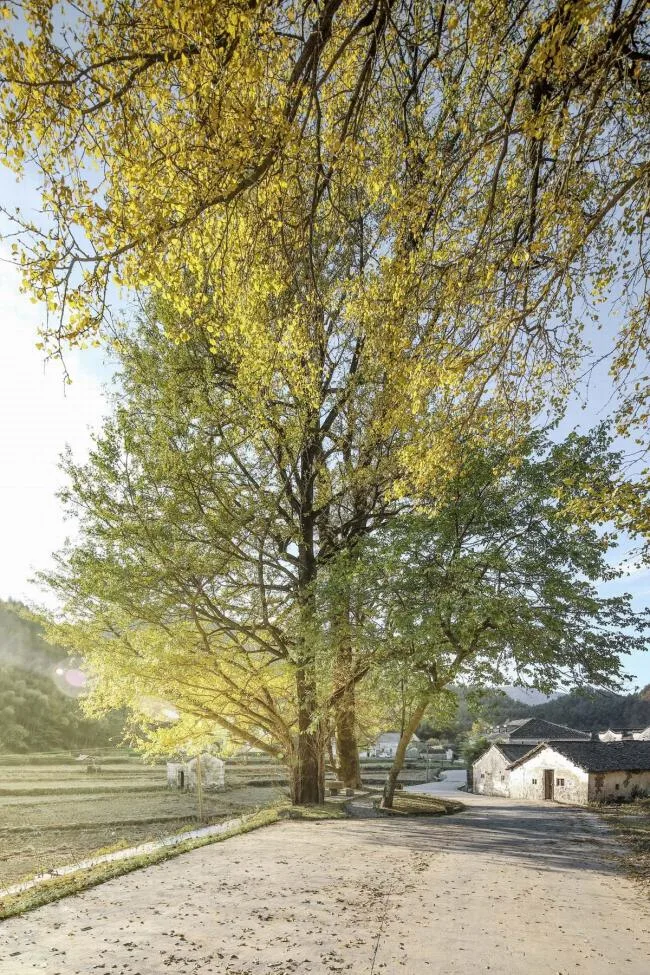
Restoration of ginkgo trees and green spaces at the village entrance.
After a thorough on-site assessment, it was found that the overall wooden structure of the team house is well preserved, with only a few beams and columns showing surface decay that can be sanded or partially replaced.
However, most smaller wooden elements, such as doors and windows, have deteriorated and deformed, offering little preservation value and requiring complete replacement. The exterior walls, constructed with brick infill, suffer from severe clay mortar loss in joints due to long-term neglect, exposing brickwork indoors and outdoors, necessitating re-pointing and reinforcement.
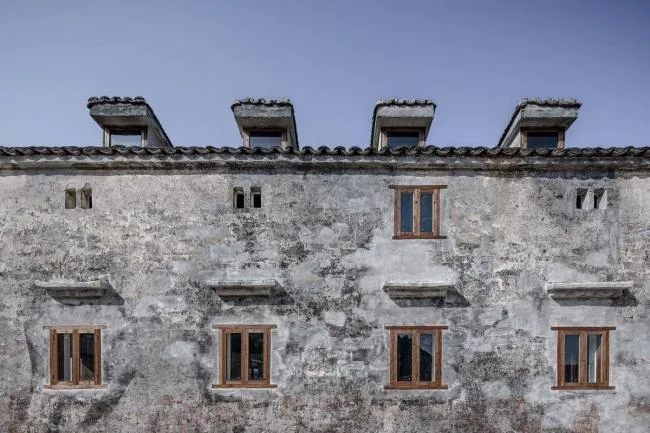
East facade after renovation.
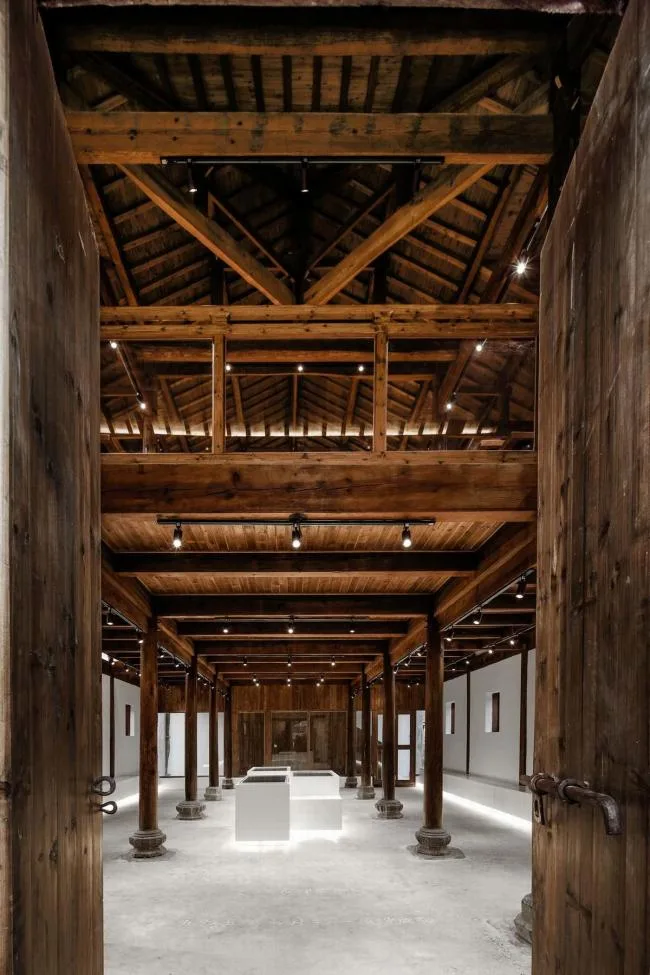
Building entrance.
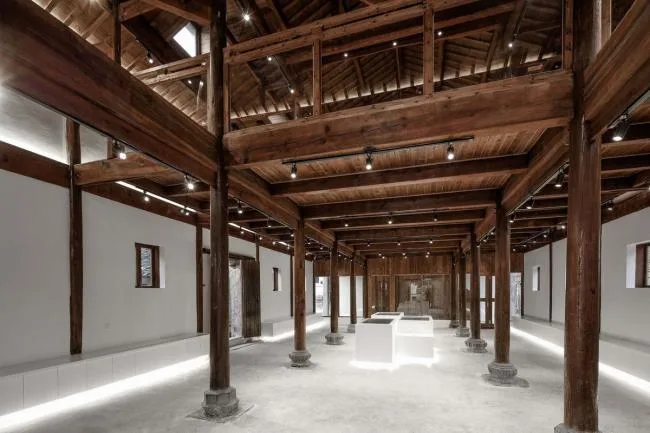
Entrance courtyard.
The renovation strategy focused primarily on structural reinforcement and repairing exterior walls and roofs to address fundamental issues such as water leakage, ventilation, and structural safety hazards.
Before starting, designers and craftsmen inspected the wooden structure and walls to determine repair methods for key elements: roof, wooden frame, and exterior walls.
The original roof, made of a single layer of small blue tiles, had numerous leaks. The renovation added a wooden observation board beneath the roof, applied a waterproof membrane, then reinstalled tiles.
The original wooden frame, columns, and main beams were largely intact, requiring only local sanding or partial replacement of decayed parts. Rafters, severely decayed due to proximity to tiles, were replaced completely.
Small, brick-sized ventilation holes in the original exterior wall windows were enlarged by adding high side windows to each column span on the roof. This improved year-round ventilation, especially during hot summers and damp springs, enhancing indoor comfort.
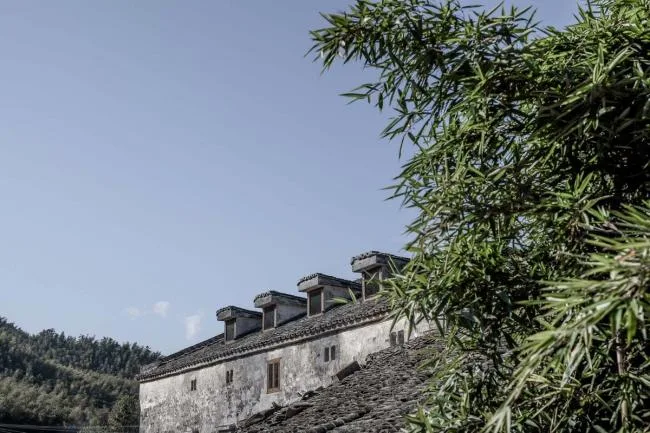
Repaired roof and added high side windows.
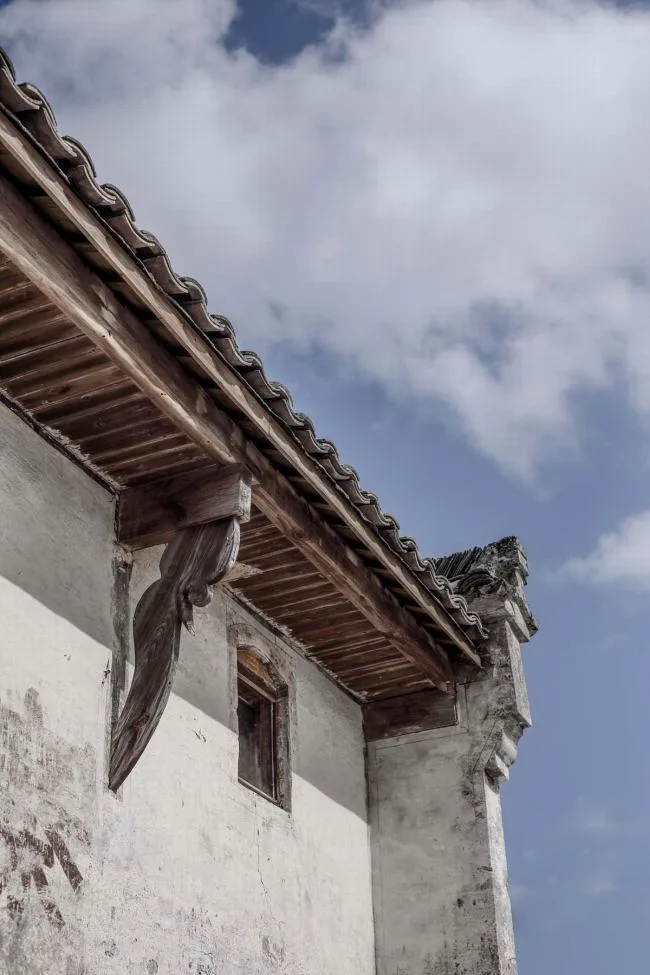
Restored entrance eaves.
The exterior walls are common brick masonry painted with white plaster, typical of the Huizhou region. Several cracks and missing plaster reveal empty mortar joints, weakening the structure. To reinforce the walls, structural consultations recommended re-pointing the brick joints to enhance overall integrity.
Interestingly, the exterior brick walls serve as a miniature historical record. They bear simple traditional paintings, slogans from the Great Leap Forward, and drum-hugging stones inserted during the Cultural Revolution to protect the walls from damage. The renovation preserved these historical markings by re-pointing only non-historical sections, allowing the patina of time to remain visible.
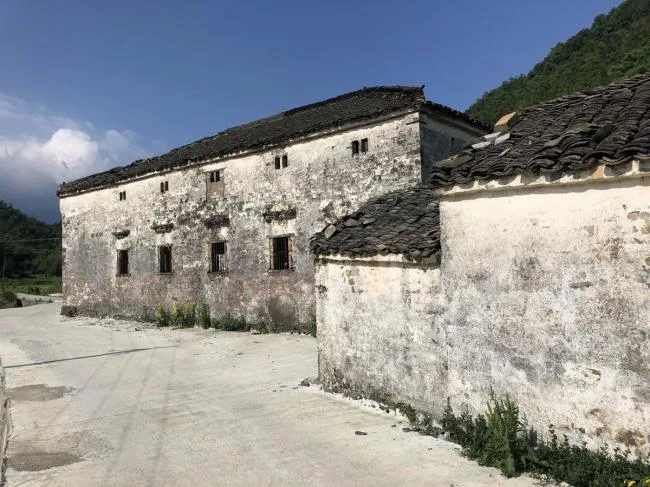
Condition before renovation.
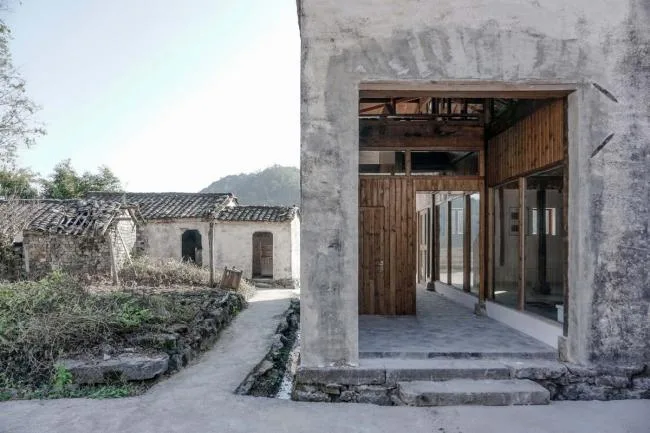
Inner street.
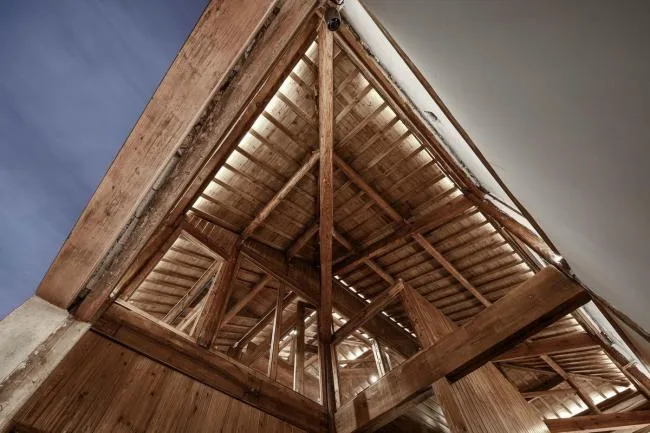
Night view of the inner street ceiling.
By modifying the original space, the renovation increased functional diversity and improved space efficiency.
The team house originally had two full floors connected by a staircase centrally located between columns. The second floor, adjacent to the eaves on one end, had a ceiling height under 1.3 meters, rendering it nearly unusable.
To address this, the renovation connected the outer wall end span to a through-height ventilation system. Most significantly, the solid walls flanking this span were removed along with the second-floor slab, creating a double-height inner street.
The staircase was relocated to this span, transforming the indoor area into a public pedestrian corridor. This design increases interaction between the exhibition hall and visitors, allowing viewing from the inner street without entering exhibition spaces. It also permits public use of the second floor independently from the exhibition hall.
This layout enables separate management and operation of the first-floor village history exhibition and the second-floor village activity center. The upstairs activity space can complement the exhibition hall through ventilation and spatial connections, enabling multiple uses and operations within one building.
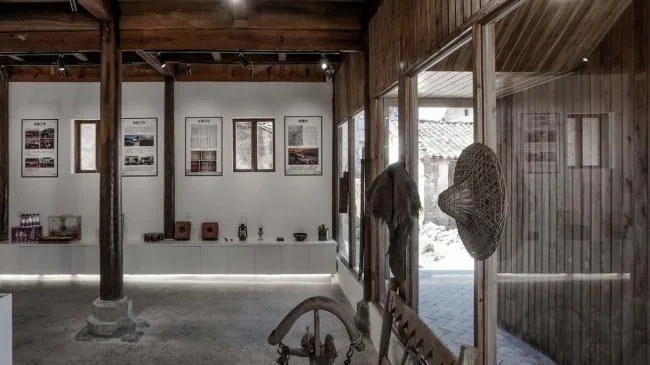
First-floor exhibition hall and inner street.
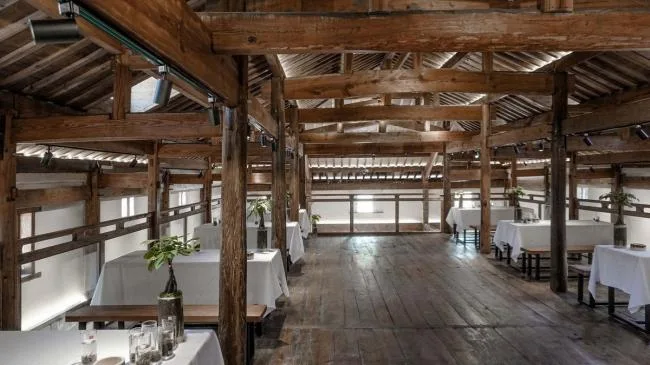
Second-floor tea room setting.
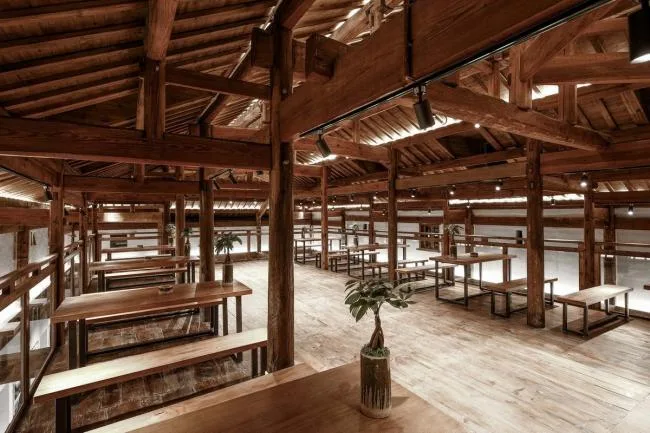
Second-floor village activity room at night.
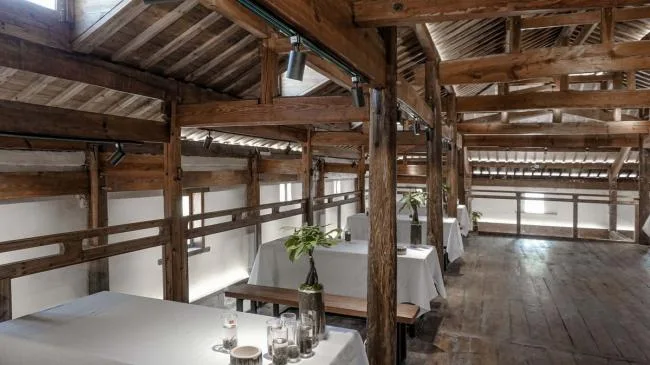
Second-floor ventilation and access area.
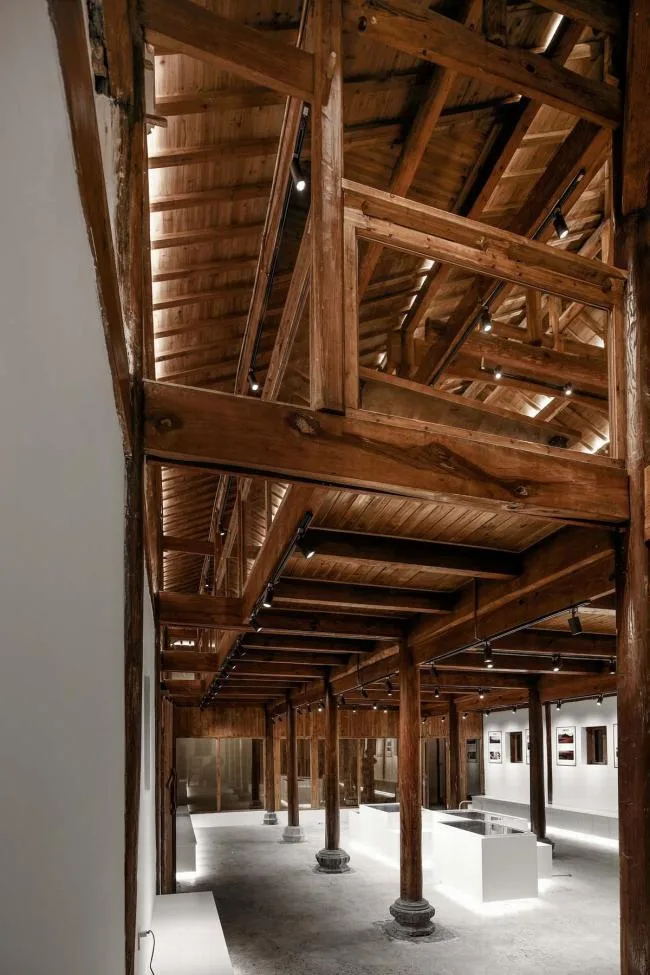
Exhibition hall ventilation and circulation.
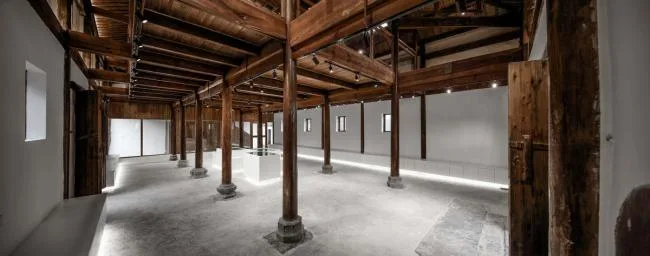
Exhibition hall before setup.
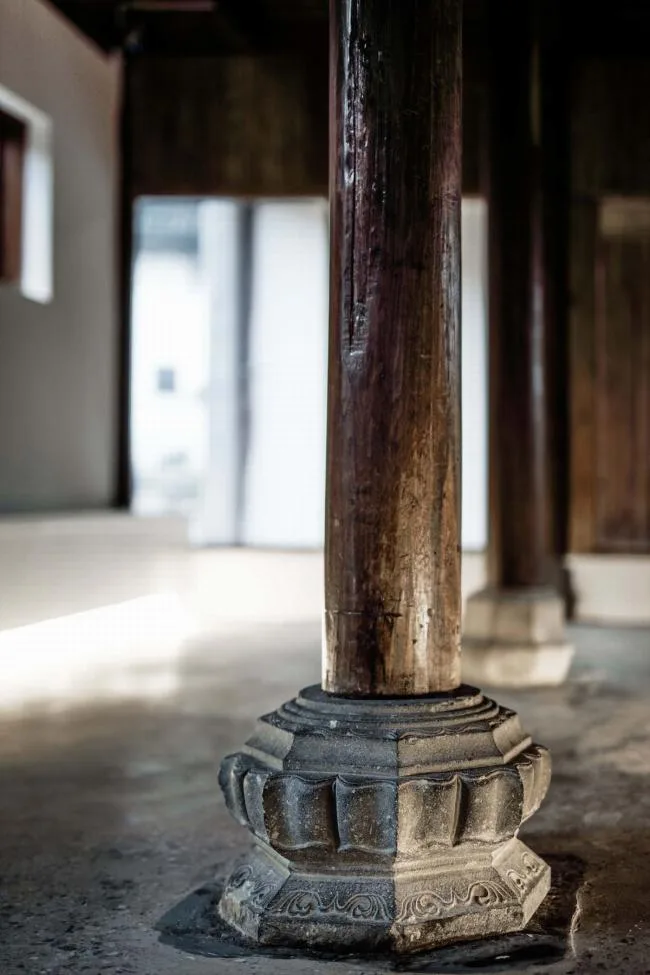
Stone foundation after repair.
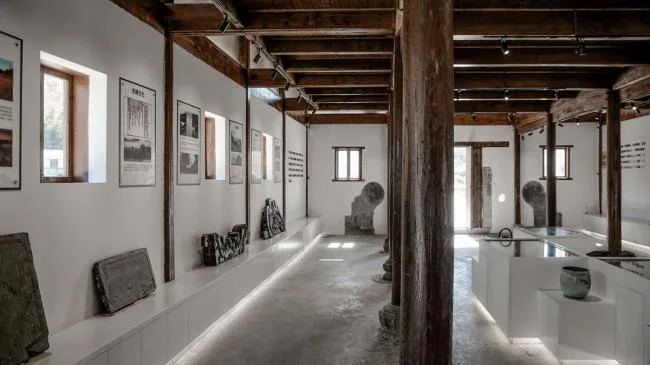
Exhibition hall after setup.
The renovation prioritized the reuse of locally sourced materials. Roof blue tiles and simple wooden flooring on the second floor were carefully removed, sorted, polished, and reinstalled. This approach not only conserves construction resources but also preserves the building’s original historical context.
While this principle seems straightforward, it is challenging to execute. It requires careful dismantling rather than forceful removal. Local villagers, serving as the main craftsmen, meticulously lifted green tiles from the roof to the second floor, sorted them, and prepared them for roof repair (BIM learning). Wooden floorboards on the second floor were gently dismantled, nails removed, sanded flat, and stored in ventilated, shaded areas for reuse. The reduction in the second-floor area meant that the quantity of removed wood was just right.
Efforts were made to utilize traditional construction techniques familiar to local craftsmen, minimizing reliance on modern industrial components and methods.
There are two reasons for this choice. First, Qifeng Village’s remote mountainous location limits logistics and industrial capacity. Using traditional methods familiar to local craftsmen simplifies procurement and construction processes. Through close collaboration, it became clear that these craftsmen interpret drawings based on experience rather than strict adherence, resulting in practical, if not perfectly detailed, outcomes.
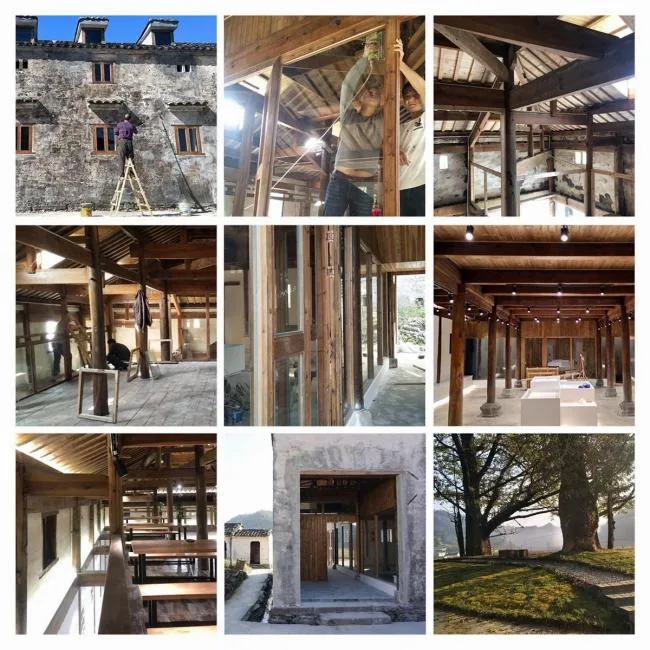
Construction process.
Second, this approach ensures local craftsmen can maintain and repair the building after completion. Unlike urban buildings, which rely on manufacturers and professional maintenance teams, rural house upkeep depends heavily on villagers themselves.
For example, the exhibition hall’s professional spotlights lacked a few accessories upon delivery. In the city, these parts are readily available and easy to assemble, but in the village, waiting days for delivery and traveling to town for pickup are necessary.
Therefore, all doors, windows, and skylights use simple traditional plug-in opening methods, and glass is installed with traditional wooden frame embedding. Except for a small steel structure in the staircase, connections rely on classic beam and slab joinery.
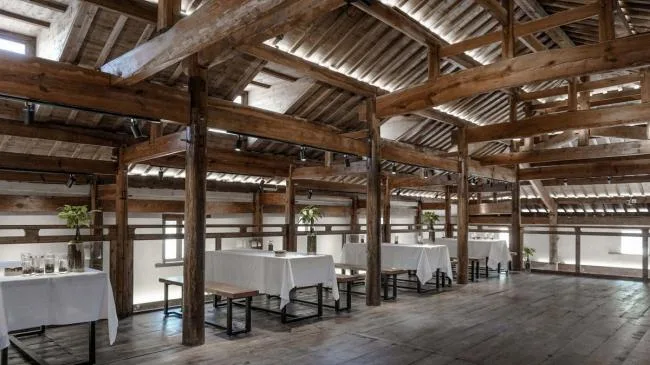
Second-floor roof truss and skylight.
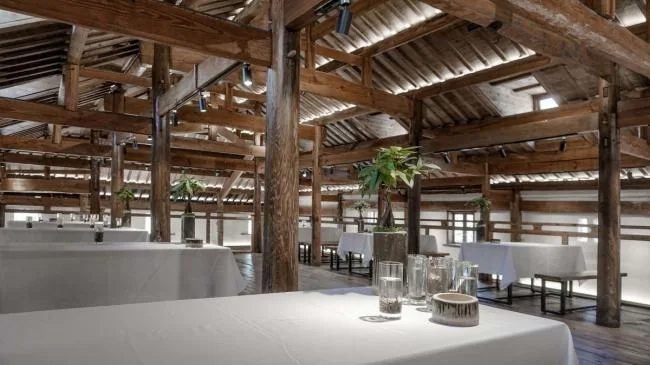
Wooden frame after second-floor renovation.
While conceptually simple, this strategy requires extensive communication to reconcile ideal design with practical craftsmanship and habits. Designers had to moderate their aesthetic preferences and conventional industrial methods to accommodate local realities.
The final result reflects a collaborative effort among the project owners, local craftsmen, and architects, all committed to the renovation principles outlined above. For the design team, it represents a thorough practice of ‘Jian Si Jian’ — minimal yet precise intervention.
Though no new buildings appear in the village, the transformed landscapes at the entrance, the alleyways around the team houses, and the interior and exterior spaces now better integrate with villagers’ daily lives. Visitors experience the village more intimately and naturally.
Following completion, villagers contributed their own collections of wooden and stone carvings, historical documents, and agricultural artifacts to enrich the village history museum’s exhibitions. They embrace the public house as an extension of their homes, inviting friends upstairs for tea gatherings and breathing new life into the team house.
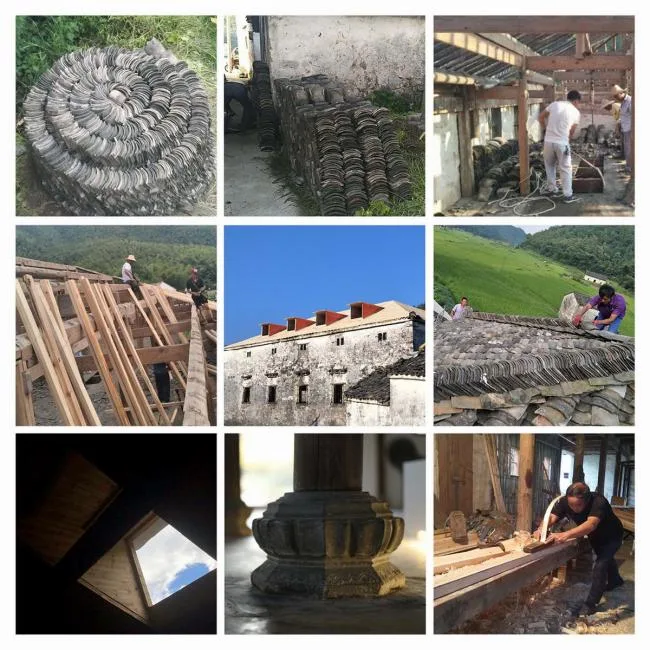
Construction process.
This experience has deepened our understanding. The ‘architecture without architects’ found in rural areas suggests that designers trained in urban approaches may not always apply their skills effectively in the countryside, where different needs prevail.
Enhancing or reflecting the simplicity of rural ‘architecture without architects’ requires avoiding imposing urban experiences or using rural sites as showcases for designers’ personal achievements. This mindset forms the foundation of ‘building without architects’.
We believe buildings should not feel deliberately designed but instead offer a comfortable and natural experience. As the Tao Te Ching states: “Great music has the faintest notes, great form is beyond shape.” This philosophy may best suit contemporary rural construction.
Design Drawings:
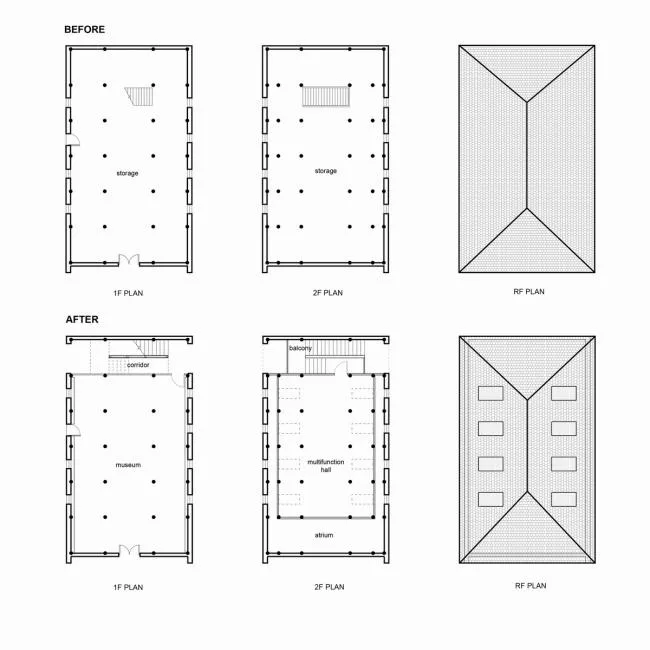
Plan before and after renovation.
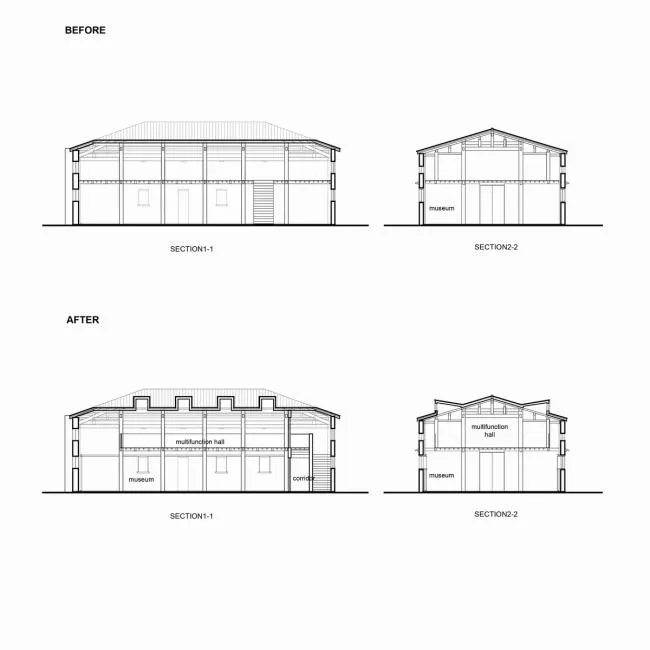
Profile before and after renovation.
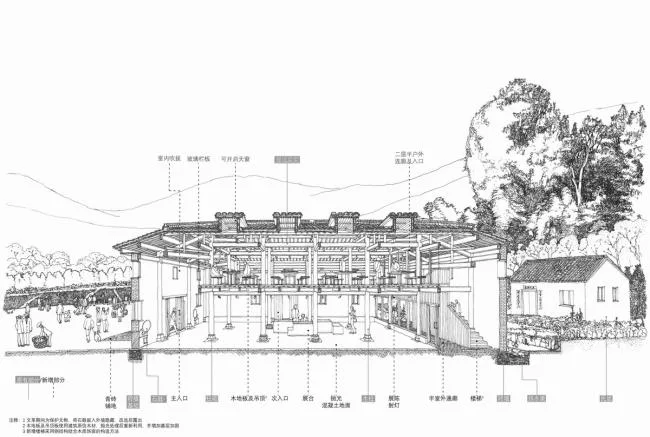
Exploded view.
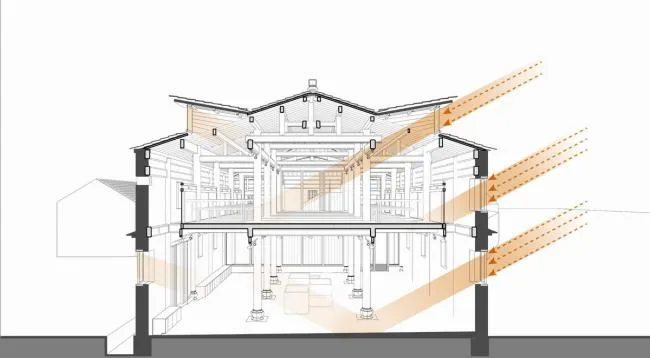
Light analysis.
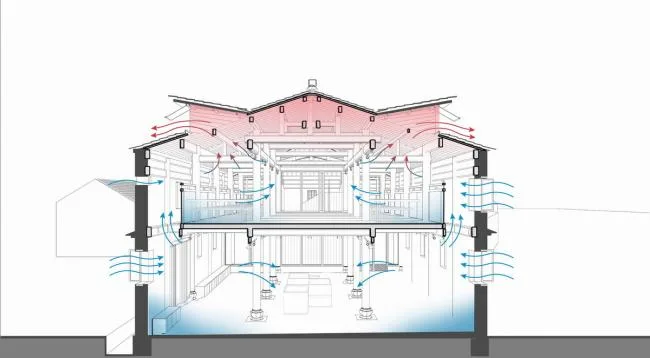
Natural ventilation analysis.
Project Information:
Architect: Su Pu Architecture Studio
Location: Qifeng Village, Shitai County, Chizhou City, Anhui Province, China
Type: Museum
Design Team: Song Yehao, Sun Jingfen, Jiang Chunyu, Chen Xiaojuan, Jie Dan, Chu Yingnan, Huang Zhihao
Building Area: 245.0 m²
Project Year: 2018
Lighting Design Consultant: Zhang Xin Studio, School of Architecture, Tsinghua University
Structural Consultants: Sun Xiaoyan, Gong Zheng
Interior Exhibition Design: Hefei Yijian Interior Design Co., Ltd
Construction Contractor: Mount Huangshan Yongzhu Construction Engineering Co., Ltd
Owner: Qifeng Village Committee












Must log in before commenting!
Sign Up